


The Vultures are Circling
Ben Wildsmith
We stand at a crossroads today and our direction of travel may be decided for us if we are not alert to the importance of the moment.
You will remember that in the aftermath of the Golders Green stabbings in April, a binary debate erupted about whether the police had been too brutal during the arrest of the suspect, Essa Suleiman.
Video footage showed an officer repeatedly kicking Suleiman to the head after he had apparently been immobilised by the discharge of a taser. The counterargument ran that he had not surrendered his knife, so the officer was justified in applying potentially lethal force to disarm him.
This week, as the UK has recoiled in horror at the circumstances around the murder of 18-year-old Henry Nowak, police practice has again become the focus of discussion.
This time, however, the voices which spoke in favour of the police in Golders Green have been loudest in condemnation of them. Whilst officers were ‘brave’ and forgiven for actions in the moment during the previous incident, this time we are encouraged to see perceived failure as the result of a malign culture that privileges accusations of racism above all other considerations.
The suggestion here is that mistakes weren’t made due to inadequate training, but because of training that encourages officers to disadvantage white members of the public.
In the political kaleidoscope in which we’ve existed since the 2008 financial crisis, it can be difficult to track shifts in ideology due to the dizzying pace at which they have been occurring.
The traditional left/right paradigm hasn’t so much evolved as mutated into a confusing hydra.
As Keir Starmer’s Labour Party has attempted to project an authoritarian stance towards issues like immigration and crime, it has found itself facing an opposition in Reform UK that is playing an entirely different game.
The collapse of traditional conservatism has meant that its basic tenets, such as unconditional support for institutions like the police, have been uncoupled from their traditional home on the right of British politics. That leaves Labour straddling two horses.
Its defining purpose is to be socially progressive and change society. Labour politicians largely see themselves in that role, which most have assumed since adolescence. Their modus operandi was shaped in a world where to be on the left was to challenge the status quo, as represented by the Tory Establishment.
Detonation
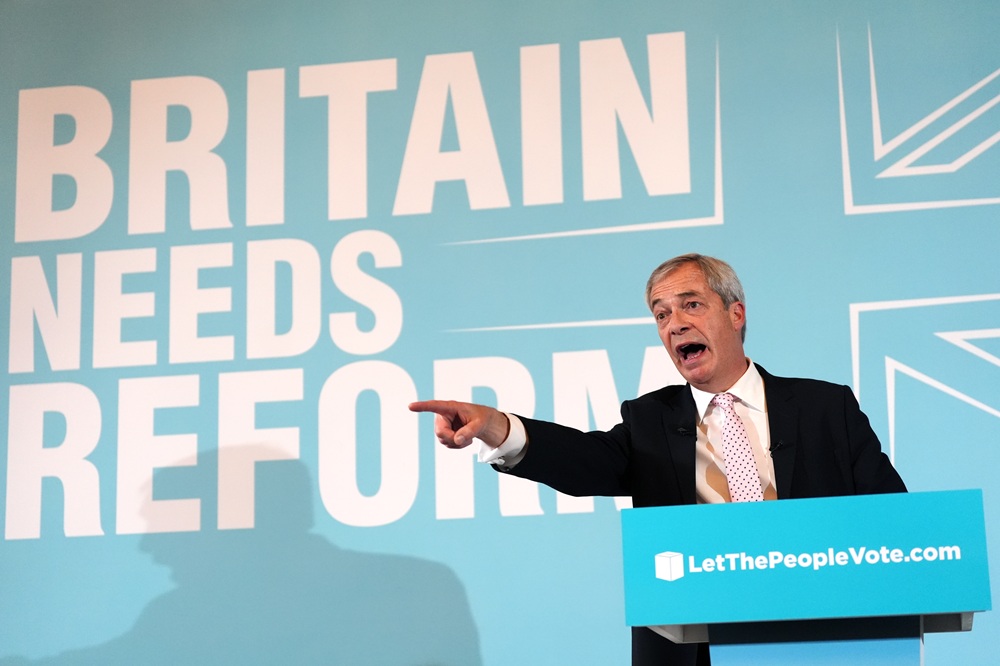
Now, Labour finds itself faced with an opponent, in Nigel Farage, who seems content to advocate for a detonation under all the nation’s institutions. The NHS, the judiciary, the Civil Service, the RNLI, the National Trust, and now the police have all, over the last few years, been characterised as acting on behalf of a shadowy ‘globalist’ elite which seeks to limit freedom for the majority.
A ‘burn it down and start again’ proposition is understandably attractive to some as our quality of life is demonstrably declining. As we bump over potholes, paying a fortune for petrol to get to our insecure jobs or overdue hospital appointments, nobody is immune to fantasies of quick, bold action that could, somehow, make all this better.
The upcoming by election in Makerfield looks very much like a last throw of the dice by Labour, who have presumably seen polling that suggests the present government’s unpopularity is insurmountable without a change of leadership and direction.
Should Andy Burnham win the seat and become Prime Minister, he will need to enact reforms at pace or be engulfed by a tide of discontent that could see Labour in Westminster reduced to non-league politics as they and the Conservatives are in the Senedd.
One of those reforms must surely be a new constitutional settlement, not only for Wales, Scotland, and Northern Ireland, but for the English regions as well.
Nigel Farage’s cynical evocation of ‘cold rage’ in response to Henry Nowak’s murder was as politically cute as it was morally reprehensible.
That rage already exists as a product of the political powerlessness that people feel over their lives. Bringing decision-making closer to them would address this lack of agency and re-engage people with the nuts and bolts of their governance.
Conspiracy theories
Detachment from that has bred an atmosphere in which grandiose conspiracy theories have replaced policy ideas as the focus of many people’s politics. If the WEF is planning to replace the entire population with immigrants, there doesn’t seem much point in campaigning for better computers in your kids’ school, does there?
If Labour is beyond saving in England, then Wales will come under existential threat as a political unit. The recent election campaign saw Reform-friendly social media accounts switch from attacking Labour or even Plaid Cymru, in favour of ‘The Senedd’.
That body would be low-hanging fruit in a bonfire of the institutions, with accusations of ‘two-tier’ advantages like free prescriptions tailormade for whipping up indignation across the border.
The new government here must maximise its powers to make our governance as distinct and accountable as possible.
If people feel alienated by the institutions we have, there is no longer a political consensus in Westminster that will defend them in the face of attacks from actors who seek financial deregulation above all other concerns.
Exploitation
The government has precious little time to persuade people that our institutions work to protect them from exploitation by the sort of predators that will run riot in UK society if international capital is given free rein in the public sphere.
To insulate Wales from such a fate, our government must prioritise community involvement in our governance. People should feel that they have ownership of the institutions they fund, full accountability from them, and a meaningful say in how they are run.
Devolution within Wales is as important as maximising that from Westminster. The vultures are circling…
Support our Nation today
For the price of a cup of coffee a month you can help us create an independent, not-for-profit, national news service for the people of Wales, by the people of Wales.
Get more trusted Welsh news
Choose Nation.Cymru as a preferred source in Google News to see more of our journalism.



One of the things that has always seemed hypocritical to me is that whilst Reform was firmly rooted in Brexit and “taking back control” from Europe, that does not extend to giving control to the devolved nations or even to doing anything better than a p**s poor job with any of the councils they hold. They are also incapable of using their seats to influence and work within the system. Farage and the others consistently fail to turn up to the Commons, vote or contribute to debates and committee work. Farage has never held a surgery in his constituency. It… Read more »
Worrying times are with us still. Can we insulate ourselves from the disaster threatening England?
Yes! Independence.
The vultures are of course funded by a global elite. Who knew?
Yes, but I’m not sure what “distinct and accountable” governance and prioritising “community involvement” means in practice. All a bit vague and smacks of process rather than results.. The best (only?) way to see off vultures is to make the institution work positively for people. Plaid seems to have made a decent start after 27 years of not very much.
Well said. I don’t want change for changes sake.. I want improvement
I’m confused by this idea that Burnham is about to bring a change of direction to Labour. His critique of Starmer is that he hasn’t gone far enough in taxing, spending and borrowing. Burnham proposes travelling the same route but at a faster pace.
A change in direction would be undemocratic. Any new PM has to deliver on the manifesto or seek a new mandate which would be madness for a party with the biggest majority ever.
But of course all this is only true in a real democracy. Liz Truss and the Cons revealed the UK isn’t a real democracy so Burnham can do whatever he wants.