


The Welsh Conservatives’ biggest challenge is getting noticed
Brenig Davies
One of the pleasures of a new Senedd is watching the MSs settle into the chamber, which can be intimidating for those new to national politics.
New governments find their feet, opposition parties establish their priorities, and commentators begin the annual exercise of deciding who is thriving, who is struggling and who is revealing embarrassing inexperience.
This year, there has been no shortage of political interest. Plaid Cymru now finds itself in government, while Reform UK has become the Official Opposition.
Both developments have dominated much of the early discussion.
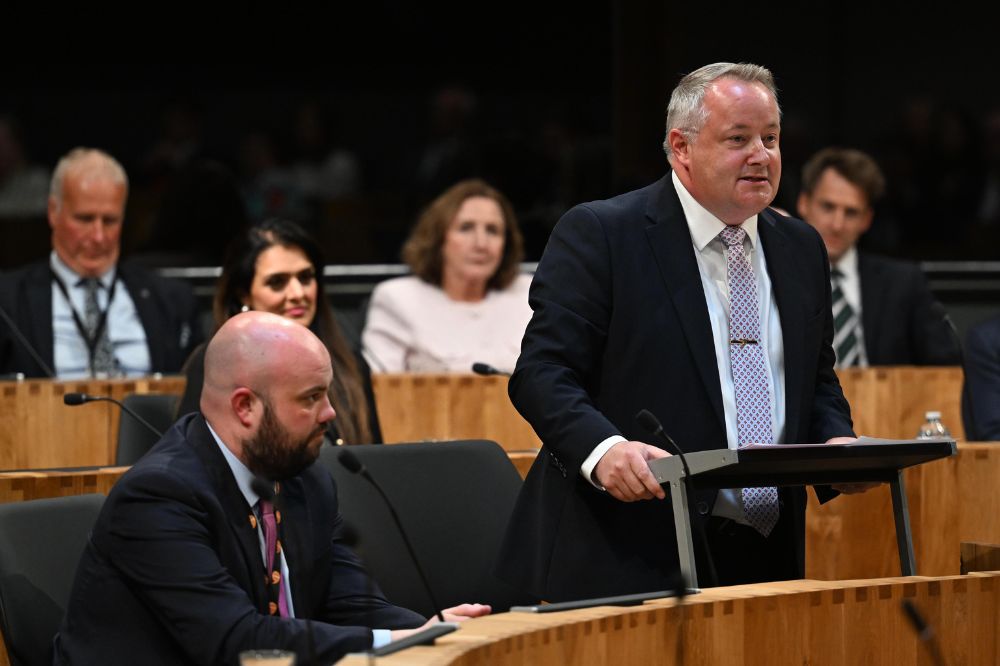
Yet amid all the attention given to political change, another feature of the new Senedd has caught my eye: the comparatively low profile of the Welsh Conservatives.
For most of the devolution era, the Conservatives enjoyed a prominent place in Welsh politics.
Whether challenging Labour ministers, responding to constitutional debates or presenting themselves as an alternative government, they rarely lacked visibility. That makes their relative absence from the current debate even more noticeable, compounded by a deep worry.
Politics is rarely short of opportunities for opposition parties. NHS waiting lists are still stubbornly high. Concerns about educational standards have not disappeared. Transport continues to frustrate drivers, rail passengers, commuters, and businesses alike.
These issues should prompt Conservative criticism, even with its seven MSs.
It is difficult to name a single issue that the party has made its own since the election. Even when Conservative politicians intervene on well-known topics, they often do not respond with force, making it difficult for their message to influence policy development.
For many years, the Conservatives could safely assume they were the principal party of the Welsh right. That assumption no longer looks secure. Reform has gained ground in political spheres that many Conservatives once regarded as their own.
Political parties recover from electoral defeats. Often, however, recovery takes time and may take an entire parliamentary term. Seats can be won back. Poll ratings can improve. The more awkward question, for the time being, is how the Conservative Party is adapting to a political scene that has changed markedly.
Plaid’s focus is on making government work. Reform is trying to prove it can become a credible opposition party. The Conservatives face a different challenge. For many voters, it is not yet clear what distinctive role the party looks to play in this new Senedd.
That is not necessarily a criticism. Political parties often need time to adjust to new realities. Nor should it be mistaken for a judgment on the quality or commitment of individual Conservative MSs. The party still has experienced representatives, institutional knowledge, and a long history in Welsh public life.
Effective scrutiny
The party is pursuing a lower-key strategy. Some of the most important work in politics takes place in committee rooms rather than television studios. Effective scrutiny rarely attracts the same attention as confrontation. The Conservatives may make a greater contribution in committees through their experience of scrutiny, and ought to do so soon.
Politics is not only about influence; it is also about clarity. Voters need reasons to notice political parties. They need bold priorities and a confident sense of purpose. At present, many people would struggle to name a defining Conservative priority.
That is not to suggest the party has not been assertive, only that it has yet to be a major player.
That may change. Politics rarely stays still for long. There are opportunities for the party to regain visibility. They will need to learn that visibility cannot be rebuilt overnight.
Collaboration
Collaboration with Plaid should go a long way to helping them raise their profile. At this early stage, childcare policy is an example of support for Plaid’s policy.
Such collaboration may not generate as much media attention as they had hitherto, but it might prove a route back to greater influence in the enlarged Senedd. The same would apply to Labour, working in support of Plaid Cymru’s objectives.
For now, however, the story of the new Senedd is being told by others, and the Conservatives occupy a less prominent place in the political conversation than they once did and valued. I suspect that will change even with their seven MSs and being the fourth largest party.
The consequence of a dramatically changed political scene, though not guaranteed, I suspect the party will recover from defeat over time.
Before seats can be won back and poll ratings improve, voters need to notice that the party is still there. The answer to the question posed in the title may therefore be simple: yes, a Tory is still there.
The challenge is ensuring that more people notice the Conservatives beyond the Senedd chamber.
Brenig Davies writes on Welsh politics, public policy, and civic life. His articles have appeared regularly in Nation.Cymru and other Welsh publications.
Support our Nation today
For the price of a cup of coffee a month you can help us create an independent, not-for-profit, national news service for the people of Wales, by the people of Wales.
Get more trusted Welsh news
Choose Nation.Cymru as a preferred source in Google News to see more of our journalism.



Who???
They could surprise everyone by representing the decent, honourable and humane politically homeless folks of the centre and centre right.
It’s rather nice being in Cymru with these guys fading into significance.
They’ve only ever helped try to destroy us.
The Welsh Conservatives and Darren Millar are the equivalent of a coffee cream that nobody wants, left in the chocolate tin after the Christmas festivities.