


They’re wrong about wild camping
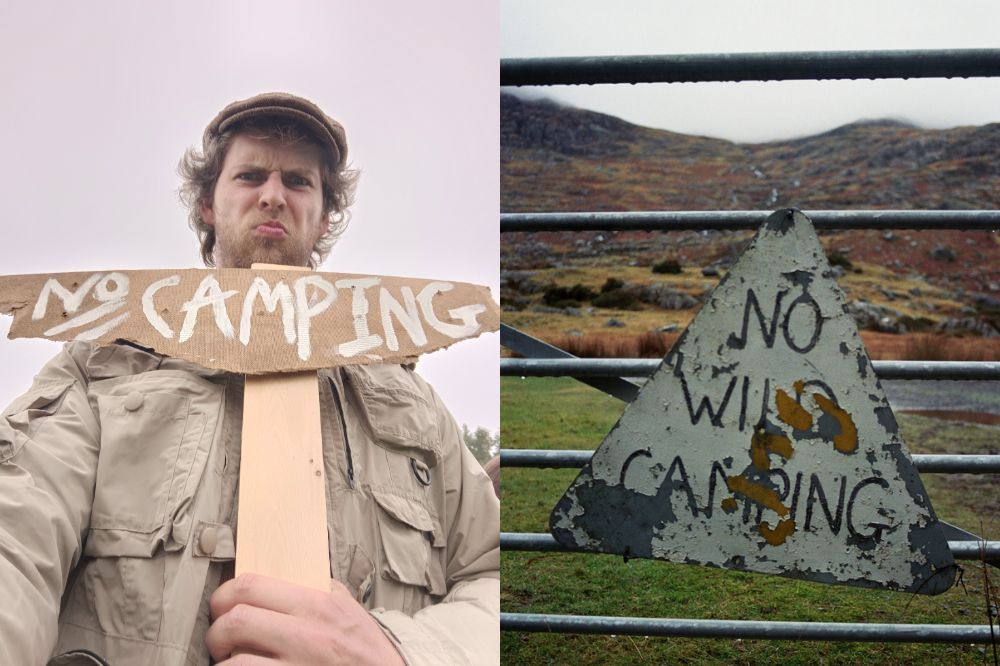
Eben Muse
If you’re in Wales, and consume ‘Welsh’ media, you’ll have heard a lot of misinformation about so-called ‘wild camping’.
You might have seen terrible scenes of destruction and litter – carnage that moves even the most stone-hearted among us to anger and anguish.
You see them at roadsides, you see large groups of them arranged around busy walking spots in broad daylight.
You might feel anger and hurt, at the impact this behaviour is having on our most important cherished landscapes; you’d be right to feel all of that.
I’m here to tell you that this impression of wild camping is completely wrong.
Wild camping actually refers to the activity whereby a person, or a small number of people, camp discreetly, without paying, using their own judgement to choose a place that’s both suitable, and not disturbing of others’ enjoyment of the space.
In Scotland they even have a code for it; this intimate but discreet way of moving through and staying a night under the stars.
People have done this in Wales for centuries, in one form or other, and if you’ve tried it yourself, you’ll understand the unique appeal of spending a night in a place of your own choosing, carrying all you need on your back, or maybe on a bike.
It is definitely not illegal – it is not allowed without permission from a landowner, but it does not pass the threshold for a criminal act, and it has been historically tolerated across Britain.
On the other hand, if someone is causing harm or disturbance in the act of camping in the mountains, this is probably a criminal act – an act known as ‘fly’ (as in fly tipping) or ‘dirty’ camping.
No help is needed by hysterical reporters to make it so; there are laws that prohibit damaging land, wildlife, or property. It actually doesn’t do much to protect the environment to lump those engaging in responsible recreation with those causing criminal damage.
You wouldn’t lump joyriders in with someone doing their morning commute, nor would you be taken seriously if you did.
Indeed, the frenzy seen in the media’s coverage of this ‘scourge’ is enough to drive those reading into a sort of madness, a madness that metastasizes into calls for all sorts of grim medieval punishments for anybody who dares head out their front door with a tent in their pack.
Lets not forget wild camping was affirmed as a legitimate form of recreation by the highest court in the land only last year. If you don’t like it, tell it to the judge!
I can understand councillors, landowners, National Park Authorities, and even well-meaning news copywriters (let’s be charitable) who hold a desire to reduce the amount of fly camping taking place in their patch. I support that.
But what I’ve seen of late are small-time politicians across the UK and particularly in Wales, decide to take this on as a sort of opportunistic cause célèbre — for what is more useful to a cynical politician than something to be against?!
Take this week’s farcical offering, which has spread all over Wales’ local and national news; “Visitor levy could ‘fuel wild camping and camper vans all over the place’”.
According to councillors, the (possibly) incoming visitor levy is going to cause a flood of wild campers that will overwhelm the countryside.
A wild stampede of canvas-dwellers swarming over our hills. Got it.
Successes
For context, as part of my day job I’ve engaged with all aspects of consultation for the visitor levy, from open, face-to-face consultation discussions, to providing evidence to the scrutiny committee, to collecting responses for the main consultation survey.
Through this, I saw a lot of things. For instance, I witnessed several representatives of big caravan holiday parks froth, seethe, and raise their voices aggressively at consultation facilitators and angrily berating any participant who dared suggest the levy could yield some positive results if funds were used to improve visitor experiences and services.
I was also part of the successful lobby effort to reduce the cost of the levy for more bare-bones facilities such as campsites or hostels.
We were also successful in ensuring that young people were made exempt from paying the levy for that kind of accommodation.
Due to this, the financial impact of the levy on families seeking to go camping is relatively small, particularly compared the overall cost of a modern campsite which is often in the region of £16-25 per night, per head, unfortunately.
I’ve also been part of the team that conducted a survey (the largest of its type that I’m aware of) aiming to properly understand the motivations, experiences, and activities of those who go wild camping, so that the social case for (or against) it can be understood, and problem elements can be managed.
The resultant report is forthcoming, but we have hundreds of survey participants, who’ve opened up their hearts about the experiences they’ve had on camping trips in the hills. The confrontations and the weather they’ve weathered, the sunrises they’ve enjoyed, the birds, the foxes, the badgers, the human beings they had as company; they’re all in there.
Through this, it’s never been more clear to me that wild camping, which has been and always should be free, is an activity completely defined by its own merits.
It’s never been a cheap alternative to a conventional campsite with a block shower and a ping pong table, but because they want to go wild camping.
Scapegoats
For some who have never ventured to try it, money seems to be the only conceivable motivating factor for braving Welsh mountain weather at night time, but trust me, it’s true.
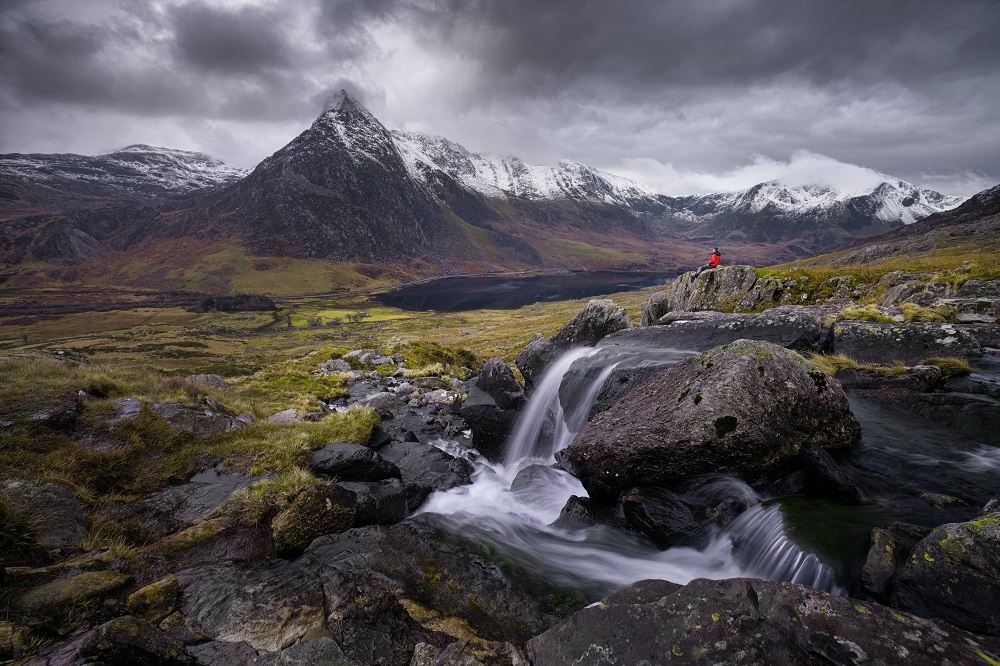
The motivations of fly campers are pretty similar – a desire to experience solitude, natural beauty, to escape the bustle of home or urban life – they simply lack the execution, the experience, the sense of belonging, that leads to good decisions.
A better and more interesting question than ‘how do we stop them?’ is ‘how do we help them?’.
So, what do those who created this story hope to achieve with such horseshit? It’s obvious; the very profitable commercial holiday-let industry doesn’t like the levy, is quite afraid of it, and wants to lobby public opinion against it.
But they know that simply saying ‘we’ll make less money!’ won’t cut it.
Hence, an ordained enemy, a bogeyman is needed, and our Welsh councillors seem all too happy to oblige.
Money matters in politics, and I promise you there is more of that in commercial holiday parks than there is in matey boy rocking a Vango in the Carneddau…
But that’s what wild camping has become in our media landscape: a convenient patsy.
Conflate the good with the bad, tar with a broad brush, and voilà ; you have a thousand scapegoats roaming the hills. A donkey on which to pin the many problems of the countryside. And to stop them, we must avoid this tourism levy!
When you spell it out like that it’s a profoundly dull premise, and unbeknownst to those dishing it out, all this scolding, the blame, the hysterics are pushing popular culture in a direction I don’t think they’re going to like.
Reactance theory: how not to get a job done
Justice
At an access forum last month I heard a National Park staff member say they couldn’t put ‘no camping’ signs up any longer because people keep stealing them.
I’m certain those signs now adorn the walls of people who probably started off wild camping as a way of connecting with nature, but who’s now motivated by something stronger; a sense of that they are being wronged.
Reactance theory is a well-established notion in psychology that posits that when individuals perceive that their freedoms are being restricted, they experience a motivational state aimed at reclaiming that freedom.
Think of a big red ‘do not touch’ button, or a sign that warns ‘do not walk on the grass’.
How do those make you feel? Any parent or teacher will know exactly what I’m talking about; there’s no more effective way of compelling the public and their tents to hit the hills than to engage in these absurd exaggerations and mischaracterisations.
An obvious case study of this cause and effect in action is the explosion of wild camping that occurred on Dartmoor where the comically villainous Darwalls took practically the whole country to court to strip their right to camp away from them. Among the many spurious grounds for doing so was the accusation of wildfire risk, which was promptly shown to be total baloney.
A sign that this process of cultural blowback is underway across the UK is the birth of a popular new genre of heavily ironic memes taking swings at a perceived authoritarianism inherent in the way wild camping is policed and in the way they are confronted.
View this post on Instagram
It’s so easy to portray the treatment that wild campers get as ridiculous and needlessly punitive, because it is. This meme went instantly viral and has more than 32k likes.
‘Cool’ is unicorn dust. Something that every marketing professional strives (and often fails) to summon, every business wants to buy.
But it seems that thanks to the pig-headed obstinacy of our click-frenzied media, an opportunistic breed of local politician, plus a compulsion to caricature an enemy against which any rural issue can be cleanly defined, wild camping is becoming very cool indeed.
View this post on Instagram
Another big hit is this meme, earning 38k likes, taking the piss out of a copper on a quad bike on his way to arrest some youths for ‘sleeping on a hill’. It’s pretty funny!
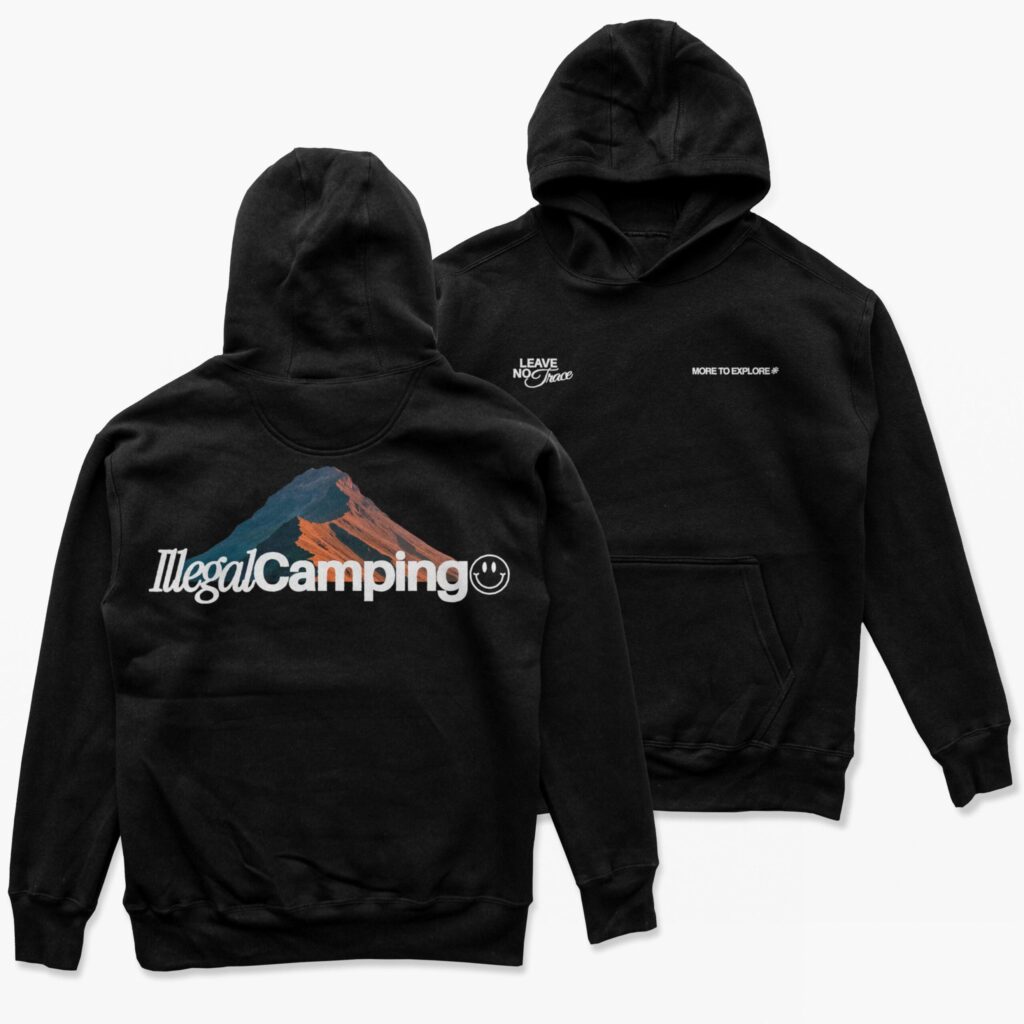
Notably it’s now a good business decision to flick V’s at anti wild camping bores and disciplinarians; it doesn’t really matter that wild camping is technically unlawful, not illegal, you can now get a ‘leave no trace/Illegal Camping’ hoody for a cool £54.
What we all know in our hearts is that sleeping on a hill isn’t really worthy of punishment. Not if you’re not harming anyone.
Outdoor educators shouldn’t have to pay off farmers or risk shouting matches on the moor. A quiet bivvy in a hidden cwm isn’t the same as a group of noisy teenagers having a fire and a party next to the road, but neither are worthy of being dragged across local news and broadsheet papers on a rotating cycle as they are.
Even if you do it ‘wrong’, it’s not worthy of a public shaming that does nothing to tackle the cause. In fact, we owe it to those who are doing it ‘wrong’ to define what ‘right’ is.
Where is the vision of our ideal, or even acceptable wild camper? It is conspicuously absent from the Countryside Code — a resource most of our National Parks currently signpost the public toward.
Other National Parks simply lie, stating that wild camping is a criminal offense. Our institutions aren’t upholding their side of the bargain (partly because the law doesn’t allow them to), and to expect things to simply improve through prohibition that can never be enforced is hopelessly naive.
No bones about it; this current state of affairs is a farce, and as long as it remains so it’ll keep achieving the exact opposite of what is intended.
More will join the masses on the canvas-dotted hillsides, more will wish to nick or vandalise prohibitive signage, more will join their voices for the call for wild camping to be treated as what it is: a valid form of outdoor recreation like any other. One you can do responsibly, OR irresponsibly.
(As ever, all views expressed in this opinion piece are my own, not those of my employer!)
Support our Nation today
For the price of a cup of coffee a month you can help us create an independent, not-for-profit, national news service for the people of Wales, by the people of Wales.



Interesting stuff, when you put it like that.
You’ve noticed the opportunist local politicians, so many opportunities to play this game…
Thank you so much for this. I’ve been doing it for 35 years, so me stopping just isn’t going to happen. I became a scout leader many years ago, and the mental and physical health benefits for children is immeasurable. From learning basic survival skills, developing social skills or even delving into some serious astronomy, a basic night under the stars provides so much. As you’ve mentioned, people who don’t get out much do like to get sucked in by clickbaity headlines and start clutching their pearls, but fortunately this had zero effect on anyone actually going out and enjoying… Read more »
Sheep make some weird spooky noises during the night…
Birthright, I treasure my first memory of escaping on all fours into the woods, crawling over fallen branches, tasting earth, smelling grass. For sure there is Glogau gold in my bones, but for this and weekends as a youth in the high country, swimming in the high lakes…Deo Gratias…
I live in Llanberis and some of what I see is truly horrific. My child was playing and found soiled toilet paper in a dry stone wall.
But I can see that current measures are falling short or making things worse.
How about a wild camp permit.
It seems to work for sensitive areas in Scotland, at busy times of year! They have them on Loch Lomond. Anything is better than
Impossible to police – I can’t see a warden tramping over the Carneddau every night looking for the odd tent, and what are they going to do when told to go and do one by the campers?
It could feasibly be policed in the busiest areas. It would probably have to exist alongside a general right to camp in other areas to work though, as in Scotland.
Why the obsession with policing. Use it to crack down on those who cause problems when it turns out they don’t have a permit.
Obsession? What obsession? I use the term “policing” in it’s wider sense, obviously; as in having some form of authority, be it a warden or ranger as they do in the US national parks. I doubt the actual police would be interested in tramping over the hills in the dark on the offchance that there might be a tent there. So what do you suggest? Maybe drones equipped with infra-red cameras, to catch someone who just wants a bit of peace and quiet, while doing absolutely no harm? No thanks, we don’t want permits, wardens or any of that, we… Read more »
I’m not suggesting that everyone who wild camps gets checked for a permit. So it’s unpoliced in the way you’re imagining. It’s only those that don’t follow the wild camp code who’ll prompt a complaint to a ranger who’ll come and check it out and fine the noisy littering abusive group £1000 each for camping without a permit. Anyone doing the right thing will never be bothered but will still pay the £30 annual permit fee after passing the online training course just to avoid the tiniest risk of a massive fine.
so wild campers do no harm and there’s nothing to worry about? we won’t mention the wild fire caused by a “wild” camper on the Black Mountain near Llyn y fan Fawr last year destroying over 125 acres of gorse & grassland, burning for nearly 3 days or the destruction of ground nesting birds etc and why do they always have dogs that apparently don’t need to be kept on leads?
As far as I can tell the point being made is that coverage needs to differentiate between damaging conduct and non-damaging conduct? Not that there is no impact at all?
And what of the wildfires started by landowners….
Very few wild campers would take dogs with them, as they know how restrictive a dog is when engaged in that activity. How do you know it was a wild camper that started that fire, and not, for example, a car day tripper with a barbecue, or a dropped cigarette? Some wild campers are stupid, selfish and anti-social, but most are not; to blame them all for the actions of a few would be the same as blaming all motorists for the fact that some are too stupid and selfish to obey speed limits.
Just going by the investigation carried out by Mid and West Wales Fire and Rescue, they concluded the fire was caused by human activity, specifically a disposable bbq used by someone wild camping near the lake. It lead to a debate in the Senedd about banning disposable bbqs entirely in the national park.
I am thoroughly in favour of a ban on barbecues, having cleared the remains of too many of them away while on my camping trips, but I don’t see how the fire can definitively be laid at the door of wild campers.
I’d have no objection to banning disposable BBQs (as a wild camper), or fires in general!
There will have to be a big stick for arsonists, careless and stupid people, it can get very dry as we know. Common woodland sense could be taught at Coed y Brenin visitor centre together with a range of mountain, lake and river safety issues…
“Wild camping” otherwise known as freeloading.
Do you own a camp site?
Some people prefer more privacy and silence than you get at a campsite. Also you can get much better views wild camping and feel much more free and away from the world.
Is there a market for “wilder” sites in isolated beautiful locations run by a national parks authority that don’t have shower blocks, swimming pools or amusement arcades, or is the problem still “other people”.
https://www.theguardian.com/travel/2019/may/30/charging-wild-camping-20-pound-pilot-scheme-england-national-parks
I have been wild camping (or as we used to call it, “camping”) for over 60 years, all over the UK and in many other countries. Even a basic camp site is out of my price range now, and even if it were not, I have no desire to try to sleep within earshot of someone’s belches, farts, music, late-night conversation or sexual activity. If any jobsworths think they are going to even find me in my tent, let alone get me to shift, they are welcome to try. Having said that, there are some rules you need to follow… Read more »
It’s pretty wild that the countryside code doesn’t contain any of this that you mention. I would have assumed it would.
The code seems to be aimed at those who drive a hundred miles to go for an afternoon’s walk, leaving their car at one of those nice organised car parks, with a ticket machine and a toilet block. Of course, human bodies being what they are, you sometimes need the loo when you are miles from that toilet, so what do you do? What a lot of people do is just poo on the ground, leaving bits of used paper to blow around. Anyone who walks in the country has seen this; on the more popular routes it is a… Read more »
Burying poo is not a good idea. Trowel holes all over sensitive botanical/archaeological sites, altering the nutrient content and/or pH of soils, damaging soil structures. I’m sympathetic to true wild camping – but the rule has to be: Take only photographs, leave NOTHING (not even footprints, if possible) and certainly not your waste. Take it with you.
Are you seriously suggesting I carry a week or a fortnight’s worth of poo in my rucksack, in the hope of finding a public toilet where I can dispose of it? It is easy to spout pious platitudes about “leave no trace”, but you don’t offer a practical alternative to the problem of poo, because there isn’t one, other than burying it. Human faeces, like those of animals, are biodegradable , and the tiny quantity which campers produce have no measurable effect. There are no “trowel holes”; you would find it impossible to detect where I buried my poo, and… Read more »
Yet, the latest research of human poo and the ecosystem in Antarctica found arrangements wanting, so much so, under the Antarctic treaty human faeces is now ‘caked’ to be flown out. It was discovered that even small increases in fertility had a profound effect. Very different from penguin poo. The issue can be seen at Swansea High Street train station, from when trains dumped effluent on the tracks. Transport for Wales now grow chillies, peppers and tomatoes between the rails. No doubt there are issues with wild camping deposits on Yr Wyddfa and Cwm Idwal. There should be a wild… Read more »
Yep, that’s exactly what I’m suggesting. Eryri is a very small place. A week’s walking would take you within dumping distance of dozens of towns and villages with litter bins (don’t need a public toilet). Yes, we can all get caught short occasionally, but if you’re planning a week’s wild camping trip you can also build in a plan to dispose of all waste. And sensitive sites aren’t always obvious, and are vulnerable to damage.
I agree, pack it in means packing it out. It’s not that hard – other countries have things like poop tubes.
Neither have you.
You have obviously not done much long-distance walking.
The Dartmoor National Park website uses the term “Backpack Camping” to refer to approved wild camping in permitted areas when following their code of conduct. I think this is a useful definition that distinguishes it from the side of the road and car park camping.
Backpack camping is the same thing as wild camping.
They also use fly camping as a term.
https://www.dartmoor.gov.uk/living-and-working/access-and-land-management/pop-up-campsites
I agree we need to be clearer that roadside camping isn’t acceptable.
No-one in their right mind would pitch a tent within sight of a road, unless they have a particular desire to be woken up, or worse, by the local yobs on their way home from the pub.