

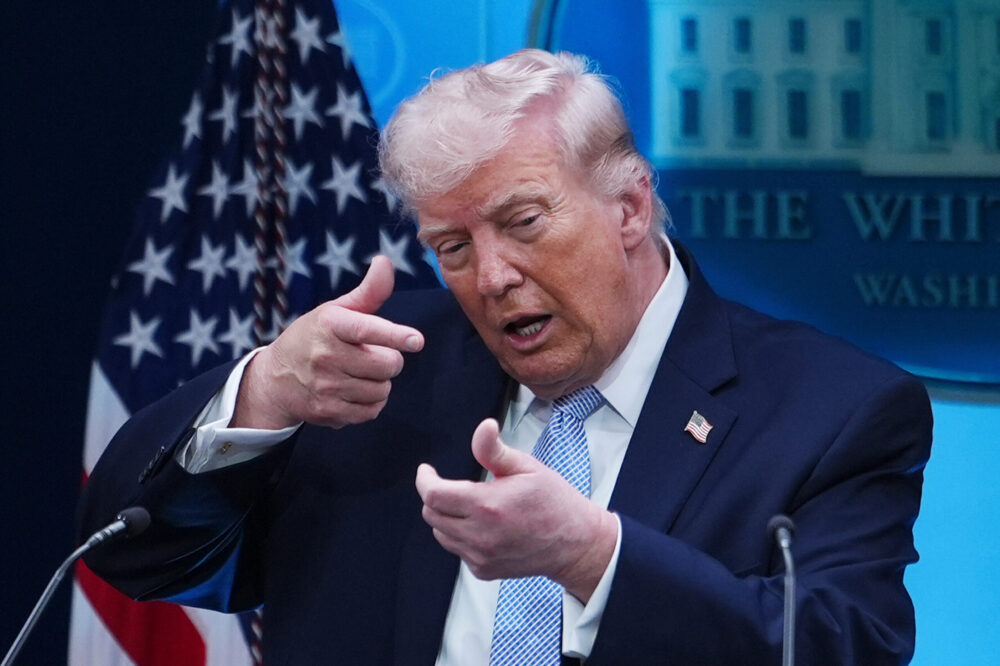
Trump has made the United Nations a dead duck – to the disadvantage of us all
Martin Shipton
The structures set up to maintain world order after World War Two are in existential crisis and in greater danger of collapsing than at any time since they were established. This should worry us all.
Whatever the outcome of the talks taking place between the United States and Iran, who can doubt that the world has become a much more dangerous place because of the criminal actions of Benjamin Netanyahu and Donald Trump?
This is not how things were supposed to be after the second worldwide conflict in less than 30 years came to an end in 1945. It’s why the United Nations was founded.
According to its Charter, the purposes of the UN include reaffirming fundamental human rights; maintaining international peace and security; and promoting the economic and social advancement of all peoples. The UN Charter mandates the UN and its member states to “maintain international peace and security, uphold international law, achieve higher standards of living for their citizens, address economic, social, health, and related problems, and promote universal respect for, and observance of, human rights and fundamental freedoms for all without distinction as to race, sex, language, or religion.
These are noble aims, but it would be foolish to suggest that they correspond in any way to the geopolitical reality of today’s world.
As a charter and constituent treaty, its rules and obligations are meant to be binding on all members. The behaviour of Netanyahu and Trump reinforces the view that the aspiration and the actual situation are poles apart.
Setting up the UN in 1945 wasn’t the first attempt to establish a peaceful world order. The League of Nations was established after World War 1 following an idea put forward by US President Woodrow Wilson. Ironically the US didn’t join due to political opposition in the Senate, constitutional concerns over war powers, and fears of permanent foreign entanglements. The League was unable to combat the rise of aggressive militarism in Germany in the 1930s, but wasn’t formally dissolved until 1946, when its functions were transferred to the newly formed UN.
The UN has had structural problems from the outset, with a system that favours the “big powers” as they were perceived at the end of World War Two. There are five permanent members of the Security Council – Russia, China, the United States, the UK and France – each holding veto powers that can block resolutions. United they may be in theory, but in practice some nations are more equal than others. There are 10 further members of the Security Council drawn from the UN’s entire membership, with each of the non-permanent members serving two-year terms without a veto.
The Security Council’s functions are to identify threats to international peace and determine breaches of peace; to authorise peacekeeping operations and military action; to impose sanctions on states or entities; and to issue binding resolutions that all UN member states must comply with.
Anyone can see that this system isn’t working. That was always true to an extent, but there’s a huge difference between the approach adopted in advance of the invasion of Iraq in 2003 and the attack on Iran 23 years later.
In 2003 the UN was at the centre of debate over whether an invasion of Iraq would be legal. I remember intricate debates in the UK Parliament and elsewhere about whether an earlier Security Council resolution could be used as a justification for the invasion that President George W Bush, with the assistance of Prime Minister Tony Blair, intended to undertake.
Principled politicians and distinguished lawyers argued strongly that the previous resolution wasn’t sufficient and that an explicit mandate would be required. Had such a course been pursued, any such resolution would have been vetoed, by Russia and China if not by France. In these circumstances, Bush and Blair went ahead with the invasion anyway, despite considerable condemnation. Adam Price, at the time a Plaid Cymru MP, was one of the instigators of an attempt to use centuries-old powers to impeach Blair for war crimes. The bid wasn’t successful, but Blair’s reputation was damaged irretrievably.
In 2026, when Trump was persuaded by Netanyahu to wage war on Iran, the UN was totally disregarded. There were no intricate debates about the legality of the attacks on Iran undertaken by Israel and the US. The US Congress seemed to be absent without leave, while Trump behaved as a dictator without restraint, committing war crimes by bombing civilians with impunity and issuing threats to destroy a civilisation.
Yet the media coverage concentrated on events as they occurred, with analysis of the logistics but very little about the clear illegality that was taking place.
Have we become so inured to Trump’s wild behaviour that we shy away from expressing our outrage?
I discussed these concerns with Mick Antoniw, a former Counsel General who has just retired from the Senedd, where he was the MS for Pontypridd.
He said: “This is a real existential crisis for the UN. Trump and Netanyahu have defied the whole essence of the rule of law and contravened the human rights of civilians. Putin has done the same before them.
“Trump has put the future of NATO in doubt, which will obviously please Putin.
“International bodies which were created to maintain peace after World War Two are in danger of becoming irrelevant, with the UN reduced to being a relief agency. From the outset the problem has been that the implementation of the UN’s aims is based on consent. When you have leaders who don’t abide by civilised norms and are prepared to flagrantly breach them, the system falls apart. This is very worrying.
“We already have a situation where the US and a small number of other countries including China and India do not recognise the International Criminal Court (ICC). People like Trump, Netanyahu and Putin should be left in no doubt that they will be arrested as war criminals if they travel to countries where the ICC is recognised.
“Europe should be standing together to reinforce human rights and social progress. Being outside the EU has made the UK particularly vulnerable, and there is a compelling case for us to move closer to the EU, with a view to rejoining as soon as possible.”
The threats posed to the UK by the likes of Trump and his erstwhile friend Musk, whose social media channel X has become notorious for pumping out far-right and racist propaganda, should be taken far more seriously by the British authorities.
As part of the defence of our democracy, voters in Wales should ensure on May 7 that Reform UK, led by a shameless Trump groupie, comes nowhere near power.
Support our Nation today
For the price of a cup of coffee a month you can help us create an independent, not-for-profit, national news service for the people of Wales, by the people of Wales.



It was always a dead duck. Firstly because of communist Russia, now because of them and communist China. It even made Saudi Arabia a leader on human/women’s rights. It is a foul organisation that should have been disbanded years ago.