


Trump’s Suez
Ben Wildsmith
Privileged people love to gamble. When the odds have been tilted in your favour from the off, tempting fate must be a way to puncture the cushioned torpor of an easy ride.
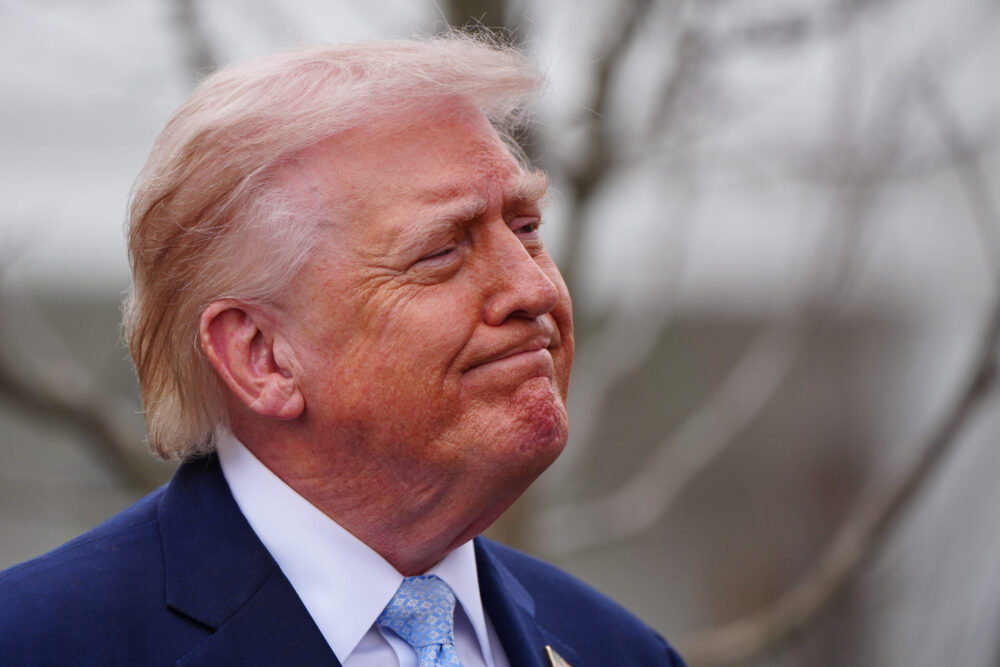
So, Donald Trump’s transformation from America-first isolationist to bomb-happy interventionist can be seen in those terms.
What’s the point of being president if you don’t get to press all the cool buttons, right? Those who suspect the tightening grip of dementia over the Donald can, in a way, find some comfort in the idea of an over-mighty president regressing into childlike irrationality. It is, at least, contained to the man himself.
That scenario offers escape routes like the 25th amendment to the constitution, although the likelihood of Trump’s lickspittle cabinet authoring his downfall seems remote.
Perhaps the CIA might decide enough is enough and JFK the deranged despot before he reaches for the nuclear football? You’d hope, wouldn’t you?
Hope, though, is a dangerous narcotic in times like these. However diminished Trump might be, there are plenty of powerful people in play whose agendas are served by the USA resuming its Bush-era bellicosity. ‘War, what is good for? It’s good for business,’ Billy Bragg once sang and with the president’s tariff regime limiting opportunities for trade, a good old bonfire of missile stocks creates chances for big returns on investment.
This reasoning again offers an optimistic ledge on which to perch. If this unpredictable conflict is a function of ungoverned capitalism – an oil and bullets cash grab – we would at least understand that in the context of what has gone before.
It’s unpalatable but simply a fundamentalist expression of the system that sells us food that makes us sick then pills to make us well; hardly perfect, but you don’t wanna be a Commie, do you?
So much for the soothing speculations. For those in the USA who oppose this war, the president’s volte-face arises from more sinister forces than greed or decline. There is a growing suspicion that Trump has been captured in a far more explicit fashion than people had been willing to admit.
We are used to anti-war voices coming from the left. A bomb falls somewhere in the world and within seconds Bernie Sanders is outside the Senate calling for it to stop. Students march, intellectuals fret, everyone goes on TV clutching pearls and nothing changes.
The ineffectiveness of the American left is so entrenched as to form part of its recognisable identity. If they were any good to challenging the military-industrial complex, they wouldn’t be allowed to do it, would they?
This time, though, opposition is being led from the right. The TV host-turned podcaster Tucker Carlson has emerged as the lightning rod for a school of American thought that previously saw Trump as their saviour.
Isolationism has long and genuine roots in American thought, stretching back to Washington’s farewell address and Trump’s previous distaste for ‘forever wars’ was seen by many serious American thinkers as being, possibly unwittingly, part of a tradition that long predates the Neoconservative global meddling with which the USA has engaged since WWII.
Betrayal
Trump’s betrayal of isolationism has caused former supporters to look for reasons why. Carlson has incrementally turned up the dial on suspicions that Trump has been personally compromised not just by Russia, as so many have suspected, but by Israel.
Last week’s resignation of Counter-terrorism chief, Joe Kent, was followed swiftly by an appearance on Carlson’s show where Kent, a decorated war hero and widower to the victim of an ISIS bomb, aired complaints that his department had uncovered foreign links to the assassination of Charlie Kirk and the attempted assassination of Trump. In both instances, he said, the White House had shut down his department’s investigations.
Kent claimed that Israeli representatives had free access to the Oval Office, where they would share unsubstantiated intelligence suggesting an imminent threat to America from Iran.
This sort of conspiracy-flavoured speculation is usually what presidential appointees are tasked with debunking. Now, either the conspiracists have taken over the asylum, or they are right.
In either case, their theories are no longer being expressed from college campuses and performative demos, but from sources trusted by heartland America and the president’s core constituencies.
It is difficult to see what is to gain for America in this war. The economic realities of energy distribution militate against an all-out assault from the air, whilst the geographical realities of Iran make a ground invasion likely costly in men and treasure.
Most of the public don’t support the war, and the president’s rhetoric of decades leaves his actions open to accusations of coercion.
US supremacy
With every day that passes the mystique of US supremacy fades, emboldening other actors both in the region and the wider world.
If the retreat from Afghanistan showed Putin that America doesn’t have the stomach for a fight, failure here would cast doubt on its technology too. After all, you can only fire $4 million interceptors at $20 000 drones for so long before the bill becomes due.
Anti-war sentiment from the centre and right of American politics has the potential to remake the country’s idea of itself – and not necessarily in a healthy way.
Anthony Eden’s failure in Suez forced the UK to reimagine itself as a post-imperial power and the impossibility of tallying that reality with the country’s weighty mythological baggage resulted in the UK’s interminable identity crisis.
America, despite all it has endured and perpetrated, still manages to cohere as a shared identity for most of its citizens. The last time that belief was seriously tested was over Vietnam.
If this current conflict ends badly for America, a crisis of confidence will ensue. If, as Carlson and Kent hint, that failure was pursued because of outside coercion, that crisis will be very ugly indeed.
Support our Nation today
For the price of a cup of coffee a month you can help us create an independent, not-for-profit, national news service for the people of Wales, by the people of Wales.
Get more trusted Welsh news
Choose Nation.Cymru as a preferred source in Google News to see more of our journalism.



It is ironic that Bonespurs avoided service in Vietnam, dismissing casualties as “suckers and losers”, and mocks the death of a decorated hero like Robert Mueller while sending other young people to die in this war.
Other facts may be at play for Trump’s decision to go to war, like – the Epstein Files – where apparently Trump is mentioned thousands of times. What better way to distract media attention than to drop a few bombs. Ultimately, Trump is a rogue who should never have become President in the first place, and now the US and the rest of us are paying the price for it.
The whole world seems to hate Trump apart from a ever shrinking MAGA clique so is that why it feels like a script idea being thrown at a room full of cigar sucking, employee molesting fat bullies in the swank offices of a Hollywood studio?. Can our (and I like Ryan Reynolds for this, simply because he saved Wrecsam) hero, ‘JFK’ Trump before the world descends into chaos? ‘JFK trump’. Demonstrates the genius status of the inimitable Ben Wildsmith, Diolch Nation Cymru! If all else fails you can always claim credit for visiting this great writer on Cymru.
People that can remove this stain on humanity are the GOP.
So far they are too scared to say no to him even if the shoes are too big.
And Edens attack on Suez was bad from the initial conception and should never have happened. Trump is in that slot right now.
“After all, you can only fire $4 million interceptors at $20,000 drones for so long before the bill becomes due.” Actually, the USA is solving this problem with APKWS (Advanced Precision Kill Weapon System), basically a cheap guided rocket made from existing Hydra rockets costing around $20k–$25k per shot which is in the same ballpark as Iranian Shahed drones ($20k–$50k) representing a cost ratio of around 1:1. A 2.75-inch rocket with a laser guidance kit providing the cheap Hydra rocket with high accuracy/drone kill rate.
Should Trump pull the trigger on Iran’s Kharg Island (thereby destroying Iran’s ambitions to rebuild/reconstruct its ballistic missile fleet and replacement of its nuclear enrichment facilities) then it is notable that the United States is the largest supplier of liquefied natural gas (LNG) to Europe, supplying over 65% of its total LNG imports in early 2025, up from 34% in 2021. Following Russia’s invasion of Ukraine, United States LNG exports to Europe surged from approximately 15 million tons annually (2018-2021) to over 50 million tons, effectively replacing the bulk of lost Russian pipeline gas. There is no reason to suppose that… Read more »