


Unpicking the UK Government’s announcement of new Welsh rail stations
Lyn Eynon
On February 17th, the UK Government announced seven new Welsh rail stations and claimed to be making a major rail funding commitment. In reality, there was little truly new in this announcement.
Transport for Wales currently estimates the total cost of all Welsh rail schemes under consideration to be £14 billion, a figure that will inevitably increase over time.
The UK Government has done no more than endorse the TfW vision, declaring its pipeline to be a ‘generational transformational commitment’, while stating that funding will depend on future Spending Reviews, as it always has.
No new money was provided beyond that already in the 2025 Spending Review, which included £90 million for the long-announced Burns stations (Cardiff East, Newport West, Somerton, Llanwern, Magor and Undy) over the next four years.
As the Burns Delivery Board in 2024 estimated a cost of £335 million to deliver these by 2030, which it assumed would come from the UK Government, there remains a sizeable gap, and no certainty over future Spending Reviews.
The statement promises preparatory work on all these stations this year, but construction of the first two will not start until 2029, so it will be into the 2030s before any are delivered, and only once the funding gap is closed.
Public money
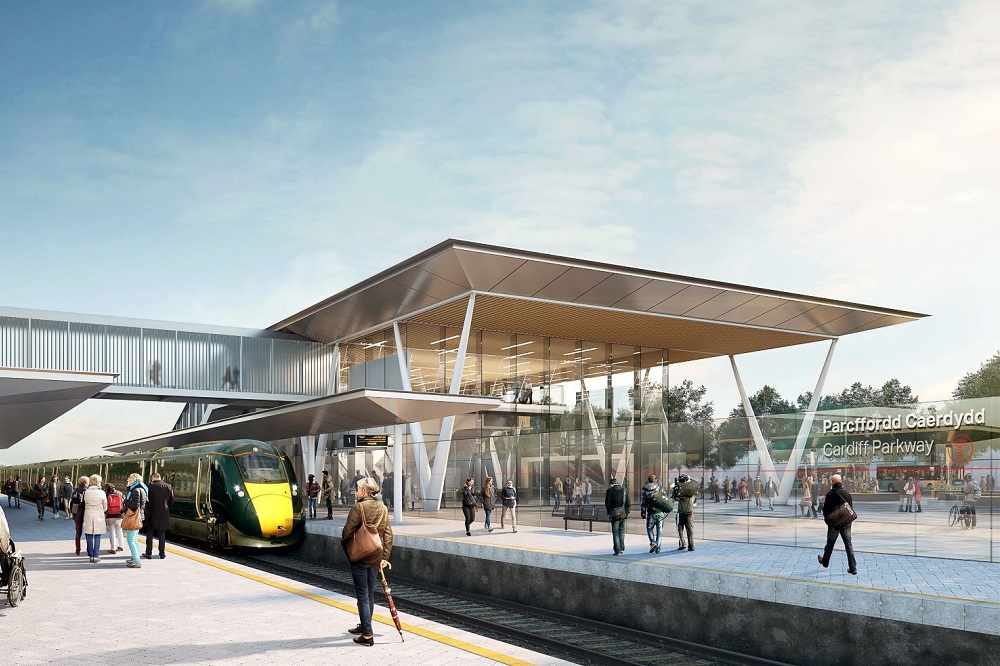
What is new in the announcement is that it now acknowledges that a station at Cardiff Parkway will not be built without public money. Cardiff Civic Society has long argued that this would be necessary, despite denials from Jo Stevens and other supporters.
The announcement summarises the revised position,
A new station will finally get built at Cardiff Parkway to help service an estimated 800,000 passengers every year. This will unlock around 6,000 jobs in the industrial district, which will get revamped thanks to additional UK Government investment and an agreed approach to funding and delivering the station between UK Government, Welsh Government and private investors.
Let’s examine this.
800,000 sounds an impressive number, but it is little over half the pre-covid total for the small station at Cardiff Bay.
It assumes a park-and-ride facility and that the business park will be fully built. P&R might be useful, although Cardiff Council seems to support closing the existing Cardiff East P&R bus service.
The developer’s own travel plan assumes two-thirds of business park journeys would be by private car. Despite claims this site will help a modal shift in travel, its dirty secret is that it is close to the M4.
Greenfield
The site is not an industrial district. It is greenfield, and a business park would destroy the Marshfield Site of Interest for Natural Conservation and damage Sites of Special Scientific Interest on the Gwent Levels, a rare biodiverse part of Wales.
The promise of 6,000 jobs has been touted for a decade, but that number exists only in the imagination of politicians afraid to call out that the developer has no clothes.
When initially proposed, it was assumed that Cardiff had a shortage of office space, and that with new offices jobs would come. But the world has changed. Home working is now a permanent feature.
The 2022 Employment Land and Premises Study for Cardiff’s replacement Local Development Plan did not identify any pressing shortage of office space, and the market has subsequently confirmed that. Offices are being converted to residential use.
While some businesses need the extra land that an edge-of-town location can offer, the plans show that most accommodation would be in towers that would fit more naturally in a city centre, if demand existed.
But what could have been prime employment land south of Cardiff Central has now mainly been allocated for housing, while large office blocks stand empty near Newport station despite renovations.
Both locations have better existing train links than Cardiff Parkway will ever provide.
Decamp
Rolls-Royce is repeatedly mentioned as a possible occupier. It has recently announced a hundred new jobs at the nearby St Mellons Business Park, from where it might one day relocate to newer offices with some extra jobs. But it will not decamp from Derby to fulfil the dream of thousands of jobs.
Hopes of a Memorandum of Understanding prior to last autumn’s Investment Summit came to nothing. No other sizeable employer has ever been identified.
Does talk of the district being ‘revamped thanks to additional UK Government investment’ point to public subsidy to try to turn this around?
Even if an approach to funding and delivering the station between UK Government, Welsh Government and private investors has now been agreed, there is not yet agreement on who pays what or when it would be delivered. Nor is there clarity on the station itself.
The vision of a four-platform station with direct intercity connection to London has always looked hubristic. Who would want to pay for that, or operate such trains?
The UK Government statement talks only of ‘cutting journey times to Cardiff and Newport and connecting them to other areas of Wales and the UK’.
Just over a year ago, the First Minister approved the outline planning application but that is far short of delivering a station.
Conditions
Even when funding and scope have eventually been determined, detailed plans have to be drawn up and approved against the 36 conditions attached to the outline approval, then contracts negotiated and signed. Media speculation about construction starting this year is over-excited.
The eastern side of Cardiff certainly needs improved public transport, including rail. The site for the Cardiff East station, by the junction of Newport Road and Rover Way, looks well chosen.
But if Cardiff Parkway were truly to meet the needs of residents further east, it would be built closer to where they live.
And as for the promised Crossrail from Cardiff Bay through Splott, that is nowhere on the horizon.
Lyn Eynon is planning lead for Cardiff Civic Society
Support our Nation today
For the price of a cup of coffee a month you can help us create an independent, not-for-profit, national news service for the people of Wales, by the people of Wales.



Really interesting, but frustrating to know it will be years until we get any new stations in east Cardiff.
We definitely need a train station for St Mellons/Rumney but there is already a business park next to the proposed Parkway site and it doesn’t look full. I think Lyn is right, there really isn’t a business case for the business park.
To be close to where people live a station little further west would make much more sense. Here for example https://maps.app.goo.gl/k7x8E3uivFfNLGN8A
Considering that they started building the estates down in St Mellons in the early 1980s (I lived there in late 80s) it just proves how little investment there has been in public transport in 45 years.
Count yourselves lucky, Hwntws. We don’t get ANYTHING
Always nice to hear from Bristol’s civic society.
Unfortunately commuting is now a fact of life, would you like to condemn investment in public transport in N E Wales because so many people in Wrexham travel to Chester, Liverpool or Manchester for work.
Having lived in St Mellons it would benefit a huge number who would like to use public transport to get quickly into Cardiff, the buses take an age.
Great article Lyn. It’s just another white elephant project with no meaningful benefit to the public.
Great if you live/work in SE Wales or Bristol. Nothing much for anyone else.
Half the Welsh population lives in the south east.
And half doesn’t.
This was always a dubious project based on uncertain “projections”. Unfortunately, politicians are easily persuaded (Gething) and their support gives projects momentum, and public money. These things always start off with promises of private financing, but that never lasts.
I don’t care about going to London 10 mins quicker from whatever ‘Cardiff Parkway’ is. Just get me a bus system that works for more than going to the center of Cardiff once an hour, up until 8pm.
Bus services are underrated, but for most locations they will always be more nearer than trains and deserve more investment.