

Wales and Internationalism
Graham Davies
Ten years ago I took a train from Valencia, a vibrant Spanish city on the coast, to Teruel, a town high in the Aragon region and famous for its Mudejar architecture and its delicious Magras con Tomate.
The train struggled a little towards the high altitude destination and the weather began to change from tee shirt to jumper.
I often recall the journey at this time of the year. I was researching my book on the Welsh volunteers in the Spanish civil war and the cool breeze when I met up with my historian colleague was nothing compared to what happened in Teruel in January 1938.
It is today an unnerving context in which to revisit the Spanish civil war, which began when Franco sought to overturn a democratically elected government. The recent serious threats to democracy and international law, not only from the usual culprits but an expansionist US, and the rise of the far right and fascism in Europe raises a chilling sense of déjà vu.
On New Year’s Eve the men sat on the steel floors of trucks that crunched their way up steep mountain roads to their position, digging into the frozen soil in the icy winds and a few feet of snow.
Alun Menai Williams of Penygraig found his hands sticking to metal and fought against frostbite in rope sandals. Temperatures were 20 degrees below freezing and the first hot meal for three days was sardines and bread.
The joke was that there was one advantage of such weather – it seemed to keep the lice passive!
George Baker of Gelli had improvised a canopy of sorts for two and a small candle, but it couldn’t cope with Franco’s two-hour artillery bombardment with his planes joining in the turkey shoot.
Jim Brewer of Rhymney has vivid descriptions of continual dampness and three feet of snow mitigated only by the ability to take cognac in the morning with the coffee and toast. This did not stop him from contracting a fever, being hospitalised and narrowly avoiding pneumonia
Of the Welsh killed was Francisco Zamora, an Onllwyn miner born in Abercrave in a Spanish family, mown down in a dangerous manoeuvre. Because he spoke Spanish he was acting as an interpreter at Teruel, although he may have not been so easy to understand with his Welsh accent.
I looked down at his resting place and that of the 21 members of the British battalion who perished at Teruel.
Politically charged
It is the bitter and politically charged Welsh experience of deprivation, struggle and militancy against exploitation and injustice that provides the backdrop to the volunteering for Spain.
Volunteers came from communities that shared a similar economic situation and knew what it was like to be oppressed. They came with the sting of the 1926 Strike and the anger of the hunger marches, and they came with a colourful history of working class struggle.
Indeed it was a heady mix of political awareness and engagement, vibrant coalfield militancy, enduring anti-Fascism and pure empathy and compassion which has produced a narrative of the Spanish Civil War, understandably at times romantic, but compelling and inspiring.
It is a story we need to revisit at this fragile point in European history and in the context of the moral bankruptcy of the US and the authoritarianism of Trump.
It is a narrative of idealism and internationalism which was prepared to call out and oppose dictatorship.
Integrity
It arose from working class consciousness, democratic ideals and integrity, not the brutality of elitist power and worship of the dollar.
There is no more fitting tribute to the Welshmen of the International Brigades than the memorable words from the speech of Spanish Republican politician Isidora Dolores Ibárruri Gómez, also known as la Pasionaria: “You are history. You are legend. You are the heroic example of democracy’s solidarity and universality…we shall not forget you; and, when the olive tree of peace is in flower, entwined with the victory laurels of the Republic of Spain — come back.”
Support our Nation today
For the price of a cup of coffee a month you can help us create an independent, not-for-profit, national news service for the people of Wales, by the people of Wales.



I’ve always hugely admired all the Welsh and the others from various countries who joined the International brigade, and also the captains and crews of the numerous merchant vessels who ran the blockade to deliver essential goods to the beleaguered Spanish citizens … They often brought many children out to the safety of friendly countries.. Wales being one…. How on earth can fascism gain a foothold again in the world?
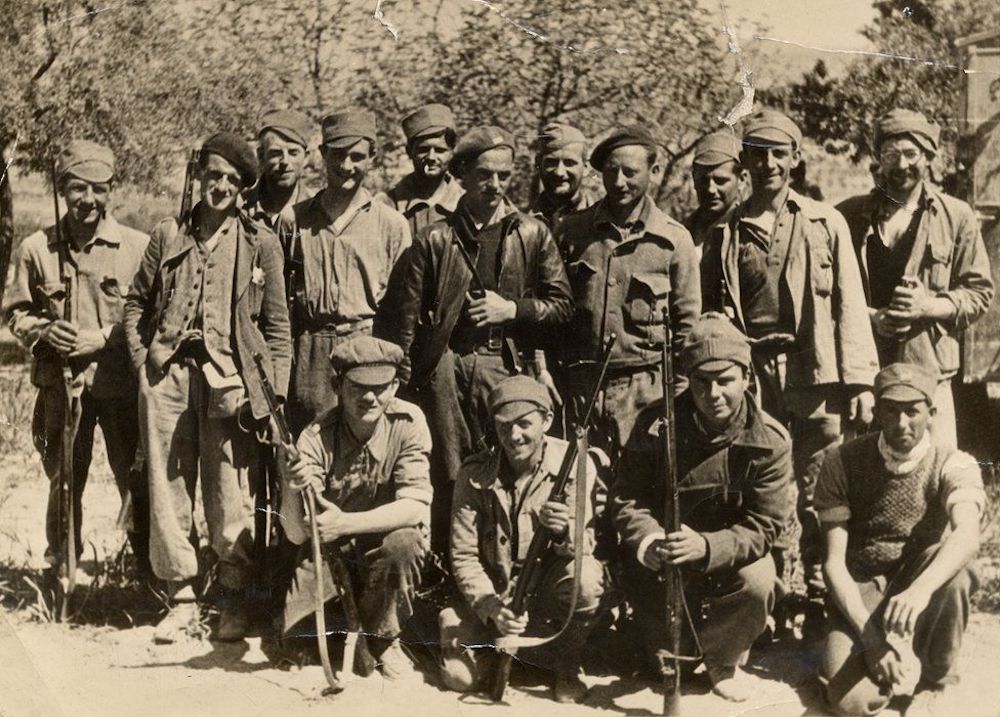
Graham’s book “You are Legend” identifies the volunteers in this photo taken at Darmos in April 1938: Standing (l to r) Rowland Williams, Tom Howell Jones, Jack Roberts, Arthur Williams, John Oliver, Tom Glyn Evns, Emrys Jones, Archie Cook, Goff Price, Sid James, Edwin Greening. Kneeling (l to r): Evan Jones, Billy Griffiths, Emlyn Lloyd, Morris Davies.
Those from Wales who fought bravely against fascism during the Spanish civil war, especially WW2 against the Nazis, must be turning in their graves seeing the rise of the far-right again today. They say if you don’t learn from history history has a habit of repeating itself. So true. Was their sacrifice worth it I ask? On reflection. Sadly no. We have not learnt one iota.
Some of us have learnt.