


Wales doesn’t have to support England – and here are the reasons why
Dafydd Mac
It’s that time again, when we hear the same old refrain – why aren’t you supporting England?
Every tournament it’s abundantly clear that, win or lose, England is particularly keen that the rest of the UK get behind them.
I’ve had many English ask me why so many Welsh people won’t support England.
They berate the “pettiness” of the “support whoever’s playing England” mantra, and insist that as part of the United Kingdom we should support each other in our sporting endeavours.
“We’d support Wales, so why don’t they support us?” cried one disgruntled England fan.
The British media have been asking the same question and articles have been written insisting that we show our support with the likes of Gary Lineker and Sir Keir Starmer vocal in their view that we should all get behind Thomas Tuchel’s men ahead of their World Cup semi-final with Argentina.
A few years ago Stephen Daisley in the Spectator imagined what would happen if one of the other nations of the British Isles, Scotland, reached a tournament semi-final ahead of England’s World Cup semi-final against Croatia in 2018:
“England fans would throw their support behind the plucky 11 and battalions of BBC cameras would be dispatched to interview players’ families, friends and old PE teachers.
“The Prime Minister would discover long-lost great grannies who once had a fish supper in (Edinburgh suburb) Portobello.
“The Sun would give away novelty kits bearing the legend ‘It’s coming hame’; the Mirror would reprint the lyrics to Flower of Scotland for its readers to sing along.
“England, in short, would be a mate about it.”
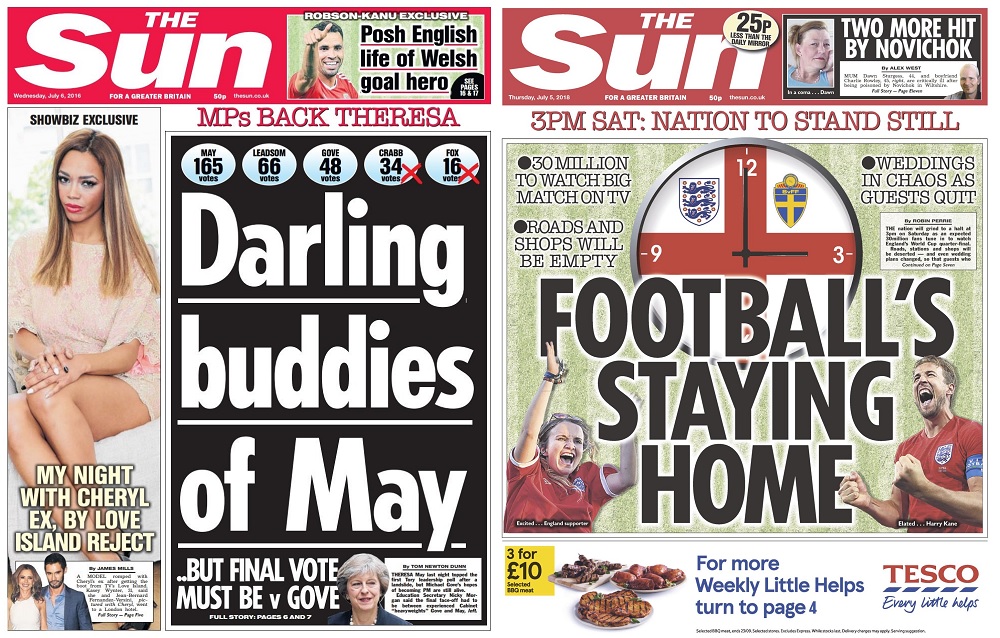
Unfortunately, we know this is nonsense because Wales did get to a semi-final in 2016 and the reaction of the British press was largely to ignore the whole thing.
The Sun’s reaction was to suggest that Wales’ players were really English.
Compare the front page of The Sun when Wales played Portugal in the semi-final, with their front page for England’s quarterfinal:
Identity
So we know that England’s support for Wales was at best lukewarm, but why are so few people in Wales ready to support England?
The short answer is that English identity is often synonymous with British identity, and when we Welsh are asked to embrace Britishness what we are actually being asked to do is to embrace Englishness at the expense of Welshness.
Demanding that Wales, Scotland and Northern Ireland support England is a classic example of this dynamic in action.
England and Britain are considered interchangeable, and therefore England are presented as the de facto Team GB at the World Cup.
Therefore it is considered only natural, in the eyes of many, that we in Wales, as British people, support England, and we are considered petty if we don’t do so.
This also explains why there was no such pressure put on England, Scotland or Northern Ireland to support Wales when we reached the semi-final.
There was no such feeling that Welshness could represent all the people of the UK in the same way as Englishness.
Neighbours
Many in Wales resent such an imposition of Englishness under the cloak of Britishness because it undermines what is an already fragile Welsh national identity.
Despite its cultural richness, Welsh culture is being slowly eroded by the soft power of its much larger neighbour.
Wales is geographically and demographically smaller than England. It is not an independent nation state and has little recognition on a world scale.
Unsurprisingly, smaller countries across the world often define their national identity against an “antagonistic other” which is often a large neighbouring country which has historically played the role of coloniser or oppressor to the smaller nation.
Thus the smaller nation’s national identity is often defined in terms of being different from the “antagonistic other”.
For example, Basque and Catalan identities define themselves against the dominant Spanish culture, and countries of the former USSR foster a national identity that is as un-Russian as possible.
The need to define Welsh national identity against an “antagonistic other” is unsurprisingly more pressing still because we also belong to a United Kingdom where British identity is considered synonymous with English identity.
In a world where English national identity enjoys constant validation by virtue of being equivalent to the national identity of a historically significant and influential world power, it is unsurprising that many feel the need to bolster a distinct Welsh identity by highlighting the differences rather than similarities from its “antagonistic other”.
This mitigates against the risk of fading into obscurity under the shadow of a British/English national identity.
The national football team is intrinsically linked to national identity. To support your national team is to show the world that you are proud of your country.
Therefore, if you identify with a national identity which defines itself against an “antagonistic other”, to support the latter’s football team is tantamount to the betrayal of the former.
England, however, has not in recent history been colonised or oppressed by a larger power and therefore does not define its national identity against an “antagonistic other”.
Therefore, while largely ignoring it, it can be much more relaxed about Wales’ sporting success because it does not consider their national identity to be a threat to their own.
Fabric
“But England is no longer antagonistic to Wales, we are all part of the same country, we should be supportive neighbours to each other” exclaims the England supporter.
But while the “Welsh-not” is no longer hung around the necks of our school children who were beaten for speaking their mother tongue in the classroom, the relationship between the countries remains unequal.
Political, economic and cultural power still rests in English hands, and not a day goes by when Wales isn’t reminded of this.
England still enjoys greater economic and infrastructural privilege than Wales, one need only to compare rail transport in both countries to be convinced of this.

Furthermore, English culture is constantly validated as superior, while Welsh culture is done down.
If every Welsh person got a pound every time they were the subject to a sheep shagger joke, or told the Welsh language is gibberish, we’d have enough money to upgrade our decrepit rail system.
So when Welsh people refuse to support England in the World Cup, it’s nothing personal or ‘petty’ – we are simply defining ourselves as Welsh in the face of an identity that would seek to undermine our Welshness.
And the call to arms for Wales to embrace its Britishness/Englishness in the wake of England’s sporting success at this World Cup suggests that we are correct to think so.
Benefit
I actually think, and hope, that England’s success in the World Cup could be indirectly beneficial to Welsh national identity in the long run.
It may remind the world – and England themselves – that Englishness, Welshness, Scottishness and Irishness are not the same.
If England embraces its own identity as being fundamentally Englishness, and not something that needs to be pressed on others, we can all benefit.
So, all I ask here is that England’s supporters don’t take our lack of support personally.
Let us grumble if England win and enjoy our nationalistic schadenfreude if they lose!
Support our Nation today
For the price of a cup of coffee a month you can help us create an independent, not-for-profit, national news service for the people of Wales, by the people of Wales.
Get more trusted Welsh news
Choose Nation.Cymru as a preferred source in Google News to see more of our journalism.



Here!Here!
Who can forget Boris Johnson’s massive England flag covering Downing Street for the Euros and total radio silence when Wales qualified for Qatar.
I’m already hearing endlessly about about…1966
If England win, we’ll never hear the end of it…
We’d support Wales, so why don’t they support us?” cried one disgruntled England fan. Not correct – when at the Belgium v Wales QF of Euro 16 (England were out of the tournament – all the English I met were supporting Belgium.
Who could ever forget that bitter Saes hack for the “Metro” newspaper who hoped Belgium would beat us all because our players celebrated Iceland’s win over the noisy neighbours.
It certainly aged well.
Would you expect Ukrainians to support Russia, or Palestinians to support Israel?
The time-lapse is not important – it’s the underlying relationship.
Except we’re not at war with England…yet!
I have no allegiance whatsoever to any part of the UK other than Wales. It is therefore pretty obvious, and logical, that the only international soccer team I support is Wales’s Soccer Team and no other – not even England’s Soccer Team. Likewise for all of Wales’ international teams, boxers, athletes, golfers, etc, etc.
Why are the English so remarkably insecure? When we got to the 2016 Euros semi finals it was fantastic to see everyone getting behind Cymru. But nobody cared if anyone outside our nation, least of all those to the east of Offa’s, supported us or not. The London commentariat seem obsessed with Scotland and, to a lesser degree (as always) us, whereas they should concentrate on themselves. They talk about “uniting the country” but what on earth do they mean by that? Why not just say ‘unite England’? It is time that they sorted themselves out, show some maturity, and… Read more »
They’re terrified that folks will wake up one day and want the Heptarchy back. Make Mercia Great Again is just so easy to say.
Thankyou, thank you, thank you!
As I wrote on a different article about our overlords playing at the world cup, I have nothing against the good everyday people of England, just the imperial, colonialist English establishment, and let’s face it, the good every day non-establishment people of England have been mistreated over the centuries by the said English establishment almost as bad as the Welsh, Scottish and Irish. However, when it comes to sport, I don’t buy into and don’t understand this ‘Supporting the 4 nations’ nonsense. I’m Welsh, why would I cheer on England, Scotland and Northern Ireland? It doesn’t bother me if these… Read more »
Wouldnt even think of supporting them! Bit of a silly subject really. Come on Argentina.
Rivalry is a huge factor in international sports. Would England ever support Germany, or would Canada ever support the USA? Has anyone ever known a Welsh rugby fan who would cheer for England?
Ah, 6/7/2016. The day when England held its’ collective breath, cacked itself in case Cymru merely reached a tournament final and heaved an easterly force 10 sigh of relief when we didn’t. It then set on us one of its’ senior attack dogs Piers Morgan who repeatedly sneered at us for having a homecoming do around Castell Caerdydd to celebrate our unprecedented progress. ‘Are you supporting England?’ is a question for English people only. Asking us is a direct insult to remind us of our place as a colony and an order to get in line.
If you think that what Piers Morgan thinks is worth a stuff, then I pity you.
Yn union! ~ Well said!
England and its biased media never supported Wales when we were the only British side left in the 2016 Euros and reached the semi-final against Portugal. Therefore, we are not compelled to show deference or loyalty to a rival. It is like saying that Germany should support France simply because both are EU member states.
I’ll never support England in any sport and I just need to step out of my house and see the poverty here in the valleys – to remember why.
England 1 ARGENTINA 2
Well least now this argument can be put to bed 🤣
“It’s not coming home”
Diolch yn fawr Ariannin!
No. But they are.
“… what is an already fragile Welsh national identity.” and “Wales is geographically and demographically smaller than England. It is not an independent nation state and has little recognition on a world scale.” I commend the author on this – I think that it is refreshing to have it stated , as it starts to address the roots of what can be a fragility / insecurity of our identity …and, in turn , drawing attention to the totally lopsided, imbalanced geopolitical history of the constituent nations which comprise the island. I myself am indifferent to England winning or losing… that… Read more »
“…because it undermines what is an already fragile Welsh national identity.”
“Wales is geographically and demographically smaller than England. It is not an independent nation state and has little recognition on a world scale.”
I think that it is good that this is mentioned in the article: it gets to the root of what can be a fragility of identity, and by extension drawing attention to the lopsided geopolitical sizes of the constituent nations of the island.
I myself am not a football follower, but am indifferent to England winning or losing; I do not have an emotional investment.
No email was attached — just the social media post below, so I’ve proofread that. **Spelling:** No errors. **Grammar fixes needed:** – Missing comma: “so naturally I will support Wales**,** but England are a rival” – Missing full stop at the very end (currently just trails off after “Welsh”) **Everything else is solid** — your voice, humour, and flow all work well as-is. This reads like a genuine take, not corporate copy, so I haven’t changed your tone or softened anything. Here’s the corrected version: — I’m so bored of this topic and what is essentially virtue signalling of Welsh… Read more »
Whoops! That’s embarrassing 😅 I’m dyslexic so I always proofread with ChatGPT before I send anything… Should’ve double checked myself before sending as well haha
…I thought my initial post had disappeared off into the ‘techno-ether’, so tried to remember what I wrote originally, and re-posted … only to see my original post re-emerge! Hot weather mangling my head I think 😀
Agree completely. The English need to have Welsh (and Scottish) people support them is quite embarrassing. The “we’d support you” line was exposed as a fantasy in 2016, too. We should stop accommodating their insecurity, and they should get a grip
No Welsh person should be made to support England, but also if a Welsh person supports England by choice then he/she should not face any bullying or pressganging from people demanding adherence to Wales only.
I have seen Welshmen wearing the shirts of English Premier League clubs berate their own for daring to back England and refuse to see the irony.
It’s just not a football thing to support your neighbouring team if your team has been knocked out of a competition or is in trouble. In Manchester, if United was knocked out of a European competition and City remained in the competition I’m sure most United fans would be supporting anyone but City or just be indifferent about the fixture. I know it is true in Liverpool with the rivalry between Everton and Liverpool splitting families and had to laugh when I was told by the Liverpool supporting relative about a small city centre company having two vans one being… Read more »