


Wales is catching its breath. Now let’s talk about what comes next
Sam Ward, Head of Climate Cymru
There’s another heatwave on its way, the third one this year, hot of the back of the last one where we had days of temperatures that Wales was not built for, homes turned into ovens, sleep impossible, rivers running low and slow and the most vulnerable among us struggling in ways that never quite make the headlines, we are catching our breath.
It’s important that we don’t treat these heatwaves as anomalies or statistical quirks. The science is unambiguous: what felt extreme this week is becoming ordinary. The question is not whether Wales will face more of this, but whether we will be ready.
And here is what I want to say, Wales has everything it needs to respond to this crisis, the legislation, the talent, the community infrastructure, and the political will, and we need to choose to use it and have the courage to act at the scale the moment demands.
The people of Wales have already started building the answer. Across the Climate Cymru network of over 420 organisations, we hear from farmers, ecologists, community builders and innovators who are cracking on. It is already in the ground, in the landscape, and in communities from the Llŷn Peninsula to the Elan Valley.
In the uplands of mid-Wales, farmer Rhodri Lloyd-Williams has been planting trees as part of a community effort to slow water flow after devastating floods.
As this week’s heatwave took hold, those same trees proved their worth for a different reason entirely: providing shade and shelter for his herd of Welsh Black cattle on exposed hillsides. One intervention, two crises answered. That is what good climate adaptation looks like.
On the Llŷn Peninsula, ecologist Jo Porter has built an 80-strong community network around growing wildflower meadows. What began with scattering seeds in a neglected field has become one of Wales’ most compelling experiments in grassroots ecological restoration, and this week, as conventional grass browned and cracked across the country, those meadows were holding moisture, cooling the soil, and humming with life.
Drought-resistant landscapes that are also beautiful and biodiverse: this is not a compromise. It is the only sensible future.
Across Wales, retrofit installer Elfed is transforming community buildings into something more than well-insulated structures. In an era of increasingly dangerous heat, a well-retrofitted community building can become a genuinely life-saving resource, a cool refuge for the elderly, the young, and anyone who lacks adequate home insulation or air conditioning.
The work Elfed does isn’t just about cutting energy bills. It’s about keeping communities alive. Every community hall that stays cool this week is a small, quiet proof of concept for a different kind of Wales.
Hydroponic growing
Near Minera in north-east Wales, Chris Boyle’s Mountain Produce operation offers a glimpse of what food production might look like in a hotter country. Faced with lead-contaminated land,a legacy of the area’s industrial history, he turned to hydroponic growing, cultivating lettuce, peashoots, watercress and cold-pressed oils entirely without soil.
The result is a farming model that uses approximately 90% less water than conventional field growing. This week, as farmers across Wales watched their crops stress in the heat, Chris watched his plants flourish. The future of Welsh food is not defeated by the climate. It is adapted to it.
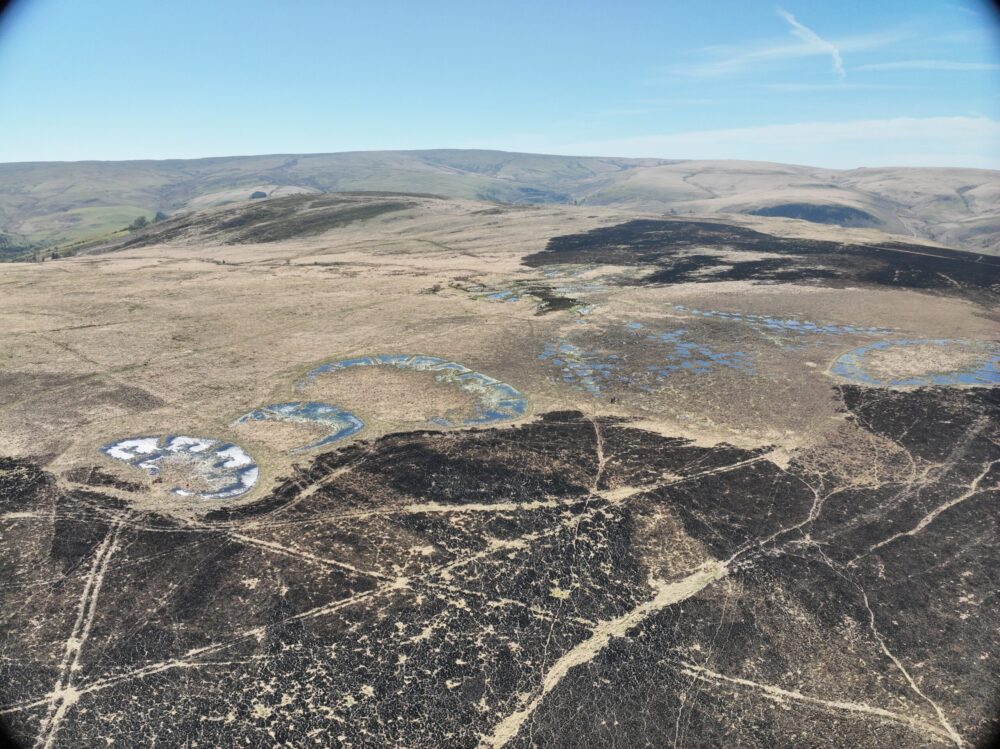
This spring’s devastating wildfire in Elan Valley, which tore through 8,000 hectares of rare habitat in just seven days, visible from space, was a stark reminder of what prolonged heat and drought means for Wales’ uplands.
But land managers across Wales are already deploying one of our most ancient and effective tools in response: targeted conservation grazing. By placing cattle on areas dominated by molinia, the coarse, dry grass that acts as tinder in upland fires, graziers can significantly reduce the fuel load on the hills, opening the sward to more diverse plant species and creating landscapes that are both more resilient and more biodiverse. It costs relatively little. It works.
Peatland
And then there is another story, about when the fire swept through Elan Valley in April, it was a restored area of peatland, land where water had been returned to the bog after years of drainage that helped halt the blaze.
Sorcha Lewis, whose farm sits in that landscape, watched the fire approach and then slow as it met the wetter ground. The peatland rewetting work done on her land did exactly what it was designed to do.
In a country that holds four per cent of the world’s blanket bog, peatland is one of Wales’ most powerful climate tools: storing carbon, holding water for livestock through drought, and, as Sorcha saw, slowing fire in its tracks.
And then there are the community energy schemes across Wales. Awel Aman Tawe, the community energy charity that has been working in the Upper Amman and Swansea Valleys, former coal-mining country, 20 miles north of Swansea,since 1998. Their founding idea was to develop a community wind farm, capturing a local resource for local benefit while taking responsibility for the global climate. It took nineteen years to build.
The two turbines on Mynydd y Gwrhyd now produce enough clean energy to power more than 2,500 homes every year. The surplus doesn’t go to shareholders. It funds jobs, community transport, and education in schools across South Wales.
This month, their sister co-operative Egni secured almost £1.4 million from the Development Bank of Wales to install new community-owned rooftop solar across Wales,one of the UK’s largest community solar portfolios, on school rooftops, village halls and swimming pools up and down the country.
Just transition
This is not a small pilot or a nice story for a sustainability report. This is what a just transition actually looks like, energy owned by communities, profits staying local, children in ex-coalfield villages learning that their valley can power the future rather than fuel the past.
What we need now is for us all to get behind these schemes at scale: reform the planning system so that community energy projects don’t take nineteen years to build; fund the peatland restoration that Sorcha proved works; back the retrofit programmes that are turning community buildings into cool refuges; support the farmers making the land more resilient one field at a time.
The Well-being of Future Generations Act asks every public body in Wales to make decisions that a child born today would thank us for. That child just grew up in this heatwave.
She deserves a government that treats what Rhodri, Jo, Elfed, Chris, Sorcha and the people of Awel Aman Tawe are doing not as inspiring exceptions, but as the template, backed by ambition, finance and political will at the scale the crisis demands.
Wales is catching its breath. The solutions are already here, let them grow.
Sam Ward is Head of Climate Cymru, the Wales wide coalition bringing together over organisations across Wales around the climate and nature emergency.
Support our Nation today
For the price of a cup of coffee a month you can help us create an independent, not-for-profit, national news service for the people of Wales, by the people of Wales.
Get more trusted Welsh news
Choose Nation.Cymru as a preferred source in Google News to see more of our journalism.



People need to be paying attention.
https://www.theguardian.com/global-development/2026/jul/08/uk-report-ecosystem-collapse-national-threat-food-security
It’s not true to say that most homes are “turned into ovens” as they were not built accordingly. All the houses in the cities, and the valleys built in the Victorian and Edwardian era were built with heatwaves. in mind. They had ‘air bricks’ designed to let cooling air circulate below the lower floors and also had circulatory soffit gaps in the eves of the roofs. What’s happened is that these homes have been ‘insulated’ as coal fires no longer exist. Attics now sealed heat stores, underfloor cavities have been concreted over. Air bricks rendered over. North facing cool parlour… Read more »
An amazing piece, mentioning, now tried and tested methods that are affordable and provide “win win” situations to the areas they’re in.
The information above needs sharing to a much wider audience as there’s still a lot of dangerous attitudes of climate denial from some corners. They just don’t realise that the actions needed really are as simple as above.