


Wales is on Fire. Meat is Fanning the Flames
Dr Carys Bennett
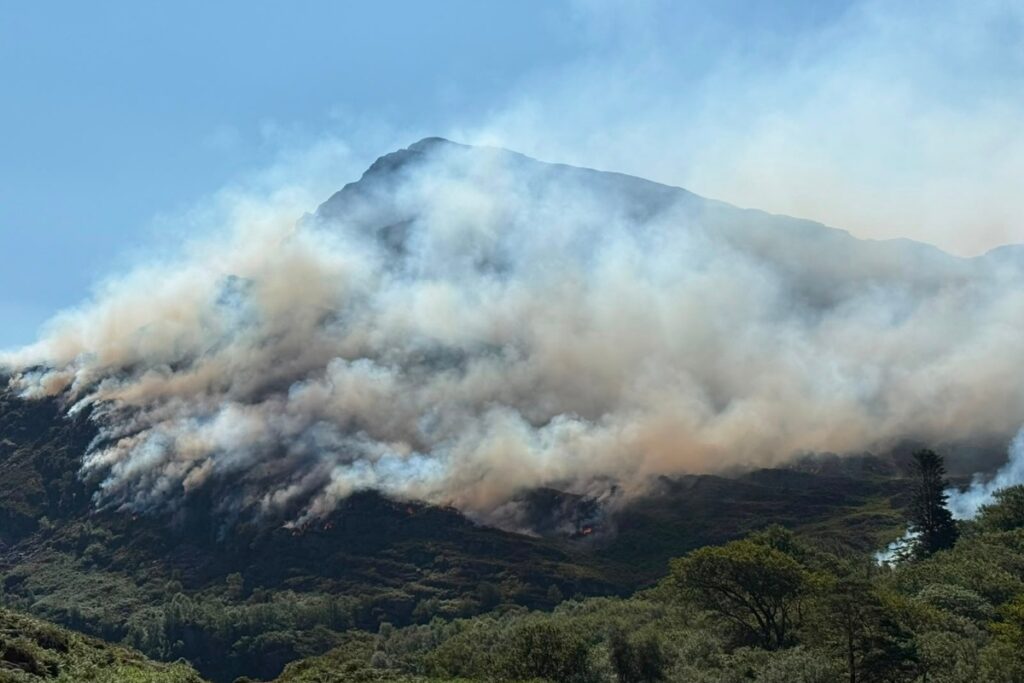
A mountain is burning on my doorstep. Since 19 July, wildfires have ripped through Mynydd Garnclochdy near Blaenavon.
When the smell of acrid smoke drifted across the valleys, it felt like a warning from the future: the climate crisis is here, and we must act before it’s too late. It starts with our forks.
July has been the driest on record in Wales in nearly 200 years, and a drought has been declared.
Wildfires have also been burning in the Rhondda Fach valley, and the Rhinogydd mountains in north Wales.
This isn’t ‘summer as usual’, it’s the undeniable signs of a planet in peril. With extreme fires raging across huge swathes of land in Spain and France too, what once felt like a problem for another day has become an immediate crisis for hundreds of thousands of people.
The debate over preventing a climate catastrophe often centres on fossil fuels. It’s true that we need to adopt clean energy, but we don’t have to wait for new legislation to pass or purchase costly electric technologies. We can each take incredibly powerful, personal action: we can go vegan.
Animal agriculture’s destructive impact on the planet is clear. Research shows that 90% of water now taken from natural systems for irrigation is used to feed the world’s over 80 billion land animals killed for food each year.
The wildfires in Blaenavon are burning land used for sheep and cow farming, agriculture that is singled out by the Climate Change Committee as hugely damaging.
Most of Wales’ farmland is used for animal farming, a model that is unsustainable, outdated, and cruel. Continuing on this path just worsens global warming and the likelihood of future fires and heatwaves.
As climate scientists call for an urgent, global shift to an animal-free diet, a solution is literally right under your nose.
Oxford University researchers report that, compared with UK meat-eating diets, vegan diets reduce greenhouse gas emissions by 75%, water pollution by 73%, water use by 54%, and biodiversity loss by 66%. Eating vegan meals can be done right now, helps animals, is healthier, eco-friendly, and can even save you money.
Beyond poisoning the planet, animal agriculture also poses the biggest and most direct harm to living, feeling animals. Three-quarters of Welsh people proudly claim to be ‘animal lovers’, but the chickens we eat are just as sensitive, clever, and capable of suffering as the whinchat and skylarks fleeing the flames in Blaenavon.
Chickens enjoy complex social relationships, dream like us, can count, and cluck to their chicks in their eggs, as an expectant human mother might chat to her unborn baby.
Despite this, they’re one of the most abused animals on the planet, with the UK slaughtering over one billion birds a year, most at just six weeks old.
Logically, even the most die-hard ‘meat-lover’ would have to admit that abusing animals at the expense of fresh water, air quality, biodiversity, and the entire future of Earth – especially when it’s proven to be healthier to eat plants – is the definition of crazy. We can, and must, change.
With wildfires continuing across Wales, the UK and Europe, and a summer of heatwave upon heatwave, I worry about the future.
Then, I sit down to eat a juicy plant protein burger and tasty cheese that wasn’t squeezed out of a cow, and feel a little hope.
After all, if we can enjoy burgers as delicious as this, without harming anyone or the planet, we can do anything.
Let’s make this small but impactful change, before the climate changes a lot, for the worse, forever. It all starts on our plates.
Dr Carys Bennett is a Blaenau Gwent resident and Senior Corporate Projects Manager at People for the Ethical Treatment of Animals, PETA.
Support our Nation today
For the price of a cup of coffee a month you can help us create an independent, not-for-profit, national news service for the people of Wales, by the people of Wales.
Get more trusted Welsh news
Choose Nation.Cymru as a preferred source in Google News to see more of our journalism.



You can always rely on a peta representative to come out with a totally biased opinion piece, amazing that wildfires in Wales are apparently caused by grazing animals while at the same time all the research in Europe is saying the lack of grazing animals due to depopulation and decline of farming is causing a serious issue increasing fuel for the wildfires, I think the European research is probably more reliable than the opinion from an animal rights activist. I’m not really sure why an opinion piece would be filed under “news” ?
If you look you will see that the article is in fact filed as an opinion piece, not news.
Oh dear, a downvote for ponting out a factual inaccuracy in a person’s statement!
Being down voted is not the end of the world it happens on this forum.
Get over it
Your name makes sense
As you are clearly capable of a “totally biased opinion” yourself, I will patiently explain to you that animal agriculture, as the article says, is a major contributor to greenhouse gas production, not to mention excessive pollution of waterways. Eliminating this would greatly mitigate climate heating, and thus reduce the risk of wildfires. There now, not so hard to understand was it?
I beg to differ as this viewpoint seems over simplistic. Please read the great book Tir by Carwyn Graves that researches the story of the Welsh landscape and points to a much more nuanced and sustainable agriculture of all sorts, where grazing animals, in limited numbers, have a crucial part to play. One also which truly harnesses local communities and their peoples.
Suggest Carys Bennett of PETA and a vegan campaigner should get out of her London flat and actually visit Wales. She can be assured that the valleys and Blaenavon do not use ‘irrigation’ to produce meat and the reason why the scrub on reclaimed coal tips it’s a temporary tinder box is it actually suffers from more recent lack of grazing livestock. Her suggestion that eating vegan is more friendly to the eco-system does not consider the fact that the majority of such produce in the British Isles is imported from all over the world with significant damage to biodiversity… Read more »
If you read the article to the end you would have seen that the author is a resident of Blaenau Gwent, so there is no need for her to get out of her London flat and visit Wales as she already lives here.
Sorry, my error. Her previous broadcast television appearances via Zoom from what appears to be a domestic setting displays the location caption of ‘London’ and previously ‘Leicester’. Perhaps they could not spell Blaenau Gwent. Yet they managed to spell Llanfairfechan on the Gareth Wyn Jones clash.
Is that the soya that is mainly grown to supply animal feed ? Yes, I thought so. You would benefit from a bit of reading and research before making a fool of yourself posting uninformed and ignorant comments.
No. Whilst 34% of imported soya feeds poultry, less than 11% feeds cattle which is less than that for human consumption and also less than is processed into artificial ultra-processed fake milks.
What a ridiculous assertion. Land and communities are on fire, and this activist has to piggy-back (yes, entirely intentional use) on this to push an ideology.
Agreed. The article is full of assertions not bourne out by fact. Too little grazing means an excess of flammable material.
Properly managed grass/ moorland is not in itself a fire risk.
An article of very poor scholarship.
Even with good land management, global warming resulting from greenhouse gas emissions to which livestock contribute, increases the risk and severity of fires.
Open grazed livestock is by definition regenerative farming. Any carbon emissions from the herd is carbon that was previously sequestrated from the atmosphere from photosynthesis making the pasture upon which the livestock graze. The only contributory atmospheric effect is when the feed is grown using fossil fuel fertiliser. Even when this happens with indoor husbandry, this input is considerably lower per human calorie than the production of vegetable and grain crops.
Except that cattle and sheep also emit methane which is a far more potent greenhouse gas than CO2.
Humans fart methane gas.
Although methane has a more ‘greenhouse’ effect than carbon dioxide it has a relatively short half life in the atmosphere. It’s a very light gas compared with other atmospheric components. It rises to the upper atmosphere and is broken down into water vapour by solar radiation. This is the hydroxyl radical reaction. A natural balance that has existed for millions of years as long as ruminant life forms have been eating. One of the most notable being the pre-Columbian Bison herds of the north American prairie.
‘One of the most notable being the pre-Columbian Bison herds of the north American prairie.’
There are many more times as many cattle in north America presently as there ever were bison.,
You come across more and more like a barrack room scientist if there were such a thing.
Not barrack room. You should note that 96% of red meat consumed in the British Isles is reared in the British Isles. We do not import beef from the United States, or very little.
You brought north america into the discussion not me
Now that your bison argument has been erased you chznge tack with another argument which ironically makes your original bison argument pointless. (in addition to being wrong)
I think “barrack room” is quite apt.
The ” natural balance” has been in an increasing state of imbalance since the industrial revolution and the consequent increase in the human population, so unless you are proposing a return to a pre-industrial global society, your reference to a long-past era as some kind of justification for continuing animal agriculture is not only stupid, but dangerously so.
Plants produce far more calories per hectare that are suitable for human consumption than animals.
Domestic livestock does have a part to play in food production but there has to be a considered and truthful argument for it.
As has been commented, you are ignoring methane, more potent for warming than carbon dioxide even though much shorter lived in the atmosphere. ‘Lower per human calorie’ is not an appropriate measure. It ignores feed conversion efficiency. Cattle require roughly 25 to 100 units of caloric and protein input from crops like soya to yield a single unit of edible energy or protein for humans. Land used for grazing livestock could be used for other more carbon-efficient purposes such as trees. I love a Welsh lamb or black beef dinner with gravy and vegetables. But we can’t deny the cost of… Read more »
Best to give up meat and dairy entirely, unless you are so lacking in empathy as to think it is ok for a sentient creature to die so that you don’t miss your sunday dinner, while at the same time increasing your chances of obesity, heart disease, and colon cancer by eating dead animals.
Public pretentious of moral superiority are rarely attractive.
Nonsense. You are ignoring the “by product” of animal farming in the form of slurry gases (ammonia, methane and hydrogen sulphide) released into the atmosphere, and the effect of what is left ending up in rivers and lakes. And your statement that growing veg and grain crops produces higher carbon emissions is simply not true.
Ammonia, NH2, is an essential fertiliser of the natural soil biome, soluble in water and is broken down by bacteria back into the soil, from which it originates in regenerative livestock agriculture. It’s actually the main component of fossil fuel fertiliser artificially manufactured to feed vegetable crops. Sulphur is not created by some magic nuclear reaction, it’s naturally geologically present in the soil, absorbed into the pasture, eaten by the livestock, and pooed back to the soil. It’s a closed cycle.
Too much grazing has resulted in the completely artificial landscape we now see on the uplands of Wales. Without sheep and cattle grazing the uplands of Wales would revert to Atlantic Rainforest and the risk of wildfires in such an environment would be far lower than the overgrazed (and artificial) landscape we have now.
Strange, as the uplands of Wales is renowned for archaic trackways even prior to Roman occupation the neolithic to iron-age routes of upland open grassland and moor affording long distance livestock droving routes. This is also confirmed in the preponderance of grass and heather pollen deposits in upland peat. It is somewhat romantic to think that the significantly higher and wetter landscapes of Wales once looked like the Cotswolds. Also indicated by archaic wild horse and cattle breeds.
What on earth are you talking about? It is generally accepted that the destruction of native forest began in neolithic times. This was long before the Romans arrived. The presence of grass pollen in peat cores does not mean that the landscape was not heavily forested in the mesolithic period. As for comparison to the Cotswolds, how does an intensively cultivated virtually treeless modern agricultural area provide any sort of parallel to Britain shortly after the last ice age? Answer, it doesn’t.
Shortly after the last ice age the British Isles became isolated from continental Europe. This is the reason why we have no boreal forest at altitude with the only native coniferous trees being Yew, Juniper and Scots Pine. Very different from Teutonic, Alpine and Scandinavian boreal forest. Our native deciduous trees have a much lower treeline, above which are natural upland peatlands. Our climate, much like Ireland, is wet Oceanic. It was never ‘blanketed in forest’. Niche habitats.
Actually, given that the highest peak in Wales is only 1085 metres there is no natural treeline in Wales (trees are perfectly capable of growing at much higher altitudes than that). The upland areas of Wales are only treeless now because of intensive sheep grazing which itself only really got going around 350 years ago. So the fact that the Welsh uplands are predominantly treeless is a modern and artificial abberation and is in no way natural. If you want to defend upland sheep farming just come out and say it, but don’t rely on spurious arguments about it being… Read more »
The two issues are not linked in the way this writer conflates them. There is a big issue about intensive rearing as in dairy cattle and chickens in terms of pollution and gases. Extensive grazing actually is part of nature and essential for a healthy plant population and reduces extensive large fires. Most of the land in Wales is unsuitable for agriculture in the sense of growing plant crops which leaves pastoral farming as the only option.
Long Mountain Powys 1,000 ft plus covered with spuds during the second world war…
North facing Tatws Bryn Market Garden Llanllechid Bethesda 1,000ft…
etc
Of course. The potatoe, in it’s wild form, is a native species of the temperate uplands of the south American Andes. In agriculture, variegations are planted for ease of cropping.
Correction: most of the UPLAND areas of Wales are unsuitable for arable farming. However, don’t make the mistake (or believe the propaganda of the NFU) of thinking that the upland areas of Wales are in any way natural – they aren’t. If cattle and sheep grazing were to stop these areas would eventually revert to their natural state: Atlantic Rainforest (aka Celtic Rainforest).
Also, hill farming is only possible with agricultural subsidies, without them the vast majority of hill farmers would go bankrupt.
Is it you who’s going to stand up in front of a hall full of farmers and tell them they’re being ethnically cleansed off the hillsides?
Yes, there is always the threat of violence from farmers if they can’t get their own way isn’t there? The fact is that upland farming (mostly sheep grazing) is unsustainable both environmentally and economically. These farms simply wouldn’t exist without taxpayers subsidies and if it’s food security you’re after there are better ways to spend agricultural subsidies than subsidising sheep (which very few people in Wales eat anyway, in spite of the NFU Cymru propaganda). I’m not suggesting that the upland farmers should be completely abandoned (although Thatcher did that to the coalminers, another unsustainable industry dependent on subsidies) but… Read more »
Superbly well said!
Perhaps if you offered them the option of transitioning to a massive rewilding and tree planting program, and earning twice as much, working as wardens of the landscape, and guides to the many tourists who would eventually come to a much more beautiful landscape, they might think it a good proposition. They might also think it preferable to the present precarious position of hill farmers, dependent not only on the weather but also on the world market for their product, the knowledge that they are reliant on state handouts, and the high rate of loneliness, depression and suicide amongst them.… Read more »
An excellent idea!
If extensive grazing is part of nature, then it must have existed before the evolution of humans, no? Well no; humans developed animal agriculture because it seemed like a good idea at the time; they could not possibly have foreseen its disastrous effects on both the environment and our health. I am so sick of the line that plant crops cannot be grown here, because until quite recently they were, and still are in many parts of the country. The reason that sheep predominate is more to do with government policy than climate. Look at how many place names contain… Read more »
Feels like a very biased piece Nation Cymru. Bad idea to put this under news. It is clearly opinion. Our crops cause massive damage to the insect and small mammal populations. A total lack of biodiversity is created when we plant huge areas of only one type of crop – basically they create vast green deserts that strip away the varied food and homes that wild insects need to survive. In order to grow more crops if we reduced meat consumption, hedgerows would need to be cleared to allow for larger fields than livestock are in – wild plants and… Read more »
If you check it is an opinion piece, not under news as you state.
There needs to be a lot of conversations around man made global warming that is killing thousands very year now, and eating less meat is one of them.
Lots of reactionary push back here which begs the question: why are meat eaters so threatened by being told some uncomfortable truths about the impacts of their meat eating? And no, I’m not vegetarian or vegan before anyone tries to shout me down on that point. The fact is that the upland farming areas of Wales are: 1. In no way natural. Without the sheep and cattle grazing the upland areas would eventually revert to their natural state (Atlantic Rainforest aka Celtic Rainforest). The upland areas of Wales are completely artificial and only exist because of sheep and cattle grazing.… Read more »
It’s totally incorrect to say the uplands left ungrazed would revert back to forest. Unmanaged upland would be totally overtaken by invasive plants which lower the soil pH making it infertile for other species and are a massive fire hazard
Fortunately you are Nesta and not the goddess of fire Vesta…you’re right too…
Why does the rooster crow every time a denial of veganism is uttered, it’s cool to come out guys…
Actually you are wrong, it would eventually revert back to Atlantic Rainforest. As for ‘invasive plants’, I’m assuming you are referring to non-native specified introduced into this country by humans. What evidence do you have that the uplands would be ‘totally taken over by invasive plants’? Incidentally, there is a piece of land near to where I live. When I first moved here 25 years ago it was used for grazing by ponies. The ponies haven’t grazed this land for 20 odd years and guess what? The trees are growing back, this parcel of land is slowly reverting back to… Read more »
Invasive native plants – bramble, fern, gorse. So it appears your scientific predictions are based on one field? Enough said.
Land left alone in the UK will eventually become woodland, with the exception of bare rock, and even that can become soil-covered in time, it just takes longer. Why do you find this so hard to digest? Of course it will go through an intervening stage of scrub, and that could well last longer than your lifetime, but if we continue our short-term views we will not survive.
Native plants are not by definition invasive.
And the piece of land I’m referring to is more than just a field for your information. The best thing about the land I’m referring to is that there has been no deliberate attempt at rewilding, all that happened was that ponies were no longer grazed on it and it is slowly reverting to woodland.
So: nice try, but no cigar.
I am not vegan nor even vegetarian, but it is undeniable that livestock farming and consumption makes an important contribution to total greenhouse gas emissions, even though the exact numbers are debated. Eating less meat and dairy would reduce those. It would also be healthier and less cruel.
There are many other factors to consider, such as land use, biodiversity, communities, incomes, lifestyle, etc. But we must not deny climate science. We need to take seriously the issues raised in this article.
The carbon that goes into the mouth of a cow or sheep is that which was extracted from the atmosphere. It’s a closed loop. However, not all that extracted CO2 is made into meat, while some does get recycled into the atmosphere, most comes out of the rear of the animal as manure. It’s best used to re-fertilise pasture and is excellent addition to growing organic veg as any gardener will testify. It’s science.
Cattle and sheep also burp out huge quantities of methane which is a far more potent greenhouse gas than CO2. This is why beef and lamb are far worse for the environment than chicken or pork. This is also science.
Nonsense. Methane has a very short life-span in the atmosphere and considerably less damaging than using fossil fuels to produce the grain that is fed to the Asian jungle foul, otherwise known as the chicken. In Wales, cattle and sheep graze on our natural grasslands.
Time scales, Panorama Walk Barmouth at 1,200ft has glacial ‘scratch marks’ in the summit rock, Bowie could have written a song about floating round the globe on a sea of magma, those were the days…
Lets not forget Cymru was on fire, concentrate…
How many of the 80 billion farm animals would be left if we went vegan? Not many… The uk accounts for less than 0.6% global emissions. All of those crying about the climate there is nothing we can do. There used to be forests at the poles, the planet has been much hotter and greener in the past. Extra co2 is good for plant life. I think pollution is more important than the climate. We are already electrifying.
Nothing we can do? This is cowardice
And ignorance.
The UK accounts for less than 0.6% of global emissions, do you really think that lets us off the hook? If every country that accounted for less than 1% of global emissions used that as an excuse no one would take any action at all. I dare say that the UK is fairly low in terms of plastic pollution but that is no excuse for doing nothing.
It would also be a big deal if the first country to undergo an industrial revolution, with all its subsequent horrors, was the first to adopt a truly sustainable economy. Better to show by example that to lecture those who, like so many here, are too ignorant and bigoted to see the wood for the tress (no pun intended)
A very simplistic explanation. Many of the intensive fires witnessed in France and Spain are because of depopulation of the countryside leading to the reduction of sheep and goats that would have traditionally grazed the scrub. Natural fertilisation of the land by livestock, negates the need for importing chemical fertilisers.
We need a balanced agriculture suited to the land in Wales. There is not a one-size fits all solution.
There is a very low density of livestock on the areas that are burning which are mainly bracken, gorse and heather. This landscape benefits from a low level of grazing and the animals aren’t necessarily for meat production – ponies for one example. I agree that intensive livestock production is harmful but on uplands, animals are a historic and valued part of the ecology. I’m not vegetarian but we need to eat far less, and better produced, meat for our health and that of the planet. It’s become far too cheap to be realistic and most people have come to… Read more »
By some margin, and against fierce competition, the most bonkers thing yet posted on this site.
Entitled to her opinion but this is a front runner for absurd article of the year.