


Wales is on the move: On 7 May, we decide where it heads

Hedd Gwynfor
Wales goes to the polls on 7 May. Sixteen new constituencies, 96 seats, a new voting system, and an election that will help decide what kind of country Wales wants to become.
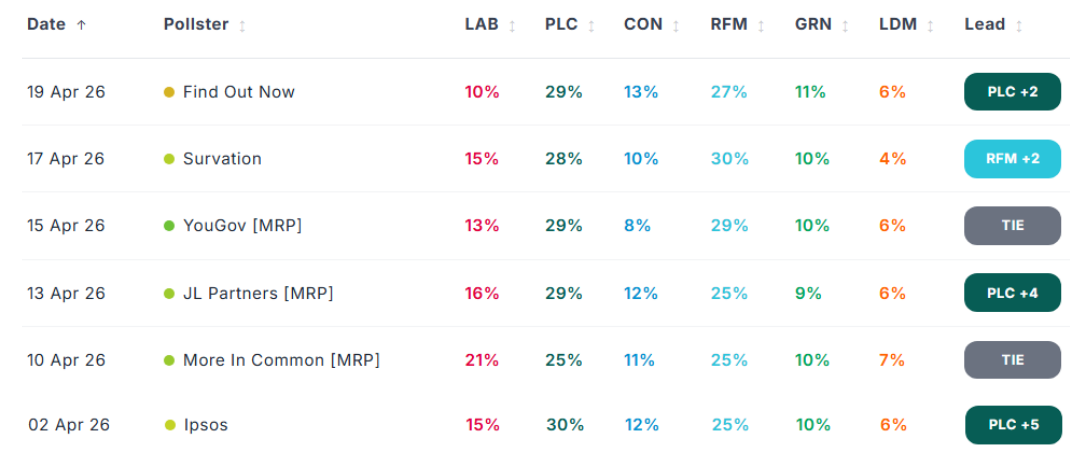
Six recent April polls, from Ipsos, More in Common, JL Partners, YouGov, Survation and Find Out Now, all point in the same direction: Welsh politics is being remade.
Plaid Cymru and Reform UK are both polling between 25% and 30%. Plaid is ahead in three of the polls, Reform ahead in one, with two showing them tied. Labour, after 27 years in government in Wales, has fallen to between 10% and 21%, averaging just 15% across the six polls. That compares with the 35% Labour received in the constituency vote at the 2021 Senedd election.
The Greens are steady, polling between 9% and 11%, while the Conservatives, on between 8% and 13%, are fighting the Greens and Labour for third place. The Liberal Democrats are a distant sixth, on between 4% and 7%.
Taking an average for each party across those six April polls, and entering those figures into the Cavendish Cymru seat projector https://seneddseatprojector-cymru.cavendishconsulting.com/, produces the following result: Plaid Cymru on 36 seats, Reform UK on 32, Labour on 13, the Conservatives on 8, the Green Party on 6, and the Liberal Democrats on 1.
That would put Plaid Cymru and the Green Party on 42 seats between them, just seven seats short of the 49 needed for a majority. The margins are close enough that a modest late swing towards Plaid Cymru and the Greens could change the course of Welsh politics. For the first time since devolution began, Wales could have a Welsh Government without Labour involvement.
Even if they fell short, a minority government could still work. The SNP showed that in Scotland in 2007, governing effectively for four years before going on to win an outright majority.
The polls tell us where the parties currently stand. Their manifestos tell us where they would take Wales.
Earlier this month, YesCymru reviewed the manifesto of every party contesting this election, focusing on what each says about Welsh independence and further devolution. The manifestos point in very different directions. https://www.yes.cymru/senedd2026
Plaid Cymru has committed to “laying the foundations for a White Paper on Welsh independence, addressing the challenges and setting out the opportunities and positive changes independence would bring for Wales.”
Their manifesto affirms that “the decision on Wales’s political and constitutional future belongs to the people of Wales” and proposes formally requesting that the right to decide on the timing, question and process for a referendum be devolved to Wales itself.
On immediate priorities, they would pursue the devolution of justice and policing, the Crown Estate, and greater tax powers, including “the ability to set income tax bands.” It is a serious, detailed programme for change, built around the principle that Wales should control its own future.
Caveat
There is an important caveat, and Plaid’s leader Rhun ap Iorwerth has been open about it. Asked whether this is an independence election, he has been consistent: “I do not think now is the time to have that referendum because the people of Wales are not telling us that it’s that time.” Plaid’s constitution is unambiguous: the party’s aim is “to secure independence for Wales in Europe.” Plaid is asking voters to back the next stage of the journey, not an immediate referendum.
The Wales Green Party also supports independence, although the manifesto itself does not use the word “independence”. What it does say is that Wales must “have the powers to shape its own future,” while committing to the same devolved powers as Scotland and prioritising justice, policing, rail, water, research and development, and the Crown Estate. Among the smaller parties, Gwlad and Propel both explicitly support independence, but current polling gives neither a realistic chance of winning seats in this election.
The remaining parties cover a wide range, from those content to leave the major levers of power in Westminster to those who would scrap the Senedd and Welsh democracy altogether.
Further powers
Labour opposes independence but supports specific further powers, including a Constitutional Reform Act, the devolution of the Crown Estate, youth justice, probation and employment support. For a party that has governed Wales for 27 years, managed decline within the union has always passed for ambition. The polls suggest Welsh voters have finally noticed.
The Liberal Democrats go further on devolution than any other unionist party, proposing a federal Britain and major new powers for Wales. Yet the same manifesto lists “Stop independence” as a headline priority and promises not to spend “a single penny of Welsh Government money on the independence agenda.” It is a peculiar position, advocating for greater powers while showing little ambition for what Wales could actually become.
The Welsh Conservatives have pledged to “rule out extending the Senedd’s powers and further referendums on the constitutional settlement, including the separation of Wales from the rest of the United Kingdom.” They would reverse the expansion of the Senedd and block any devolution of policing, justice or welfare. Reform UK anchors its entire platform around using “the powers Wales already has.” Their leader Nigel Farage was widely criticised in March after referring to Welsh speakers as “foreign speakers” in a story reported by The Guardian, which tells you most of what you need to know about the party’s attitude to Wales. At the furthest extreme, the Heritage Party would “abolish the Senedd” altogether.
Self government
Across the six main parties, only Plaid Cymru and the Wales Green Party support full Welsh self-government. Labour, the Liberal Democrats, the Conservatives and Reform UK are opposed.
In that opposition they share a common assumption that Wales lacks the ability, the resources, or the ambition to become a normal, self-governing nation.
The polls suggest Wales is on the move and Labour’s grip is broken. But the question now is where Wales moves next.
On one side is Plaid Cymru, offering a government with ambition for Wales and belief in its people. On the other is Reform UK, a party rooted in Westminster politics, division and hostility to Welsh nationhood.
Wales has a chance on 7 May to elect a Senedd with real belief in Wales and its people. Chances like that do not come often. It would be a shame to waste this one.
Support our Nation today
For the price of a cup of coffee a month you can help us create an independent, not-for-profit, national news service for the people of Wales, by the people of Wales.
Get more trusted Welsh news
Choose Nation.Cymru as a preferred source in Google News to see more of our journalism.



Down the pan if you let farage in, who was absent last Sunday on the BBC because it was found out someone bunged him 5 million.
No place in Cymru for the filth of racism, no place in our communities for reform supporters.
Let’s hope that decency and respect play a part in the voting choices, rather than hatred and plain stupidity.
You’ve found a downvote, well done.