


Wales is ready, but we’re being held back
Carrie Harper, Plaid Cymru MS, Fflint Wrecsam
With an incoming Burnham Government in London, it’s now time to make sure Wales has the power to match our potential.
The recent Senedd election was a significant shift. After years of political drift, Cymru has finally begun to assert itself more clearly. That matters, because a lack of political assertiveness has long had consequences. It’s one of the reasons we have been left with a weaker devolution settlement than Scotland, both in terms of funding and the powers available to get things done.
The comparison with Scotland is difficult to ignore. Wales is responsible for major public services such as health and education, yet we don’t have the same level of control over the wider system that shapes outcomes.
Powers over policing and justice remain reserved and fiscal levers are more limited. The ability to borrow and invest is constrained. The result is a mismatch between responsibility and capability. It’s a gap did not emerge by accident, it reflects political choices, and it can be changed by political pressure.
Where Scotland has been consistently assertive, it has secured more. Wales has shown similar moments of confidence, but less consistently.
Those moments are useful to acknowledge. The decision to locate the DVLA in Swansea in the late 1960s came at a time when Welsh political consciousness was growing, with Plaid Cymru’s breakthrough at Westminster in 1966 signalling that Wales could no longer be treated as politically dormant.
The same period saw the Welsh Language Act of 1967 begin the process of formal recognition for our language. In the following decades, sustained pressure also led to the creation of S4C, and ultimately to the establishment of our devolved Government in 1999.
These developments were not simply granted, they were responses to a changing political reality in which Wales was becoming more confident, more organised and harder to overlook.
HS2
A similar dynamic can be seen more recently. Plaid Cymru’s relentless focus on the classification of HS2 and the consequences for Welsh rail funding, succeeded in moving the issue from a technical dispute to a political one. It forced Westminster to engage.
In the run-up to the last Senedd election, commitments on rail investment began to emerge at a scale of billions, whereas previously it had not been on the agenda at all. Again, the pattern is familiar, political pressure creates movement.
With Plaid Cymru now leading the Welsh Government, the argument is that the next step should be a fairer settlement, both on funding and powers. That means parity with Scotland as a starting point rather than an aspiration. It means the devolution of policing and justice, greater control over the Crown Estate, fair treatment on rail infrastructure, and expanded borrowing and tax powers.
It also requires reform of the Barnett formula, which has long been criticised for failing to reflect Welsh need.
It’s not only about fairness, it’s about effectiveness. A system in which responsibility sits in one place and key powers in another is unlikely to deliver consistently good outcomes.
The broader context is also shifting. Across the UK, there is a growing appetite for different constitutional arrangements, whether through devolved governments or stronger regional leadership in England. This creates space for a new discussion, the devolution of powers does not inevitably have to be combative, it can be cooperative. A simple shift in perspective could offer a plethora of new opportunities.
Distribution of wealth
A more cooperative approach to the distribution of power, one that recognises that decisions are often better made closer to the communities they affect could ultimately also deliver a much more balanced distribution of wealth.
However, new UK PM Andy Burnham would be wise to recognise the difference between devolution in English regions to that of the UK nations. As bluntly put by the late Alex Salmond in relation to Scotland, ‘we’re a country not a county’.
With the emergence of three nationalist First Ministers in Wales, Scotland and Northern Ireland, it is a distinction London centric political parties would do well to remember. Failing that, I have no doubt that a new emboldened Celtic Alliance will give them a short, sharp reminder.
For an incoming government in London, the choice is whether to respond to this shift or resist it. The signs so far have been mixed, but the direction of travel is becoming clearer. Wales has reached a point where expectations are changing. The debate is no longer about whether further powers are needed, but about how quickly they can be delivered, and on what terms.
The question now is not whether Wales is ready for a stronger settlement.
It is whether Westminster is ready to accept it.
Support our Nation today
For the price of a cup of coffee a month you can help us create an independent, not-for-profit, national news service for the people of Wales, by the people of Wales.
Get more trusted Welsh news
Choose Nation.Cymru as a preferred source in Google News to see more of our journalism.



There may be other ways to get Westminster’s attention. Gandhi used salt – what could Cymru use? Understandably, much is owned by business or the crown but it is still on Welsh land. Water companies charged for pumping water into England? Electricity companies for transporting electric east? Radical and provocative maybe but a consideration? For too long things have traveled east and not much has returned. One way traffic that’s led to decline and poverty. It must end.
Ready for what exactly? You’ve not mentioned a single plan or policy that you are holding back?
Outsiders have always come to Cymru and exploited its resources taking all profits out of the country usually leaving a hell of a mess for us to clean up. When will Cymru start exploiting its resources, if there are any left of course?
Put simply – once we have the power to do so. Remember Cameron’s commission into the feasibility of exploiting our potential for tidal power generation? The commission said we should do it; Westminster said no.
Isn’t it unbelievable that Cymru has to ask another country for permission to do things because we have almost zero “power” to do and think for ourselves. The conquering times and the Empire is a distant memory and any dominance status should have died out when those generations also died. Are we men or mice?
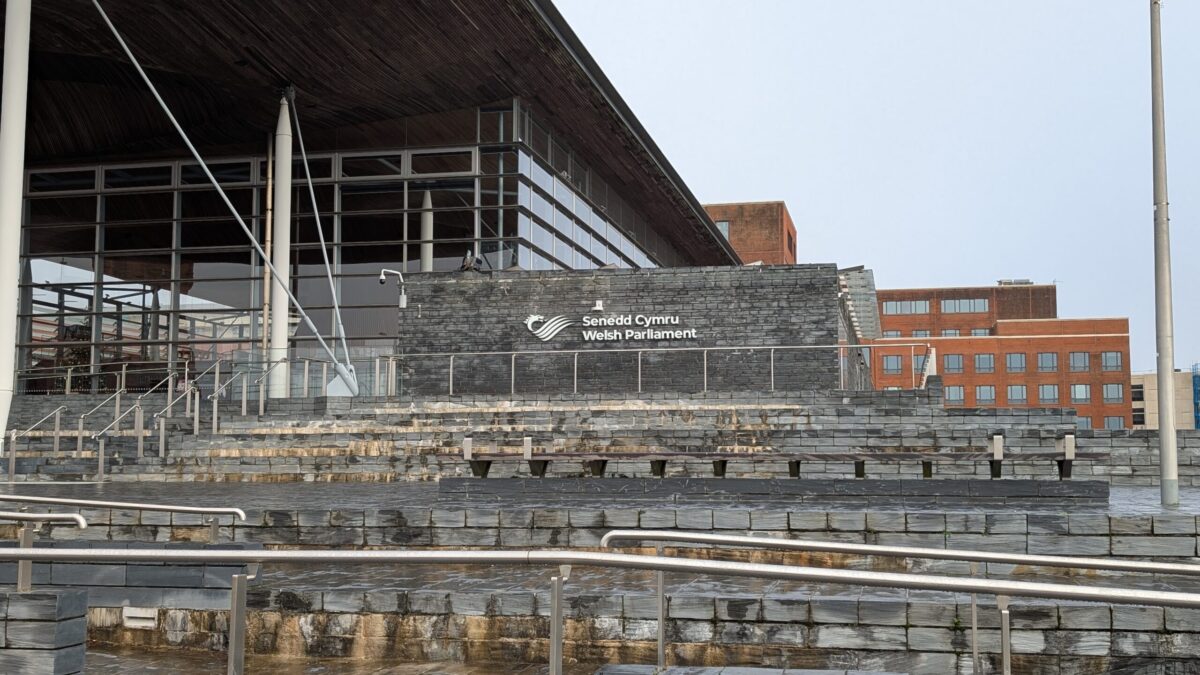
What an eyesore it looks…Desolation Bay…
You’re right. Looks like a livestock auction market. The architect should be ashamed. Worse still, who passed the plans? Compare it to Scotland and Northern Ireland.
Someone needs to get scrubbing with a slate efflorescence and limescale remover.
Perhaps we should not criticise too much or they may want to spend tens of millions of pounds for just jet washing it. Maybe much much more after they pay their lawyers, advisers and friends just to get the job done.
Those professionals who always get paid their ten percent regardless of a brick being laid right after the ‘Batman’ puts his bill in you mean. That is how it works in Cymru, we must all have a serious chat about this phenomenon one day…
The whole deal should move to Griffiths Crossing on the site of the old Ferodo Baggins brake factory overlooking the Menai in sight of Rhun’s island home…
I thank the above for their honesty, this the first time, I went there about 25 years ago, a wet sunday if it had not been for the Norwegian church bright and cheerful, its colour the warmth of a rusty red barn roof in summer, the welcome so warm, happy families galore while outside on the waterfront it screamed a silent nordic seagull cry of concrete desolation…
No change no hope, move from the cursed place…
We celebrate all the wrong things Castles and Palaces…
King Coal is dead and Bristol will never see the light of an honest day…
Which replacement for Barnett do you want? There are dozens of options for a needs based formula. And by how much does it leave us better off?