

Wales Must Define Itself
Ben Wildsmith
The arrival of a Plaid-led government was always going to provoke debates that reach deeper than the paddling pool confines of devolved government.
Handing responsibility to a party that operates without the guard rails of London management means that the fundamentals of Cymru’s relationships with the rest of the UK and beyond must be redefined.
This task of reimagination is cultural as much as political and early signs are that it’s causing significant anguish for some.
Those disquieted by the new paradigm are having to switch positions from those which they held during the campaign. On the right, Reform and the Tories are lumbered with their number one talking point, which was that Plaid are continuity Labour.
This, for a while, seemed to have cut-through with the electorate, which is evidence of how significant Labour’s unpopularity has become in UK politics – the party can be invoked to damage others merely by association.
The supposedly cosy relationship between the two parties, however, was never authentic. It was clear for months that Labour would lose this election and that Plaid would be the destination for many of its voters.
That no Labour politicians attempted to join Plaid illustrates the very real cultural gulf between the parties.
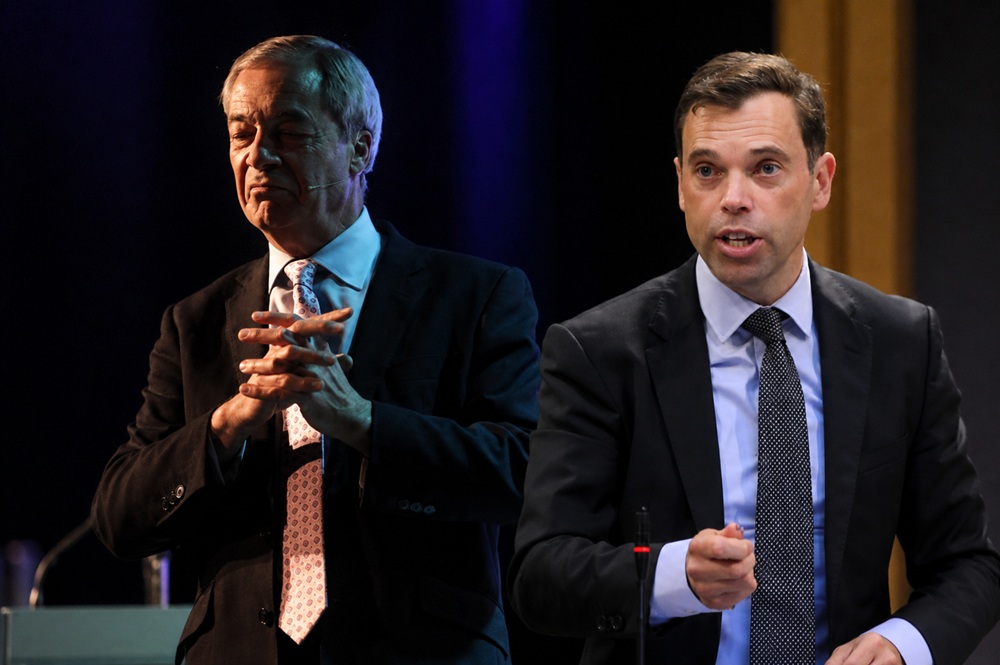
Whilst Tories can become Nigelites simply by denouncing Rishi Sunak and buying a turquoise tie, the water between Labour and Plaid is teeming with historical resentments, geographical rivalries, and substantive differences of approach.
The Welsh electorate could make that swim, protected by the world-weary scepticism that defines it, but politicians would have found themselves pleading for a bigger boat as Keir Starmer peered through binoculars from Amity Beach.
So, having spent months claiming that Plaid and Labour are the same thing, the opposition now has to find reasons why Plaid is worse than what has gone before.
This is complicated by Labour (what isn’t?) now acting as opposition in Wales for the first time.
The modern mode of politics is to oppose absolutely everything that the other side says or does. None of it can be a qualified success, and all of it must be ascribed to bad intentions.
You can feed literally anything into an Andrew RT Davies tweet generator, and it will come out as a perfectly formed trope.
‘Plaid separatists support illegals serving pizza with pineapple on it.’
Labour’s remaining Senedd cohort has been on the receiving end of this sort of thing for years, solemnly batting it back with diminishing effectiveness. Now, it must decide whether to join in or attempt to rise above.
Rising above is going to be extremely difficult for Ken Skates’ crew, given their party’s reaction in Westminster. Hang your heads, Welshies, proper Labour, the ones that sit on green benches and start wars in the Middle East are disappointed with you; very disappointed indeed.
Desperate contempt
Wes Streeting’s resignation speech, in which he drew a direct comparison between the ‘nationalism’ of Plaid and that of Reform laid bare Labour’s attitude in all its desperate contempt.
In the same way that Reform couldn’t imagine a progressive alternative to Labour that wasn’t identical to it, Labour is unable to conceive of opposition to it being anything but right wing.
Neither party can compute the existence of a political force that isn’t defined by Westminster politics.
This confusion has led to the mask slipping from Labour’s ostensibly pro-devolution representatives in the UK government. Rhun ap Iorweth’s commonplace announcement that he would be assuming responsibility for international relations prompted both Chris Bryant and Jo Stevens to order the First Minister back into his lane. Despite this arrangement being identical to that operated by Labour, it was now, apparently, evidence of vainglorious overreach.
So, two weeks in, we have the Labour Secretary of State for Wales, along with its trade minister united with Andrew RT Davies and Cllr David Thomas of Reform in falsely conflating foreign affairs with international relations to diminish the role of the Welsh Government.
This issue is both substantive and symbolic. The announcement included the ambition for Wales to be more ‘outward looking’, and it’s this, I suggest, that has provoked unionist ire.
Now that nobody in the government is looking east for party funds, career opportunities, or disciplinary censure, it is free to explore opportunities for Wales from any direction, to act, in other words, as a nation.
‘Too poor’
Wales is, you’ll have heard, ‘too poor’ to survive without Westminster largesse. How curious, then, that those responsible for that state of affairs should object to the Welsh government exploring other sources of investment.
On the heels of breathless consternation to the cabinet holding a meeting in Cymraeg, this row exposes the true Faultline in Welsh politics. Plaid is not continuity Labour. Nor, as Wes Streeting suggests, is its politics comparable to the insular jingoism of Reform. As far as Welsh issues are concerned, it is Labour and Reform who have emerged as bedfellows.
Plaid’s task is difficult, but simple. It is free to govern for Wales, and Wales alone, in a way that its predecessors were not.
As its opposition funnels themselves into an anti-devolutionary alliance of Anglocentrism, the government must empower Wales to define itself, both within these islands and globally.
Support our Nation today
For the price of a cup of coffee a month you can help us create an independent, not-for-profit, national news service for the people of Wales, by the people of Wales.
Get more trusted Welsh news
Choose Nation.Cymru as a preferred source in Google News to see more of our journalism.



Fabulous observations which give rise to hope despite all other members, bar two Greens, being ranged against those in Plaid Cymru and the interests of our people in their ‘STOP WALES’ coalition.
This is a good article.
An articulate analysis.
Well said Ben. Scratch a Reform surface and find a Labour/Tory/Lib Dem Anglo-Nationalist
In the end the truth will out.
Wales will never truly flourish while its best interest’s are diluted by the opinions of the unionist parties.
The lack of courage, framing us as a poor and weak as a nation is shameful, and the truth is we have never been given the opportunity to show what is possible.
Colonialism still exists in Westminster and Cymru is it’s last stance. Cymru was the first country of empire and it will be the last. The system in Westminster is corrupt, archaic and increasingly obsolete. It’s the creation of the British establishment that itself is coming to an end with the breakup of the UK.
Yes, we need more talking, more focus groups, more planning, more meetings, more diagrams, more roadmaps, more flipcharts, more three year plans, more five year plans, more holistic synergies, more frameworks etc. No, we need doing. If Rhun isn’t stamping his feet and knocking down the door of #10 and Buck House about Barnet, HS2 and the Crown Estate by the end of June then it will send a strong signal – that his tenure will simply be more of the same, more of absolutely nothing.
All anyone needs to know about Sir Chris Bryant’s attitude towards Cymru
https://x.com/owainrhyslewis/status/1306190788670431232