


Wales standing with Ukraine won’t be forgotten
Yuliia Bond
For some people, the Ukrainian flag outside the Senedd may seem like a small thing.
A symbol. A temporary political gesture. A foreign flag outside a Welsh institution.
But for thousands Ukrainians living in Wales, it has meant something much deeper than politics.
It meant safety. It meant recognition.
It meant that after losing homes, communities, loved ones and certainty, we arrived in a country that looked us in the eyes and said:
“We see what is happening to you. And we stand with you.”
That is why recent discussions around whether the Ukrainian flag should continue flying outside the Senedd have mattered so deeply to so many Ukrainians in Wales.
Because for us, this was never simply about a flag. It was about whether the solidarity Wales showed in our darkest moment still stands.
And before anything else, I want to say this:
Thank you, Wales.
Wales did not just welcome Ukrainians, it stood with us
When Russia launched its full-scale invasion of Ukraine in February 2022, Wales responded with compassion.
The Senedd publicly condemned Russia’s illegal invasion.
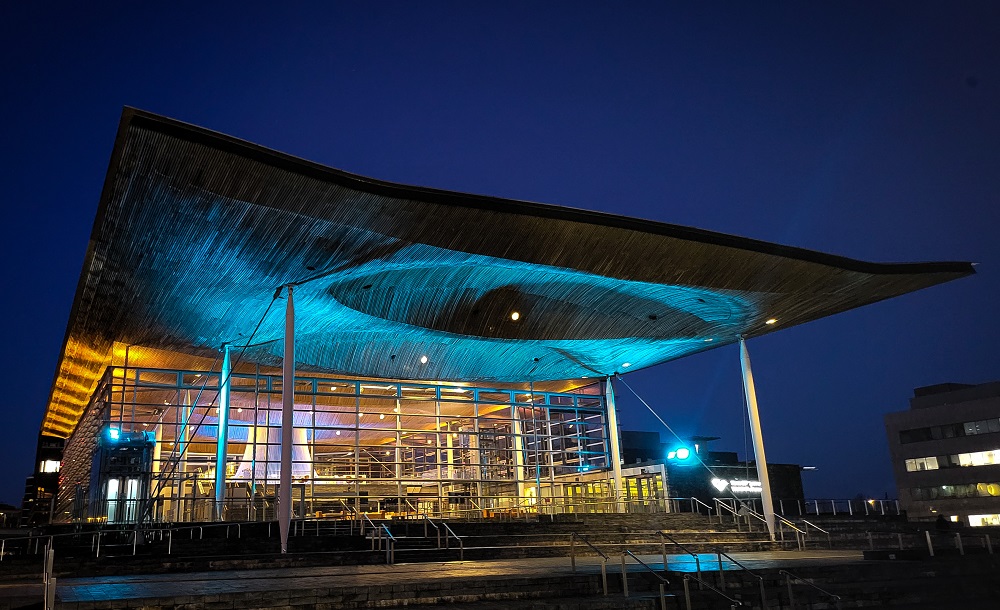
The building was lit in blue and yellow.
The Ukrainian flag was raised outside the Senedd.
Wales welcomed thousands of Ukrainians fleeing war.
The Welsh Government proudly called itself a Nation of Sanctuary.
These were not neutral acts.
They were moral choices.
They sent a message, not only to Ukrainians in Wales, but to Ukrainians across the world, that Wales understood what was happening and chose solidarity over silence.
Missile attacks
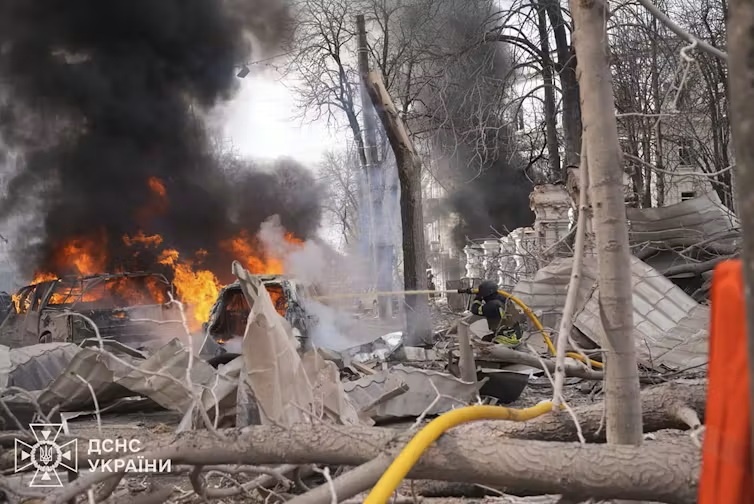
War changes how people experience symbols. When your home has been bombed, when family members remain under missile attacks, when loved ones are fighting on the frontline, public solidarity stops feeling symbolic.
It becomes emotional survival.
Many Ukrainians in Wales are living with trauma, uncertainty and grief. For some, the Ukrainian flag outside the Senedd became a visible reassurance that the country helping us rebuild our lives had not forgotten us.
That is why this conversation matters. Not because of politics. Because of people.
Why I contacted political parties
In recent days, I reached out to political representatives across Wales regarding discussions around the Ukrainian flag outside the Senedd.
The purpose was not political point-scoring. The purpose was reassurance. Many Ukrainians were upset, worried and confused. People wanted to know: Does Wales still stand with us?
And so I asked parties and politicians directly. Not to create division. But to seek visible, cross-party reassurance for a community already carrying enormous emotional weight.
And I want to sincerely thank every person who took the time to respond.
Cross-party support matters
At a time when politics often feels divided, one thing has genuinely moved me: support for Ukraine has come from across political lines. That matters.
Because Ukraine should never become a party-political issue.
This is not a “left” issue.
It is not a “right” issue.
It is a human issue.
It is about democracy, sovereignty, human dignity and opposing the invasion of one country by another.
Plaid Cymru
I would like to thank Plaid Cymru, particularly Lindsay Whittle, for publicly supporting the continued flying of the Ukrainian flag outside the Senedd.
Lindsay stated publicly that calls to remove the flag were out of touch with the overwhelming majority of Welsh people and reaffirmed solidarity with Ukraine. That public support mattered deeply to many Ukrainians.
Welsh Conservatives
I also want to thank the Welsh Conservatives and Darren Millar, who publicly stated their support for the Ukrainian flag continuing to fly outside the Senedd as a visible sign of solidarity with Ukraine and opposition to Russia’s illegal invasion.
Again, that clarity matters. Because when people are scared, uncertain or traumatised, silence feels louder.
Wales Green Party
I am deeply grateful to Anthony Slaughter, Wales Green Party leader and the Green Party of England and Wales, who quickly and publicly expressed support for the Ukrainian flag remaining outside the Senedd.
Anthony described the flag as a symbol of kindness and and solidarity with Ukrainians suffering under Russian aggression and with those welcomed to Wales through the Nation of Sanctuary scheme, while rejecting calls for its removal.
That response was thoughtful, compassionate and reassuring.
Welsh Labour
I also contacted Welsh Labour.
In correspondence, Ken Skates MS told me clearly that Welsh Labour “absolutely supports flying the Ukrainian flag” and that he would raise the issue with the Llywydd.
That was warmly welcomed. It matters.
Welsh Labour has also consistently supported Ukraine publicly since 2022, including through motions condemning Russia’s invasion and through the Welsh Government’s support for Ukrainians arriving in Wales.
I hope this support will also continue to be visible publicly, because visible solidarity matters.
Welsh Liberal Democrats.
I also reached out to Jane Dodds and the Welsh Liberal Democrats with the hope that all Welsh parties can stand together visibly in support of Ukrainians in Wales.
They have now also publicly reaffirmed their support for Ukraine and for the Ukrainian flag remaining outside the Senedd. In a statement shared with me, they said they “stand firmly with Ukraine”, continue to condemn Russia’s illegal invasion, and believe the flag should remain as a visible reminder that Wales stands with Ukraine and with those who sought safety here.
That support matters deeply.
Reform UK and why its position worries many Ukrainians.
I also contacted Dan Thomas and Cai Parry-Jones MS from Reform UK Wales, asking whether they would publicly reassure the Ukrainian community and support the continued symbolism of solidarity represented by the Ukrainian flag outside the Senedd. At the time of writing, I had not received a response.
I want to be fair and factual here. Reform UK Wales has not explicitly targeted Ukrainians.
However, many Ukrainians in Wales have understandably felt unsettled by recent comments and policy positions, and I think it is important to explain why openly and honestly.
Recently, Reform representatives criticised the Ukrainian flag flying outside the Senedd, with it being described as “virtue signalling”.
Separately, Reform Wales has proposed ending the Welsh Government’s Nation of Sanctuary scheme. It is important to be accurate here.
Reform does not explicitly mention Ukrainians in that section of policy.
But this is where many Ukrainians feel uneasy because Nation of Sanctuary is not an immigration system. Immigration decisions are made by Westminster. Wales does not decide who enters the UK. Nation of Sanctuary is about how people already here are treated once they arrive in Wales.
It is about support, dignity, integration, language support, employment support, safety, humanity.
And yes, it includes Ukrainians who fled war. This matters because Senedd Research has noted that approximately 91% of Nation of Sanctuary funding between 2019 and 2025 supported Ukrainians arriving in Wales following Russia’s full scale invasion.
To put it simply:
Reform says: “We are not talking about Ukrainians.”
Ukrainians hear: “But you are talking about the systems that helped us rebuild our lives.”
Or in the more humorous version many Ukrainians quietly joke about:
Reform: “We are not talking about Ukrainians.”
Also Reform: “ We are scrapping the policy that supported many Ukrainians in Wales.”
Ukrainians: “We can read.”
Humour matters. Especially when life has been very hard.
But beneath the humour is something real: fear. Because refugees are not slogans. They are people. And this concern does not exist in isolation.
Across parts of the UK, there have already been debates and real actions involving Reform politicians seeking to remove/ removing Ukrainian flags from public buildings. Ukrainians notice these things.
We notice patterns. We notice when visible solidarity starts becoming controversial. And timing matters. Because the war is not over. In many ways it is escalating.
Ukraine continues to face missile attacks, drone attacks and civilian deaths. Families remain separated. Children continued to grow up hearing air raid sirens. Entire communities still live under daily uncertainty.
This remains the largest and most devastating ongoing war in Europe. Ukraine is not simply defending itself. Ukraine is defending the idea that borders cannot be changed through violence. That larger countries cannot simply erase smaller ones.
That democracy matters. That sovereignty matters. That nations have the right to decide their own future.
In many ways, Ukraine is defending the wider European security order. Because if aggression succeeds without consequence, it reshapes what becomes acceptable across Europe.
That is why symbols matter.
The Ukrainian flag outside the Senedd is not decoration.
It is not fashion.
It is not empty symbolism.
And for many Ukrainians it is certainly not “virtue signalling”.
It is a visible statement that Wales understands the difference between aggressor and victim.
Between invasion and resistance. Between democracy and authoritarianism. Between truth and propaganda.
The United Kingdom also carries a particular historical responsibility. In 1994, Ukraine gave up the world’s third largest nuclear arsenal under the Budapest Memorandum, receiving security assurances from the UK, United States and others in return.
Ukraine chose disarmament.
Ukraine trusted international agreements. Ukraine believed its sovereignty would be protected. For many Ukrainians that history matters deeply.
It is one reason visible solidarity from UK institutions feels so meaningful. It says: We remember. We understand what was promised. We recognise that Ukraine’s security is connected to Europe’s security.
There is also a practical question here. For many Ukrainians, parts of this political debate feel deeply disproportionate.
The Nation of Sanctuary budget represents approximately 0.05% of the overall Welsh Government budget.
In other words: An incredibly small amount of spending, much of which has supported Ukrainians fleeing Europe’s most devastating war since the Second World War.
This is why some Ukrainians quietly struggle to understand the political framing.
Cutting refugee support
Sometimes it can feel as though major structural challenges, housing shortages, pressure on services, inequality are being presented as if they could somehow be solved through cutting refugee support.
As though rebuilding housing or public services could be achieved by removing one of the smallest spending lines in Welsh public life.
One Ukrainian recently joked to me: “It feels a bit like promising to buy a house by cancelling your Netflix subscription.”
The humour works because the point underneath is serious.
Wales faces real problems.
Housing pressures are real.
Public services are stretched.
People feel economically anxious.
Those concerns deserve serious political answers. But Ukrainians did not create those problems.
Most Ukrainians in Wales are simply trying to rebuild life after war, work, contribute, volunteer, support communities, raise children safely and give back to the country that welcomed them.
And Wales has welcomed us.
That is why this conversation matters emotionally.
Across Europe, Ukrainian flags still fly outside parliaments, councils, embassies and civic institutions because European democracies understand something important.
This war did not end.
Ukraine still needs solidarity.
So naturally, many Ukrainians ask:
Why should Wales be the place that takes it down?
What message would that send?
To Ukrainians, it could feel like:
Your suffering is becoming politically inconvenient.
To Russia, it risks suggesting:
European solidarity can be slowly worn down.
To Ukrainian soldiers defending Europe, it may feel like: Even symbolic support is now negotiable. And to the world, it risks suggesting that Wales is stepping back from a moral position it proudly took in 2022.
I do not believe that reflects Wales. The Wales I know opened homes. The Wales I know welcomed Ukrainian children into schools. The Wales I know stood beside people fleeing bombs. The Wales I know called itself a Nation of Sanctuary And the Wales I know understands that compassion is not weakness. It is strength.
That is why so many Ukrainians are asking for something simple: Clear, public, cross-party support.
Not because a flag stops missiles. But because symbols shape belonging. Symbols shape morale. Symbols tell traumatised people whether they are forgotten.
I personally have seen extraordinary kindness in Wales, and extraordinary efforts by Ukrainians to give back to the communities that welcome them.
This matters because sanctuary works best when it becomes relationship, not charity. And Wales has built many of those relationships beautifully.
Wales and Ukraine: deeper connections than people realise.
Support for Ukraine in Wales is not random.
There are real historical connections between our nations. One of the strongest is Gareth Jones, the Welsh journalist who courageously exposed the Holodomor, Stalin’s man made famine in Ukraine, to the world.
At great personal risk. Gareth Jones told the truth when many preferred silence. For Ukrainians, he remains a figure of enormous respect.
Today, Kyiv honours Gareth Jones. A memorial is being created. A street bears his name.
That history matters. Because once again, Ukraine faces attempts to erase truth.
And once again Wales has chosen solidarity.
There are also growing civic links between Wales and Ukraine, including twinning initiatives, educational partnerships and growing relationships between Welsh and Ukrainian communities.
These are not distant connections anymore. They are human ones.
Why Wales understands Ukraine
There is another reason this resonates so strongly here. Wales understands something deeply important: the right of a nation to determine its own future.
This is not exactly the same as debates about Welsh independence. But many Welsh people instinctively understand why self-determination matters. The right to language. Identity. Democratic voice. Political choice.
Ukraine did not threaten Russia. Ukraine simply chose independence. And for that, it was invaded.
Many people in Wales recognise something emotionally familiar in that struggle.
One person recently said something powerful to me: Many British people understand Ukraine through their own family histories, histories of migration, persecution, displacement, war and struggles for identity.
That empathy matters. And I believe it is one reason why support for Ukraine across the UK remains strong.
We noticed who stood with us.
Wars are remembered through statistics.
How many missiles.
How many deaths.
How many people displaced.
But human beings remember something else too.
They remember who stood beside them.
Who called.
Who answered.
Who stayed silent.
Who made them feel welcome when everything familiar had disappeared.
In Wales, Ukrainians noticed.
We noticed the families who opened homes.
The teachers who welcomed frightened children into classrooms.
The neighbours who helped people navigate a new country while carrying grief.
The volunteers, councils, charities, churches, schools and communities who quietly chose kindness.
And yes, we noticed the politicians and parties who stood publicly with Ukraine when reassurance mattered.
At moments of uncertainty. people remember who gave them dignity.
For many Ukrainians in Wales, support was never abstract. It meant sleeping safely. Children laughing again. Finding work. Learning English.
Beginning to believe that life could still hold something good after loss.
That is why this conversation about the Ukrainian flag matters emotionally. Not because symbols win wars. But because symbols tell people whether they are forgotten. And Wales never made us feel forgotten.
The war continues. Families remain separated. People are still dying. Ukraine is still fighting for its survival, for democracy, and for the right to exist freely.
But one day this war will end.
And when Ukrainians tell the story of who stood beside them in the darkest years, Wales deserves to be part of that story.
Because Wales did not look away.
Wales welcomed us.
Wales stood with us.
And whatever decisions are made in future, one thing should be said clearly:
Wales standing with Ukraine will not be forgotten.
Yuliia Bond is a refugee from Ukraine. She has lived in Caerphilly since 2022.
Support our Nation today
For the price of a cup of coffee a month you can help us create an independent, not-for-profit, national news service for the people of Wales, by the people of Wales.
Get more trusted Welsh news
Choose Nation.Cymru as a preferred source in Google News to see more of our journalism.



Powerful writing. The Ukrainian people’s ongoing struggle for survival against their oppressive and genocidal neighbour must not be forgotten.
Reform should make their views clear about supporting the people of Ukraine.Having the Ukrainian flag flying from public buildins is NOT a financial burden but a show of support for a country that was invaded illegally by Russia.
You have to understand that there aren’t many Welsh Reform supporters. The majority of their support in Cymru ironically comes from “immigrants”.
They’ve come into our country while complaining about outsiders then decided that they want to change our culture and completely remove our democracy…..you genuinely couldn’t write it.
Ukrainian people have come into our country, they’ve become part of the beating heart of our communities, they’ve learnt our language and earnt our admiration and respect.
Your solidarity with Cymru will never be forgotten.
Thank you Yuliia. This is a very balanced article and shows a good understanding of Welsh attitudes. It is an emotional read. When we say that people living here are/can choose to be Welsh we mean it. We reach out, we don’t build walls and look inwards and backwards. You are Ukrainian but perhaps you begin to feel a little bit Welsh as well? There’s nothing forced, It’s your choice. I look forward to the day when the Ukrainian flag will not need to be flown outside our Senedd. But that day won’t come until #Ukraine is free again and… Read more »
Yuliia, to Wales you will always be much more than a refugee. A voice that Wales needs more than ever today.
Slava Ukraini.
Thank You for a very powerful and emotional statement, your integrity shines through. May your flag fly outside the Senedd for however long it takes and may you and everyone else in your situation be welcome forever.
Thank you once again.
We would rather a thousand Ukrainian refugees than one Reform supporter.
Thanks to your people for showing our country respect and learning the language, nothing shows more appreciation.