


Walking a Desiccated Land
Ken Moon, Chair, Tir Pontypridd
I’ve been promising my son a walk up Pen y Fan since the spring, so yesterday evening I set aside feeling unwell for a couple of hours and headed up the Taf Fechan to the Blaenyglyn Forestry carpark to walk up Craigyfanddu towards Pen y Fan.
On the map this seems like an achievable destination, a short steep climb at the outset and a leisurely stroll along the ridge. Easy. My mistake lay in an assumption that the Blaenyglyn carpark is at a much higher elevation than the more popular Story Arms.
It is higher, but only by 4ft!
The short steep climb up Craigyfanddu gains elevation over a much shorter distance than the more popular route up to Pen y Fan. Whoops! Rowan bounded on ahead of me like the fit young person that he is, while I struggled on way behind, like a blown horse.
Once up y Craig we met a small group of young lads who’d set-up camp for the night. One didn’t own a tent and had made a bivouac out of a piece of tarp in a small dip, which looked excellent. Setting off across y Craig I started to notice the state of the bog.
I’ve been walking up Pen y Fan since childhood and I’ve long been conscious of the efforts the park authority have made over the years to reduce path erosion caused by the many visitors. And in recent decades we’ve all heard of the efforts to restore peat bogs.
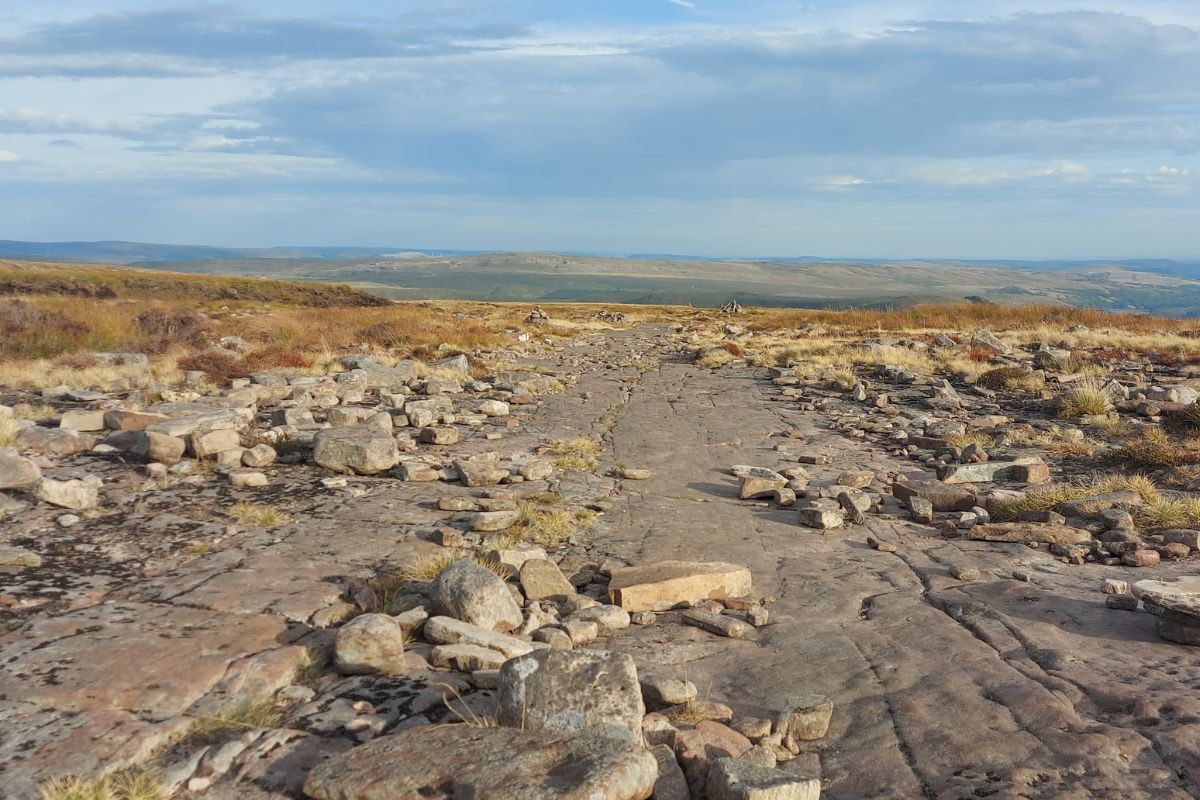
I’ve never witnessed an almost total collapse of upland peat bogs before yesterday. At first I thought I was seeing where peat has historically been cut for fuel. But as I looked more closely it dawned on me that these bogs have completely desiccated.
Even in the height of summer the ground we were walking on would normally have been soft and spongy underfoot, oozing moisture as we walked. Not now. In the distance towards Abergavenny we could see a huge grass fire sending up a giant smoke plume.
The Llangynidr moorland burning.
From Craigyfanddu we followed the ‘Beacons Way’ across Gwaun Cerrig Llwydion. This is where a basic understanding of Cymraeg can help us understand our landscape, the impacts of climate change, and the links to increasingly frequent upland fires better.
The name Gwaun implies a damp, boggy, place and our uplands are well endowed with names that basically mean that they’re usually wet underfoot. Towards the huge fire raging across the Banau are Gwaun Nant Ddu & Gwaun Danydarren.
Such damp places aren’t supposed to dry out to the extent they have. Even when flammable vegetation like heather is dry, wet places are not supposed to burn in the way they now do. Despite remediation efforts the Gwaun Carrig Llwydian is damp no longer.
In places the extent of peat collapse in our uplands is starkly evident. Not far from the bedrock path we were walking along are areas of exposed ‘bog cliff’. These stand the height of a person. Unless we act swiftly our desiccated uplands may burn and wash away to bedrock too.
Still, at least they’ll be less flammable.
Many look to the point of ignition for the cause of this years more frequent, more intense upland fires. Blame is laid upon those who set off fire works, light a disposable BBQ, a camp fire. In hot weather discarded litter or the exhaust of a vehicle can start an upland fire. But none are responsible for desiccated uplands.
Our overstretched firefighters know the cause of these fires: “Anyone who thinks we still have time to ease ourselves into the realities of climate change should spend a shift with a firefighter”, said Steve Wright, general secretary of the FBU in the Observer.
Living in a society that remains dependent on the burning of fossil fuels makes us all fire starters.
Having crossed the Gwaun we sat at the edge of Craig Cwareli for a rest before concluding that an hour out was far enough for one evening. Having enjoyed the views towards Brecon we retraced our steps back along the ‘Beacons Way’, my son bounding ahead.
We stopped for chips in the Red Cow, Pontsticill, which were delicious, before heading home. As I write this, our planet is still warming, the UK’s fifth heat wave of the year is gradually building, and the Llangennidar moorland still burning. We must change.
More information on Tir Pontypridd and their work is available here.
Support our Nation today
For the price of a cup of coffee a month you can help us create an independent, not-for-profit, national news service for the people of Wales, by the people of Wales.
Get more trusted Welsh news
Choose Nation.Cymru as a preferred source in Google News to see more of our journalism.



If you look around you, notice Gwaun Carrig Llwydian drains into Talybont reservoir. Data shows that this body of water actually above normal levels this year compared to previous years, despite the drought declaration. The profile over the years can be seen here. https://dahiti.dgfi.tum.de/en/41657/water-level-altimetry/ Satellite Altimetry. So it is not a death of water and rainfall at play but a change to a more ‘peaky’ rain cycle. This year has been a wetter spring and dryer summer. This obviously has implications for flammability at any given point in time, but a more logical explanation for footpath erosion through the bog… Read more »