

If ever an English place name needs binning it’s ‘Waterfall Country’
Stephen Price
Once upon a time, in a land far far away (Blaenau Gwent), I took my first tentative steps into the horrifying working world with real grown ups with strange job titles, even stranger job descriptions and much too much time on their hands.
Lunch times were spent seated around a large table where everyone had to endure the hierarchical chatter – family nonsense, sexploits and the like, while a term kept being repeated again and again by one of the older staff members – namely ‘up country’.
Every few days we’d hear about so and so from ‘up country’, a drive ‘up country’, or someone who’d moved to the area from ‘up country’ and since none of us got a word in at the table, I never really got the chance to ask: “Whut?”
Alas, I’m still scratching my head.
I think it meant England to her, but maybe more of a left off the M4 rather than carrying on, but Cambridge dictionary tells me it means: “in the direction of or relating to the parts of a country further from the coast, especially where there are few towns and people.”
They give the examples: “We’ll travel up-country by horse tomorrow” and “Some people find up-country customs strange.”
Indeed they do. But thankfully, the term never rears its head in any official capacity or on any media outlet I digest, so I can almost let it go. Almost.
One term that has me scratching my head and rolling my eyes in equal measure though, is ‘Waterfall Country’.
Firstly, again, “Whut?”
I grew up in what was the Brecon Beacons, now the Bannau Brycheiniog National Park, and believe me, I live and lived near some spectacular waterfalls, as many of us do across Wales (Wales being a country), but these somehow aren’t part of ‘Waterfall Country’.
I’ve yet to admit it in writing, but I’m actually rather fond of the term ‘Brecon Beacons’ – I grew up with it, I used it regularly, I even named a small business of mine after it, but when the official name went the way of our beautiful native language, I adapted with it, and I’ve championed it ever since.
Easy peasy!
‘Waterfall country’ I’ve never had such affection for, though.
Who came up with it? What is the logic? And has anyone in the whole of Wales ever used it?
So-Called By Who?
Earlier this month, I had the honour of plonking in a news item about ‘Waterfall Country’ from the local democracy service, and before I could hit publish, I had to make a little tweak, altering its name to ‘so-called Waterfall Country’ instead – perhaps subconsciously influenced by so-called Islamic State.
The piece reads: “Plans to extend a car park and build a toilet block for visitors in so-called ‘Waterfall Country’ have been approved.
“At a meeting of Bannau Brycheiniog National Park Authority (BBNPA) Planning Committee on Tuesday, September 8, members received plans by Natural Resources Wales (NRW) to redevelop and extend the existing car park at Gwaun Hepste, Four Waterfalls Car Park, near Ystradfellte.”
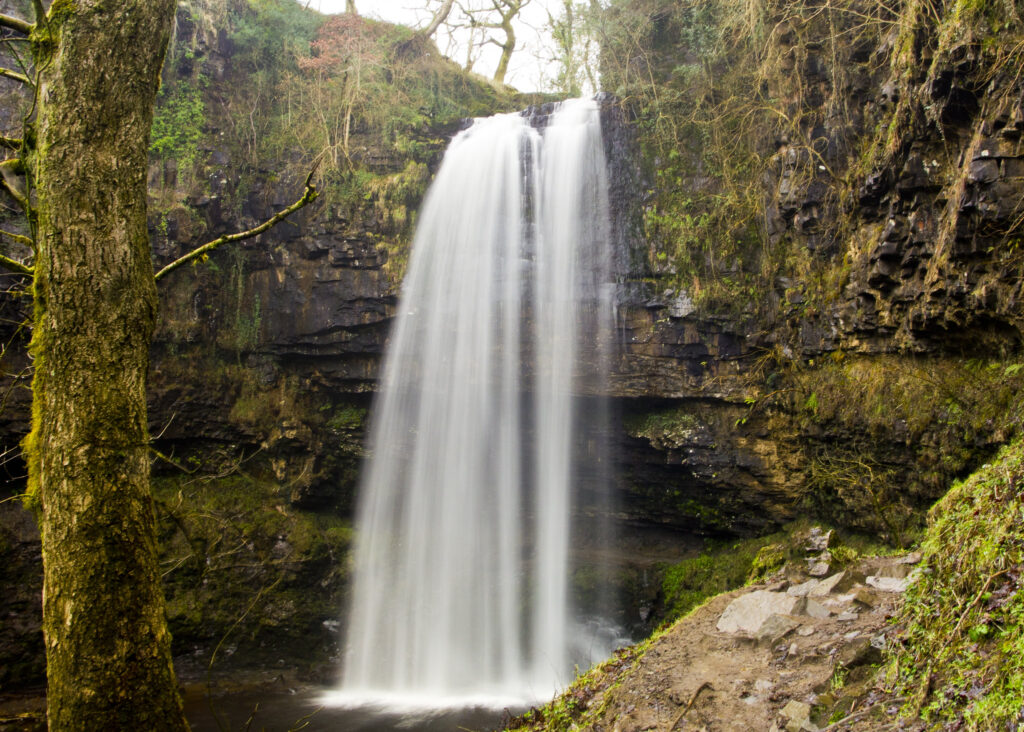
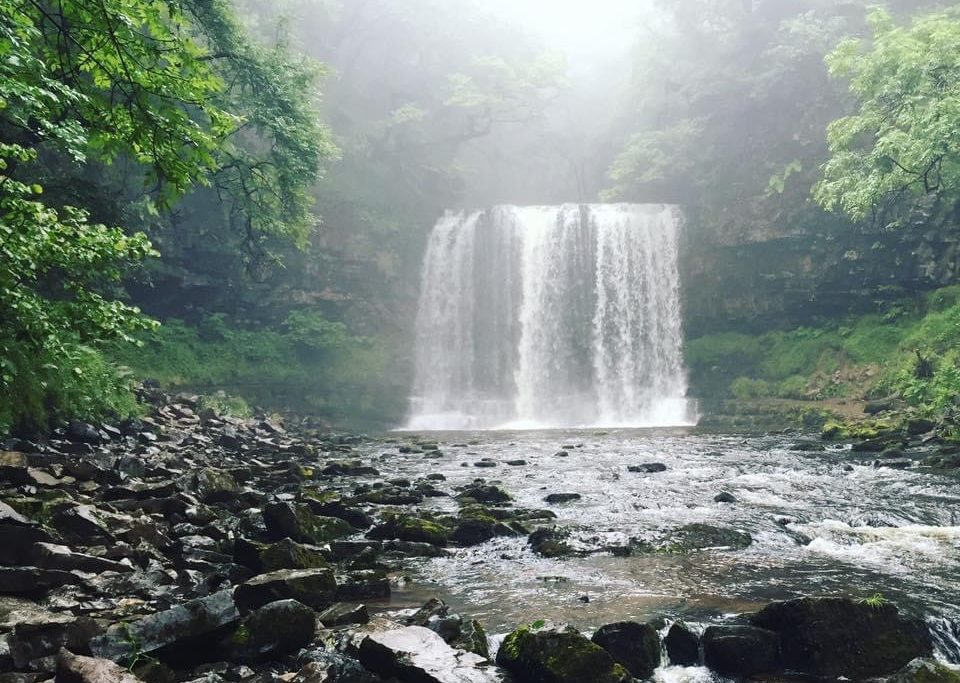
Waterfall Country (or sometimes Waterfalls Country *ych*) does in fact have a Welsh equivalent which is ‘Bro’r Sgydau’, with ‘Bro’ meaning ‘area, region or locality’ and Sgydau, the plural form of the masculine noun sgwd, a word for “waterfall”.
The Welsh term is logical and appropriate, while the English one – a country? Really?
Both terms, however, are given to the upper reaches of the Vale of Neath. The tourist area around the head of the valley has an unusually large number of publicly accessible waterfalls. The area is not officially defined but generally includes the group of falls on the Nedd Fechan, Pyrddin, Hepste and Mellte rivers, all of which lie between the villages of Pontneddfechan and Ystradfellte in the Bannau Brycheiniog National Park.
Each of these falls lies within or on the boundary of the county of Powys. A few miles further west are Henrhyd Falls on the Nant Llech, a tributary of the Tawe and to the south-west are Melin Court Falls on the Melin Court Brook, a tributary of the River Neath. These, along with Aberdulais Falls on the Dulais, a further tributary of the Neath are also encompassed by the term ‘Waterfall/s Country’ by some writers.
Collectively the falls are one of the more popular natural attractions in south Wales, which has caused problems of erosion in the vicinity of many of the falls. Most occupy locations designated as sites of special scientific interest and as special areas of conservation which aim to protect the biodiversity and geodiversity of these sites.
Status
So who’s calling it ‘Waterfall Country’?
Well, pretty much all of our councils and tourist boards. It even has its own website. And, of course, visitors from across the world (and mostly England) who can’t be blamed for thinking it’s perhaps something we’re in on too.
The biggest surprise for me, however, is Bannau Brycheiniog National Park lapping it up and running with it.
They share: “Located right on the south-westerly edge of the National Park this area is truly one of the splendours of Wild Wales and amongst the most beautiful and popular parts of the National Park. Here the rivers Mellte, Hepste, Pyrddin and Nedd-fechan wind their way down deep, tree-lined gorges, over a series of dramatic waterfalls, before joining to form the River Neath.”
This, from the organisation that stopped using the term ‘Brecon Beacons’ out of cultural sensitivity to the Welsh language and also as it referenced carbon-emitting beacons which ‘no longer fits the ethos of the park’.
Catherine Mealing-Jones, the park’s CEO, told the PA news agency: “Given that we’re trying to provide leadership on decarbonisation, a giant burning brazier is not a good look.
“Our park is is shaped by Welsh people, Welsh culture, and as we looked into it we realised the brand we’ve got and the name we’ve got, it’s a bit of a nonsense, it doesn’t really make any sense – the translation Brecon Beacons doesn’t really mean anything in Welsh.”
Meanwhile, however, Waterfall country doesn’t mean anything logical in English.
Mealing-Jones added at the time of the ‘Beacons’ name-drop: “We’d always had the name Bannau Brycheiniog as the Welsh translation and we just felt we needed to put that front and centre as an expression about the new way we wanted to be celebrating Welsh people, Welsh culture, Welsh food, Welsh farming – all of the things that need to come with us as we go through this change in the management plan.”
Michael Sheen then featured in a moving short film to launch the name switch from Brecon Beacons National Park to Bannau Brycheiniog – describing it as “a name from our past, to take us into our future.”
The short film entitled ‘Cynefin’ was written by Welsh novelist, poet and playwright Owen Sheers, and begins with breathtaking shots of the park’s rivers, woodland and mountain walks as Sheen wanders through the rugged landscape.
Precedent
I’m a lover of a rule, me.
And in the National Park’s switch to Wales’ native, beloved language, a precedent has been set.
With only a few exceptions, Wales doesn’t need two names for one place. And Wales certainly doesn’t need to advertise itself as having a reductive, imposed and baffling non-descript area named by outsiders for outsiders.
It’s not a country. And the country it’s in has its own, more appropriate, native name.
Sheers, Sheen and Mealing-Jones have got a new video to work on. And it can’t come soon enough.
Support our Nation today
For the price of a cup of coffee a month you can help us create an independent, not-for-profit, national news service for the people of Wales, by the people of Wales.
Get more trusted Welsh news
Choose Nation.Cymru as a preferred source in Google News to see more of our journalism.



This is an example of a word in one language not mapping onto the same word in another. Country in English has about 7 meanings depending on concept. Sovereign state is only one of them. Welsh is now so heavily influenced by English that its idioms snd expressions are under threat as are the specific meanings of words. One of my favourite is the ridiculous literal translation of Tredegar House as “Ty Tredegar”. It ought to be Neuadd or Plas. I favour Plas. Anyway if the English is Waterfall Country it could be Waterfall District instead…
I prefer Waterfall Country and Ty Tredegar. I am also quite fond of countryside.
Gwych! Excellent article from Stephen Price. A great champion of bring normality to Welsh life.
I’d like people not from Wales to stop talking about “the Brecons”. There’s only one Brecon; there are lots of Beacons. Don’t suppose even the official adoption of “Bannau Brycheiniog” will stop them. And if anyone with influence from NRW is reading this could they please put a correct sign on the entrance to the forest on top of Trichrug/Trychrug in Ceredigion (“Trychrug” is a common spelling even amongst speakers of Cymraeg)? They have labelled it “Tychrug” and it’s becoming the norm. Even Dyfed/Powys Police used it in a recent traffic an announcement and it was faithfully echoed by “Tivyside… Read more »
Or embrace and expand the term to cover the whole of Wales, encouraging visitors to turn day trips into extended visits touring more of the nation.
Waterfall Country is an awful name and I agree a Welsh name should be used. The only issue I see with Bro’r Sgydiau is English speakers saying “BUT I THOUGHT THAT WAS SHOES?!?!”
100%! Cant stand it.
I think it is lovely.
I find the term “Waterfall Country” is referenced by those too lazy to pronounce their original names in Cymraeg.
Nice article. I must say I expected an anti English rant of which there seems to be no shortage but I find myself in total agreement. I love this neck of the woods but first time I went as a member of Bettws youth club camping by the natural pool, that was in the 60s when we called it Ystredfellte. Been back many times but sadly not for the last decade or so.