

We don’t need ethno-nationalism to succeed as a nation
Martin Shipton
It’s no surprise that one of the consequences of stirring up racially based grievances is a rise in ethno-nationalism.
There’s polling evidence to show that’s been happening, and while the number of people polled in Wales as part of a Britain-wide survey is too small to be definitively relied upon, what figures there are suggest that attitudes in Wales are not significantly different from those in Britain as a whole.
For those unfamiliar with the jargon, ethno-nationalism is a form of nationalism that defines a nation by ethnicity, emphasising shared ancestry, culture, language, and faith as core to identity, often leading to the belief that a state should serve only that specific ethnic group.
It contrasts with civic nationalism (based on citizenship) and can manifest as movements for autonomy, unification, or dominance, sometimes marginalising or excluding other groups, and is linked to nativism and the radical right due to its ethnocentric, exclusionary nature.
Polling carried out in December 2025 by YouGov for the IPPR think tank indicates that while ethno-nationalism is increasing in Britain, the majority continues to prefer civic nationalism.
Those surveyed were asked to decide between two options: “It is possible to become truly British if a person makes an effort” or “A person has to be born British to be truly British”. Option A was chosen by 51% with Option B chosen by 36%, and the rest saying they were unable to choose. Two years before, just 19% backed Option B.
Supporters of Reform UK were more firmly in the ethno-nationalist camp than those of any other party, with 71% of them saying that having British ancestry was a prerequisite for someone to be truly British, and 59% saying they believed the nation was an ethnic, not a civic, community.
Other findings showed that 37% of Reform UK voters said they would be prouder of Britain if there were fewer people from minority ethnic backgrounds in a decade’s time, and 10% said it was important to have white skin to be a good British citizen
The Guardian stated: “The results are evidence that hard-right narratives are having some success in remoulding the public’s conception of national identity; overall, though, popular opinion still supports a progressive vision of Britishness based on shared values, not ethnicity or ancestry.”
‘Nationalist’
Over the 100 years of its existence, Plaid Cymru has been criticised as a “nationalist” party by people who fail to distinguish between ethno-nationalism and civic nationalism.
For as long as I have taken an interest in politics, I have heard Plaid Cymru politicians make the point that anybody who makes their home in Wales and is committed to helping make Wales a successful country should be able to consider themselves Welsh.
This is civic nationalism. It is a world apart from the tub-thumping, imperial nostalgia indulged in by those who insist on being photographed next to a Union Jack or two. They are impotent fools whose racism led us to leave the most successful trading bloc in the world and who want to install a mini-Trump in Downing Street in three years’ time.
As we approach the Senedd election, Reform and its social media outriders – in which category I would include the former Tory Senedd leader Andrew RT Davies – are seeking to promote ethno-nationalism by stirring up a sense of white grievance.
In recent weeks it’s been suggested that offering a grant of £5,000 to encourage people from ethnic minority backgrounds to train as teachers is in itself racism. The argument that the existing shortage of ethnic minority teachers is depriving ethnic minority pupils of role models isn’t even mentioned, let alone argued against.
A public health official questioned at a Senedd committee about healthy eating was castigated online when he suggested some thought should be given to advising ethnic minority communities about healthy variations to their customary diet.
Bullied
Women, including a Plaid Cymru candidate and the director of the Electoral Reform Society in Wales, have been bullied online for using the term “pale, male and stale” to criticise the perceived lack of sufficient diversity in the corridors of power. It is, of course, the word “pale” that is homed in on as the cause of manufactured offence.
There is no doubt in my mind that those seeking to create feelings of resentment in this way are doing so because they have no credible policies to improve people’s lives in Wales.
Mercifully, because of the wholly proportional electoral system we now have, it is unlikely that Reform will get into government – a fact they are aware of. But they are hoping to get elected to the Senedd so that they can engage in a four-year-long whinge-fest, the like of which we haven’t previously seen. It is dispiriting that rather than the kind of forensic, scrutinising opposition the Senedd needs – and which was, after all, the justification for increasing the number of MSs – we are likely to have a large rump of MSs who will constantly be engaging in tiresome culture wars.
Racial purity
The idea that racial purity in a nation is something to be applauded and emulated is absurd. There are, of course, places where the make-up of a country’s population is more homogenous than elsewhere, due to their relative isolation. But the vast majority of people who live in countries where there has been international trade and other forms of interaction for centuries will have a complex genetic make-up.
A few years ago I took a DNA test to determine my ethnic make-up. I thought its results would be simple; they were anything but. The percentages vary slightly as more matches are made through my family tree with distant relatives. The other day I received the latest update, which tells me that elements of my DNA come from these different regions: West Midlands; Northern Wales and North West England; Northwestern Germany; South Eastern England and North Western Europe; Connacht, Ireland; Denmark, Cornwall; Munster, Ireland; Donegal, Ireland; Sweden; Netherlands; Hebrides and Western Highlands.
I’m a mongrel and proud of it.
Until 30 years ago, the most readily recognisable kind of ethno-nationalists were white South Africans, the exponents of an apartheid state built on ethnic dominance. The ruling National Party during the apartheid period tried to peddle the lie that “separate development” was taking place in the interests of other races. No one was fooled into believing that the system was based on anything other than the oppression of the majority by a racial minority.
Today the most obvious ethnno-nationalist and settler-colonial country in the world is Israel, for reasons that should be all too obvious (If in doubt read the book The Ethnic Cleansing of Palestine by Ilan Pappe).
Do we want to follow their path? Surely not.
Support our Nation today
For the price of a cup of coffee a month you can help us create an independent, not-for-profit, national news service for the people of Wales, by the people of Wales.



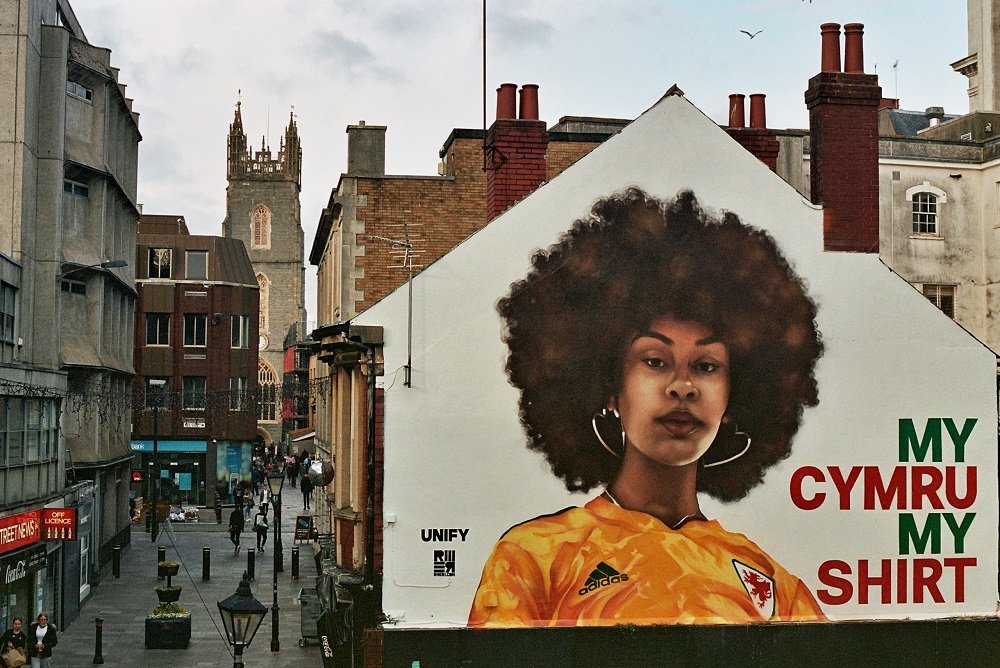
I despise racism, so when diversity demands the same preference for one race to the detriment of another it’s exactly the same and stirs up the same animosity. All this is ammunition to Reform, who can compare the 1% black population of this country with the multitude of murals in the capitol city which seem to be inversely proportional.
Lets just forget about skin colour and regard everyone as one.
You would not be able to forget about skin colour if you were black or brown.
For some in the name of equity, this is wrong.
But I concur fully, forget about skin colour.
I go with a remark made in a TV interview by an SNP politician – I now forget which one – who said, a few years ago, something along the lines of ‘if you live here or work here and you’re happy to be here, then you’re simply one of us’.
What more than that could you want?
Maybe not to suffer racist attitudes and behaviour in your everyday life?
Skin colour matters. It matters so much that it hurts. Skin creams to lighten the skin tone and make us fairer and prettier. Then comes the judging on the Skin colour. Then comes the hatred. And I haven’t even opened my mouth and said anything. Go back to where you came from. We don’t want your kind here. Paedo. Terrorist. Islamist. This is all what I heard shouted at me. But, it doesn’t end there. I have forgotten to say thank you and to be grateful.
Well said!
Reform’s whole drumbeat is fostering and manufacturing ” white grievance”
Creating tensions and fears in neighbourhoods to secure votes
Caerphilly was a prime example bussing in supporters from the UK to misinform the locals about spending £55m on asylum seekers.
They will probably be a little more sophisticated than outright lies as they approach the election
Ethno-nationalism must be rejected. Civic nationalism is indeed Plaid Cymru’s predominant perspective but ethno-nationalism still lingers.
Nation.cymru recently published an article by Mathieu Guihard, Breton Party President, that was strongly ethno-nationalist and drew on the writings of Nazi collaborator Yann Fouéré.
Using civic nationalism as a tool to eliminate history, heritage, culture and language is no less sinister. As you well know Yann Fouéré voluntarily returned to France to face trial in 1955 and was acquitted.
By 1955, many known Nazi collaborators had been ‘rehabilitated’ as European elites sought support against communism at the height of the Cold War. It is notable that it Fouéré’s conviction took 9 years to reverse and that the court refused to return property that had been confiscated.
Fouéré had been allowed to publish La Bretagne under German occupation and had included anti-Semitic articles. Even after his return he defended the collaboration of Breton milices with the German army and the SS against the French resistance.
Don’t excuse fascism.
Defending history, heritage, culture and language isn’t fascism. Trying to eliminate it is.
If your “history, heritage, culture and language” is threatened by a few black and brown faces, it’s not worth saving. I happen to think the Cymry are better and stronger than that. If you are keen to find a threat, look at the number of anglo-saxon immigrants here; there seem to be more cockney accents than local ones in Carmarthen (for example), every time I go there. But that’s ok, because they are white?
I’m talking about those that try and use “ethno-nationalism” as a device to shut down support for Welsh history, heritage, culture and language in an effort to turn Wales into a county of England.
Denigrating or excluding others on allegedly ethnic grounds is a core element of fascism. That’s why the likes of Fouéré collaborated with Nazism. If Plaid Cymru wants to be viewed as a progressive party, it should keep clear of ethno-nationalism and groups like the Breton Party.
How is anyone excluded? There’s room for multiple histories, heritages, cultures and languages.
Did you read Guihard’s article with its racist attacks on so-called ‘miscegenation’ and ‘métissage’? That’s where ethno-nationalist exclusion leads. Its Nazi connections are no surprise.
The very essence of ethno-nationalism is to deny the validity of multiple histories, heritage, cultures and languages. We should instead celebrate our diversity.
I’m not defending ethno-nationalism. I’m calling out those who try to use the “ethno-nationalist” label and related sinister concepts to oppose anything that isn’t ordained by London in order to turn Wales into a county of England. Eliminating rather than celebrating the diversity on this island. If anyone feels excluded by bilingual signs and different speed limits to England the problem is theirs and not ethno-nationalism.
Like with many things there is clearly overlap and grey areas between ethno-nationalism and civic nationalism. If balanced, the article should also highlight there plaid councillors and candidates for the Senedd who have communicated quite divisive, disparaging things about the English as a “race”. I think it’s obvious to say plaid are more focused on civic nationalism but there certainly are elements that are ethno nationalistic as well, though arguably some of the basis of that is rightfully for language and cultural reasons and only a minority ethno-nationalist in the racial or exclusionary sense. I wouldn’t conflate civic principles with… Read more »
Fish and chips served by white people is a great thing and it takes its’ place nicely alongside the wide range of other food served by authentic staff connected to the origins of that food (Indian/Asian/Chinese/Turkish etc). What these clearance freaks want is a return to fish and chips ONLY served by white people ONLY. No thanks.
Ah yes, that well known Portugese Jewish dish of fish and chips! A great example of where this benighted island would be without the massive contribution of many different races and skin colours over centuries. Otherwise we would be living on turnips.