


Welsh Devolution: Just the Latest Character in Reform’s Shadow-Play
James Downs, Mental health campaigner
Reform UK’s party conference in Doncaster produced its first Welsh headline when Laura Anne Jones declared that the party would not rule out scrapping the Senedd. Jones, the former Conservative Member of the Senedd for South Wales East, crossed the floor to Reform earlier this year and wasted no time in dangling abolition as a possibility, if not quite a policy.
A party spokesperson quickly clarified that axing the Senedd won’t appear in the manifesto. But then came the caveat: “we do not want to shut the discussion down.” In other words, Wales’ Parliament is safe, unless it isn’t. Secure, unless it proves inconvenient.
Permanent, until it becomes temporary.
This ambiguity isn’t indecision: it is the method.
The Politics of Grievance
At the heart of Reform’s politics is phantom debate: arguments conjured not to resolve anything, but to keep grievance alive. Reform is a movement built on perpetual complaint, a self-sustaining outrage machine. Problems must remain unsolved, otherwise the oxygen of grievance runs out.
Take immigration. A complex social and economic reality is boiled down to a bogeyman: borders collapsing, communities swamped, civilisation on the brink. Grains of truth are distorted out of all recognition, then plastered across billboards and panel shows.
Now Welsh devolution is at risk of being treated in the same way, with the Senedd being portrayed as a looming symbol of Welsh decline, rather than a flawed but necessary institution. It has been offered up as a grievance-in-waiting.
Denying Reality
What makes this politics particularly corrosive is not only Reform’s co-dependency on phantom problems, but the deliberate denial of the real, grinding problems that might demand actual reform.
These problems are too complicated, too unglamorous, too much like hard work to think about solving. Take climate change, for example. Where overwhelming evidence demands urgent action, Reform’s response is to delegitimise net zero policies as expensive fantasies. One of the greatest existential challenges of our age is reduced to just another culture-war grievance, folded neatly alongside immigration and devolution.
Shadow-Play
Instead, Reform grasps for power by exploiting phantoms, distortions, and spectres of the national imagination. Plato’s cave is retold in a Doncaster conference hall: the public is invited to stare at flickering images on the wall which portray immigration as invasion, devolution as disaster, and net zero as a con.
In the clear light of day, reality is harder to deny: the rampant inequality that drives poverty and lack of opportunity in Wales, the global crises displacing people abroad, and the planetary emergency accelerating before our eyes. Reform might even – heaven forbid – glimpse the harms of leaving the European Union.
But of course this is the party that never had any answers for how Brexit would actually be implemented, only the slogans that made it saleable. Reform UK is simply the latest incarnation of the same project: grievance without governance, rage without responsibility.
Refusing Reform’s Terms
We only have to look at the media to see the gravitational pull exerted by Nigel Farage, where debate is framed to his advantage, and the spotlight is fixed where he chooses. When it comes to the substance of Reform’s policy agenda, the danger is not only in the popularisation of divisive rhetoric and imagined enemies. It is that the rest of us become trapped in debating on Reform’s terms, too, subsumed into a politics of grievance.
If we are to resist being recruited into Farage’s shadow-play, then calling out the emptiness of Reform is not enough. That would only mirror their own politics: pointing, blaming, and never building. It would allow Wales to be used as a prop in what Reform sees primarily as their warm-up act for Westminster.
The real task is to drag debate back into the light of day, and to meet the challenges of Wales with meaningful solutions.
Delivery over Discourse
This means grappling with the realities Reform denies: poverty and inequality in Wales, the public services straining under decades of neglect, the climate emergency that will not wait. It also requires defending the Senedd, not just as a constitutional principle, but as a forum that has the potential to provide real answers to real problems.
Reform’s politics of grievance thrives in the current climate of political monotony, economic stagnation, and poverty of ambition in Wales. It is a hollow pantomime that feeds on despair rather than addressing it. The 2026 Senedd election must mark a shift towards a democracy that delivers for Wales – one that demonstrates a clear superiority to both the status quo and Reform’s specious solutions.
James Downs is a mental health campaigner, researcher and expert by experience in eating disorders. He lives in Cardiff and can be contacted at @jamesldowns on X and Instagram, or via his website: jamesdowns.co.uk
Support our Nation today
For the price of a cup of coffee a month you can help us create an independent, not-for-profit, national news service for the people of Wales, by the people of Wales.



Excellent article and analysis. Reform are creating a debate around issues which are symptoms of a problem, rather than analysing the underlying causes.
Reform and its predecessors thrive on spreading lies and misinformation, creating an alternative reality to the one we all live in.
They are allowed to get away with this and have the support and encouragement of a compliant media controlled by those who want to perpetuate the inequality and unfairness in society.
It is important that they are subject to scrutiny and challenged. Nation Cymru are key in this process.
Thank you very much for your encouragement. We really do need to look beyond the superficial towards a deeper analysis. It is so hard to work out how to engage with/cover Reform without simply fanning the flames (as per a lot of the media). Even harder to not just preach to the choir, perhaps…!
For decades the British nationalists have perceived the supposed exeptionalist status and former undisputed power of their country, threatened and ebbing away in two directions – firstly towards Europe, and secondly towards the devolved administrations in Scotland and Wales. They believe they have stopped the first ‘leakage’ at the time of Brexit – and, let’s not fool ourselves for one second, they are now determined to fix the second.
Your sentence only makes sense for “English nationalists” because Scotland and Wales are both geographically part of “Britain” which only has one real meaning – the island of Great Britain – even if that meaning is hijacked by a few delusionists.
I think the use of “British nationalist” by John is precise for that reason. I wonder whether English nationalists would prefer English independence or to be more expansionist (i.e. GB = England with the names Wales and Scotland as quaint decorations for pseudo-English regions). I’m not sure if many English nationalists have thought about it in any depth, though…
The instinct is to finish the Germanic conquest.
Would Nigel Farage and Reform UK (England) advocate abolishing Westminster seeing Wales and Britain suffered 14 years of chaotic crooked Conservative rule and 14 months of authoritarian neoconservative Labour policy flip-flopping in London? No. They want to become the next UK Government. It’s only in Wales do Reform UK want to abolish our Senedd Cymru without a vote re-establishing direct rule out of historical ideology espoused by them in the past under the guise of Brexit Party and Ukip. At the moment they say it’s not party policy, but with ex- Welsh Tory MS Laura Ann Jones and Llŷr Powell… Read more »
Exactly
If Reform was genuinely a party of reform the first institution they would abolish is indeed Westminster which was set up by wealthy landlowners as a private members club to look after wealthy landowners. It was never designed to be a real government of the people, by the people, for the people. It should be obvious to everyone that Reform just want their own turn running the club and it’s VIP lanes for their own benefit.
More shocking (or not, as the case may be) is that I strongly suspect that most people in Wales will lap it up and cheer on the destruction of their own democracy, until it’s too late.
How anyone can invest trust in their rhetoric after Brexit is staggering. Perhaps the fantasy of a “Brexit that could have been” still holds sway. Brexit-If-Nigel-Farage’s-Imagination-Ruled-Everything (BINFIRE for short).
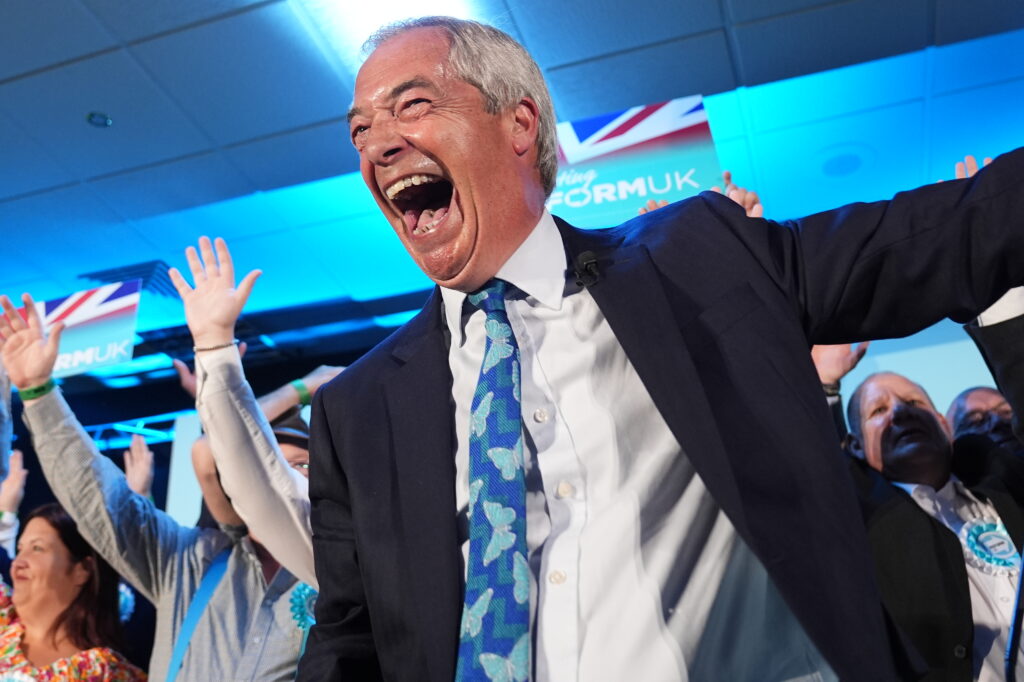
Manic laughter from Farage ……. laughing at the supporters who have been sucked in by the c*ap he is dishing out.
This is why many of the councils won by Reform are now beginning to struggle – the party is great at highlighting the grievances and gaining votes from them but absolutely useless at actually resolving those grievances once in power. If Farage becomes PM, yes probably he’ll close the borders, probably try to dismantle Welsh and Scottish Parliaments and probably try to scrap the Human Rights act here, but once these have been accomplished and he realises the grievances still remain – he’ll have nothing. Brexit is the prime example of this – we are out with nothing to show… Read more »
I don’t think they’ll abolish devolution. Unless they have a referendum, in which case yes, I absolutely think there is a chance the public will vote for abolition. But I don’t think they’ll do it without a referendum.
And some believed Nigel when they voted in 2016 that we wouldn’t leave the single market.
If people remain convinced by the scapegoats for the problems we see, and the underlying problems (such as inequality) deepen, then Reform may well even grow in power and influence. I hope we can get over Peak Reform sooner rather than later…
I think abolishing devolution is a harder sell than Brexit, because more people identify, and more strongly, as Welsh than as European.
Having said that, abolition could still win, but if it does it will be by a much smaller margin than Brexit, maybe 50.1%.