

Welsh land for the Welsh nation – the unfinished business of devolution
Peter Ainsworth
In 1965, the village of Capel Celyn was drowned. Liverpool Corporation needed a reservoir. The Welsh community in the valley – Welsh-speaking, rooted, irreplaceable – objected.
Thirty-five of Wales’s thirty-six MPs opposed the bill. It passed anyway, because England had the votes.
Tryweryn became the name for something the Welsh already knew: that when distant institutions make decisions about Welsh land, Welsh communities pay the price.
We are supposed to have moved on. Devolution transferred powers over planning, environment, education, health and language to the Senedd and the Welsh Government.
The principle was simple and unarguable: decisions affecting Welsh life are better made by Welsh institutions accountable to Welsh people. Twenty-five years on, that principle is broadly accepted even by those who once opposed it.
But devolution left something out. It transferred powers. It did not transfer the land.
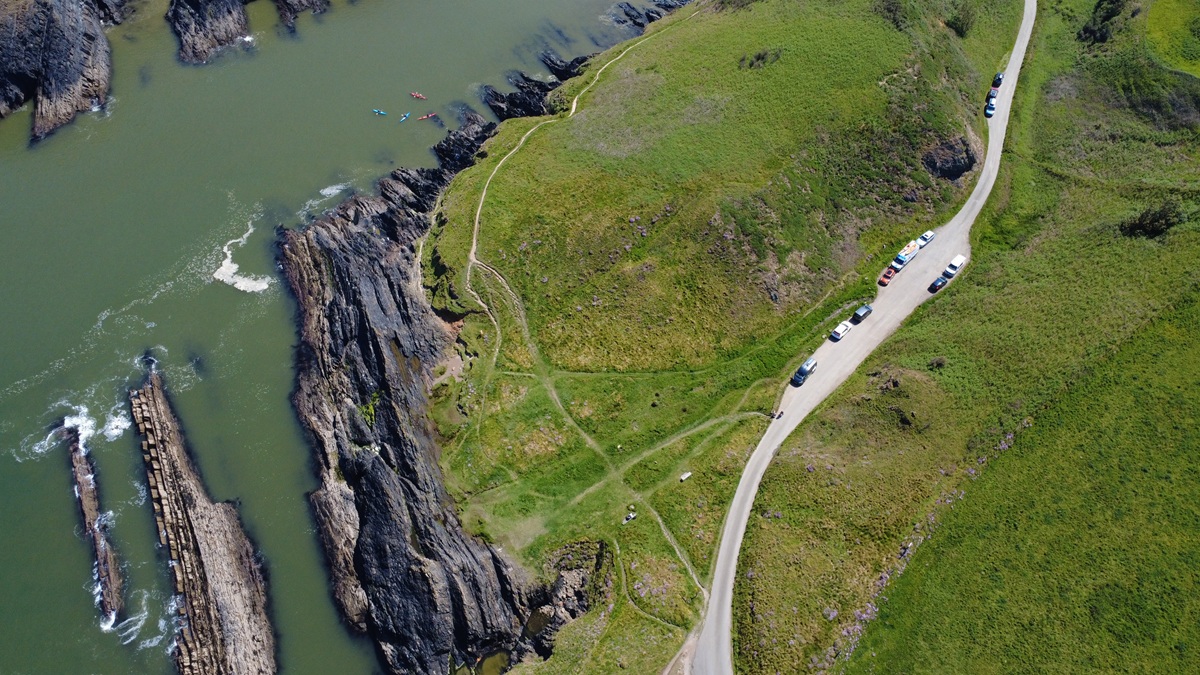
I live half a mile from Ceibwr Bay on the Pembrokeshire coast – land gifted to the National Trust by Wynford Vaughan Thomas, the Welsh broadcaster and writer, so that it would be held for the benefit of the nation.
Last week, the Trust’s Cambridge solicitors threatened a local Welsh coasteering operator, whose family have been on this coastline for generations, with accusations of trespass, asserting that the Trust owns the headland as a “private landowner” entitled to “restrict use of the land as they see fit.”
The land they are claiming as entirely private is part of the Wales Coast Path – a statutory national trail established by the National Assembly and running, unmistakably, through every inch of the headland in question.
The Trust’s management had not seen the land, not noticed the clear path markings and apparently not even read the map. Their solicitors, when challenged on the Wales Coast Path point, replied that their instructing officer was on holiday.
I wrote formally to the National Trust’s Board of Trustees raising these concerns. The chairman, Rene Olivieri, replied that he was “satisfied the matter is being dealt with appropriately by the local senior leadership team.”
He was satisfied. The people of Wales, whose coastal path his organisation had just attempted to close, were not consulted.
Structural problem
This is a small and vivid illustration of a large and structural problem. The National Trust is an English charity. Its board sits in Swindon. Its senior leadership answers to that board – not to the Senedd, not to the Welsh Government, not to NRW, not to any Welsh democratic institution whatsoever.
It was not created by statute to serve Wales. It has accumulated Welsh land through gift and purchase over more than a century and exercises powers over that land – powers over public access, over commercial activity, over the character of Welsh communities – with no democratic accountability to Wales at all.
It holds some of the most spectacular and culturally significant land in the country on the legal basis that it holds it “for the nation.” But which nation?
That Wynford Vaughan Thomas intended his gift to benefit the Welsh nation does not mean the institution receiving it is fit to honour that intention. Ceibwr demonstrates that it is not.
Consider what else the Trust controls – and ask whether an English elite governing from Swindon is the right custodian of any of it.
Powis Castle is a medieval fortress built by the Welsh Princes of Powys. It was the seat of Welsh sovereign power for centuries. It is now owned and interpreted by an English charity. The princes of Powys deserve better than a footnote in someone else’s national story.
Tŷ Mawr Wybrnant in the Conwy Valley is the birthplace of Bishop William Morgan, who translated the Bible into Welsh in 1588. That translation did not merely provide spiritual sustenance — it standardised the Welsh language at a moment when it faced extinction, and in doing so preserved the linguistic identity of a nation.
It is arguably the most important building in the history of the Welsh language. It is owned by the National Trust.
Penrhyn Castle near Bangor was built on two forms of exploitation: the enslaved labour of Jamaican plantation workers, and the labour of Welsh quarrymen who launched the longest industrial dispute in British history — three years, over 2,800 workers, communities divided, homes bearing the sign Nid oes bradwr yn y tŷ hwn.
That story – of Welsh working-class solidarity and courage against an anglicised aristocratic overlord – is Welsh history. It is currently being told by the institution that owns the overlord’s castle. Welsh hands would tell it as it deserves to be told.
The Dinefwr estate in Carmarthenshire surrounds one of the symbolic centres of the ancient Welsh kingdom of Deheubarth, seat of the Lord Rhys and some of the greatest figures in medieval Welsh history. It too sits substantially in the hands of an English charity.
And then there are the 157 miles of Welsh coastline that the Trust controls – including the headland at Ceibwr, gifted by a Welshman to benefit Wales, now used to threaten trespass proceedings against a Welsh family that has worked the coast for generations.
Transfer
The positive case for transfer is as compelling as the constitutional one. Welsh historic properties in Welsh hands would tell Welsh stories as Welsh stories – not as regional curiosities appended to an English national collection, but as the central chapters of a national narrative that Wales is now, at last, in a position to write for itself.
A Welsh-controlled Tŷ Mawr Wybrnant would place the survival of the Welsh language at the heart of its own heritage. A Welsh-controlled Powis Castle would restore the princes of Powys to their own country’s history. A Welsh-controlled Penrhyn would give the quarrymen’s story the dignity and centrality it has always deserved.
Revenue that currently sustains an English charity would instead benefit Welsh communities and Welsh institutions.
The solution is not complicated. Welsh historic properties held by the National Trust – castles, houses, monuments – should transfer to Cadw, the Welsh Government’s historic environment service, which exists precisely to care for such places in the Welsh public interest.
Welsh countryside and coastal land should transfer to Natural Resources Wales, the statutory body responsible for the Welsh environment, which already manages significant landholdings and has both the expertise and the democratic accountability that the National Trust lacks.
Last week Rhun ap Iorwerth was sworn in as First Minister – the first non-Labour First Minister in the history of devolution, leading the first Welsh nationalist government Wales has ever had.
Something has stirred in the soul of Wales, he said. Plaid Cymru’s manifesto commits to the further devolution of Welsh assets. Here is a specific, achievable and symbolically powerful first act for the new government: open formal negotiations with the National Trust for the transfer of its Welsh properties and landholdings to Cadw and NRW.
English charity
Why does an English charity in Swindon still control some of the finest land in Wales? Why, when it gets things badly wrong, does the chairman simply say he is satisfied?
Why are Welsh stories still being told by an institution with no accountability to the Welsh people?
Tryweryn was the answer to that question last time. Ceibwr is a small but precise reminder that the question has not gone away.
Something has stirred in the soul of Wales. Now is the moment to act on it.
Peter Ainsworth is a policy analyst at the Institute of Economic Affairs, an entrepreneur, a former charity trustee, and an Englishman who has lived in Moylegrove, Pembrokeshire for many years.
Support our Nation today
For the price of a cup of coffee a month you can help us create an independent, not-for-profit, national news service for the people of Wales, by the people of Wales.
Get more trusted Welsh news
Choose Nation.Cymru as a preferred source in Google News to see more of our journalism.



You make a persuasive case for a separate National Trust for Wales.
Public Control and management of these Welsh lands and properties, and of our histories, should be in our hands, just as other parts of our heritage are through CADW.
There are several issues here. First it is evident that the NT needs to have separate arrangements for Wales including legal advice as the Welsh Legal system is now distinct from the English. Second there are a lot of issues about the NT and its politically correct attitude to the heritage it guards which is now being heavily spun to cover the modern view of historical events usually out of context. Third there are all sorts of issues about the charity sector which is an Augean stables in need of cleansing with a massive flood.
As you are local, then you would know that seabirds nest on those cliffs and that concerns about their well being have been voiced by people living in that area. You should also know that chough are seen regularly there. It is one of Britain’s rarest bird and holds a symbolic value to the Celtic people. On the heraldic crest of Cornwall and of Flintshire.Indeed it does not nest naturally in England, rather it is found in Cornwall, Ireland, Isle of Man , Scotland but mostly holding half the British population in Wales, with some 200 pairs. It is a… Read more »
You need to read NRW’s definitive report no 800. It confirms that coasteering causes no harm and there are no chough in the relevant area.
I have read it, I have also seen photos of choughs taken by an ornithological group claiming they were on that cliff. The report you cite claim they only saw the groups a couple of times and once they nearly tried on a ground nesting chick.
Try googling Chough and Ceibwr bay, I got some 5 photos of the birds, eg
Facebook https://share.google/MWK52ld9jjEvJzTtb
Try some excellent photos of choughs at Ceibwr bay https//www.facebook.com/share/p/18c8Q5jxo8
Interesting discussion, which led me to read 800. As you know, its about gulls and auks, not chough. But it does say “Chough does not nest in the survey area and recent monitoring of this species suggests recreational activities are not a significant factor to breeding outcomes in North Pembrokeshire. ” Hardly a coherent or convincing sentence, is it? From what I know of the site, living in Pembs, and from what little I know about choughs, NRW should look much harder at why choughs don’t actually nest at Ceibwr.
Ardderchog. Indisputable. Do it.
Since 1931, the National Trust for Scotland has been the charity that cares for, shares and speaks up for Scotland’s magnificent heritage. But for Wales? See England.
http://www.nts.org.uk/what-we-do
Cai Wogan Jones adds a point I should have made in the piece itself. Scotland established its own National Trust in 1931 – 95 years ago. The National Trust has no properties in Scotland whatsoever. Scottish land, Scottish heritage, Scottish accountability. Wales missed that moment. It is not too late to correct it.”
See also, the Canal trust where Wales is a footnote to this English trust.
The Isle of Man also has its own national trust.
Both the National Trust for Scotland and the “National Trust” (for England, incorporating Wales) were established by Acts of Parliament. If the political will were there, it would be a relatively simple matter to hive off the Welsh assets and remit into a parallel organization. By another Act of Parliament.
It’s also somewhat ironic that the National Trust’s first property was a 4.5 acre piece of land , Dinas Oleu in Barmouth in 1895.
Strongly support splitting out a separate NT Cymru like Scotland has.
Mr Ainsworth is absolutely correct in that the National Trust in Wales should be a separate organisation not controlled from Swindon but responsive to conditions, laws, by-laws and traditions in Wales. Coastering is a relatively modern activity that has gained in popularity in the last 30 (?) years. The NRW report Mr Ainsworth quotes regarding coastering in the area is someones observations on 4 occassions, hardly a full scientific assessment of the effects of the activity on all wildlife (not just birds). There is no baseline as to whether the numbers of birds, for example, has changed over time. But… Read more »
I have no issues with a Welsh National Trust; but CADW is not the answer. It has a capital budget of less than £10m, which doesn’t go very far and is likely to be cut further. Wales is already littered with heritage buildings in very poor condition. Frankly, I would rather see NT buildings maintained properly from Swindon rather than neglected from Cardiff.
Money would be the biggest problem in having a seperate organisation but it could be dealt with, say by having a confederal organisation where monies are shared to reflect responsibilities taken on before the split.
I do have some concerns with the NT interpretation and presentations to visitor. At Chirk for example there is little to point out the Norman takeover, the battle of Crogan or even Offas Dyke that bisects the site. Plus at Welshpool there is no mention of the Welsh Princes of Powys and the origin of the site as a Welsh stronghold.
You may be right (and I’m sure NT could do better with their visitor information). Mine is a wider point though. Barely a week goes by without a call for more devolution of land, rail, police, justice, broadcasting, Crown Estate etc etc. I agree in principle with some of it; but there is a cost as well as a benefit and I’m sceptical whether the money is there medium term to meet rising costs with Welsh government spending more than half its budget on the NHS and rising. There might be an initial distribution of resources to Wales for new… Read more »
The doesn’t appear to be a single inventory of who owns or controls what in Wales: infrastructure such as ports, land, businesses, material heritage, media, sports clubs their worth and where the profit goes. And importantly what are the trends. The amount of oversight and control exercised by democratically elected institutions is also unclear, or for that matter the potential for political patronage. There is a Facebook page “National Trust Cymru”. Is that disingenuous?
National Highways owns/is responsible for 338 Welsh structures (tunnels, bridges etc) and other assets of the Historic Railways Estate. It would be good to see these being handed to the Welsh Government too.
It seems daft that these are still in the care of a government business that is based in England. Cadw could be making use of these for the Welsh nation, especially if the budget was also passed over.
About the HRE – National Highways
Regarding capel celyn didn’t a previous Welsh secretary get legislation enacted to enable the Welsh government to charge Liverpool (and also birmingham for tha elan valley water. But doesn’t seem to have happened?