


Welsh Language Commissioner’s 5-year report: Our time to act
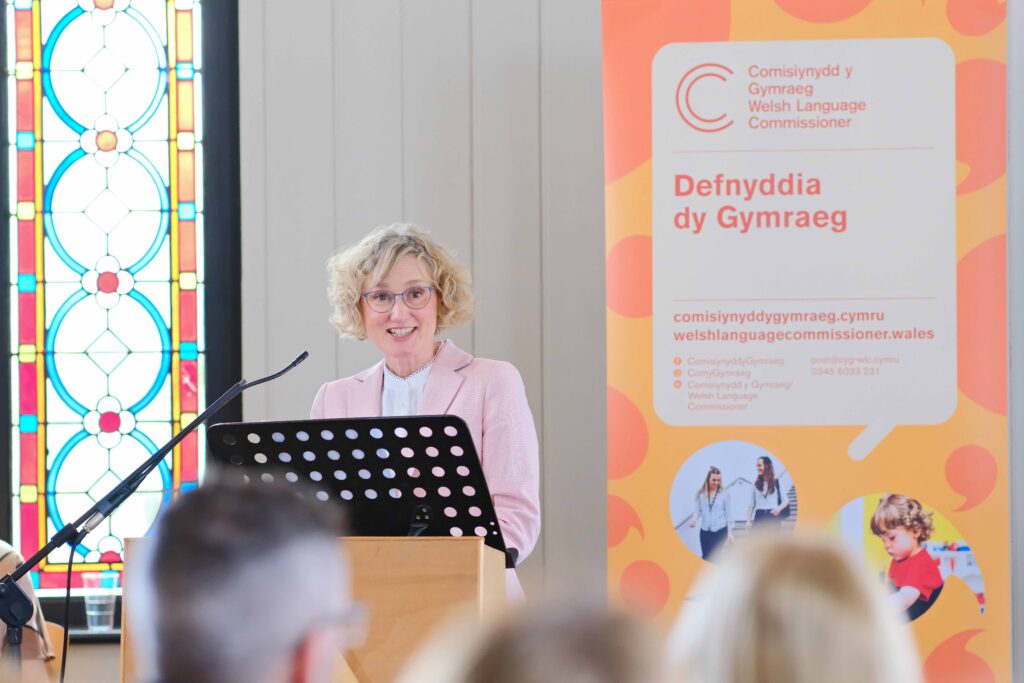
Efa Gruffudd Jones
I am publishing this five year report almost exactly halfway through my term as Welsh Language Commissioner.
Since beginning my post in January 2023, I have taken the opportunity to meet with and engage in discussions with many individuals and organisations to better understand the opportunities and challenges facing us in Wales from the perspective of the Welsh language.
While the statistics clearly demonstrate the scale of the challenge currently facing the Welsh language, I am confident that we are moving in the right direction. There is general support among policymakers and community leaders to create an environment in which Welsh can grow and develop naturally at a grassroots level.
It is a statutory requirement for the Welsh Language Commissioner to publish a report every five years; however, this report is not merely an exercise in meeting that duty. I am keen for the information we hold as an office about the position of the Welsh language to provide a firm foundation for bold and ambitious action to support it.
2021 Census
As you would expect, the most recent census provides an independent assessment of the position of the Welsh language during the reporting period. In this report, we have analysed the census data in full and considered its implications.
The Welsh Government has consistently stated that the census is the benchmark for measuring progress towards a million Welsh speakers, and I fully appreciate that. However, census data is not without its complexities or limitations. We know, for example, that the number of people who report that they speak Welsh is consistently lower than that indicated by other surveys, including the Annual Population Survey.
We must also remember that the census is a self-assessment questionnaire, and that responses to the question about Welsh language ability are inherently subjective. Each of us assesses our language skills differently, and it is entirely possible that two individuals with very similar Welsh skills would provide quite different responses.
My intention is not to suggest that the situation is significantly better than that indicated by the census, but rather to emphasise the importance of recognising the complexities involved in analysing a wealth of information, and of avoiding overly simplistic interpretations.
I hope this report represents an attempt to explore the statistics in greater depth and to question what we can understand about the position of the Welsh language and its speakers based on responses to the 2021 Census questionnaire.
Personally, I find it encouraging to see that so many school-aged young people are able to speak Welsh. The research we published last year supports the fact that young people are keen to use Welsh, but we need to create an environment where they can do so naturally – whether while socialising, on the sports field, or in the workplace.
An exciting period ahead
The report is published as we approach a Senedd Cymru election that will bring about substantial change in the way Wales is governed, regardless of the political composition of the next Government.
For the first time, 96 Members of the Senedd will be elected to new constituencies – constituencies that have Welsh-only names. This represents a deliberate policy decision in favour of the Welsh language, one that feels very symbolic to me. It shows confidence in our language and in our identity – a small, but important, step.
But I also recognise that symbolic action alone is not enough – decisive action is needed to achieve real change. And that is where this report sets the challenge: if we are serious about reaching a million Welsh speakers by 2050, we need a new, more ambitious and bolder approach if we are to have any real prospect of seeing the Welsh language thrive.
Looking ahead, what I see are exciting opportunities – opportunities to think and act differently. In saying this, I am not dismissing the significant efforts of recent years. We have seen important policy and legislative developments, such as the introduction of the Welsh Language and Education Act, which could be transformative if fully implemented, but further change is needed.
As you would expect, I have my own views on how best to achieve that change, informed by my day-to-day work advocating for the Welsh language.
Many of these views are already in the public domain, following the publication of our strategic plan and, more recently, our manifesto for the forthcoming Senedd election. In the manifesto, I have outlined five ambitious yet practical proposals with the potential to significantly change the position of the Welsh language by the end of the next Senedd term.
These include extending the Welsh Language Standards, transforming clinical care, and establishing a Welsh language training framework for the education workforce.
Co-operation is key
I fully acknowledge that introducing these proposals, or achieving the objectives of my strategic plan, would not in themselves be sufficient to transform the position of the Welsh language.
The overall picture is far more complex than that, but I am trying to be practical in identifying and highlighting the main priorities and opportunities for the next period.
Underpinning all of this is a clear message: if we are to see the real and lasting change that is needed, the Welsh language must be central to every policy and legislative agenda introduced by a new Welsh Government.
I fully appreciate the responsibility I hold as Welsh Language Commissioner to lead much of this work, but I also want to emphasise the importance of people contributing evidence and sharing their experiences as the discussion progresses.
I understand this is a substantial report. However, as people engage with it over time, my hope is that they will sense the same energy and enthusiasm that my office and I feel – and that they will share our conviction that the future of the Welsh language depends on intelligent action and positive collaboration.
You can read the full report by following this link on the Welsh Language Commissioner’s website.
Support our Nation today
For the price of a cup of coffee a month you can help us create an independent, not-for-profit, national news service for the people of Wales, by the people of Wales.



I wrote to the Welsh Language Commissioner a couple of years ago about a bus company that was breaking the law by having only English language announcements on its route. I didn’t get a reply or even an acknowledgement of receipt. If the Commissioner isn’t serious about implementing the law, it’s just another waste of taxpayers’ money.