


What happens if the Welsh Government can’t pass its budget?
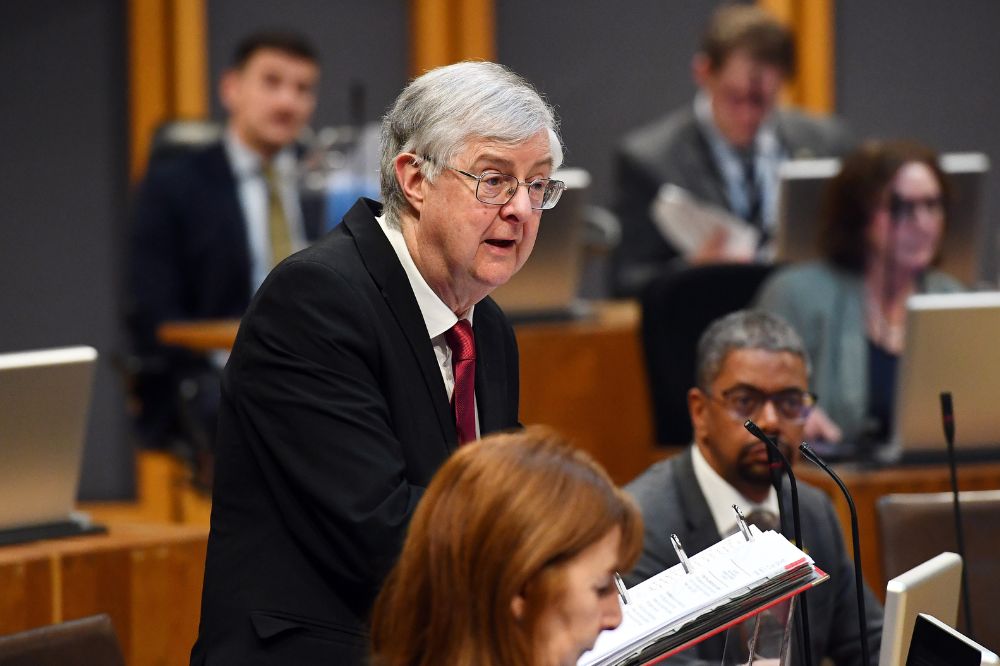
Mike Hedges, MS for Swansea East
The budget is the major decision made by the Senedd. A failure to pass a budget has catastrophic consequences not just for the Welsh Government but for those employed in Welsh-Government-funded public services and the people of Wales.
The Senedd’s Budget Motion authorises the Welsh Government and bodies directly funded by the Welsh Consolidated Fund to spend resources as agreed in the motion. It also sets the limits of income that may be retained by the Welsh Government and directly funded bodies.
If a Budget Motion is not passed before April 1st, Section 127 of the Government of Wales Act 2006 automatically takes effect. This would give the Welsh Government and directly funded bodies authority to spend up to 75% of the limits approved in the previous year.
If a Budget still has not passed by the end of July, up to 95% of the previous year limits are deemed authorised. This equated to a 5% cash cut in money terms as well as no increase for inflation.
Cuts
In practice this means that health boards will overspend from the beginning of the year up to the guaranteed 95% but instead of the increase currently proposed they will have to cut back on treatment.
Local authorities can use reserves in the first part of the year up until July to protect 95% of the current expenditure again this will cut services and reduce provision. For those councils with minimal reserves the Welsh Government would need to make short term loans to allow the council to continue operating. Either of those scenarios would be replicated in the rest of the public sector.
This means substantial cuts to public services and large-scale redundancies if there is no budget agreed and passed in the Senedd. The alternative suggested by the cabinet secretary for finance is to increase all budgets by inflation and leave any money left over, to be decided post-election by the incoming government, effectively a roll over budget.
Inflation
Whilst this appears simple, it is not. Inflation is the rate of increase of prices and there are lots of ways of calculating it. Every month, the Office for National Statistics checks the prices of about seven hundred items in a ‘basket’ of goods and services, which is designed to represent what people buy on average, creating the consumer price index.
The basket includes everyday low-cost items such as a loaf of bread or a bus ticket but also includes much larger ones, such as a car or a holiday.
Holiday prices do not affect public service costs or public service inflation. To calculate the rate of inflation, they compare the CPI with what it was a year ago. The change in the price level over the year is the rate of inflation.
But much of the recent rise in inflation has been created by global commodity prices, mainly energy and food. In health, inflation is driven by wage increases, service provider costs, and the cost of medicines. Local government inflation is driven by wage rises plus increase demand for care, both adults and children, and homelessness.
Whilst CPI focuses on a basket of goods and services purchased by households, an RPI includes mortgage payments and council tax.
Neither of these are the same as the rate of inflation for health, local government, or other public services. In August, the public service inflation rate was 4.7% and in July it was 5%.
Challenging
The inflation rate for the different service areas in public service will be different, but wage increases will be common to all.
Service inflation for local government is considered to be running over 4% higher than accepted inflationary estimates, so a 2% uplift would be extremely challenging and not a stand still budget but a reduction.
If councils continue to make efficiencies across all service areas where these are possible, the options for combinations of council tax increases, service cuts and job reductions will be felt by both staff and communities.
What we can see is that public sector inflation is substantially higher than either CPI or RPI so the use of either would be inappropriate and it would not lead to a roll over budget but would lead to cuts in public services.
A roll over budget needs an increase of over 4% and I would suggest 5% would be a more suitable figure. Anything less than that is a budget based on cuts not a roll over budget.
Support our Nation today
For the price of a cup of coffee a month you can help us create an independent, not-for-profit, national news service for the people of Wales, by the people of Wales.
Get more trusted Welsh news
Choose Nation.Cymru as a preferred source in Google News to see more of our journalism.



Ask Trump for advice.
The way to pass the budget is quite straightforward.
(a) Rhyn to call Drakeford into the office,
(b) Rhyn to place the Plaid Cymru proposals before him,
(c) Drakeford to say “yes sir”,
(d) ensure he shuts the door on the way out,
(e) vote of full plenary in the Senedd.
Important to wish Drakeford and his colleagues well in retirement starting May of next year. Chat nicely about the holiday chalet in Saundersfoot.
Baroness Morgan has already got some ermine and a flat in London.
Normally that would be true but this is an election year.
I’m not sure why you’ve received down-votes because yours is a pertinent point to make.
I’d suggest that no party would wish to appear unreasonable or obstructive to the passing of the budget before the election, hence why the Conservatives have been quick out of the blocks in offering their support (with a price tag, of course) instead of choosing to adopt last year’s unaccommodating stance again.
I’d venture that most are awaiting the result this Thursday to see the full lay of the land before negotiating.
Reform will be wanting to paint Plaid as no different to Labour so Plaid are unlikely to do a deal. Dealmaking and good governance just isn’t in the Cons DNA. My money is on the independents.
As one of the big boys in the playground, I’d have said it’d be highly unlikely for Plaid Cymru to be influenced by Reform UK’s propaganda, just as it would be for Labour to be receiving support from two suspended Plaid Cymru and Conservative MSs, the help of both being needed to win the vote.
Interesting times.
I strongly suspect that a budget will pass after weeks of posturing on all sides. If I’m wrong, a great many people will wonder what’s the point of the Senedd if it can’t do the very basic of tasks. The politicians know that and won’t take the risk particularly in the run up to the elections.
It should be the Cons galloping in to save the day this time to prove to the doubters they do care about the important stuff. Unfortunately they can’t come up with any cost neutral proposals because that puts their “party of fiscal irresponsibility” narrative at risk. Only unfunded tax cuts will do.
The brainlessness of the debate does me head in. I can’t recall a single mention of policy or expenditure which the Tories or plaid or lib dems disagree with.
They blame Westminster
It will only be by the choice of Welsh Labour (for political reasons) that the budget fails to pass. It is always open to them to strike the best deal they can with another party or individual AMs.
Making a good case for independence here …
Beth am Caerfily?