


What is Terrorism?
Ben Wildsmith
This week’s sentencing of four Palestine Action activists sets the scene for a wider scenario, in which the definition of ‘terrorism’ will come under sustained scrutiny. The ‘Filton Four’, who were convicted of offences arising from direct action at the premises of Elbit Systems UK, an Israeli arms manufacturer near Bristol.
The sentences they received were enhanced after Mr Justice Jeremy Johnson ruled that the offences were aggravated by a ‘terrorist connection’ under section 69 of the 2020 Sentencing Act. As well as increasing the length of sentence, this ruling means that the four will be subject to ongoing censure and restrictions, including disqualification from early release, extended licence periods, and requirements to register with the police and provide details of computers and mobile phones.
Attention has focused on the actions of Samuel Corner, who was convicted of GBH without intent for striking a female police officer with a sledgehammer, fracturing her spine. For this and criminal damage, Corner received a combined sentence of 7 years and 8 months. His co-defendants, Charlotte Head (5 years), Leona Kamlo (5 years), and Fatema Rajwani (4 years & 8 months) were convicted of criminal damage only. One can surmise from this that the greater weight of the sentences was apportioned to the criminal damage charges, with the attack on Sgt Kate Evans only attracting an enhancement of less than three years in extra time.
The inevitable appeal of these sentences will be interesting. The effect of the judge’s ruling was that the defendants were convicted of different crimes from those for which they were sentenced. So, controversy around this case will continue but the wider context around it is set to be yet more inflammatory.
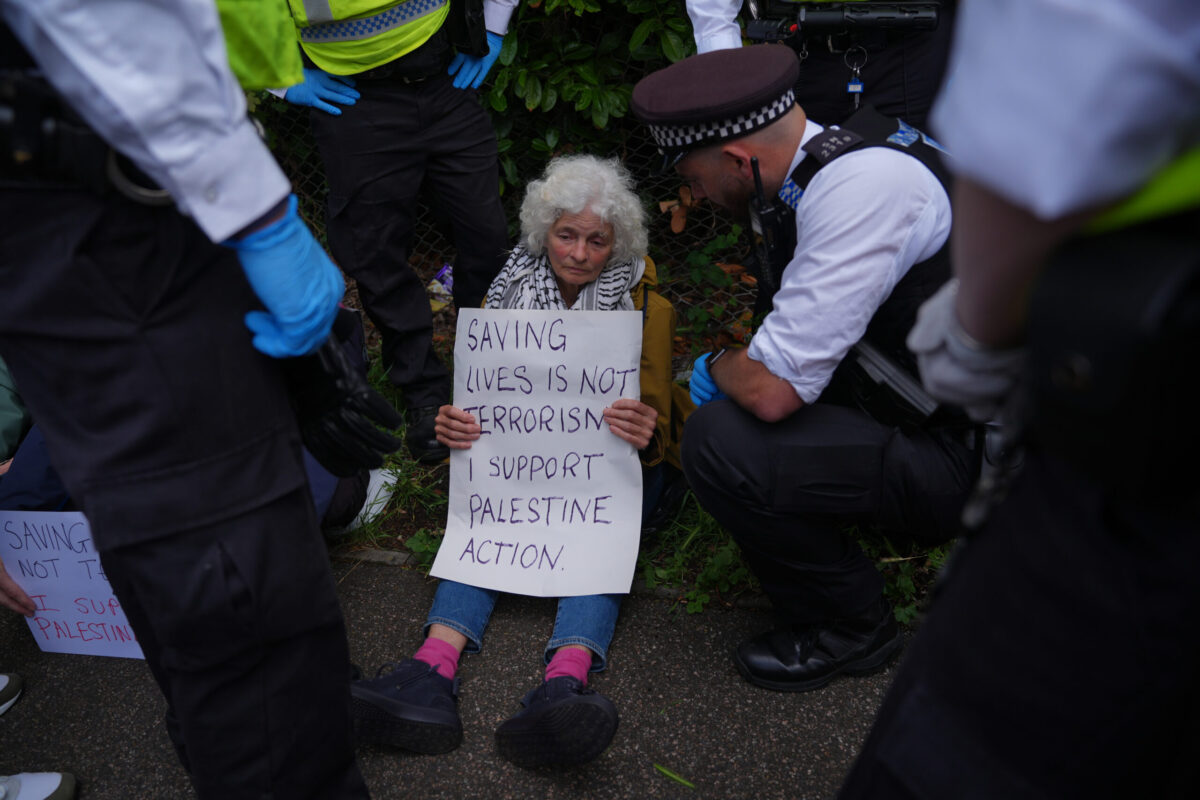
Palestine Action was proscribed as a terrorist organisation after the commission of these offences, so the status of the organisation was not, or ought not to have been, a factor in the trial. That proscription, however, will be back in the news tomorrow when the Court of Appeal announces its ruling on the government’s challenge to the High Court’s assertion that proscription was unjustified. Over 1600 protestors are currently awaiting trial on charges of supporting terrorism, mostly for holding up pieces of paper reading ‘I oppose genocide, I support Palestine Action’ at demonstrations against the proscription. Because of the far-reaching effects of a terrorism conviction on employment prospects and travel, a disproportionate number of these defendants are retirees who felt that they could absorb the inconvenience more easily than working-age people.
If the Court of Appeal rules in favour of the government, there will need to be over 1600 trials of mainly elderly, law-abiding people. The potential for enormous protests against this spectacle is obvious. Even in the fevered imaginations of the most enthusiastic authoritarians amongst us, it’s hard to picture these defendants in the role the government is seeking to cast them. A vicar holding a piece of paper is not what most of us associate with the term ‘terrorist’.
Then again, neither is Stephen Yaxley-Lennon. ‘Tommy Robinson’ was detained this morning by officers at Heathrow Airport Counter-Terrorism Border Security Act 2019. His mobile phones were confiscated. Very many people, me included, find Yaxley-Lennon’s role in UK politics to be repugnant and contrary to the public good. Terrorism legislation, however, exists to suspend universal rights in response to coercive threats to safety. Yaxley-Lennon clearly has more potential to spread fear than paper-holding pensioners, but that potential has not yet been fulfilled.
Likewise, the unexplained detention of George Galloway, the broadcaster and former MP, under the same legislation last year also seems like a stretch. Galloway has a large audience and often offers analysis that favours positions taken by the Russian government. There is an argument that under the current circumstances that represents disloyalty. His previous employment by Russian media outlets has led some to question the motivation behind the lines he takes. That, however, is not terrorism. For the state to use terrorist legislation to harass those engaged in peaceable disagreement with it sets a dangerous precedent regardless of the subject’s views.
The current controversy over the definition of terrorism is diametrically opposite to one we have recently had. Many argued that Axel Rudakubana ought to have been prosecuted as a terrorist. The rationale here was that he had caused widespread terror amongst the population. In the absence of a proven political motive, however, his crime could not be classed as terrorism. Now, the opposite position is being pursued by the government. A political motive is clearly provable for all the Palestine Action cases, Yaxley Lennon’s activities, and George Galloway’s career. None, however, have personally issued threats or committed serious violence in support of their political views. Rudakubana spread terror without an agenda, these people have an agenda but have not spread terror – although Yaxley-Lennon is treading a very thin line.
The suspicion persists that because terrorism legislation allows the state more latitude in detention and sentencing, it is misrepresenting purported crimes in order to invoke those powers. That perception alone is enough to undermine confidence in the system, but how the government proceeds now might have unexpected consequences.
A common reaction online to this issue is that it only affects people who are acting at the very fringe of acceptable politics. Those engaged in direct action, like the Filton Four, and controversial figures like Yaxley-Lennon and Galloway live political lives that are far removed from a public that remains largely moderate or disinterested in the causes that they champion. ‘Don’t make trouble and you’ll be fine,’ is the polite version of FAFO which you can google if you need to. Such discussion as there has been tends to split along political lines, with those on the left seeing government overreach regarding Palestine Action and the right feeling that Yaxley-Lennon is unfairly targeted. This misses the point.
In shifting the goalposts as regards the definition of terrorism, the government is moving the boundary between society and its enemies closer to us all. Those on the right who think the Palestine Action protestors deserve their fate should contemplate the status of people who spray paint speed cameras. On the left, cheering the arbitrary detention of Yaxley-Lennon comes with the responsibility to ponder what a Reform UK government might do with such powers now that the precedent is set.
When the High Court ruled the proscription of Palestine Action unlawful, the government had an ideal escape route from this mess. It could have reluctantly accepted the court’s decision, noting that courts are independent in the UK, and quietly dropped the 1600 plus prosecutions of peaceful protestors that will, at best, make a mockery of our system and potentially spark civil disobedience with which the system can’t cope. Instead, Shabana Mahmood opted to appeal the decision and is left with a lose/lose situation. Either the government prevails, leading to the outcome I’ve described, or it loses, revealing itself as illegally authoritarian.
Those who reflexively see the hidden hand of Israeli influence in the decision to proscribe, might have underestimated the political incompetence of Keir Starmer’s team. There is a reason that hundreds of Labour backbenchers are willing to risk all on a new leader, and it is because they have seen up-close how dangerously clueless the Prime Minister and those around him are in office. A litany of tin-eared decisions, U-turns, and indifference to public opinion has created an atmosphere in which the most right-wing government in UK history may well be elected. The misapplication of terrorist legislation hands such a government, and conceivably, a far-left successor, the necessary toolkit to carry out widespread repression without the need for fresh legislation. In the dog days of his failed premiership, the Prime Minister should draw on his human rights background and reverse this momentum. If he does not, the spectacle of hundreds of pensioners being carried into courtrooms to face extraordinary penalties for confected offences will cling to his legacy forever.
Support our Nation today
For the price of a cup of coffee a month you can help us create an independent, not-for-profit, national news service for the people of Wales, by the people of Wales.
Get more trusted Welsh news
Choose Nation.Cymru as a preferred source in Google News to see more of our journalism.



I thought that was a good well reasoned article. Sorry to say I was not expecting it to be.
I am not sure why you would not expect a good, well reasoned article. The Nation writers generally, and Ben Wildsmith as demonstrated here, have a record of talking sensibly about a wide range of potentially contentious subjects.
It is a shame that more of the media – and politicians – do not follow their example.
Very true indeed.
The knee-jerk reaction to criticism of Israel is that it is “anti-Semitic”. As I understand it, the term refers to the holding of discriminatory views about adherents of Judaism. However, this certainly is nothing to do with my criticisms of Israel which are directed entirely at the actions of that state’s politicians. My view of those actions would be the same if Israel was inhabited solely by English people, by Ukrainians, by Martians or by electronic robots. Criticism of a specific religion has absolutely nothing to do with it; the results of political and military actions most certainly do.
There is also the subject matter of Cenk Uygur of the Young Turks and Hasan Piker being banned from entering the UK for allegedly spreading hate or division, when all they did was criticise the Israeli government’s war crimes. Russia on the other hand is different. The Salisbury poisonings, cyber-attacks and repeated nuclear threats demonstrate that they are a genuine threat to national security. Therefore I have no issue with the authorities questioning or detaining people like George Galloway or Tommy Robinson returning from Russia if there are legitimate security concerns. I have no sympathy for anyone who supports a… Read more »
Mr and Mrs Bumble and their new yet familiar Home Sec are a threat as much as any mentioned to life as we knew it.
After Fat Shanks it was obvious that the UK population were capable and willing to believe any old tripe offered on all media outlets (Mr Private Eye, one could not make it up)…
First Brexit now Reform, it must be clinical why not so many little grey cells are talking to each other…
Lead poisoning over generations followed by the modern forever replacements on a scale that should be expressed in Trumpian language…
Ben expresses so well the frustration so many of us feel. The U.K. is slowly sliding into a populist dystopia. I can’t wait & I don’t believe we can afford to wait for independence from a nation that allows judges like this to ruin good people’s lives.
It has now become a matter of urgency that we get a good distance away from whats happening next door.
PAG has shown itself to be no better than the rioters in Belfast. They severely injured that poor police officer (no excuse for such violence) and have been justly dealt with. Any protest should always be non-violent and non-aggressive.
Beats genocidal elimination of 20000 semitic Palestinian children by the evil zionist regime and their IDF goons.
Just unfortunate casualties in a war started by Hamas. Sad but true.
The war was started by the IDF and the settlers incursions in June and july 2023 in the West bank if that is the way you want to frame it. Pathetic, ,childish, elitist, racist but true.
Disappointing responses to a reasonable post.
Then condemn the genocide in Ghazza of 80000 semitic Palestinians. Condemn the attack on a sovereign country bringing the entire world to the brink of a depression when we have barely managed to surface from covid.
Meanwhile, the medics who actually risk their lives daily to help Palestinians under appalling circumstances go unremarked.
All Palestine Action achieves is to hold up some traffic.To designate them a terrorist organisation seems to be very wide of the mark. GBH on the other hand remains a criminal offence.
Hmm, the 15 medics targeted and killed by the IDF on orders from the evil zionist regime last March has been well reported.
Just pointing out that organisations like MSF and others, have a bigger effect on saving lives in a war zone, than well-meaning folk waving placards that have no effect on the wider political situation.
Well meaning folk ensure that the world remains aware of the evil genocidal actions of the zionist government and their IdF goons on those medics and the semitic Palestinian people.
The modern day Labour parties support of everything Israel is nothing new but certainly came to the fore when Jeremy Corbin voiced his criticism of the Israeli government about a decade of more ago. The likes of Margaret Hodge, along with British based zionists and other’s were very vocal in their support of the Israeli government & were quite vicious in the way they shut down any opposition in the uk. There’s quiet talk about another faction within the Labour party called Labour Together, which, apparently contains some members of the cabinet who control the narrative regarding support for Israel… Read more »
When you have quite finished with your Jewish conspiracy theories, I suggest you listen to what the judge said about PAG and the way that violent organisation operates. It was scary stuff that simply demonstrates why it was proscribed as a terrorist organisation.
Not as scary as the genocidal elimination of over 60000 semitic Palestinian people by the evil zionist regime and their idf goons.
When you have quite finished with your ” Jewish conspiracy” theory may I suggest you read my post again and tell me where I voiced my support of PAG!!! The four members of PAG who were arrested & later sentenced committed the crime before the uk government proscribed the movement as a terrorist entity as stated in the article. The main point was that the four people involved should have been charged & sentenced according to the law at the time of the offence. Another point being made is the incumbent UK government has been somewhat heavy handed even with… Read more »
Well said.
The arguement often set out against Palestine Action supporters is that they are ‘middle class privileged lefties’ trying to make themselves feel better . So what ? What if they are middle class, left wing and privileged and doing something that they feel right about and feel good by doing something they feel is just. Also , to prescribe Palestine Action as terrorists is ridiculous. So a few windows are smashed etc and a few expensive things were vandalized. Ok , so one police officer was attacked with a sledgehammer, and Injured badly but it was without intent remember. Terrorists?… Read more »
Well said.
“Ok , so one police officer was attacked with a sledgehammer…” Priceless. Utterly priceless.