

What we didn’t get
Vishvapani Blomfield
My son turned 17 on Wednesday. On Thursday he voted for the first time.
We had to wait for him. He is in the middle of his A-levels, his head elsewhere, and it was his mother who wanted us to go together — who had, she reminded him, taken him to the polling station as a baby.
He came, baffled by his parents’ insistence that this mattered. We walked to the polling station, the three of us, and voted in a system that exists nowhere else in the United Kingdom.
My wife learned Welsh at school, as all Welsh children do — but she came back to it as an adult, embraced it fully, and made it her own. She works in the Rhondda — in community recycling, and as a storyteller, helping people tell the stories of their own lives and their community.
She knows the Plaid candidates. She is immersed in the life of a place in a way that I, who came from England, can never become. My son plays rugby in Welsh, wants to study politics, has grown up with a disillusionment at Labour which I don’t share. I am still, in some sense, arriving.
We each voted for the same party. We each meant something different by it.
For my wife it was natural — her community, her language, her turn. For my son it was the first expression of something already formed, already Welsh in a way mine will never entirely be. For me it was harder. A week earlier I had planned to vote Green. Then a leaflet arrived.
It was bright green and yellow, Nigel Farage’s face glowering from one corner, the local Green candidate smiling from the other. “The final seat is between Reform and Greens,” it declared. “Your choice is clear.”
I’m a natural Green voter. The environment is my core concern. The Wellbeing of Future Generations Act — that quiet, world-leading piece of Welsh legislation embedding long-term thinking into public decision-making — represents exactly the political philosophy I believe in. I wanted to believe the leaflet.
So I checked the maths.
Wales’s new electoral system uses D’Hondt proportional representation — six seats per constituency, allocated by dividing each party’s vote by the number of seats they’ve already won. It is elegant in theory and genuinely difficult to follow in practice, which is why I wanted help understanding it, not to be misled.
Working from the most recent polling for Caerdydd Penarth, the calculation told a different story. After five seats were allocated, Reform’s vote — divided by three, having already won two seats — came to around 8.6%. Green’s vote, halved after winning one seat, came to 9.2%. Plaid Cymru’s vote, also halved, came to 11.7%.
The contest for the sixth seat was Plaid versus Green. Reform wasn’t in it.
The leaflet had been delivered in the final days of the campaign, citing YouGov polling from March — two months earlier, in a race that had moved significantly. On current numbers, the central claim didn’t hold. A vote for Green would not deny Reform a seat. It would deny Plaid one.
Clarity
Whether that was naivety or cynicism I still don’t know. What I needed was clarity about a new and genuinely complex system. What I got was a misleading claim. A party whose identity rests on honesty cannot afford that — and cannot afford it least of all with the voters most likely to check.
So I voted for Plaid Cymru.
I came back to the results between other things — a busy day, the ordinary texture of life continuing around the extraordinary. My son was on his phone. My wife was watching.
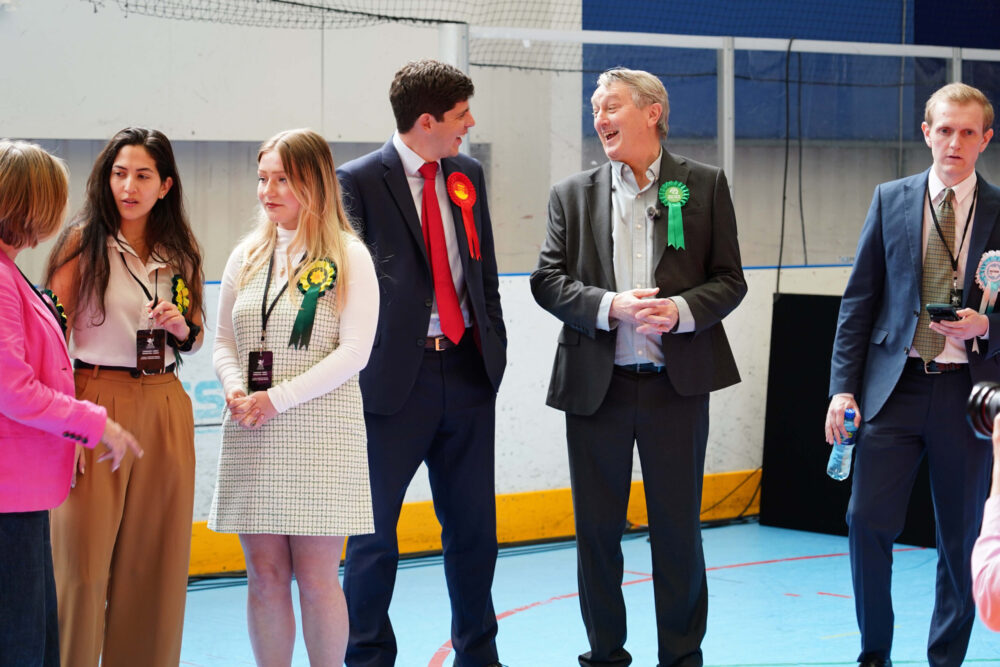
When it became clear that the Rhondda had not gone to Reform, she said she was proud of her community: the people whose stories she helps tell.
She knows the anger Reform speaks to — it is the anger of people she works among, in the same valleys that once sent miners to Westminster and now send their grandchildren elsewhere.
She had been afraid that anger would go one way. It hadn’t, quite. She was relieved in a way that was specific and local.
I felt something more complicated.
The final numbers told a story beyond the headline. Plaid won 35.4% of votes and 44.8% of seats — overrepresented by nearly ten points, the direct imprint of thousands of people reasoning as I had reasoned. Reform won 29.3% of votes and 35.4% of seats. The Greens won 6.8% of votes and 2.1% of seats. Not squeezed. Crushed.
I had wanted to limit Reform. I had also wanted to see the Greens do well. The tactical logic I followed delivered the first at the direct expense of the second. Even my careful calculation had misfired — the actual result was so far beyond what any model predicted that the tactics were irrelevant. Plaid didn’t need my vote.
The Greens might have.
That is not a comfortable thing to sit with. But it is an honest one.
The architects of Welsh electoral reform had been explicit about their intentions. The new system was carefully designed to prevent any single party gaining a majority — chosen precisely because Wales’s long experience of Labour dominance had shown the dangers of concentrated power. Fragmentation, coalition, negotiation: these were features, not bugs.
What they didn’t model was fear.
Keep Reform out
Reform UK’s presence transformed the election from a multi-party contest into something closer to a binary choice. The question voters asked, in constituency after constituency, was not which party best represents me but which vote most effectively keeps Reform out. The answer, again and again, was Plaid — some voting out of genuine conviction, the product of a century-long journey from linguistic and cultural movement to Wales-wide governing force; many others, I suspect, reasoning as I had. A system designed for conviction voting got tactical voting on an industrial scale, and produced a result its architects had specifically tried to prevent.
Reform’s 34 seats is its own kind of landmark: a beachhead, rather than a defeat. Dan Thomas spent the campaign presenting himself not as a culture warrior but as a mainstream Welsh Conservative, stressing his Valley roots, distancing himself from the more extreme national positions, offering the collapsed Welsh Conservatives’ voters somewhere credible to land. That is a more durable achievement than a protest surge.
And the trajectory is familiar. In France, the Netherlands, Sweden, Italy and Germany, populist right parties have proved remarkably persistent — absorbing defeats, moderating where necessary, occupying opposition benches and waiting for governing parties to disappoint. Proportional systems have contained them — Marine Le Pen has never governed France — but containment is not resolution. The grievances persist, and the parties persist with them.
The Rhondda knows this. My wife knows this. The anger is real.
Labour’s collapse carries a different kind of weight for me. I met Mark Drakeford several times and he spoke powerfully at a conference I organised on mindfulness in public life.
He represented something I believed in: a Welsh Government willing to think beyond the electoral cycle, to legislate for people not yet born. The Wellbeing of Future Generations Act was Labour Wales at its most serious and its most distinctive. I don’t share my son’s disillusionment Welsh Labour.
Frustration
The politicians I know are good people. The disillusionment they face is, I think, on balance, is unfair — the accumulated frustration of twenty-seven years laid at the feet of people who were trying. Wales was Liberal country before Labour displaced it in the interwar years, inheriting its nonconformist energy and its instinct for collective life. Now Plaid has displaced Labour in turn. Whether that is as durable as the displacement it echoes, or whether it is borrowed — lent by people like me who voted without quite believing — is the question the coming years will answer.
The Greens face a different reckoning. Two seats — below the threshold for a formal Senedd group, frozen out of the committee rooms where the environmental argument most needs to be made. Their natural supporters, the people most likely to reason carefully about their vote, went elsewhere. A party whose identity rests on honesty cannot afford to mislead precisely those voters. The leaflet through my door may have cost them more than they realise.
I followed only Wales on Thursday. England felt like a different country — which, in electoral terms, it now is. But the England results, arriving through the day, carried a specific dread that the Welsh results couldn’t dispel.
Whatever Wales does, I will live under the government England elects. That is the constitutional reality of the United Kingdom — and the oldest argument for independence, in Scotland and increasingly in Wales.
Thursday didn’t create that exposure. It brought it home.
Terminal
And Labour — the party that might once have been the answer — is disintegrating before our eyes. It looks like something more terminal than just losing an election: a party failing to cohere around any convincing account of what it is for, haemorrhaging support in every direction, its core vote going to Reform in the towns and to the Greens in the cities.
I felt sorry for the Welsh Labour politicians I know — good people, facing a disillusionment I think largely unfair. But sorry is not the same as confident they will recover. What comes after Labour, in England, under first-past-the-post, is the question Thursday posed most urgently and left entirely unanswered.
Which is where electoral systems matter — and where their limits show. PR contains the distortion that first-past-the-post produces. In Wales on Thursday it worked — Reform given voice, denied dominance, a government forming that is something other than what Reform wants. But PR under existential pressure, in its first Welsh outing, produced its own distortion: tactical consolidation so intense it nearly delivered the single-party majority the system was specifically designed to prevent.
That may be transitional. Scotland’s electorate has spent twenty-five years learning to use its proportional system with growing sophistication, understanding that a vote for a smaller party genuinely contributes, that tactical consolidation is less necessary than fear suggests. Wales has had one election. We are all still learning — the leaflet through my door a small, telling illustration of that confusion.
There is one further irony. Under first-past-the-post, the logic of consolidation will eventually push the fragmented progressive vote toward a single vehicle. It need not be Labour. The Greens — gaining mayors, winning by-elections, polling strongly in England — are the one party on the progressive left with momentum and clean hands. They could yet become the consolidation point for the anti-Reform majority. But only at the cost of the environmental purity that made them worth voting for. The party I most wanted to support may face a choice between remaining a conscience and becoming a force.
Later, when the results were settled, my wife said again that she was proud of the Rhondda. My son had gone back to his revision. I sat with what the day had been.
Performative opposition
The environment is the question I keep returning to. The Greens used to offer something rarer than green policies — a politics that started from what a finite planet can bear, that questioned the growth-based assumptions every other party accepts.
They are negotiating that now, trading philosophical coherence for electability. I understand the imperative. I don’t like performative opposition that achieves nothing, and gestures toward purity while Reform consolidates. That’s a luxury we can’t afford. But Thursday suggested the negotiation isn’t working on its own terms either. They have fewer seats than projected, and less institutional presence. The radical ecological voice could be even quieter in the Senedd than it was before.
Plaid has genuine environmental commitments — net zero targets, green infrastructure, opposition to new oil and gas. But they sit within a Welsh national story rather than an ecological one. What I want is a party that offers a credible transition to a sustainable planet and honestly confronts runaway consumerism. I am not convinced any party can do that fully — not the Greens under Polanski or perhaps anyone, not Plaid, not a Labour party that produced the Wellbeing of Future Generations Act and then struggled with implementation and culture change.
And yet the WFG Act remains the best available model. Not because it solved the problem but because it created the institutional architecture within which the problem could be seriously addressed — making future generations legally cognisable and embedding long-term thinking in public decision-making.
The question is whether Plaid will use that architecture, deepen it, fund it and make it real. Perhaps, governing with the constraints they face, they will find their way to being a more effective environmental force than a Green party with two seats and no committee presence. Or perhaps this is simply not the political moment for an environmental focus from any party, however urgent the need. Too many other challenges are drowning the environment out of the debate.
So I thought about my son, who was a baby the last time his mother took him to a polling station, who turned 17 the day before his first vote, who came with us because we asked him to. He will vote again in 2030, aged 21, in a Wales shaped by what is done now with the mandate lent to Plaid on Thursday — including by people like me, who voted for them without quite believing, because the alternative was worse.
I’ll support Plaid because Reform are waiting if they fail — on the environment, on competence, on cost of living, on everything that matters to the communities my wife works alongside in the Rhondda. That is not a ringing endorsement. But it is an honest one — and in this political climate, honesty about uncertainty may be the most useful thing any of us can offer.
Trustees
The Wellbeing of Future Generations Act asks us to act as trustees for people not yet born. My son was not yet born when devolution began. He voted yesterday in the country it created.
The Green leaflet was wrong about the arithmetic. But the impulse behind it was right — to make the environmental case count, to turn concern for the future into political representation. That case still needs making. It just needs making honestly, in a system we are all still learning to use, in a country that is still, slowly, becoming itself.
The choice was clear, the leaflet said. It was. We just had to work out, each of us, what that choice actually was — and live, together, with what we didn’t get.
Vishvapani teaches at the Cardiff Buddhist Centre and is a regular voice on Thought for the Day on BBC Radio 4
Support our Nation today
For the price of a cup of coffee a month you can help us create an independent, not-for-profit, national news service for the people of Wales, by the people of Wales.
Get more trusted Welsh news
Choose Nation.Cymru as a preferred source in Google News to see more of our journalism.



What do the Greens offer that Plaid don’t? It’s not policies, Plaid’s are generally adjudged to be greener, so what is it? Being less Welsh? That’s not a great look in, er, Wales, is it?
For the 2026 Senedd election, Plaid Cymru has received high praise for its green policies, ranked by Greenpeace as the strongest among Welsh parties. Their platform focuses on a 2040 net-zero target, community-owned renewables, and significant investments in public transport, aiming to make Wales a “climate and nature champion”.
I’m yet to be convinced Plaid Cymru will deliver for our environment. No Cabinet minister for climate or nature, just ‘sustainability’ tacked onto Rural Affairs.
When you vote tactically under this system the only party you are really voting against is the one you otherwise would have voted for. Reform did pretty much exactly as well as the average of polls said they would. The main impact of Plaids final day bounce was almost exclusively at the expense of Lab/Green/ and probably one Lib Dem. There’s nothing wrong with that. But as this writer suggests. Possibly not what everyone expected.
I struggle with the same feelings that the author does, my views pivot towards the Greens, but – I also want Cymru to be independent.
On another note, would it benefit the Green party in Cymru to seperate from it’s English part and become its own independent political entity? I wonder…
I thought the green party always have supported independence?
Yes, you’re quite right! I do still believe Plaid are the better vehicle in government for achieving it however!
The new electoral system promised to allow voters to choose the party they most believed in. But in the end it reduced to FPTP between Plaid Cymru and Reform, with tactical voting claims squeezing out policies. Democracy became hostage to the polling companies. Wales should follow the lead of many countries and ban opinion polls in the run up to elections.
The polls reflect public opinion/the will of the voters. I’ve seen this line wheeled out a lot and it is nonsense. People choose who they vote for, not polling companies.
In an election that became dominated by ‘only X can beat Reform’ calls for tactical voting, opinion polls carried a lot of weight. It is widely thought that voting to stop Reform explains a significant part of the vote for Plaid Cymru, whose politicians certainly pushed that line. But it was a guessing game in many constituencies as to which party would in fact stop Reform getting an extra seat. For example, Blaenau Gwent Caerffili Rhymni saw Plaid Cymru top the poll ahead of Reform, both of which obtained 3 seats. But if 247 of those who voted for PC… Read more »
Sorry, the correct number for the number of Labour voters who would have had to vote for PC for PC to beat Reform for the 6th seat should be 2,627.
In any case, this is not a good way for voters to be asked to make judgements.
Thank you for the article. A discussion about the fact that us individual voters really only have the choice on which candidate gets sixth place. The most favoured candidates are not facing an election, they have already been selected by the party process. We are hearing about the fairness of the process, but fairness to whom? Favoured members have little personal skin in the game, his party may not do well but he’s not going to be walking down to the job centre on Monday. Number 6 has everything to loose. Ask yourself if you have a problem, who do… Read more »