

Why are ethnically diverse families under-represented in Welsh-medium education?
Kirran Lochhead Strang, Cymdeithas yr Iaith Gymraeg
Every child in Wales has a right to access education through the medium of Welsh. This provides an opportunity, therefore, for every child in Wales to grow up as someone who can speak, think, live and dream in Welsh.
That is to say, have access to a unique view of the world, a way to approach life and themselves, to relate to the place they live. As well as lots of social and career opportunities, of course.
In practice, not all children are equally likely to receive that opportunity. That is partly geographical, but it is also to a major extent social, and a failure of mindset on the part of education and support services.
This is a very complex story, and I won’t be trying to address all of it in this article, by any means. But this is important for us to be talking about. Why aren’t all children having equal access to the Welsh language? Why are some more likely than others to have that?
A big and obvious part of this story is ethnic and cultural background.
Welsh is, and always has been, a multicultural language. It belongs to all its speakers, and every single speaker enriches the common world shared between them, through their own personality and experiences.
Right now, today, there are Welsh-speakers from every background, including from global majority backgrounds, who are making massive contributions to our communities. As one would expect.
However, when we look at the numbers, children from global majority backgrounds are drastically less likely to be accessing that. That is a major loss, in terms of opportunities for young people, and for the Welsh language world.
Ethnic Background in Cardiff’s Schools
I’m going to look at Cardiff as an example. Our capital city is a good place to start, and is one of the most multicultural areas of the country.
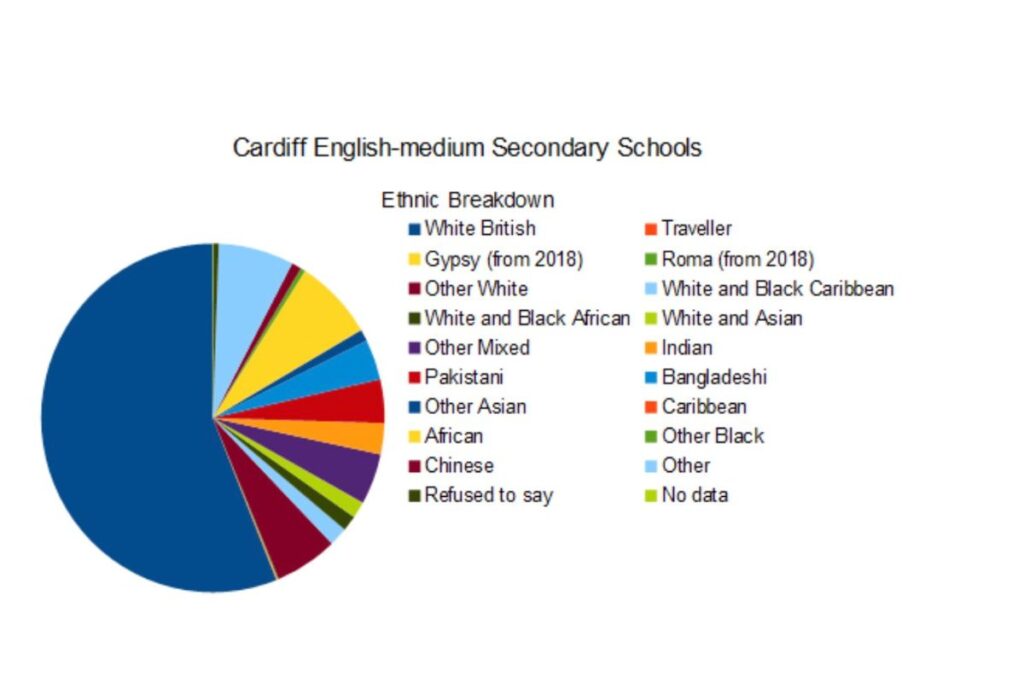
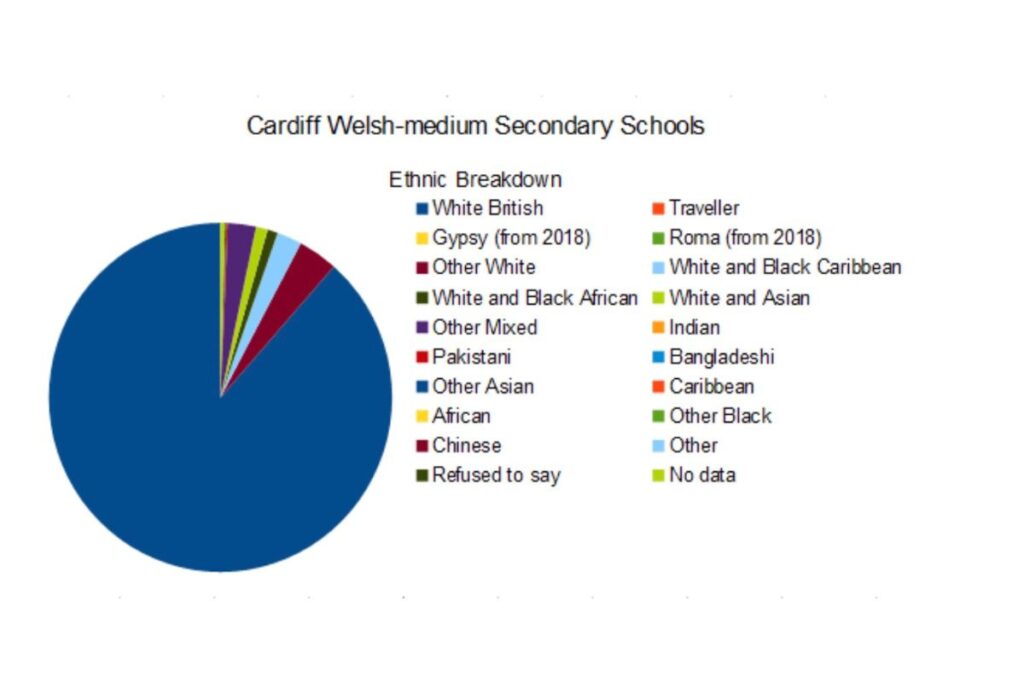
Here are some pie charts about the reported ethnic background of children in the city’s primary schools. All the data is from Stats Wales.
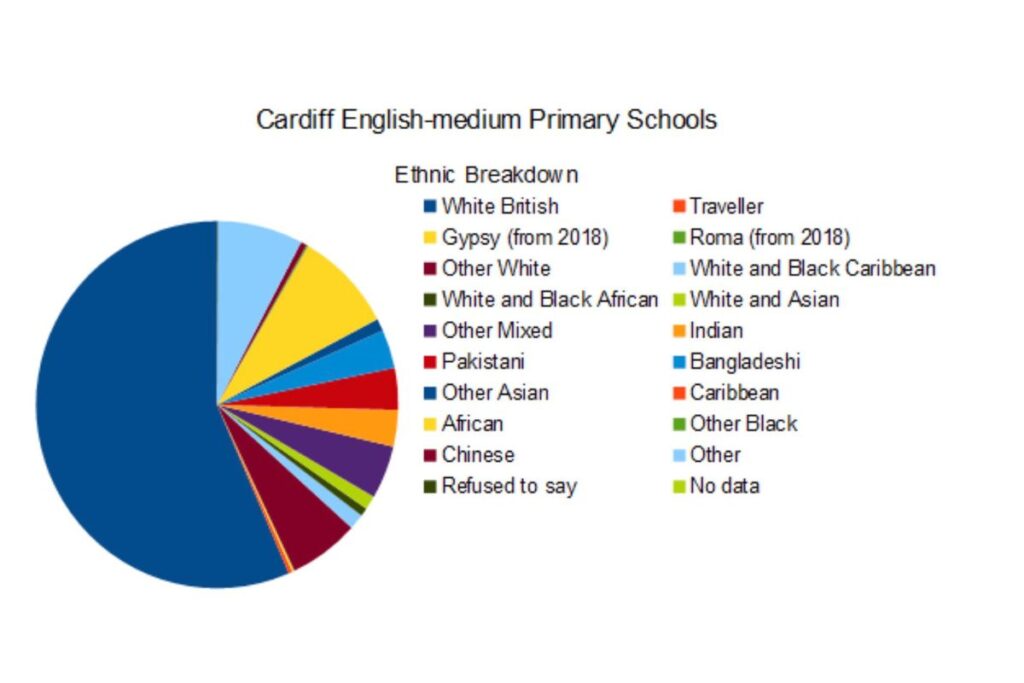
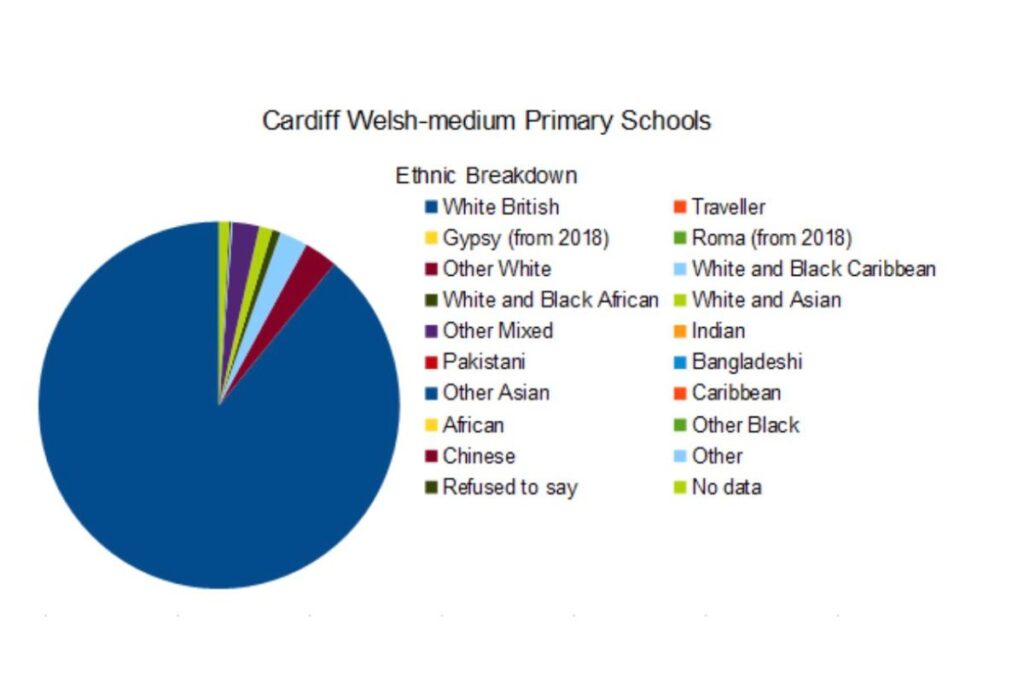
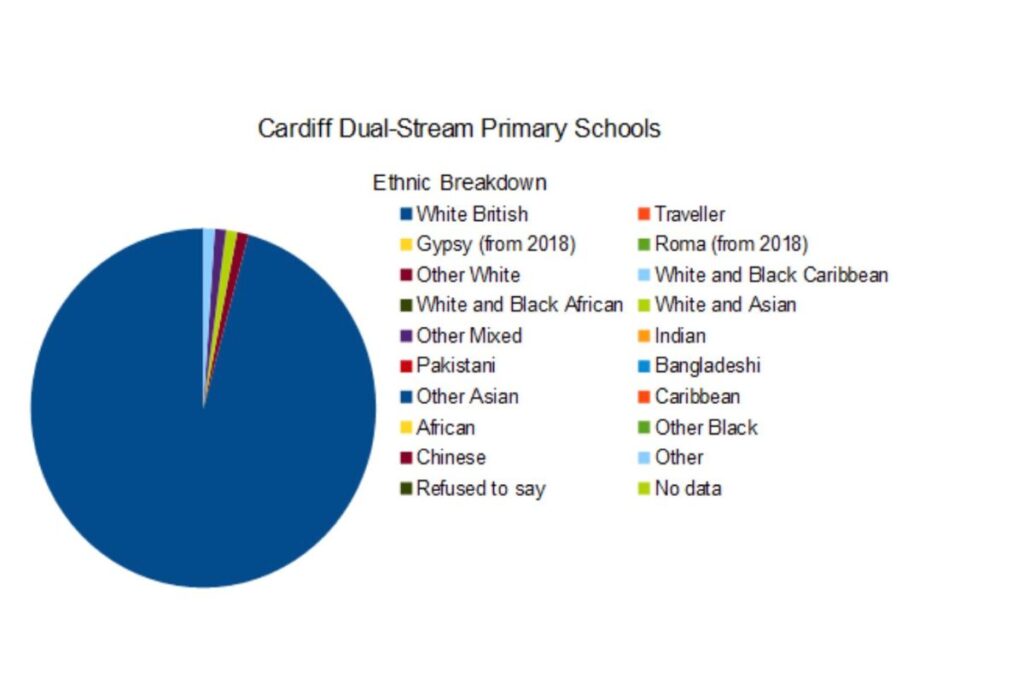
Some disclaimers: the data on Stats Wales is rounded to the nearest 5. As many Welsh-medium primary schools have less than 5 children from any ethnic category on the spreadsheet, this means they are essentially invisible to these charts.
So the numbers might vary up and down a little, but they are definitely showing the general picture. I have also separated the three dual-stream schools in Cardiff into their own category, as I wasn’t able to access data about the ethnic background of children in the different streams – in any case, these schools have less than 500 children between them, and are located on the edges of the city in comparatively less diverse areas.
They present quite different pictures. It is very clear that children from every background other than “White British” are making up smaller parts of the pie chart in Welsh-medium schools.
On a macro level, something is clearly not right here.
Cardiff Council, in common with most public authorities across the country, is failing to ensure that Welsh-medium education and the Welsh language reaches families from global majority communities in the same as it does white families, taken as a group.
This should be a cause of alarm for the local authority, and for any other local authority observing a similar pattern. The Welsh Government should be taking note. Children from these backgrounds are disproportionately failing to access Welsh-medium education, something which is clearly championed publicly as beneficial to children and our communities in Wales (which I would agree with!).
Clearly this has implications for representation in fields of work, in the private and public sectors, and in higher education, as well as Welsh-language cultural and social life on every level.
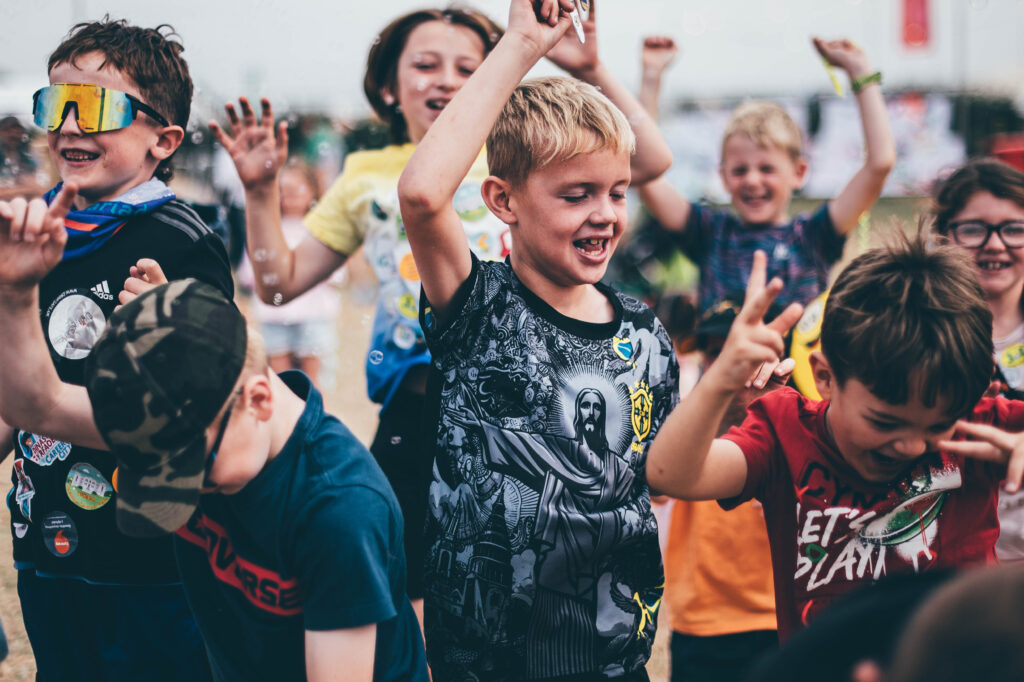
Let’s be very clear – we need more children of every background accessing Welsh-medium education – but this is a clear area needing attention!
Why this is the case
So, why is this happening? It is a very varied picture. Especially as someone falling somewhere around the ‘White Other’ and ‘White British’ categories on those pie charts, it’s not my place to speak on families’ experiences and decisions.
But both in the information which services are providing to families in different ways, and in the physical location of schools, there seems to be subtle but strong message about who Welsh-medium education is for. The correct answer, of course, would be anybody and everybody.
The relative lack of Welsh-medium provision at primary and secondary levels in the most multicultural southern wards of Cardiff is of course a factor, but, more subtly, there is the matter of how Welsh-medium education is presented and how accessible it feels.
One could respond that, for various reasons, all ethnic minority communities are on average deciding to choose English-medium education despite feeling the alternative is entirely accessible and knowing all about it.
I’ll offer a counterexample.
Oasis, a charity based in Splott and supporting asylum-seekers and refugees, has for several years been proactively offering Welsh-medium education as an option to its service-users who ask for help accessing schools for their children.
These are, one could quite reasonably surmise, some of the people who would be the least likely to consider it – their status in the UK, and in Wales, is uncertain, their children’s educational journeys have likely been disrupted, both parents and children may be less than fluent in English, and they are unlikely to have any past background or relationship with Wales or the Welsh language, having been dispersed to temporary accommodation in Wales on a random basis.
These are, overall, a small number of people and certainly in no way necessarily representative of broader ethnically diverse communities. Nevertheless, 30-40% of these families who access support via Oasis choose Welsh-medium education.
That is higher than the proportion across Cardiff overall, by a large margin. All Oasis is doing, without receiving any public money for its work, is explaining Welsh-medium education in a positive light to people and talking about the advantages and relevance of the Welsh language in Wales. (Disclaimer! I used to work there, and saw this work first-hand)
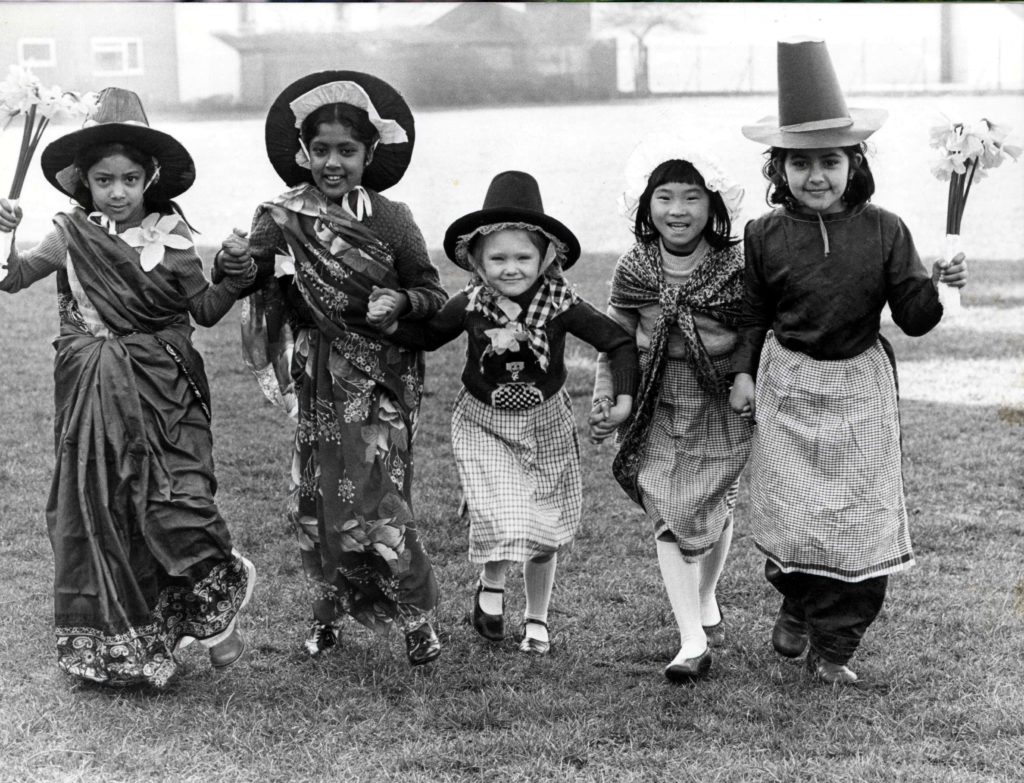
What this makes very clear is that this is not happening elsewhere – while there is public promotion of the Welsh-language and Welsh-medium education, that clearly isn’t reaching everybody.
Resources are being produced, and there certainly are people out there who are living out the policy in their work, but there is clearly a relative lack of those human conversations, and/or confidence, and /or enthusiasm at the grassroots level – the results bear that out.
Now, most asylum-seekers and refugees are coming to Wales with a blank slate in terms of preconceived notions around the language.
This is not the case for the majority of the population, and there are certainly people from many communities who feel a lack of belonging to the language or a lack of relevance to their own families.
This is, again, something clearly not being sufficiently or fully addressed publicly, but perhaps also not by champions of the language within our own communities.
What to do?
I think it has to start with acknowledging openly that this is a problem. There is clearly disproportionate lack of access to Welsh-medium education amongst children of many ethnic backgrounds.
If we want to see the Welsh language growing and thriving, it needs to be something for everyone, and it needs to be something which feels natural to everyone.
This is not true only for ethnic minority communities, by any means – there are also plenty of other social and geographical communities who are disproportionately not accessing education through Welsh!
People-facing services which are providing support to families need to be talking about Welsh-medium education as a matter of course, and doing so comprehensively and with enthusiasm.
I’ve met many families, especially those newly-arrived in the UK, who have accessed public advice services to register their children for school and come out without any awareness of Welsh-medium education as an option.
I have met several who went in and asked for it, and were actively discouraged. I know a family who have required someone to advocate for them, two phone calls and an email for a preference for a Welsh placement for their child’s Flying Start Childcare to be recorded instead of an English placement.
This is not good enough, and there needs to be a culture change around it. In every case, we need to be promoting not through forcing or pushing, but through listening and working together at a community level.
Of course, we also need to be calling for more Welsh-medium provision, and for it to be fairly distributed with input from communities, and for us as Welsh-speakers, y Cymry Cymraeg, to be increasing visibility of the language socially, and making very clear that the language is for everyone.
The Welsh language needs to be normalised. It needs to be accessible and relatable to any young person growing up in Wales, and even anybody moving here as an adult.
If there was any other public service, in particular one which was being promoted as a beneficial option for young people, which was being under-accessed to such a degree by people from ethnically diverse backgrounds, there would inquiries, investigations, press attention, debates in Council and Senedd chambers.
We need that attention to this, as well.
Find Welsh medium nursery, primary or secondary schools in your area with RHAG’s School Finder.
Support our Nation today
For the price of a cup of coffee a month you can help us create an independent, not-for-profit, national news service for the people of Wales, by the people of Wales.
Get more trusted Welsh news
Choose Nation.Cymru as a preferred source in Google News to see more of our journalism.



This is a special case of the oft complained about emphasis on British culture in schools in the UK. Why this is considered undesirable escapes me – I am sure that in Bangladesh or Nigeria the local culture and language takes precedence. Schools are provided to educate children to function in the society in which they find themselves. Whether we like it or not in the UK that means acquiring fluency in English whatever other languages you may or may not speak. For a Somali or Nigerian, or Bengali in Cardiff that means English as a second language as a… Read more »
I am not surprised that Cardiff council has been seen to be lacking in promoting Welsh medium education. They are holding a consultation to shut down Bro Edern school to the east and build a larger welsh medium school in the south of the city. The students fron the east of cardiff would then have a longer journey each day to the school. The fact they are even having this consultation demonstrates their lack of enthusiasm with Welsh medium education.
Cardiff Council’s approach to Welsh Medium education has boggled my mind for almost as long as I’ve lived in Cardiff. I remember some of the campaigns to get a second Welsh medium in the east of Cardiff which the council had dragged its heels on for a number of years, eventually builging and opening Ysgol y Berllan Deg, which immediately stimulated interest in Welsh Medium education in Llanedeyrn where previously there had been little interest, not through hostility but more through practicality and availability. Of course, this school’s catchment area included Splott andI know that many in Splott were not… Read more »
To me, the answer is obvious. But hey, let’s cook up a research project for a university to do even though there’s no research needed. Think of the stats that can be wheeled out. Jobs for the boys!
Iaith Pawb? Absolutely! Two connected issues: demand and provision. It is understandable why parents who speak languages other than English or Welsh at home may favour English medium education for their children. But how do people from Cardiff’s docklands, (never Welsh speaking communities), identified by heritage (if you must) compare with their “White British” neighbours? -all having lived locally for generations. If we ignore ethnicity and identity, what choices are made by parents who are recent immigrants from England? There are factors influencing demand for Welsh medium education other than ethnicity which need to be better understood.
Erthygl arbennig o dda, Kirran. Gwaith da.
The statement that Welsh has ALWAYS been a multicultural language is complete nonsense of course. DNA research has shown that welsh people are unique within the UK. Wales has a unique culture and people, and I hope they are protected and conserved.
What utter twaddle. DNA would show that the Welsh, Y Cymry, are as mixed a bunch as anyone else on these islands. Both north and south Wales saw massive immigration during the industrial period, and Wales’ maritime connections would have seen a significant, if not huge influx of people from around the world. Cardiff of course, saw the biggest influx. Human beings are just that, and wacky racialist notions just make those promoting them look ridiculous. It’s the kind of thing Reform UK would like to promote, but even they realise they’d become a laughing stock if they promoted such… Read more »
I agree with Padi, I don’t think I have ever come across such twaddle anywhere in the NC comments section.
So you implying that Anyone who is 100% Brythonic should be protected and conserved on Reservations as is the case with Native American and Australian Aboriginal people.
In my view, the reason is very simple – as is the solution. It is simply a question of public information, or the lack thereof. Three key messages should be communicated widely:- 1. Welsh medium education is for all, whether your home is Welsh-speaking or not. 2. Welsh medium education delivers literacy and proficiency in two languages — English as well as Welsh, — and not just one. As well as access to two linguistic cultures. 3. Bilingualism is proven to produce valuable benefits for intellectual development — as well as a great advantage when it comes to adding on… Read more »
Saying Welsh has always been multicultural feels like projecting a very modern concept backwards.
Even the words Cymry and Cymraeg come from a historically specific sense of peoplehood. That doesn’t mean Wales was ever completely isolated or homogeneous cos obviously it wasn’t. But contact with other peoples and cultures isn’t the same thing as multiculturalism.
I don’t think rewriting history is helpful.
Commenting on the Welsh language in public is always fraught with danger mainly because the state of the language remains vulnerable in the sense that the number of its speakers is still going down. There are, of course, many important initiatives in the education and media sectors which will hopefully bear fruit eventually. At the heart of the language is the culture of Cymreictod. It has sustained the language through thick and thin and brought us to where we are today. The Eisteddfod represents the main focus for this culture and long may it continue. However, as someone who grew… Read more »
The thing is Welsh language is inherently tied up with Welsh culture, they can’t be split apart, it’s not like English where it is a global language and used to express multiple different societies.
It has something to do with both the parents and education system, on one side you have parents who feel it might be culturally inappropriate as they don’t see themselves as Welsh, secondly the Welsh-medium education I feel are bias towards Welsh children who’s parents are from a Welsh background so it’s more ingrained in the family connections, I’m unsure on how you would even bridge this cap without it sounding like a ethnic issue.