


Why we’re loving being in the grip of Welsh Film Summer
Chapter Arts Centre Cinema Programme Curator, Claire Vaughan, reflects on a summer of Welsh-made, Welsh-told films, and what it means to finally see Wales on screen without the usual shorthand
“This has been a strange summer, with challenging heatwaves and football controversies, but one thing I’ll take away from it is the sense of hope and excitement we have in Wales. One after the other, beginning with Madfabulous, we’ve had huge audiences for films made in Wales, telling Welsh stories.
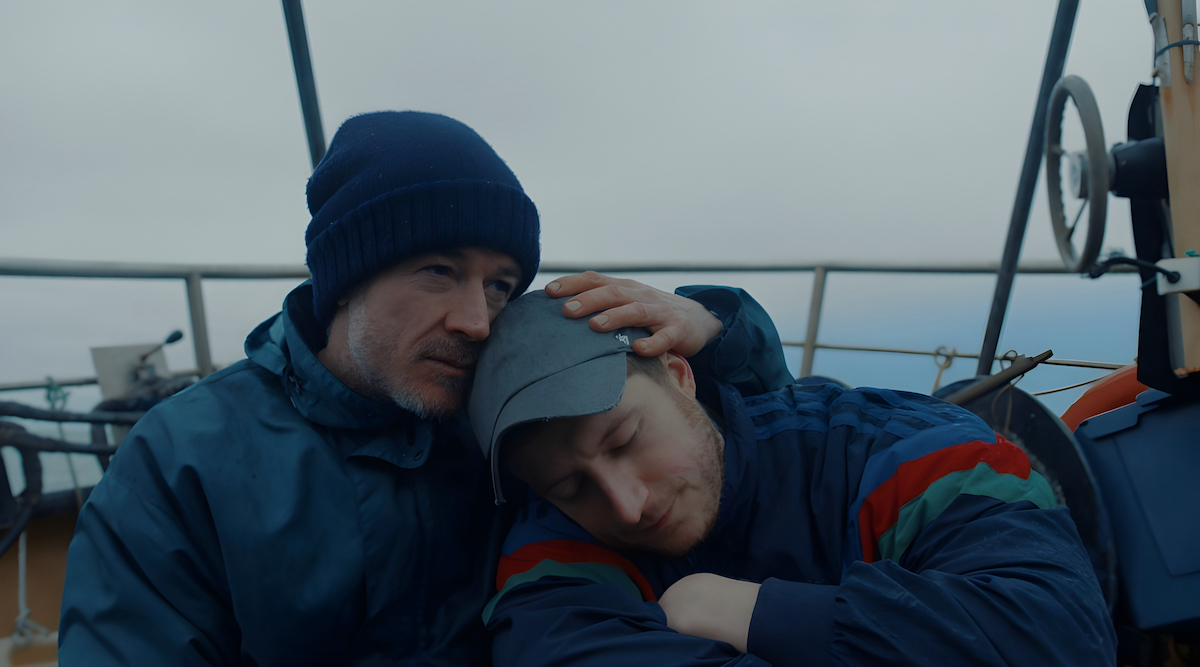
The latest we have from filmmaker Helen Walsh is On the Sea, which is a tender story of a middle-aged man in a small fishing village on Ynys Mon who uncovers a side of himself that he has previously kept hidden. This is the third film this year from a corner of Wales that we don’t usually see on our screens, which coincidentally features Celyn Jones (filmmaker behind Madfabulous) and Leisa Gwenllian (who seared through the screen in Effi o Blaenau).
Seeing our culture on screen through an authentic and unfiltered Welsh lens, rather than just being used as a backdrop, is a moving experience. Wales has been used as “generic rural area”, “mountainous fantasy landscape”, “industrial estate”, “grand urban street”, but rarely is a film made here in which the location identifiers of the landscape are as important to the characters. “Mae hen wlad fy nhadau yn annwyl i mi.”
In On the Sea, the village, though pretty and cosy, feels oppressive. Jack’s livelihood is dependent on the land (or, more accurately, the sea which surrounds it), hard on the body, hard on the skin. He endures. But then someone from outside brings a new perspective.
With the atmospheric Black Church Bay; touching sci-fi comedy Out There; beautiful Port Talbot documentary Smoking Shores; and Craig Roberts’ squirrel comedy-horror The Scurry; all due out later this year, it feels that Welsh Film Summer, like the weather, might last longer than we’ve dreamed.”
View Chapter Arts Centre’s cinema programme HERE
‘It’s a universal story’: Barry Ward on queer fishing village romance On The Sea
Lynn Rusk, Press Association
Irish actor Barry Ward has said his new queer romance film, set in a Welsh fishing village, tells a universal story.
The Bad Sisters actor plays Jack, a mussel harvester who falls in love with Daniel, a younger itinerant worker, in Helen Walsh’s On The Sea.
Jack, who is married to his childhood sweetheart and lives in a community shaped by the church and the fishing industry, sees his world turned upside down when Daniel, played by Scottish actor Lorne MacFadyen, awakens desires he has spent most of his life suppressing.
Ward, 46, said the Welsh setting could represent communities anywhere in the world.
“I think that’s the point of the movie, in a way, that the Welsh location we chose can stand in for anywhere in the world,” he told the Press Association.
“I think specifically in the more traditional working-class towns and industrial towns where, given the nature of manual labour, there’s often a bit more of a macho culture.
“We were both reading Édouard Louis, a beautiful French writer, while filming. He’s from a town in the south of France, very much not coastal, but an industrial town and it chimes very much with On The Sea. So I think it’s a universal story.”
Dublin-born Ward, who adopted a Welsh accent for the role, said it was an interesting challenge.
“We’re always looking as actors for interesting challenges, and they were plentiful on this,” he said,
“The accent, first and foremost, was a tricky one, and Welsh is notoriously difficult.
“It was such a specific part of Wales as well, up north, closer to Liverpool, that it was a strange hybrid accent.
“We spent a lot of time working on that, but then, as Lorne mentioned, the dialogue is so sparse, given Helen’s beautiful and restrained writing, but also because of the world we’re in, which is very macho.”
MacFadyen, 36, who has also starred in Vigil and The Lazarus Project, said: “I loved the writing, and the setting was something I really connected with because I’m from a fishing community in Skye.
“I felt that that world was depicted very well, the close-knit, somewhat closed-off community and the pressures that come with trying to exist within it as someone who is a bit different.
“I really loved the way Helen wrote the dialogue as well, and how there was so much space between the lines. We could fill the silences with loaded context and back story.
“It’s a really beautiful script, and it went through several iterations, it was an ever-evolving process. So a big part of it was the script, but a big part of it was the team as well.”
MacFadyen added: “It’s interesting to think about how different it would be if you set the story in an Irish or Scottish village, in an equivalent community, like a rugged island compared with Craggy Island. I think there are a lot of similarities.
“The common factor as well is class. The way sexuality is dealt with and perceived in certain trades and professions can make it more difficult for people who are queer, or who are living with some kind of alternative identity, to work in these very macho, heteronormative environments.
“I think that would be the common theme I recognise, but it would be interesting to see where the differences lie. I’m sure there would be some big ones that I wouldn’t know until I experienced it. It would be interesting to see.”
On The Sea is in cinemas now.
Support our Nation today
For the price of a cup of coffee a month you can help us create an independent, not-for-profit, national news service for the people of Wales, by the people of Wales.
Get more trusted Welsh news
Choose Nation.Cymru as a preferred source in Google News to see more of our journalism.



I like Chapter but the staff always seem so fed up.