


With the world in chaos, and Britain adrift, standing up for Wales has a new urgency
Martin Shipton
For those who are sceptical about the British state, two recent developments provide convincing evidence that it is not functioning in the best interests of the people of Wales.
Keir Starmer’s version of muscular unionism takes us back to the 1970s, when hostility to the notion of political devolution was seen as a tenet of faith by a certain kind of Labour politician.
Such a position inevitably led to a situation where successive Conservative Secretaries of State ruled Wales in the same way as Governors General ran countries like Australia and India during the colonial era.
Welsh Office ministers answered parliamentary questions at Westminster, but there was little effective scrutiny of their actions and cronyism blossomed.
Together with the ravages to the Welsh economy during Thatcher’s premiership, concerns about the undemocratic nature of rule by Governors General led to rising demands, in the political class at least, for a devolved Welsh Assembly.
In 1997, by a small majority, and in 2011, by a large majority, two referendums resulted in the law-making Senedd we have now.
Over the years, the powers of what is now the Senedd accrued, although Wales continued to lag behind Scotland and in some cases Northern Ireland in the extent of devolution that took place.
For those who want to see the Senedd grow in terms of its responsibilities, it remains a grievance that the justice system and policing are areas reserved to Westminster.
Brexit, however, became a turning point as successive Tory UK governments decided to take for themselves powers that had previously been exercised by the devolved administrations, most notably the allocation and distribution of regional aid funds from the European Commission.
While Labour was in opposition at Westminster, it protested about such power grabs, but soon after its victory in the 2024 general election it became apparent that the UK Government wanted a major role in what had previously been a wholly devolved policy area.
The fact that economic development was, according to the devolution settlement, devolved was ignored by the current Labour UK Government in the same way as it was ignored by its Tory predecessor.
The leak to Plaid Cymru of Starmer’s email to his Cabinet colleagues from last December, in which he revealed that, so far as he was concerned, there was no parity of esteem between his government and those of the nations, demonstrated what had been apparent for some time.
Despite protestations to the contrary, it’s clear that Starmer believes there is nothing wrong with encroaching unilaterally on devolved responsibilities such as economic development. Indeed, it is apparent from his leaked email that he sees a positive virtue in doing so because he believes it gives him the opportunity to enhance the political capital of his own government.
Betrayal
This is a betrayal of devolution and Rhun ap Iorwerth was right to call it out. What is the point of devolving powers to the Senedd if the UK Government is going to undertake projects in parallel to it in devolved policy areas?
The UK and Welsh governments should not be competing with each other, but getting on with their own responsibilities. It is inconceivable that the Welsh Government would be permitted to set up rival courts in Wales, so why should it be acceptable for the UK Government to build infrastructure projects that should fall within the purview of the Welsh Government?
Unsurprisingly, most Labour MSs are shocked by this turn of events, not least because it undermines the successful brand that their party has built up in Wales: that Labour is standing up for Wales against centralising forces that would consign the nation even more to the margins of British politics.
The brand worked when the Tories were in power at Westminster, but the idea of a Labour Prime Minister sabotaging a carefully cultivated and successful political image is alienating and counter-productive. Votes will be lost in spadefuls.
U-turn
The U-turn on devolution – for that is what it amounts to – is more significant than Starmer simply pulling rank on what he sees as a bunch of Celtic Nationalist disrupters.
Many people who have severe reservations about the British state have been able to see the Senedd and the Welsh Government as bulwarks against the disturbing drift to the right in contemporary political discourse.
Starmer hasn’t succeeded in much, but he has managed to ensure that a high proportion of those who saw the accrual of extra powers by the Senedd as a good thing have now been alienated.
Meanwhile, the humiliating way in which Starmer manages to sound as if he’s sucking up to Trump even when he would like us to believe that he is adopting a more independent stance is another turn-off for those of a progressive disposition.
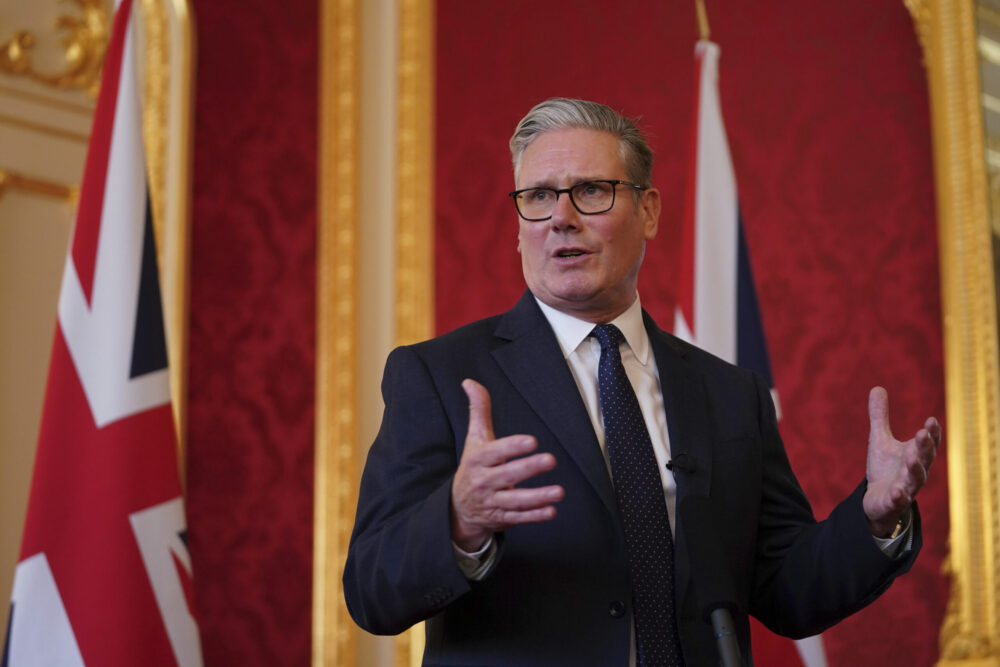
Simultaneously, he seeks to invoke a pathetic strand of imperial nostalgia by insisting on being filmed between two Union flags every time he makes an appearance in his office. Labour is supposed to be a party of the left.
People of the left that I know don’t want to be associated with the long-gone British Empire and its legacy of violence and oppression in those countries it conquered and plundered.
If they supported the continuation of the British state, they wanted it to shed its negative baggage and become committed to a more equal society where poverty was marginalised and in due course eliminated. None of that is compatible with signing up as an albeit halfhearted supporter of Trump’s wars.
Hogtied
In terms of its international approach, the UK Labour government is indistinguishable from its Tory predecessor. Hogtied by Brexit, Starmer offers little in the way of a progressive roadmap for the future (as contemporary jargon would put it).
Britain’s days of strutting the world stage as if it was an important world power with its own respected perspective on geopolitics have gone for good, and we are left with a shell of a state whose influence is negligible.
In these circumstances the way forward is surely to concentrate on making Wales the most successful nation it can be.
With the world in chaos, and Britain adrift, standing up for Wales has a new urgency.
Support our Nation today
For the price of a cup of coffee a month you can help us create an independent, not-for-profit, national news service for the people of Wales, by the people of Wales.


