

Y Sais: Why is a Welsh language talent show sidelining Welsh talent?
Stephen Price
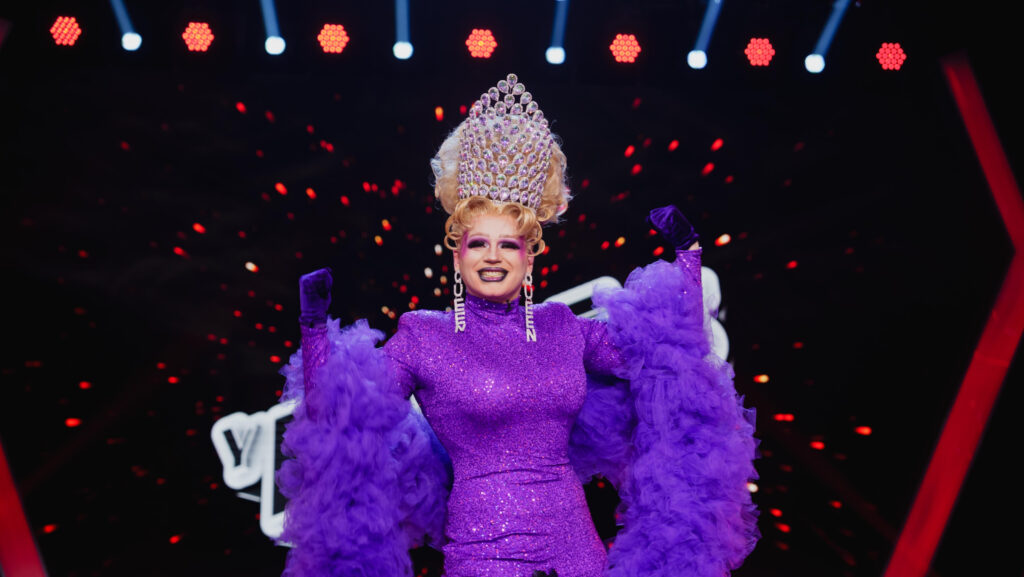
A drag artist who moved to Wales from Somerset became the winner of Y Llais over the weekend, famously becoming the first drag artist to win a series of the Voice anywhere in the world.
Anyone following Welsh language media will have noticed, however, that Carrie Sauce – the stage name of Oliver Martin – has conducted all media interviews in English.
A clunk, you’d think? Well, like a quarter of Y Llais contestants, Carrie is ‘learning’ – only unlike many others, not really going further than a few words and the lyrics during the show or afterwards.
The press release reads: “Carrie Sauce has been crowned the winner of the second series of Y Llais on S4C.
“Carrie Sauce is believed to be the first ever Drag Queen to win The Voice across all territories since it started in 2010.
“Oliver Martin from Cardiff, who performs as Carrie Sauce, stunned the Coaches throughout the series and ultimately claimed victory as a member of Sir Bryn Terfel’s team.”
Speaking about performing alongside Sir Bryn Terfel, Carrie Sauce said: “Working with Sir Bryn was a dream come true. Having watched him in shows over a decade ago – to know that one day I’d actually be on stage performing with him, holding hands, looking into his eyes – I had to pinch myself! It was incredible, I loved every second of it.”
The press release adds: “Just over a quarter of the contestants in the first two series’ of Y Llais have been Welsh learners or people reconnecting with the language. Carrie Sauce, originally from Somerset, is also a proud Welsh learner and enjoyed the experience of singing in Welsh: “The series is incredibly important. It really brings focus to the Welsh language and I really hope it reinvigorates the language. It’s such a beautiful part of our culture and we can’t afford to lose it.”
“I just want to be able to keep performing, keep learning Welsh, keep enjoying this amazing country. I’ve lived here for 7 years and I hope I live here for the rest of my life.”
So this is going to divide the room, and I’m going to be lambasted for saying it, let alone putting it in print – but I’m unemployable anyway, what do I care!
Comments on social media also show a divide, with some asking (translated): “Welsh programme?”
While others added: “Without learners, there’s no future for the language?”
So of course, it’s commendable that anyone is learning Welsh, da iawn pawb, but something feels amiss when S4C – the home of Welsh language broadcasting – sidesteps for English language so readily and easily as long as someone has the DuoLingo app on their phone.
S4C was born through decades of blood, sweat and tears.
The channel launched in 1982, the result of a bitter struggle by Welsh speakers who were fearful that the language would suffer further decline if it was not shown on television. Campaigning included refusal to pay for television licences and scaling television masts.
When the Conservative government at the time reneged on its promise to set up the channel, prominent politician Gwynfor Evans even threatened to carry out a hunger strike to his death.
There is still a lot of passion still burning for the channel, but also a lot of apathy. Something is ‘off’ at the minute – perhaps even its very Welshness.
Bending ’til broken
I listen to a lot of world music and can sing songs by Yasmine Hamdan, Sébastien Tellier and many more. Do I know what I’m singing? Not really.
Would talent shows bend to English speakers who can’t speak other languages?
The answer isn’t straightforward in this case, since much of the world kowtows to English. And a vast number of people can speak the language with ease.
When Jessie J went on a Chinese talent show, the show bent for her. Would it do so for a Welsh speaking celebrity or nobody? Nah, let’s get real.
When the Cheeky Girls or Wagner went on X Factor, did they engage with the panel and TV production people in their native languages?
When Welsh speaking artists appear on UK talent shows, too – Alys Williams and Bronwen Lewis herself – do they speak to the panel, the production, the English press in Welsh? What do you think?
So why are the Welsh always so eager to bend for English speakers?
One reason, no doubt, is the strange reverse role of knowing what it feels like to be in a minority, and then a false setting whereby Welsh is top dog means English speakers need a little pity, a little help, a little support and encouragement.
Aww bless!!
Ble Mae’r Gymraeg
In years gone by, S4C felt like an island of sanity and accessible Welsh culture, with learned presenters and contributors and a focus on history, music, arts and the like.
Still today, the channel has some fine shows like Cynefin and Am Dro (both featuring learners with varying standards) but all too often, S4C has even a new speaker myself asking Ble Mae’r Gymraeg?
Again, I’m the biggest user of and champion of using whatever Welsh you’ve got, accepting mistakes and growth. But standards are still expected on English TV and all other countries’ TV stations, so why not Wales?
S4C has long championed the learner but they, again, met a standard. Similarly, Aleighcia on the panel provided a breath of fresh air for the new speakers among us – but her appointment was based on merit and the fact that she can indeed string a sentence together, and she worked very hard to get there.
Carrie’s win as the first Voice drag winner might feel like a pat on the back for S4C and those involved with the show but it’s a damning sign of the times for the channel’s future – one that no longer belongs to the very people it was set up to represent.
Why should Welsh speakers need their English speaking skills sharpened when watching TV? And why is it S4C’s job to bend to English speakers who are, effectively, taking chances away from up and coming Welsh performers??
In a previous role working in communications at a children’s cancer charity, we had S4C in for filming for a few hours one day and I met the lovely Mari Grug.
Knowing I’d studied Welsh, but hadn’t used it in the wilds for some time, she walked me through my lines and ensured the cameraman left with some words from me in Welsh.
It’s perhaps illusory – just as finding the sole speaker in a crowd of hundreds for a news item can be – but it’s what S4C viewers want and deserve. And it’s what I also should have given them after all my years writing essays and learning new words from a dictionary as we did back then.
It’s that feeling of a lived language that S4C offers and gives hope to. Not one that’s calling itself progressive for allowing English to take centre stage. It might be intended to be edgy, but sadly comes off offensive and lazy.
Is it really too much to ask that those qualifying for a spot can at least speak the language, the raison d’être of the station?
Welsh people, Welsh speakers especially, are denied platforms on the world stage and so very often – as proven by UK TV and film companies – a platform in our own land.
This might feel like a clever, forward thinking win for the show, but it reeks of smugness, hidden agenda and ‘doing the right thing’.
After the win, Carrie said, in English: “I hope that I make the queer and the drag community so proud. This is for every drag queen, every drag king, every drag thing, anyone who’s ever thought about auditioning, performing, this is for you, and I could not be happier.”
The focus is on drag, and queer, but as one of those old fashioned homosexuals that have fallen by the wayside in the new rush for anyone and everyone to dress up in victimhood and the word ‘queer’, I’m out.
Star quality?
Unlike the star quality of last year’s winner Rose Datta, Carrie is a very niche choice based on singing style and marketability – akin to all other Voice franchise winners who haven’t exactly set the world on fire.
Yes, it’s great that someone is singing in Welsh and has learned the word ‘anhygoel’, but if they’re not speaking it too, it’s sheer opportunism.
“Oh but you’ll put learners off!” I’ll be told.
Only it doesn’t work like that. We need wider, more accessible Welsh medium education in Wales and sustainable communities for our own people to live in. Therein lies the only real answer – hobbyists can only do so much. S4C can only do so much.
I learned Welsh because it had been denied to my family through historical wrongs, and through a love of arts, culture and history of the land.
Would I be so keen on learning based on seeing Carrie work the stage and then speak in English afterwards anyway? Let’s just leave it at ‘no’.
If S4C are concerned with clicks and hits, then perhaps this move will do their stats well. I’ve not checked the ratings.
But beyond the headlines and the figures, I wonder if S4C’s originally-intended audience will be watching series three? I know I won’t.
Support our Nation today
For the price of a cup of coffee a month you can help us create an independent, not-for-profit, national news service for the people of Wales, by the people of Wales.
Get more trusted Welsh news
Choose Nation.Cymru as a preferred source in Google News to see more of our journalism.



Spot on. Yes, we need to encourage those who are genuinely learning the language. But English speakers already have The Voice to aim for, and should leave Y Llais to contestants who can actually speak Welsh to whatever standard.
Your headline for this article says y Sais which, I believe, means English man. Does that refer to the male drag artist?The article is about y Llais, which means the voice. As a Sais Brummie, who has learned more Cymraeg than most Cymry, is your title a mistake and should it have read y Llais or is it a play on words which is beyond my capabilities to understand with my basic Cymraeg?
Bang on – as one of the ‘originally intended audience’ from the mid 80s our TV was just about permanently on S4C. With young children, we were happy to watch together as a family, certainly any of the output before the watershed. Things started to go downhill when Pobol y Cwm went ‘realistic’ and out went a mainstay of our evening viewing. So when that came on we switched over, starting a trip down a very greasy slope. I rarely watch S4C these days – I look at what’s on offer and it’s slim pickings really. I have seen a… Read more »
Diolch am dy sylw cywir call. S4C is rolling downhill faster than most other declining aspects of Welsh culture. The rush to embrace niche junk like any old drag queen that pops its head over the parapet is typical of our media and political establishment. You see it among our Senedd members and other influential people. By all means recognise real top talent but don’t rig the results to favour someone’s pet project.
Carrie did have an extraordinary voice and she will have certainly added credibility to Y Llais as a singing competition. But I agree, her commitment to Cymraeg seemed fairly minimal …even her giant earrings said QUEEN rather than something in Welsh. But a Welsh speaker won last year, so I certainly haven’t lost hope.
Blummin’ foreign drag queens coming over here and stealing our jobs…
Made me smile thanks