


From B&Q to the Lions – Alex Cuthbert reflects on his remarkable rugby journey
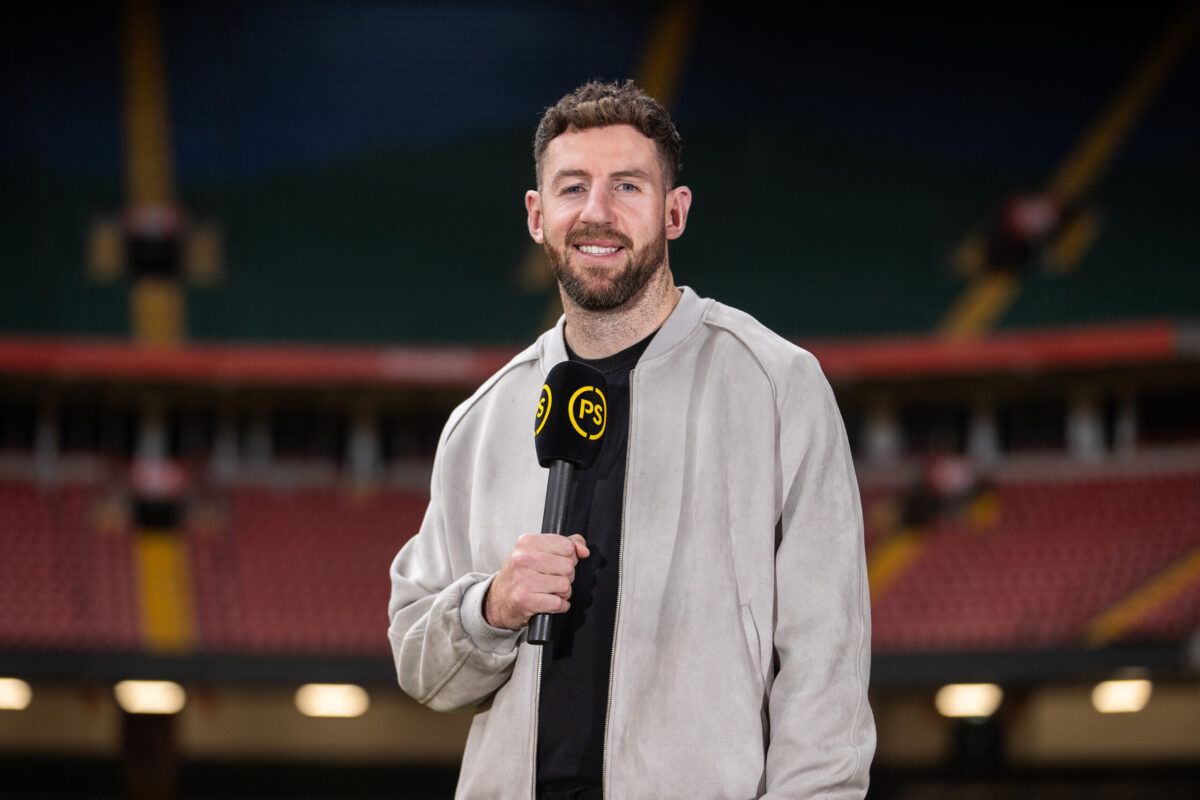
Simon Thomas
Some 15 years on, Alex Cuthbert still has to pinch himself when he reflects on how he exploded onto the international scene.
He had played precious little senior rugby when he made his regional debut for Cardiff in the autumn of 2011, but within three months he was lining up for Wales.
Amid a remarkably rapid rise to stardom, the predatory winger went on to score the tries that clinched the 2012 and 2013 Six Nations titles and became a Test Lion, while winning 57 caps in all.
Now retired and forging a successful career in the media and with his business interests, the 36-year-old is able to look back on it all with an acute awareness of just how much rugby has given him.
Born and raised in Gloucestershire and educated at Newent Community School, he first took up the sport around the age of 14 with Hucclecote RFC.
“I only joined because a mate of mine played and he asked if I fancied playing,” he recalls.
“I was doing a lot of athletics at the time. That was probably my main sport back then. I was also playing football for Gloucester City.
“I guess I sort of just fell into the rugby role.
“I remember playing against the likes of Taulupe Faletau and Billy Vunipola at junior level when we used to play against Bristol teams. They were unreal, just unplayable, to be honest. It’s mad to think about it now.”
Cuthbert moved on to his father’s club, Westbury-on-Severn RFC, and then headed for Hartpury College, where his tutor was the current Wales Women’s coach Sean Lynn.
“I only played for the thirds and fourths at college,” he says.
“I was pretty raw and rugby probably wasn’t in the forefront of my mind.”
But then everything changed when he tried his hand at Sevens.
“My way in is pretty unique really. I can’t imagine anyone has got a story quite like it,” he says.
“I just got spotted playing Sevens at college and then someone said ‘Do you want to play in a tournament?’. I said yeah and it snowballed from there.”
Crucially, he ended up turning out for a team called the Marauders.
“I have to give a lot of credit to them. They were a big part of my story. I ended up playing at Twickenham.
“With the Marauders, I played with Craig Hill and Ifan Evans who had just won the Sevens World Cup with Wales.
“They texted the coach, Paul John, to say I was Welsh qualified. Then Paul got in contact and said ‘Why don’t you go to Cardiff Met and we can sort it out with Sevens’.
“I said go on then, that sounds like a good idea. It went from there then really.”
Cuthbert went on to represent Wales Sevens while studying sports science at Cyncoed, including being part of the squad for the 2010 Commonwealth Games in Delhi. He also played 15-a-side for the college first team, with his talent and potential being recognised as he was handed an Academy contract at Cardiff.
“I was quite an old Academy prospect. I was 19 and with lads like Ellis Jenkins and Harry Robinson who were two or three years younger than me.”
He made his debut for the semi-pro Cardiff club side as a replacement versus Pontypool in January 2011 and then announced himself with two tries against RGC a few weeks later.
Fast-tracked
Come the start of the following season, he found himself fast tracked into the regional set-up.
“I came off the bench in a friendly at home to Bath and scored a try and that’s when I think they took note and said ‘Hang on a minute, maybe he’s got something here’.
“I remember I was travelling reserve for Edinburgh away, then I made my league debut against Benetton at home and then I played pretty much every game for about seven years straight.
“I was still so raw when I started out. I had hardly played any senior 15-a-side rugby. I was such a novice.
“They just took a punt and I guess it paid off to a degree.”
You can say that again.
After just a handful of appearances for Cardiff, he was selected to make his Wales debut against Australia in December 2011, qualifying through his Wrexham-born mother.
A few months later, he scored the try against France that sealed the Grand Slam and the following year he claimed a memorable double versus England to secure another Six Nations title.
Named in the Lions squad for the 2013 tour of Australia, he touched down once again in the opening Test victory over the Wallabies in Brisbane.
This really was the stuff of fairytales.
“It was mad – just on another level,” he says.
“What I achieved in that two year period is what people dream of as rugby players.
“I don’t think I really realised what was happening. I was 21, 22, 23.
“You don’t really think about it too much. You have no fear.
“I just took it in my stride and tried to enjoy every moment as much as possible.
“I was lucky I was in some very good teams and some very good environments with some very good players, which helped me along the way.”
Key role
Looking back, he is quick to acknowledge the key role Cardiff played in his meteoric rise.
“I have always had that mindset where if anyone did give me an opportunity, I would take it,” he says.
“It was just I didn’t get them until I got the chance at Cardiff. Luckily, Justin Burnell and Gareth Baber believed in me and I guess it went from there really.
“I was just trying to do what I did my whole childhood – just get the ball and run as fast as I could.
“I thought nothing of it. If I had an opportunity in a game, I just took it.
“I tried to look at scoring tries as a habit, like a normal thing, and that was my job.”
He added: “There were a lot of senior players in that Cardiff team in my first year who were such influences in my career.
“You had the likes of Xavier Rush, Paul Tito, Martyn Williams, Sam Warburton, Leigh Halfpenny, Ben Blair and Casey Laulala, who was probably the best player I ever played with.
“With Casey, it was just his skill set in the centre. He always seemed to put me in the right position. I scored a lot of tries off him.”
As for the highlights of his time with Cardiff, he picks out a few notable victories.
“When we beat Toulon at home in 2013, that was pretty special. We were one of the few teams in Europe to beat them during the three years they were champions.
“There was the Challenge Cup semi-final against Pau in my last year at the club in 2018. That was up there.
“But I would probably go for my first game in the Heineken Cup, which was Racing Metro away in November 2011.
“That was really cool. The atmosphere in the stadium was proper epic. I had really long hair, a pink kit and I remember scoring in the corner.”
Exeter
After making 112 appearances for Cardiff, scoring 46 tries – second only to Tom James in the regional era – Cuthbert decided to head for pastures new in 2018 by joining Exeter.
“It was quite hard to leave because we’d had a really good year.
“Culturally it was amazing. Danny Wilson and Matt Sherratt were very good at that. I absolutely loved it.
“We had a really good team with the likes of Nick Williams, Gareth Anscombe – one of my best mates – Ellis Jenkins, Lloyd Williams, a real good core that knew the club.
“But when Exeter came in for me, I was looking at the team they were going to have for the next two or three years. I always wanted to win the Champions Cup and I probably wasn’t going to get that long term with Cardiff.
“It was something I just needed to have a crack at.
“I had turned them down twice before, so I think it was third time lucky for Exeter that I ended up going down there.”
Cuthbert fulfilled his dream when the Devon club won the 2020 Champions Cup, while also claiming the Premiership title that year, either side of twice more reaching the domestic final at Twickenham.
“It’s an epic club. It was amazing off the field and then obviously there was everything we achieved on it, with the double.
“My son was born down there as well, which makes it extra special. I made a lot of very long term friends.
“Exeter is a city, but it’s like a town really. It’s a pretty small place and rugby is its heart. Everyone just lives and breathes it.
“There was hardly an empty seat in the three years I was there. Every game felt like a cup final.”
60-cap rule
Moving to England did mean Cuthbert became ineligible for Wales under the WRU’s 60-cap rule as he was on 48 at the time.
“I knew that would be the case. I was probably having a bit of a grey period with Wales. I just needed that reboot.
“When I went to Exeter, I started to see the game very differently.
“The coaches there just simplified the game and it was all about doing what I do well. I knew my job, I knew my role. It was to get the team into the 22 by whatever means necessary.
“For nine years in Wales, I got told that I needed to work on all my weaknesses, whereas at Exeter it was very simple – just be good at what you are very good at.
“I probably ended up playing the best rugby of my career there and I couldn’t play for Wales.
“I missed the Grand Slam and the World Cup in 2019.
“I do find that a little bit hard to take sometimes, but that’s just rules, isn’t it? It is what it is.”
Cuthbert picks out the 42-12 Premiership semi-final victory over Dan Biggar’s Northampton in 2019 as a particular favourite memory and No 8 Sam Simmonds as the best Chiefs player he lined up with.
After three years with Exeter, he returned to Wales to join the Ospreys in 2021, earning a recall to the national team and adding nine more caps.
As for the contrast between life on either side of the bridge, he says: “The banter is very much different.
“It’s a lot more brutal in Wales. It’s a little bit nicer in England!”
Since hanging up his boots at 34, Cuthbert has moved into the media, working as a pundit with the BBC, Premier Sports and Talk Sport, while also having his business interests as a director of Sportin Wales and Businessin Wales.
As for family life, with his wife Sarah he has two children – six-year-old son Harrison and four-year-old daughter Coco.
B&Q
Looking back on his rugby journey, he concludes: “I owe the game a lot. It’s given me opportunities and I have so many stories to tell.
“Having come into the sport a bit later than most people do is probably why I am a little bit more appreciative of it all.
“I had a job at B&Q when I was at Hartpury, working on the cashier desk.
“I lived a pretty normal life before rugby came to me at 18 or 19. Going in later was probably beneficial.
“There have been so many life learnings along the way.
“I wouldn’t change it for anything.”
Support our Nation today
For the price of a cup of coffee a month you can help us create an independent, not-for-profit, national news service for the people of Wales, by the people of Wales.
Get more trusted Welsh news
Choose Nation.Cymru as a preferred source in Google News to see more of our journalism.


