


Here be dragons: How the Football Association of Wales was founded
Iwan Williams
Those who know their Welsh football history will be familiar with the background to the FAW’s founding. For those who don’t, it involves a daring and forward-thinking solicitor, a crowdfunding plea to play Scotland, and a busy February in Wrexham.
In January 1876, Llewelyn Kenrick, a 29 year old solicitor from Rhiwabon, answered a proposal by a young London-based coal merchant from Sir Gâr, George Alexander Clay-Thomas, in The Field newspaper to form a Welsh team to play Ireland or Scotland.
The proposal, published on 8th January, was to play the Celtic cousins in rugby, and that the team would include London-based Welshmen. Kenrick proposed however that the game should follow (Association) football rules and look beyond London.
Kenrick wasted no time and informed The Field on 22nd January, using the pseudonym ‘Cymry’, that the footballers of north Wales were ready and willing to play.
Scotland answered the call (“the Scottish team is prepared to play a match with the Welsh team” reported the Cambrian News on 18th February) and arrangements were put in place for a game in Glasgow (the West of Scotland cricket ground, venue of the first ever international match between Scotland and England in 1872) in March 1876, with a return game to take place in Wrexham the following year.
If there was to be a Welsh team, then Kenrick needed an association, a formal body to manage and administer the team and provide governance through a committee. He also needed players!
Phil Stead’s Red Dragons mentions that Kenrick “was the founding father of Welsh football, and he dragged the FAW screaming into the chaotic and lawless world of organised ball games in 1876”.
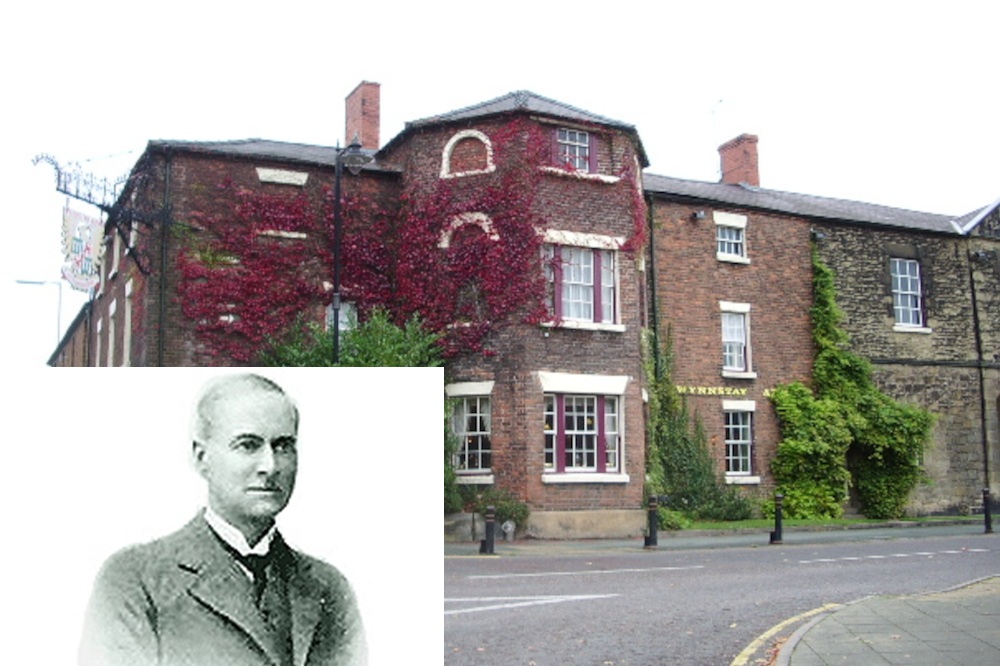
A meeting was hastily arranged for 26th January, with a more formal meeting on 2nd February at the Wynnstay Arms Hotel in Wrexham. There was only one item on the agenda: confirm the arrangements for the game in Glasgow!
The FAW began life as the CFA, the Cambrian Football Association. In addition to Kenrick, the first CFA/FAW committee included future Cymru players and brothers Alfred (a stonemason and Sunday schoolteacher) and James Davies (a stonemason), and another set of brothers, David (a Captain with the Royal Denbighshire Militia) and George Thomson (a timber merchant).
They were joined by Sir Watkin Williams-Wynn (6th Baronet, MP for Denbighshire, local Justice of the Peace and the first FAW President); Edward Evans Snr (an insurance clerk from Mold); Richard Mills (a printing company owner from Newtown); Charles Edwards (a barrister from Dolgellau); and James Sprott (a solicitor from Shrewsbury).
Social networks
Martin Johnes’ ‘The New Craze: Football and Society in North-East Wales 1870-90’ mentions that an analysis of the first committee “reveals both its relatively narrow social composition and, perhaps, its reliance on existing social networks”.
Following the historic meeting, a trial match to select the Welsh team was held at Y Cae Ras/The Racecourse in Wrexham on 12th February, featuring players from the (Ruabon) Druids and Wrexham clubs.
A second trial match would be held there on 19th February, with a third match (against Oswestry Town) on 26th February.
On 5th February, the Wrexham Guardian and The Field reported that those who wished to play in the trial matches needed to provide their details to Kenrick (as FAW honorary secretary) as soon as possible: “Gentlemen desirous of playing in these matches are requested to send their names and addresses”.
It wasn’t Together Stronger in the early days. Accusations of parochialism and favouritism would be placed at Kenrick’s door, and with reason: the (supposedly) all-Welsh trial matches were very much a north-east affair!
The accusation was that Kenrick had done more to advertise for players on his doorstep and across the border than in the south.
As stated in Red Dragons, a disgruntled C.C. Chambers, captain of Swansea, wrote to the Western Mail on 3rd March and said that “I can only come to the conclusion that there must be some error…and that the team to play Scotland is to be selected from North Wales only.
I shall be happy to produce from these parts a team who shall hold their own against any team from North Wales”.
Another disgruntled individual complained in the Wrexham Guardian on 18th March that “It is hardly to be expected that players would travel from Cardiff, Swansea, Neath, Merthyr…or even from Carmarthen and Brecon, to take part in trials of which they knew absolutely nothing”.
Dorsetshire
That said, and a point made clearly by Kenrick in his response to C.C. Chambers, some players travelled from afar for the chance to represent their country, the Wrexham Guardian mentioned that “gentlemen residing as far away as Dorsetshire” made the journey.
The Wrexham and Denbighshire Advertiser backed Kenrick and his committee from the start, stating on 19th February that “We feel sure…that only the best men will be chosen, and that the committee will allow no other considerations than the merits of the candidates to influence them in their decision”.
In a far cry from today’s luxury travel and accommodation for international players, the Wrexham Guardian stated that “the chief obstacle which the committee have to contend with is the expense which necessarily has to be incurred”.
Sending a Welsh team to Glasgow would require financial support from the public, with the Guardian expecting that people’s “patriotism will induce them to generously accord it”.
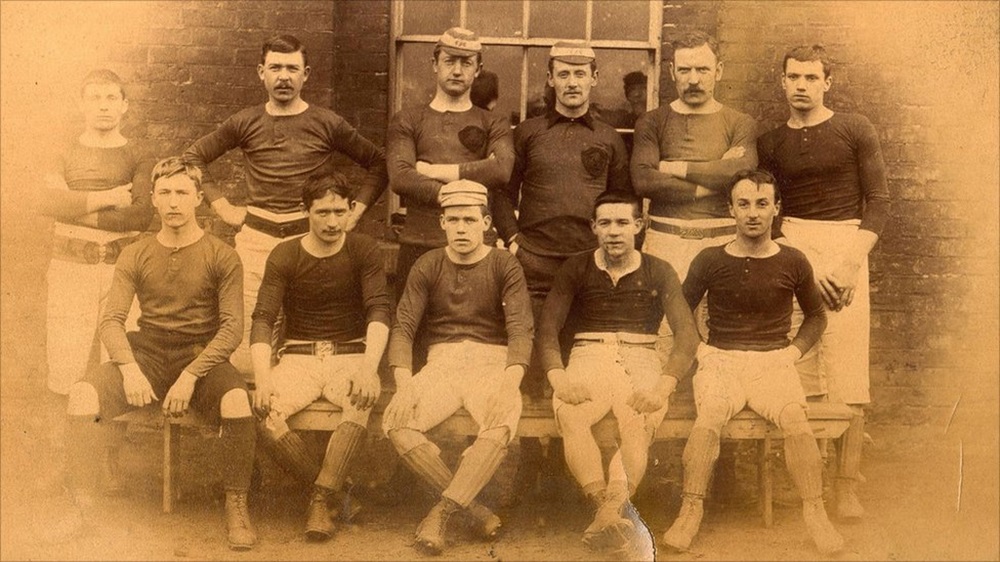
With support secured, the first Cymru team headed to Glasgow, and lost their first ever game (in white shirts) 4-0 against Scotland on 25th March, played at Hamilton Crescent in front of 18,000 supporters.
Following the trial games, Kenrick selected six players from his Druids club for the Cymru XI: goalkeeper David Thomson (a fine cricketer who sadly died in September 1876) and his brother George; William Williams (‘Little Billy’ was a chimney-top maker); Dr Daniel Grey (a surgeon and medic); John Jones (‘Dirty Jack’ was a coal miner) and Kenrick himself at fullback and captain.
Edwin Cross (another fine cricketer) and Alfred Davies played for Wrexham, whilst William Evans (Oxford University and a Churchman) from Usk was the only Southwalian selected.
William Henry Davies (a registrar) played for Oswestry, and would score Cymru’s first ever goal against England in Kennington Oval in 1879. John Hawley Edwards played for Wanderers in London, represented England in 1874 and was the FAW treasurer.
International eligibility was more relaxed then, and living in Cymru for at least three years was sufficient.
As a result, only six players were Welsh born: Evans; Kenrick; Cross; Williams; Alfred Davies and John Jones. The Thomson brothers were from Dudley, WH Davies was from Oswestry, JH Edwards from Shrewsbury, whilst Grey was born in New Mills in Scotland.
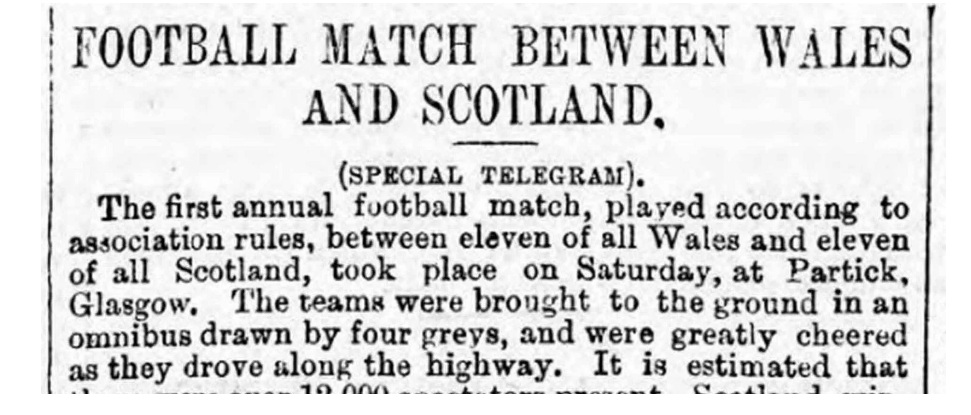
Following the game, the first FAW general meeting was held over the border in the Lion Hotel, Shrewsbury on 24th May. It was agreed that the association would represent the whole of Cymru, with six representatives from the north, and six from the south.
However, and as a result of the north v south tensions over the game in Glasgow, the south declined to put names forward.
Another meeting was arranged for 31st May 1876, held at another Wynnstay Arms Hotel, in Ruabon (addressed in a previous Nation Cymru article).
It was at this meeting that the name of ‘Football Association of Wales’ was formally adopted and the constitution was formed. The legend goes that hearty and spirited discussions on FAW rules and regulations continued long into the night, with the local policeman turning up to call time.
Fortunately, Sir Watkin Williams-Wynn was in attendance, and promptly headed across the square to the court, extended the Wynnstay’s licencing hours with immediate effect, and returned to the meeting!
The rest, as they say, is history…although between 1879 and 1884, Kenrick had to contend with a rival governing body, the Northern Welsh Football Association.
Eventually, the alternative governing body collapsed, with Bangor and Caernarfon returning to the FAW’s structure.
The south’s early preference for rugby led to the establishment of the South Wales Football Union in 1878, and Welsh Rugby Union in 1881, and no Cymru games were held in the south until 1894 (a 4-1 win against Ireland in Swansea).
It would be fascinating to see what Llewelyn Kenrick would make of it all now, 150 years later. How football has become a global game, crossing linguistic, geographical, religious and ethnic boundaries. How the game has become a multi-billion industry, a magnet for millionaires and corporate sponsors (ask FIFA). How football is a full-time profession for some, with those at the peak being able to accumulate extraordinary wealth.
In Cymru, how the men’s national team has achieved success, reaching two World Cups (to date!) and two European Championships (with special recognition for the quarter finalist team of 1976).
How the women’s national team has developed and also reached a European Championship. How national leagues for men and women have been formed, drawing together clubs from all parts of the country.
Progressive
How thousands of boys, girls, men and women play the game across Cymru every week. And how the FAW has evolved to become a modern, progressive association, promoting Cymraeg at all times, considering its role in sustainable practices and being as inclusive as possible to reflect today’s society.
For Kenrick, it would all be unrecognisable. He would have witnessed Wrexham winning the first ever Welsh Cup in 1878, beating his Druids side 1-0. He would scarcely believe the global popularity of Wrexham in 2026!
Despite the significant changes, Kenrick would chuckle at the ongoing debate around Cymru’s “national sport”: football or rugby? So it was in 1876, when Welsh clubs had to choose whether to follow Association or rugby football rules, and largely followed a north (FA) v south (rugby) path. And no doubt that Kenrick would relish an insightful tactical discussion with Cymru manager Craig Bellamy, and the evolution around tactics since the 2-2-6 employed in his day!
Kenrick died in May 1933 (four days after Cymru’s 1-1 game v France in Paris), having seen the progression of his Welsh football dream over half a century and more: the record 11-0 win against Ireland in Wrexham in 1888, the magic of Chirk’s Billy Meredith (48 caps between 1895 and 1920), and British Home Championship success in 1907, 1920, 1924, 1928 and 1933.
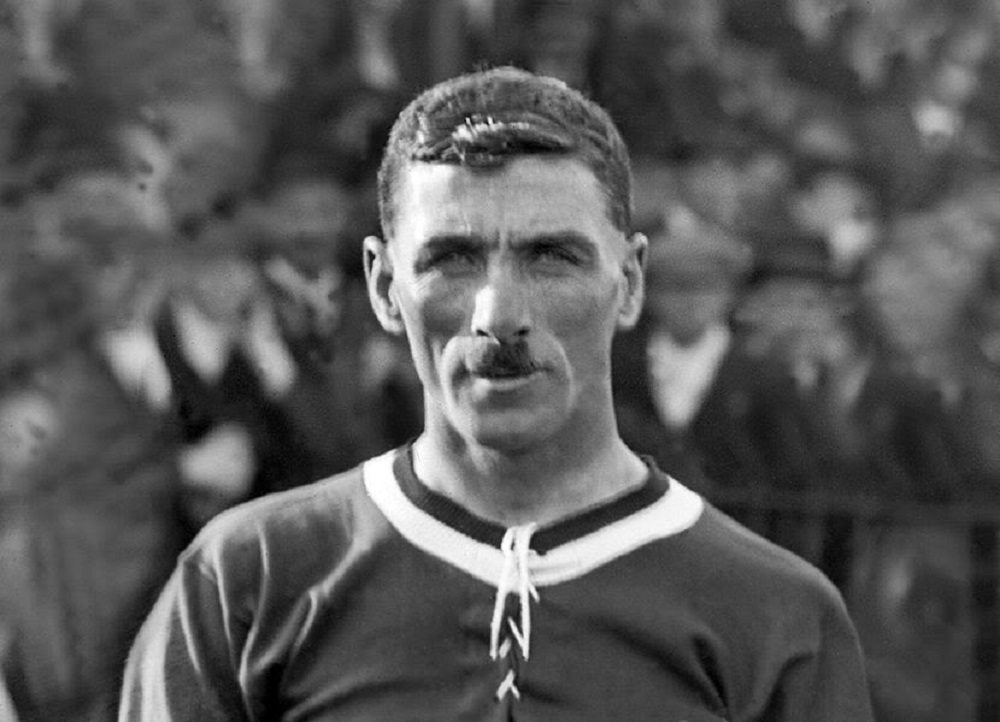
He won five Cymru caps in total, and in his final cap, the 1-0 win against England in Blackburn in 1881, he played in his work attire! As mentioned in Gareth Davies and Ian Garland’s Sons of Cambria, “when Jack Powell missed his train connection at Chester…Kenrick turned out in his everyday clothes to give a splendid performance despite carrying a knee injury”.
Welsh football has given us plenty over the course of 150 years. From the highs and lows, the memorable and not-so-memorable, the thrilling victories and heartbreaking defeats, the tales that accompany e.g. Jimmy Murphy’s boys, Terry Yorath’s men, Chris Coleman’s warriors, and the extraordinary talents of e.g. John Charles and Toshack, Rush and Bale, Ludlow and Fishlock, it has entertained us and thrown us in all directions on the emotional rollercoaster that only sport can provide.
And given Cymru’s unique political and constitutional setup, it’s given us a rare and important platform where we can play with pride as our own nation, telling the world since 1876 that we’re Cymru.
For this, we have much to thank Llewelyn Kenrick for, the father of Welsh football.
Kenrick served as FAW secretary until 1884, stepping back from the game as it lost, in his view, its amateur roots. He returned briefly in 1897 to oversee a crisis, and resigned over a dispute around gate receipts at the Welsh Cup. “No man has done more for football in Wales than Mr Kenrick” was the perfect tribute by journalist George Lerry. Diolch Llewelyn, Penblwydd Hapus CBDC/FAW, and here’s to the next 150 years.
Thanks to Phil Stead, Martin Johnes, Gareth Davies/Ian Garland and Shôn Lewis (Football Museum Wales) for their research and publications
Support our Nation today
For the price of a cup of coffee a month you can help us create an independent, not-for-profit, national news service for the people of Wales, by the people of Wales.


