


Lleeds United? The extraordinary roll call of Welsh players to star at Elland Road

Leon Barton
With the Premier League season now underway, a lot of Welsh eyes will be on a city in West Yorkshire over 80 miles from the nearest border crossing to Wales.
Even the departure of goalkeeper Karl Darlow to Manchester United hasn’t left Leeds United any lighter in the Welsh department, with Harry Wilson’s arrival from Fulham seeing Cymru’s attacking talisman joining Ethan Ampadu, Joe Rodon and Daniel James in the first-team squad.
All four are still in their twenties, have already amassed a ton of caps, and are headed towards ‘Welsh great’ status. Wilson, 29, has 69 Wales games under his belt (with 17 goals), James, 28, has 65 (10 goals). Rodon, also 28, has 62 (2 goals) and Ampadu has already played 63 internationals at the age of just 25. All four could well get 100-plus, and, with a few tournament qualifications, Leeds’ skipper and Cymru captain-in-waiting Ampadu might very well become the first Welsh player to hit the 150-cap mark.
Perhaps the four current Leeds stars will at some point be asked to recreate the fantastic photograph of Alan Curtis, Brian Flynn, Carl Harris and Byron Stevenson from Malta before a World Cup qualifier in 1979. Although, the Admiral shirts and tracksuit tops donned by the Leeds-Welsh quartet then are certainly a lot more stylish than Sudu’s opening offerings.
Those four weren’t the only Welsh players at Elland Road at the time either. Swansea-born midfielder Gwyn Thomas played over a hundred times for the club over the course of a decade (with no loan spells) but never won a Wales cap. After transferring to Barnsley in 1984 he played 230 games in South Yorkshire, but three Cymru under-21 caps were his only international honours.
Of the quartet who were Wales regulars, Flynn was the most successful at international level with 66 caps and 7 goals. Alan Curtis’s 35 games with six goals was a disappointing return for a player of his ability but the injury the former (and future) Swansea playmaker suffered after colliding with Nottingham Forest goalkeeper Peter Shilton early on in his Leeds career cost him caps and affected the impression he was able to make in Yorkshire.
Curtis was also unfairly damned by his association with the man who signed him; manager Jimmy Adamson, someone the Elland Road faithful took against from the start. The player was to enjoy a much happier spell upon returning to the Swans, helping the club reach Division One in 1981 and scoring a memorable goal against Leeds to top off a 5-1 rout in the club’s very first top-flight game.
Carl Harris, from Neath, played alongside Port Talbot native Flynn for the all-conquering Neath schoolboy team of the mid-Sixties. The winger, known for his express pace, would link up with the diminutive midfielder for the majority of his 24 caps between 1976 and 1982, and provide the assist for Flynn’s famous winner against Manchester United at Old Trafford in 1981. It was only a few months ago that Leeds managed to win a league fixture there once again, after a gap of just the 45 years.
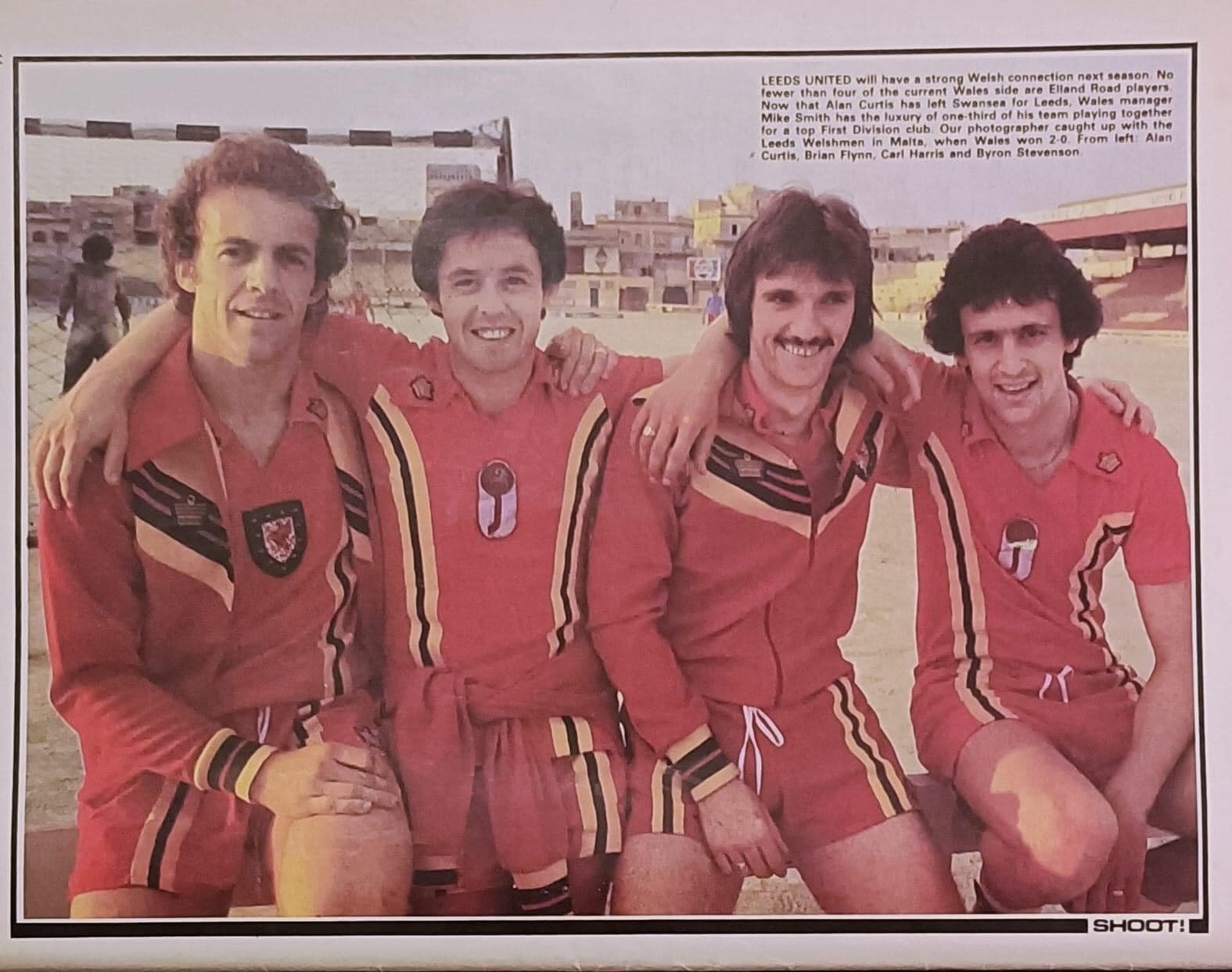
Described by Leeds legend Eddie Gray as ‘a very elegant player’, Byron Stevenson, a full-back, won fifteen caps. It would have been many more if he hadn’t been banned for five years by FIFA for fracturing the jaw of Turkish midfielder Buyak Mustafa while playing a European Championship qualifier for Wales in 1979, despite his improbable claim of mistaken identity.
After a six-year career at Leeds he joined Birmingham City but following his retirement from football, Stevenson returned to Leeds to become the landlord of the New Inn on Elland Road, a pub which had been managed by John Charles years earlier. Stevenson died of throat cancer in September 2007—one day before what would have been his 51st birthday. Peter Lorimer, Leeds’ all-time leading scorer, described him as ‘a very pleasant young man’ at the funeral service. Which was probably news to Mustafa.
But Stevenson was far from the most controversial Welshman to play for Leeds…
On YouTube, there’s some excruciating footage of Gary Sprake meeting Leeds fans in a cafe in the mid-2000s. On the surface, there’s no reason why a club legend – who played over 500 games in goal and kept more than 200 clean sheets during Leeds’ golden era of success – chatting with supporters should be so squirm-inducing. But, in the words of long-time fan Dr Ian Hall, ‘if you ever find yourself in a Leeds pub, best not bring up Sprake – his name is mud in the city after naming Don Revie and Billy Bremner as match fixers’.
In 1978, Sprake, having been forced into an early retirement due to injury, was paid £7,500 by The Daily Mirror to make allegations against former Leeds manager Don Revie and captain Billy Bremner, regarding match-fixing, though no charges ever arose from the accusations.
Sprake’s claims revolved around the final match of the 1971–72 season against Wolverhampton Wanderers. Leeds needed one point to win the league but lost 2–1 and the title went to Derby County. Sprake told the paper that Revie and Bremner had tried to bribe Wolves players before the match, but four years later Bremner sued for libel and was awarded damages of £100,000.
In court, Sprake testified that he ‘couldn’t remember’ Bremner offering a bribe. Did he just need the money or was there a basis to Sprake’s claims? Opponents of the era have spoken about being approached by Bremner and/or Revie ahead of games, among them Frank McLintock and Bob Stokoe. Certainly, there were enough rumours flying around for Revie to earn the nickname ‘Don Readies’.
As for Sprake, he was Wales’ youngest ever keeper when he debuted at the age of 18 and won 37 caps altogether, although it would have been more if Readi..sorry, Revie, had been more inclined to release his players for international duty. A shame, as Sprake was undoubtedly a massively talented keeper. For example, I highly recommend watching the YouTube footage of Wales’ 1-1 draw against England at Wembley in 1973, where his saves earned Wales a notable result in England’s first World Cup game at Wembley since winning the trophy at the venue seven years earlier. (And while you’re on YouTube, check out Sprake sparking out Bobby Gould in a game against Arsenal in 1969. I don’t condone violence but any Wales fan who lived through Gould’s 1995-99 reign as manager will surely derive a glint of guilty pleasure from watching the incident.) Sprake died in 2016 at the age of 71. I presume he isn’t buried in Leeds.
Sprake was another Leeds great from Swansea and in the 2020s Joe Rodon continues the striking Swansea-Leeds tradition (Ampadu – sort of – does too as that’s where his mum hails from). Meanwhile, Harry Wilson now has the chance to follow in the footsteps of Gary Speed in becoming a Leeds hero from the north of Wales.
Speed, from Deeside, was the star of the Flintshire schoolboys team and nearly signed for local club Chester but instead was taken to Leeds at the age of 14 by scout Adrian Jones.
Despite the homesickness, his determination to make it eventually paid dividends in spectacular fashion when Leeds won the League title in 1991/92, the final season before the formation of the Premier League. The famous midfield four he formed alongside Gordon Strachan, David Batty and Gary McAllister, was a key factor in the team’s success under Howard Wilkinson.
Back to the Swansea area, Crynant-raised Connor Roberts played 15 games in 2023/24 on loan from Burnley and made a strong impression, especially with his goal against promotion rivals Leicester City in February. Leeds lost the play-off final to Southampton at the end of that season, condemning them to another year in the Championship.
But, in 2024/25, Ethan Ampadu led the club over the line to prove himself a worthy addition to the line of Welsh leaders at Leeds, although he’s unlikely to win a top-flight title à la Speed or Terry Yorath.
Yorath’s title medal came from 1973/74; Don Revie’s final season before leaving to replace Alf Ramsey as England boss. His replacement Brian Clough would famously only last 44 days. If Revie had stayed on longer it might well have been beneficial to Yorath, who had finally grafted his way into the first team picture. Billy Bremner and Johnny Giles were Revie’s first-choice midfield pairing and it had taken a while for the Cardiffian to establish himself.
Although he left for Coventry in 1976 and later went on to represent Spurs and Vancouver Whitecaps, Yorath returned to Yorkshire, which is where he was based for the duration of his coaching career and retirement. All four of his children were born in Leeds, including daughter Gabby Logan.
And now to the greatest Leeds Welshman of all, another Swansea star.
Although he was on the books at Swansea Town, John Charles was spotted by Leeds scout Jack Pickard while playing for Gendros, his local youth club side, and was given a trial in September 1948. After impressing, he signed aged 17, and relocated to Yorkshire.
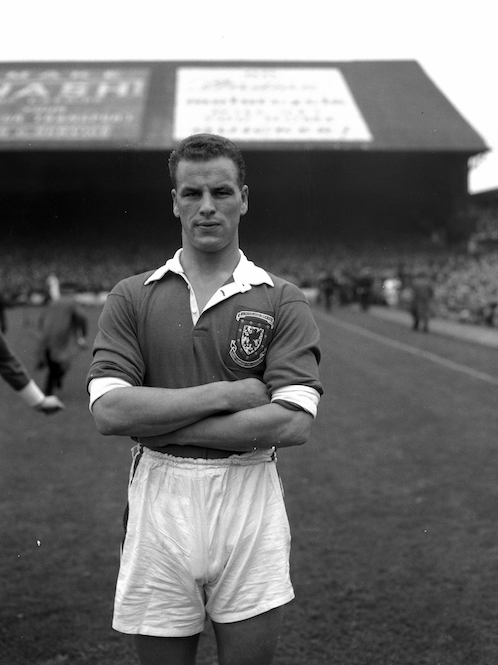
In his very first game for the club, a friendly against Queen of the South, he kept Scotland striker Billy Houliston quiet and afterwards Houliston described him as ‘the best centre-half I’ve ever faced’.
Charles established himself in that position as a teenager at Leeds but was later moved to centre-forward, where, if anything, he was even more impressive. Between his debut and leaving for Juventus in 1957, he hit 150 goals in 297 Leeds games.
Following his glory days in Turin, Charles’s brief return to Leeds was unhappy. By then used to the southern European sunshine and his God-like status in Italy, he returned to Serie A to play for Roma after less than a dozen games back at Elland Road (he scored three times to take his overall total to 153, second only to Peter Lorimer in the club’s all-time goalscoring charts).
To this day, he’s still arguably the only footballer in history to have been truly world-class in two very different positions. As England World Cup winner Jack Charlton said of his former colleague, ‘John Charles was a team unto himself. People often say to me, ‘Who was the best player you ever saw?’, and I answer that it was probably Eusebio, Di Stefano, Cruyff, Pelé or our Bob (Bobby Charlton). But the most effective player I ever saw, the one that made the most difference to the performance of the whole team, was without question John Charles’.
While Welsh greats like Charles, Yorath and Speed started at Leeds there are some Cymru legends who went to Yorkshire at the tail end of their careers and failed to make much of an impression. Ian Rush may have bagged 346 goals for Liverpool but managed only 3 in 41 games for Leeds after signing in 1996. Apparently, Wrexham legend Mickey Thomas (51 Wales caps) started one game for Leeds in the 1989/90 season. Wonder if he remembers it? (I don’t).
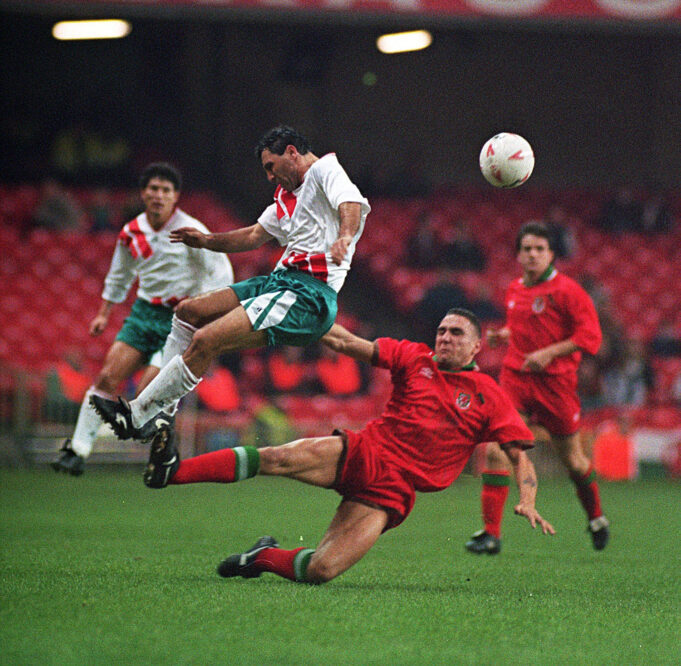
Vinnie Jones made much more of an impact that season, helping the club to promotion from Division Two, although the notorious former on-field enforcer and Hollywood star had left Leeds four years before winning the first of his eventual nine Welsh caps. Jones’ time in Yorkshire was marked by a newfound maturity – he was only booked three times all season, despite his ever-present status. Jones was also an important figure in the club’s off-field attempts to shake its racist, hooligan image, visiting schools and local community centres.
Unlike Sprake, Jones is fondly remembered in the city, despite leaving for Yorkshire rivals Sheffield United early in the 1990/91 season after losing his place in the team to Batty and Speed.
Promise
Striker Tyler Roberts showed plenty of promise in his early days at Leeds, having signed from childhood club West Bromwich Albion, but, for both club and country, the undoubtedly talented player never really blossomed, sadly. Roberts, now 27 and at Mansfield Town, seems unlikely to add to his 20 caps (0 goals). Roberts and Rush are the proof not every Welshman enjoys a golden spell at the Whites.
For youngsters like twice-capped Cardiffian midfielder Charlie Crew (on loan at Walsall for the season) and 18-year-old academy defender Jayden Lienou – who has already been called up to the senior Wales squad by Craig Bellamy – the challenge in the years ahead will be to add to the roll call of Leeds Welsh greats.
Support our Nation today
For the price of a cup of coffee a month you can help us create an independent, not-for-profit, national news service for the people of Wales, by the people of Wales.
Get more trusted Welsh news
Choose Nation.Cymru as a preferred source in Google News to see more of our journalism.


