


Talent Is everywhere, opportunities are not
Andrew Jones
As Welsh rugby loses development pathways, what can we learn from systems that have preserved theirs?
In two previous articles, I explored whether Wales’ best young players are being given enough opportunities to develop. The first looked at the importance of meaningful senior minutes; the second compared the senior experience accumulated by the Wales and France U20 squads, revealing a significant gap not necessarily in talent, but in opportunity.
But minutes do not appear from nowhere.
They are created by teams, competitions and development pathways. With Welsh rugby preparing for the loss of another professional team, it is worth asking a broader question: are the opportunities available to young Welsh players disappearing?
Wales A has not played since 2002. Regional A teams have gone. The British and Irish Cup and Celtic Cup have gone. Wales Sevens has gone. Its successor, GB Sevens, has since seen its full-time programme scrapped in favour of a camp-based model and has now been relegated from the top tier of HSBC SVNS. Now, either the Ospreys or Scarlets is set to disappear from the professional game.
Each decision has its own context and rationale. But viewed collectively, they represent something significant for player development: fewer places for young Welsh players to play, compete and, crucially, develop.
During a recent conversation with Bordeaux-Bègles attack coach Noel McNamara, one sentence stayed with me.
“Talent is everywhere, opportunities are not.”
Perhaps the question for Welsh rugby is no longer simply whether the talent exists.
It is whether the opportunities will.
The case for contraction
The WRU’s position is that the current four-team model is financially unsustainable and that moving to three equally funded professional teams will allow Welsh rugby to concentrate its resources and playing talent, creating more competitive sides.
In a statement issued on 15 August, the WRU board said the available finances and player base were “spread too thinly across four teams”, arguing that the new three-team model would create “a pathway system that gives future players, across our rugby strongholds, the best opportunity to develop.”
In a BBC Sport article published on 4 December 2025, Jamie Roberts, a non-executive director on the WRU board, said: “If you were to give all the data to any 10 rational people with a love of the game in Wales, which board members do of course, they will come to the same decision.”
But if the evidence is that compelling, it begs the question: why isn’t more of it publicly available?
On 5 August, Scarlets managing director Jon Daniels raised that concern: “I understand that there is data which has been used to come up with this decision. It hasn’t been shared. We will really call for transparency in that discussion. These are decisions that are going to have a long-lasting effect, not just on rugby, but on communities in west Wales. I think that needs a proper airing publicly.”
The Ospreys also accept Welsh rugby needs reform but reject the move to three professional teams, arguing that “four sustainable professional clubs, built on the communities, pathways and history they represent, remain the stronger foundation for the Welsh game.”
Amid the debate around finance, sustainability and competitiveness, there is another consequence of contraction that risks being overlooked: opportunity.
The pathways that disappear
Wales A has not played since 2002. Regional development sides later provided another route through competitions such as the Celtic Cup, but that competition has not returned since the 2019–20 season. The British and Irish Cup, which offered another cross-border environment for developing players, had already ended in 2018.
Each was different, but collectively they provided something increasingly scarce in the Welsh pathway: competitive rugby between age-grade and the senior professional game.
Sevens provided another route.
Wales’ programme was suspended during the Covid-19 pandemic before returning briefly and then being replaced by a combined Great Britain programme in 2022. Three years later, the full-time GB Sevens programme was itself scrapped, with permanent contracts replaced by a camp-and-competition model.
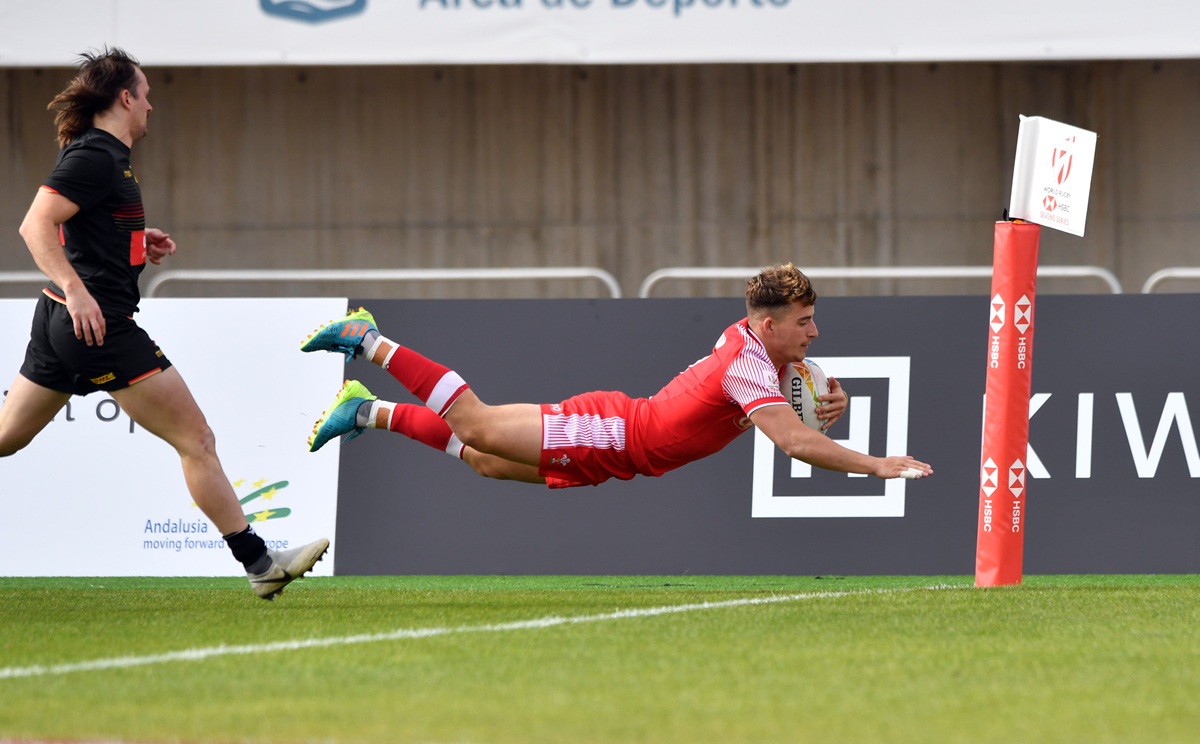
The contrast with a decade earlier is stark. Great Britain’s men won Olympic silver in Rio in 2016. By 2025, the full-time programme was gone. A year later, the men’s team was relegated from the top tier of HSBC SVNS.
But perhaps more significant from a player-development perspective was the reasoning behind the decision.
In May 2025, RFU performance director Conor O’Shea said: “With an increasingly congested sevens calendar and crossover opportunities with the 15s game reducing, we are taking time to review how best the format can work both from a player development and financial perspective.”
Nine days earlier, the IRFU had announced the end of its own men’s Sevens programme, stating that a review had found it did not contribute sufficiently as a development pathway for the 15-a-side game.
But is this the case everywhere?
There is certainly evidence elsewhere that the skills developed in Sevens can transfer to the very highest level. South Africa’s Kwagga Smith spent several years with the Blitzboks before establishing himself as a Springbok and becoming a double World Cup winner. Smith himself has credited Sevens with developing his speed, agility, vision and individual skill, describing playing Sevens at a young age as “one of the best things” he ever did.
So perhaps the question is not simply whether Sevens can develop players for 15s. It is whether a rugby system is structured to allow it to do so.
Contrast
France offers an interesting contrast. The Ligue Nationale de Rugby created the In Extenso Supersevens in 2020, bringing together Top 14 sides alongside invitational teams in a domestic Sevens competition.
Rather than separating Sevens entirely from the professional club structure, it created another competitive environment in which young players could be exposed to high-level rugby.
That development coincided with an extraordinary period for French Sevens. France won Olympic gold in Paris in 2024 and also claimed the overall 2024 SVNS title in Madrid.
One player’s journey illustrates why that matters.
Aaron Grandidier-Nkanang developed through the France Sevens programme and became an Olympic champion in Paris before joining Pau for the 2024/25 season. After establishing himself in the Top 14, he progressed into the senior French national side. In July 2026, Grandidier-Nkanang scored twice on his Test debut as France defeated Australia 42-26 in Brisbane.
Rather than existing in isolation, one development environment had opened the door to another.
In my conversation with McNamara, he repeatedly returned to the importance of keeping development systems broad.
“You want to keep that base as broad as you possibly can, and you want those people that are in that base to be as good as they possibly can be, to be challenged to be as good as they can possibly be,” he said.
For Wales, however, many of those routes are becoming narrower or disappearing altogether.
I asked McNamara specifically about the consequences of Wales reducing its number of professional teams.
“There’s absolutely no doubt that limiting the number of teams limits the number of opportunities,” he said.
McNamara acknowledged that those responsible for the decision will have considered what they believe is the best way forward. But from a player-development perspective, he questioned what fewer opportunities could mean in the longer term.
“I find it hard to believe that by providing less opportunities, you’re going to end up with a better product in the long run.”
That is perhaps the fundamental tension in the WRU’s plan. Concentrating resources may create three stronger professional teams. But what happens to the players who would previously have occupied the opportunities that disappear?
Keeping the door open
The danger of narrowing a pathway too early is that development is rarely linear.
Mark Tele’a is a striking example.
Tele’a played First XV rugby at Massey High School and entered the North Harbour Academy, but he did not represent New Zealand U20 or another New Zealand national junior side. His route instead continued through club and provincial rugby.
He made his provincial debut for North Harbour in 2016 and spent several seasons at that level before earning a full Super Rugby contract with the Blues for 2020.
McNamara remembers seeing him during that period.
“I saw a 23-year-old Mark Tele’a in New Zealand play for North Harbour, and often he didn’t play, but he ended up becoming an All Black four or five years later,” he recalled.
His story is important not simply because he developed later than many future internationals.
There was still somewhere for him to develop.
Tele’a had not been selected for New Zealand U20, but that did not mean his opportunity to become an elite player had disappeared. Provincial rugby provided an environment in which he could continue playing, improving and remaining visible.
By 2022 he was an All Black. A year later, he was named World Rugby Breakthrough Player of the Year.
That is central to McNamara’s view of successful development systems. They do not simply identify the best players early and concentrate everything around them. They keep the base broad and allow players to emerge at different speeds.
As he put it, “the door is never shut.”
It is worth asking where the Welsh equivalent of Tele’a would develop today, and whether that door is becoming increasingly difficult to keep open.
What if Connacht had disappeared?
Welsh rugby is not the first system to consider whether it can sustain all of its professional teams.
In 2003, the IRFU proposed closing Connacht as a professional operation as part of cost-cutting measures. The proposal prompted extraordinary opposition, including supporters marching on the IRFU’s headquarters in Dublin.
Connacht survived.
Their 2015–16 Pro12 title provides perhaps the most obvious measure of what followed. Just thirteen years after facing extinction, the province won its first major trophy.
But silverware tells only part of the story.

Over the years, Connacht has also provided opportunities for players whose routes to the highest level were far from guaranteed. Some developed through the province itself. Robbie Henshaw came through the Connacht academy before becoming an Ireland international and, later, a British & Irish Lion.
Others arrived from elsewhere looking for opportunity. Mack Hansen arrived from Australia having made only a handful of Super Rugby appearances and, within months of establishing himself at Connacht, was playing international rugby for Ireland.
The individual circumstances are different, but the principle is the same: another professional environment meant another place for players to play, develop and potentially become something more than they were when they arrived.
More than two decades later, Connacht’s survival provides an interesting perspective on the debate taking place in Wales. With the benefit of hindsight, it is possible to ask a question that could not have been answered fully at the time: what would Irish rugby have lost had Connacht disappeared?
McNamara pointed to Connacht’s continued contribution to the Irish national team as evidence of what that surviving professional environment now provides.
“You look at the stadium that Connacht have now, the stadium that they’ve built,” he said, also pointing to the experience of Stuart Lancaster as head coach and the province’s contribution to Ireland’s summer tour.
The numbers are striking. Six Connacht players were selected for Ireland’s 36-man squad to face Australia, Japan and New Zealand in the summer of 2026. Three of them, Billy Bohan, Sam Illo and Sean Jansen, were uncapped when the squad was announced.
All three subsequently made their Test debuts against Japan.
More than two decades after Connacht’s professional future was under threat, the province was not simply still existing. It was providing six players to an Ireland squad while creating opportunities for the next generation of internationals.
None of this proves that preserving every professional team will automatically produce international players or sporting success. Nor does Ireland’s financial position in 2003 provide a direct comparison with the challenges facing Welsh rugby today.
But Connacht demonstrates something harder to quantify. Once a professional environment disappears, so too do all of the future opportunities it might have created.
The development gap
One of the most vulnerable points in any development pathway comes after age-grade rugby. At twenty, a player may have reached the end of the U20 pathway without yet being ready to establish themselves in the professional game.
For McNamara, providing meaningful rugby during those intervening years is one of the major challenges facing development systems.
“That’s the biggest challenge. It’s how you provide the opportunities for that group between 20 and 23, 25 even, you could argue, some of the late developers.”
The issue can be particularly significant for tight-five forwards, whose physical development may take longer. McNamara pointed specifically to players who “aren’t quite ready or haven’t quite developed yet”, highlighting the challenge of finding opportunities for them to continue progressing.
It exposes one of the risks of narrowing a pathway too early. Concentrating resources around the players considered the best prospects at 18, 19 or 20 may make sense in the short term. But identifying the best players at 20 is not necessarily the same as knowing who the best players will be at 24 or 25.
For Wales, that leaves a simple but important question:
As development competitions and playing opportunities disappear, where does the 21 or 22-year-old who isn’t yet ready for URC rugby actually develop?
The WRU’s answer, in part, is a new National Academy alongside greater investment in Super Rygbi Cymru. Both may provide better development environments. But Super Rygbi Cymru remains a semi-professional competition, and there is an important distinction between preparing a player for professional rugby and providing opportunities to experience it.
High-quality coaching, strength and conditioning and individual development programmes can prepare a player for the professional game. Semi-professional rugby can provide valuable senior experience. But neither can fully replicate the demands, decisions and pressure that come from actually playing at professional level.
The question, therefore, is not whether Wales can provide better coaching to its most promising young players. It is whether the competitive opportunities surrounding that coaching will be sufficient to allow them to become professional players.
Financial challenges
Welsh rugby’s financial challenges are real. Maintaining teams, competitions and development programmes costs money, and preserving structures simply because they have always existed is not in itself an argument for keeping them.
But contraction has a cost too.
Wales A, regional development rugby, cross-border competitions and Wales Sevens once provided opportunities that no longer exist. Another professional team is now set to follow.
Perhaps the most important question is therefore not simply whether Welsh rugby can afford four professional teams. It is what happens to the opportunities when one of them disappears.
Because the players Wales will need in five or ten years’ time will not all be obvious today. Some will develop later. Some will need more games. Some will fall outside the pathway before finding their way back in.
Mark Tele’a’s route through New Zealand shows what can happen when that door remains open. Connacht shows what an entire rugby system can gain when a professional environment survives.
Welsh rugby may ultimately conclude that contraction is unavoidable. But if opportunities are removed, there needs to be a convincing answer as to where the next generation will find them.
As McNamara put it:
“Talent is everywhere, opportunities are not.”
Andrew Jones is a former professional rugby performance analyst with more than 16 years’ experience across the international and professional game, including Welsh rugby, England Sevens, the 2015 Rugby World Cup and six seasons in France. He writes about player development, high-performance systems and the structures that shape professional rugby.
Support our Nation today
For the price of a cup of coffee a month you can help us create an independent, not-for-profit, national news service for the people of Wales, by the people of Wales.
Get more trusted Welsh news
Choose Nation.Cymru as a preferred source in Google News to see more of our journalism.



I wonder if the steps taken this year by Ospreys and Scarlets to recruit several more Southern Hemisphere players also reduces the opportunities for young Welsh players….???
The quality of journalism here far exceeds the other online offering on Cymru. Well done Andrew on producing an insightful piece. It would be very interesting to hear from the regions, how they justify spending scarce resources on bringing over non-Welsh Qualified players, all of them journeymen, and by definition reducing the opportunities for young Welsh talent. The response that they provide inspiration to youngsters and guidance stretches things a bit: none of them are Jerry Collins, Justin Marshall or Marty Hola ! As was illustrated by another article on here, the WRU are profligate with funds in areas such… Read more »