


Uncertainty reigns in Welsh rugby as new season gets underway
Simon Thomas
Political turmoil is nothing new in Welsh rugby, but seldom has a new season dawned amid quite so much uncertainty and controversy.
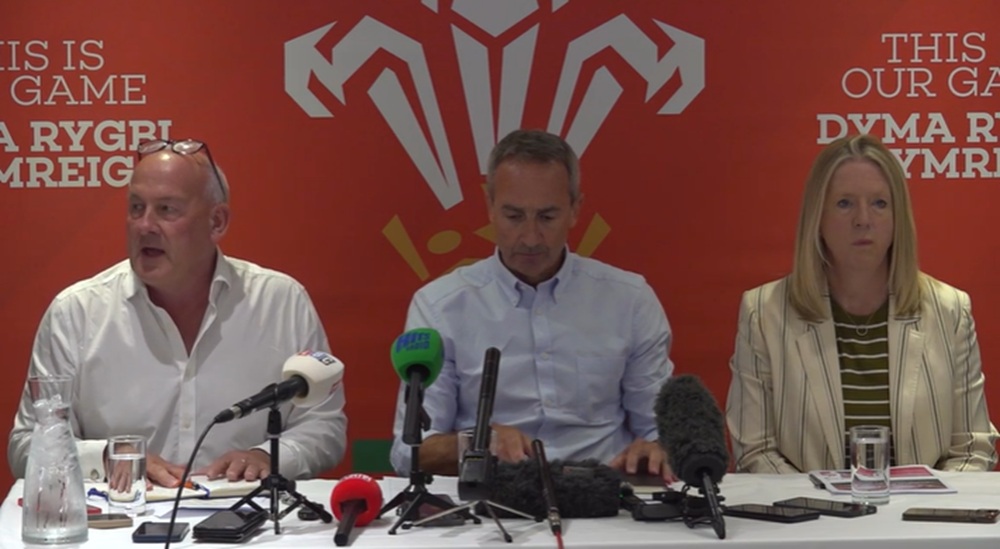
The backdrop, of course, is the proposal from the WRU executive that the number of professional teams should be cut from four to two.
It wasn’t a huge surprise when they confirmed this “optimal solution” last month as it had been well trailed for some time.
But what was startling were the accompanying comments from executive members.
When asked about the danger of fans of culled teams being lost to the game, WRU chairman Richard Collier-Keywood said “We think, going forwards, there are fans of players, with individual supporters following players”.
As numerous people swiftly pointed out, there weren’t too many Scarlets fans who switched loyalties to the Ospreys when Jac Morgan swapped one west Welsh region for the other, just to give an example.
In addition, the Union’s new director of rugby and elite performance Dave Reddin said: “We are asking people to let go of the past and the present and imagine a completely different future.”
In both cases, they were comments which appeared to demonstrate a real lack of understanding of the history and culture of Welsh rugby.
Widespread opposition
Unsurprisingly, there has been widespread opposition to the proposals from regions, players and supporters alike.
People have argued that cutting to two sides would have a damaging impact on the player pool and limit the opportunities for talented Welsh youngsters who might be even more likely to head for England.
It has also been pointed out the two team model hasn’t brought any great international success in Scotland and Italy.
Suggestions that new entity East and West sides might be created, with all four existing pro clubs being ditched, has provoked particular fury, amid questions over who would support them and where would they play.
Moreover, when the plans were scrutinised, serious financial issues emerged, notably that the WRU wanted full control over all rugby matters at the two sides, but were still seeking significant benefactor investment – to the tune of £17m over five years.
Understandably, questions were asked over just who would want to put money in under such a set-up. One couldn’t imagine a queue forming.
Eyebrows have also been raised over the idea that both teams would train together at a new and presumably pretty costly national campus.
So, all in all, it’s fair to say the reaction to the Union’s blueprint has largely been a negative one.
Stakeholders
Former WRU chairman Gareth Davies perhaps summed the situation up best when he spoke on the BBC last week.
“Your important stakeholders in the game are players, supporters and your clubs,” he said.
“They are all saying ‘No’.
“So there’s obviously no chance of it happening, I think.
“If the Union did push through with it, then I think there will be an almighty crisis after that.”
The former Wales and Lions fly-half added: “Only a few months ago, it was going to be four teams. The agreement was on the table for the four regions to sign for equal funding of £6.5m. So that’s £26m for four. Now it’s only £16m for two. So where has that £10m gone?”
Davies concluded: “I just find it a little bit defeatist to think we have only got 90 professional players in Wales. I would like to think we would be more forward looking than that and try to build on what we’ve got.
“It’s a precipice really. We either fall off the end and make the wrong decision or is there another solution here somewhere?”
Of course, there is still a chance the Union executive might stick to their two-team plan when they complete their consultation process at the end of this month.
But that would still need WRU board approval and one wonders whether that would be forthcoming given the level of opposition out there and, in particular, the comments of someone with the gravitas of Gareth Davies.
The mood music seems to be that we may well end up with a new alternative proposal.
That could mean a move to three sides, either on equal funding or via a two-tier 2+1 model. Then again, that’s easier said than done as it would still involve either a merger or one team disappearing.
Another option would be to stick with the existing four sides, but under a 2+2 formula, although, as ever, the question is which teams would be happy to receive lesser funding?
So the bottom line is it’s all still very much up in the air and there is no easy solution.
One suspects there are plenty more twists and turns to come.
Meanwhile, players and staff have to crack on with the new season, while still being in the dark about their long term job security, with fans wondering just how long they have left to support their respective teams.

Wales
There are two ways of looking at the job facing newly appointed Wales head coach Steve Tandy.
On the one hand, it’s a really daunting task as he is inheriting a team which endured a record 18-match losing run before that finally came to an end with victory over Japan in July.
Moreover, the players will arrive in camp for the autumn internationals just after the WRU confirm their restructuring plans, with all that might mean for morale, not to mention the possibility of some kind of strike action.
Yet, on the other hand, expectations will be pretty low in terms of results, so Tandy will have the time to undertake the rebuilding process which is clearly needed with what is a relatively young squad.
He does also have a fair amount of talent to work with as he establishes the core of his side, looking at the likes of Jac Morgan, Tomas Williams, Dewi Lake, Blair Murray, Daf Jenkins, Josh Adams, Aaron Wainwright, Nicky Smith and the ageless Taulupe Faletau, not forgetting the very welcome return of Louis Rees-Zammit.
There is also youthful promise in the shape of Dan Edwards, Teddy Williams, Archie Griffin, Alex Mann, Freddie Thomas, Morgan Morse, Harry Beddall and Tom Bowen to namecheck a few rising stars.
As for the immediate challenges ahead, the autumn delivers home games against Argentina, Japan, New Zealand and South Africa.
One would hope for another victory over Japan, but after that it will realistically be about performance against the southern hemisphere big three who are all vying for the tightly contested Rugby Championship.
The Springboks game, in particular, will be extremely testing as Wales will be without their players who are based across the bridge and beyond with the fixture being outside the official Test window.
So, some tough assignments ahead, but what we do know is Tandy will give the job his all.
The former Waratahs, Scotland and Lions defence coach is renowned for his work ethic, detailed preparation and mental toughness and is highly respected by his peers.
He’s also made a judicious appointment in Danny Wilson, a fine technical coach, with the ex-Cardiff, Glasgow and Harlequins boss looking after the all-important lineout and contact area.
As for other assistants, Wilson’s good pal Matt Sherratt – who acted as caretaker following the departure of Warren Gatland – looks to be the leading candidate for the role of backs coach.
That would be a further good move as Sherratt is hugely popular with the players and is a real creative attacking thinker on the game.
But, it would of course have a significant impact on Cardiff. On the subject of which…
Cardiff Rugby
Cardiff will be fuelled by the frustration of having missed out on the URC play-offs by the narrowest of margins last season.
Having been in the top eight for pretty much the entire campaign, they fell at the final hurdle, finishing just one point and one place adrift.
Since then, they have welcomed some new faces on board, with Welsh internationals Taine Basham, Ioan Lloyd and Sam Wainwright joining, along with Scotland Test prop Javan Sebastian and former Dragons lock George Nott.

They will be suitably encouraged by an eye-catching 31-10 pre-season victory away to URC champions Leinster as they go into next Saturday’s league opener at home to the Lions.
But they do have a few injury issues, particularly among the outside backs, with Mason Grady, Theo Cabango, Iwan Stephens, Elijah Evans and Matty Young all sidelined for the initial block of fixtures.
So you do wonder whether they will look to bring in a wing/13, perhaps on loan, with the current situation re-emphasising just how important the finally retired Rey Lee-Lo has been over the past decade.
Off the field, the search goes on for new owners in the wake of the WRU stepping in after the club went into temporary administration back in April.
Then there’s the question of what they will do if Sherratt does move on to Wales, as he would be a hard man to replace.
Dragons
Will this finally be the season when the Dragons’ fortunes change?
It’s a question which has been asked a number of times over the years without a positive outcome.
But, on paper, they do look equipped to make a much better fist of things.
It’s fair to say the only way is up as they finished bottom of the URC table last season, winning just one solitary league match.
In response to that sorry situation, they have undertaken an extensive recruitment drive, bringing in a number of well known players.
So it’s welcome to Wales caps Thomas Young, Wyn Jones, Dillon Lewis, Seb Davies and Mackenzie Martin, along with Tongan Test backs Fetuli Paea and Fine Inisi.
The end result is there are now no fewer than 19 internationals at the Gwent region, while they have also brought in South African pair Tinus de Beer and Robert Hunt, plus big Welsh-qualified second row Levi Douglas.
Up to now, the signs have been positive, with a number of the new faces having impressed during pre-season victories over Hartpury and the Scarlets.
So, can this be the year? Time will tell.
Ospreys
The Ospreys will have a new home this season and one where they have enjoyed notable success in recent times.
Originally, the plan was that they would move to St Helen’s towards the end of this year.
But that relocation has been put on hold until the start of next season to allow sufficient time for the required redevelopment work to be completed.
Rather than staying at the Swansea .com Stadium – which has been their home since 2005 – they have opted to utilise Bridgend’s Brewery Field in the meantime.
That’s certainly been a happy hunting ground for them over the last couple of years, being the setting for notable victories over Cardiff, Sale and the Stormers.
Now, rather than making an occasional visit, they will be permanently based at the 8,000-capacity venue for the coming campaign.
On the playing front, it’s the end of an era with club legend Justin Tipuric having hung up his boots to take on the role of defence coach.
But, as one seasoned Welsh international bows out of the back row, so another joins the breakaway brigade with Ross Moriarty arriving from Brive, while former Queensland Reds skipper Ryan Smith comes in to fill the second row vacancy created by Adam Beard’s move to Montpellier.
Mark Jones’ men face a really tough start with a trip to South Africa for games against the Bulls and the Stormers in the opening two rounds, but then it’s back-to-back games at their Bridgend fortress.
Scarlets
The Scarlets will be Wales’ sole representative in the Champions Cup, having secured their spot in the top tier event by finishing eighth in the URC last season.
Making the league play-offs was a real achievement for Dwayne Peel’s team who proved themselves to be a highly competitive unit during the course of the campaign.
They won nine of their 18 league matches – including memorable triumphs over Leinster and the Bulls – while coming tantalisingly close to victory in a number of other fixtures.
That consistent competitiveness was underpinned by the solid platform provided by the pack and the boilerhouse has been further bolstered by the return of Welsh international second row Jake Ball.
There’s also plentiful young talent behind the scrum and that too will be reinforced with 10/12 playmaker Joe Hawkins joining from Exeter.

For head coach Peel, the target is to build on the achievements of last season and experience more knock-out rugby.
“We want to compete and we want to be in those play-offs again. That’s ultimately what we’re trying to do,” said the former Wales and Lions scrum-half.
“We’ve got a squad and the appetite for that.”
They open their URC campaign at home to Munster next Saturday evening and there will be a “Save Our Scarlets” march from the site of the old Stradey Park posts before the game, enabling supporters to show their backing for the club in these uncertain times.
Super Rygbi Cymru
Under the WRU’s preferred restructuring plan, the semi-pro SRC has a pivotal role to play.
The Union say halving the number of pro teams “would release significant investment” for the second tier competition.
Just what will happen on that front remains to be seen with the two-team plan looking increasingly dead in the water.
In the short term, the salary cap for playing staff in the SRC has gone up from £150,000 to £160,000 for this second season of the ten-club league.
It’s Newport who were crowned inaugural champions after beating Ebbw Vale in May’s play-off final, having defeated regular season table toppers Cardiff in the semi-finals at the Arms Park.
So far this season, it’s Llandovery and Ebbw Vale who are setting the pace having won their opening two fixtures, while title holders Newport have suffered successive defeats.
Support our Nation today
For the price of a cup of coffee a month you can help us create an independent, not-for-profit, national news service for the people of Wales, by the people of Wales.


