


Wales 23, Scotland 26: A tale of what might have been
Simon Thomas
So, just where on earth do you start with that one?
Well, first thing’s first – what a game. It was a truly compelling contest from start to finish.
It’s a fixture which has thrown up a succession of classics over the years and this was another to add to the list.
Secondly, you really have to feel for the Welsh players.
They gave it absolutely everything and came so close to ending their long losing run in the Six Nations – within five minutes to be precise.
The look on their faces at the final whistle said it all. This was a heartbreaking experience for them.
They had contributed so much to a tremendous match, producing their best half of rugby in years in the opening 40 minutes.
Rather than kicking the ball away, they kept it in hand and went through multiple phases to carve out the scores that gave them a 17-5 lead at the break – an advantage they soon extended to 20-5.
It really looked as though the tide was about to turn after 13 successive Championship defeats.
But, in the end, it wasn’t to be, with the outcome hinging on a couple of key moments.
Firstly, there was the try from Scotland winger Darcy Graham just before the hour.
It came straight after Wales had gone 23-12 up through a penalty from replacement fly-half Jarrod Evans.
But that was the cue for Finn Russell to show his class and his quick thinking.
Spotting that winger Gabriel Hamer-Webb wasn’t back in position having chased the Evans kick in case of a rebound, Russell took the restart swiftly and sent it long into the vacant corner.
Then it was all down to the vagaries of a rugby ball as it bounced back into the arms of the speeding Graham who dived over jubilantly.
Wales had been caught sleeping and had paid the price.

Speaking after the game, former England captain Martin Johnson said: “That’s too simple a try to give away at this level.”
Giving his reaction, Wales coach Steve Tandy admitted it was “a massive moment”.
“We have got to be a bit smarter. That was bitterly disappointing,” he said.
However, Tandy’s team were still in front and had a chance to go further ahead 13 minutes from time when they were awarded a penalty.
It would have been a regulation kick for Evans and would have put Wales 26-19 up.
But then came the second decisive moment, as referee Matthew Carley reversed the penalty, having become aware of a croc roll by Tomos Williams in the build-up.
From that moment on, Wales were to be under the cosh for a prolonged period and Scotland’s sustained pressure finally told when hooker George Turner rounded off a lineout maul drive.
It was the first time the hosts had been behind all game, but there was to be no way back, with their fate sealed when they were penalised at a late scrum put-in midway inside the opposition half.
That was that, with Russell running down the clock with a late penalty attempt and the final whistle sounding to signal Welsh despair.
It was cruel and it was hard to take, but it will also serve as a big lesson for this young side about staying switched on and nailing the key moments.
In fairness, they had done both of those things in the first half and it’s right to acknowledge just how well they performed in that period.
There lies the hope for the future as we reflect on a truly cracking game of rugby.
Speaking of which, just what is it about Wales-Scotland matches in Cardiff?
Down the decades, it’s a fixture which has produced some fantastic memories and wonderful Welsh wins.
There was the record long distance penalty from Paul Thorburn 40 years ago, then there was the 1988 game which was lit up by the side-stepping from Ieuan ‘Merlin the Magician’ Evans and the genius of Jonathan ‘Jiffy’ Davies.
In 1994, you had the try double from the sliding Mike Rayer in the rain and then in 2010 came the comeback of all comebacks, completed by Shane Williams’ last gasp touchdown.
In truth, Welsh fans would have turned up more in distant hope rather than expectation of seeing any repeat of such high points.
But they were to be so pleasantly surprised in the first half.
From the outset, it was clear the Welsh players were right up for this one and determined to take the game to their guests.
That’s precisely what they did from minute one as they set the tone with an assured and assertive opening passage, attacking one way and then the next.
In the end, it didn’t come to anything, but they had set their stall out and there was even better to follow.
If you look at their three scores in the first half – two converted tries and a penalty – there is one common factor, ball retention.
Respectively, they came after 10, 11 and 12 phases.
Moving away from the kicking strategy that backfired badly against France, they opted to keep the ball in hand and it was a change which reaped rich reward.
Everyone contributed, but there’s special mention for Sam Costelow, Aaron Wainwright, Dewi Lake and Eddie James.
The recalled Costelow pulled the strings so expertly, playing with confidence, control and surety as he took charge and bossed proceedings. It was such a huge shame when he had to leave the field with what appears to be a bad lower leg injury and one wishes him all the best.
As for No 8 Wainwright, hooker Lake and centre James, they provided the priceless gain-line crossing, with the two forwards topping the carrying chart with 21 and 17 respectively, while James delivered the strike running and hard yards behind.
But, as I say, it was very much a team effort with lots of well-oiled moving parts.
Wales’ opening try came on nine minutes despite them being down to 14 men following a yellow card for centre Joe Hawkins.
It started off with a lineout steal from Alex Mann, with the
spark then provided by scrum-half Tomos Williams who took a quick tap penalty and burst away, showing the creative instinct he demonstrates week-in, week-out for Gloucester.
Then came a couple of big carries from Wainwright amid ten phases where the ball went through numerous hands amid prolonged probing which ultimately drew a penalty near the line.
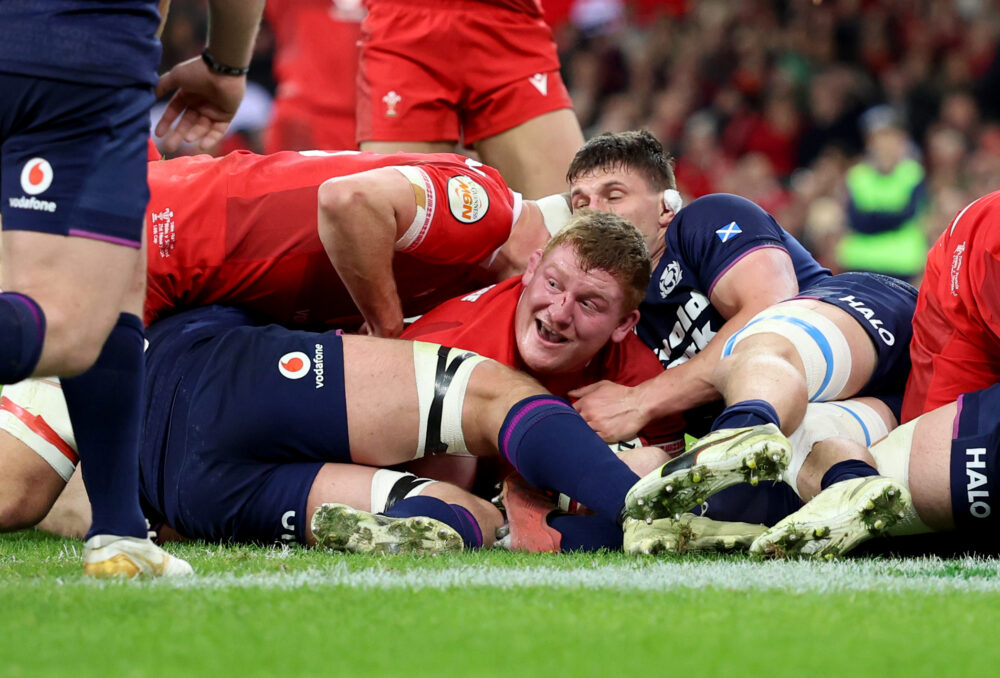
That presented the opportunity for Rhys Carre to do what he does best as he crashed over off a tap for the second time in this Six Nations. The Saracens prop takes some stopping from that range and the Scots couldn’t do so.
The visitors responded as they capitalized on their extra man behind by working winger Kyle Steyn over out on the right. But, once restored to their full complement, Wales struck again with a really well constructed score off 11 phases.
It began with a Ben Carter lineout take and saw two big carries from James either side of one from Lake. Then came a one-handed offload from Carre, a spinning surge up to the line from Mann and a sharp take and give from Costelow to put Josh Adams in at the left corner.
It really was a quality score, with the build up and execution purposeful and precise.
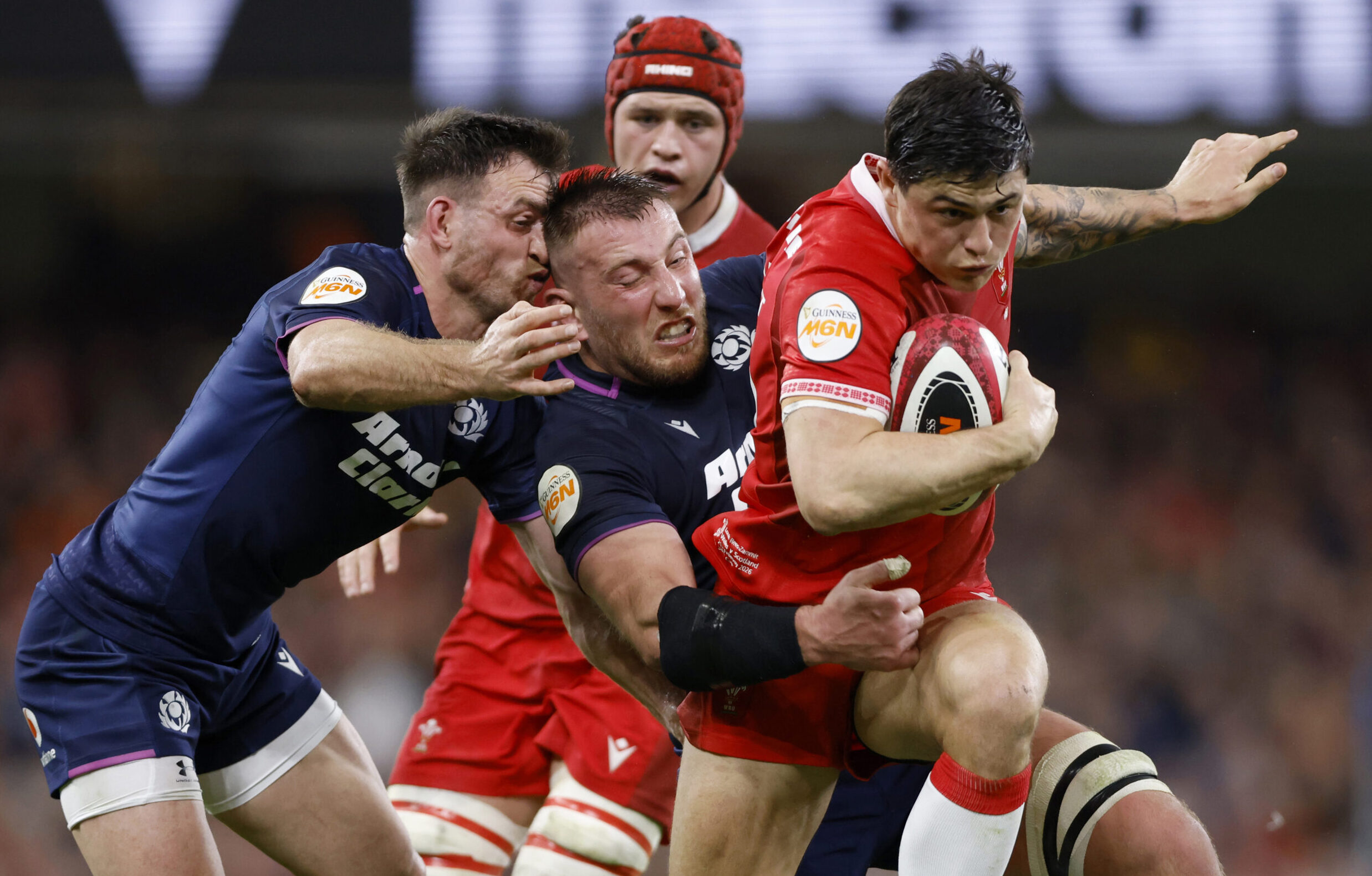
A further extended passage of attacking, 12 phases this time – featuring bursts from Wainwright, Louis Rees-Zammit and James – led to a penalty which Costelow slotted.
That made it 17-5 and that was to be the score at the break thanks to a crucial relieving penalty won by Mann over the ball deep in his own 22.
He was forming an effective breakdown partnership with fellow flanker James Botham, who had come off the bench for Taine Plumtree early on, while Wales were scrambling like dervishes in defence.
So all looked good and, when play resumed, it soon looked even better, as the hosts extended their lead with Costelow again bisecting the posts after good work from Adams, Mann and the ground-gaining James.
At that point, the home fans were in dreamland, with choruses of Hymn and Arias, Sospan Fach and Bread of Heaven echoing around the ground.
Scotland did respond with a try from Russell after some 26 phases, but then came the Evans penalty which made it 23-12.
Could this be Wales’ day? People were starting to believe.
But then came that quick restart from Russell and the crucial Graham try. The momentum had changed and it was Scotland who ultimately got the job done.
So, a great effort from Wales, a great game and a tale of what might have been.
Support our Nation today
For the price of a cup of coffee a month you can help us create an independent, not-for-profit, national news service for the people of Wales, by the people of Wales.


