


Wales 26, New Zealand 52: Signs of hope despite another All Blacks drubbing

Simon Thomas
There’s been a lot of talk recently about just how much history matters in Welsh rugby amid the proposals for seismic change to the professional game.
So it seems appropriate to put this hugely eventful encounter at the Principality Stadium into some kind of historical context.
To start with, there’s the obvious one in that you still have to go back to 1953 for the last time Wales beat New Zealand.
In terms of recent history, there’s also the fact that it was the All Blacks’ third successive 50+ score in Cardiff.
But stick with me because there are definite plusses to come.
For one thing, Wales scored four tries for just the second time in the history of a fixture which dates back to 1905.
The only other occasion was the memorable World Cup clash in Sydney back in 2003 when Mark Taylor, Sonny Parker, Colin Charvis and Shane Williams crossed in a 53-37 defeat.
This time it was wingers Tom Rogers and Louis Rees-Zammit who shared out the tries, with Rogers claiming three of them on a day he will never forget.
In doing so, he became the first Wales player to score a hat-trick of tries against New Zealand, with the previous best being two by fellow wing Geoffrey Rees-Jones way back in 1935.
Moreover, he’s the first player from any country to touch down three times against the Kiwis since centre Marius Joubert did so for South Africa in 2004.
This was also Wales’ biggest score versus the All Blacks in Cardiff, surpassing the 25 they posted in both 2004 and 2010.
For further historical comparison, their average tally in the previous 37 meetings between the two countries had been just 12 points and one try, with 38 touchdowns in all.
So from an attacking perspective, this performance was a big step forward and not just in terms of the historic context, but for the here and now and this group of players.
There had been real signs of promise on that front in the autumn opener against Argentina, only for there to be a disappointing regression the following week versus Japan.
But now it’s clear there are genuine signs of encouragement and hope to be derived from the way this Welsh team is performing with ball in hand when you look back at the four cracking tries they conjured up this afternoon.
Clearly, there are still other issues to address. Defence remains a major work in progress given they conceded seven tries and missed no fewer than 38 tackles, coming second best in the physical collisions too often against more powerful opponents.
The breakdown was also a real problem area as they struggled to slow down or steal possession, meaning it was remorseless black wave after black wave coming towards them, while discipline was again an Achilles Heel as they received two yellow cards and lost the penalty count 14-4.
So lots to work on still and it doesn’t get any easier next week, in fact it gets even harder with world champions South Africa coming to town and Wales without their 13 exiles as the game is outside the Test window.
Hope
Yet for all this, there’s a sense of hope for the future and a feeling of positivity after a game which people had been dreading but, in the end, would have really enjoyed.
You could tell this from the warm applause the Welsh players received as they went round to thank the supporters after the match, with a good number of people having stayed behind to show their appreciation.
Former Wales skipper Sam Warburton summed it up when he said he was left feeling much more optimistic on the final whistle than he had expected.
Joining him on TNT, Dan Biggar echoed this by saying: “Welsh fans can walk away from the stadium and feel there were more positives than negatives.”
To return to my initial point, those positives very much revolve around the attacking play from the home team.
All four of their tries are worth looking at in some detail and they were real bangers!
The first three all came from Wales winning aerial contests which was a welcome change from what we saw in the first two autumn Tests.
Their opener was sparked by Louis Rees-Zammit beating Damian McKenzie in the air and then it was all about clinical execution.
Flanker Alex Mann popped up at first receiver as he has done on a number of occasions so far this autumn, showing how much his hands are trusted by the coaches.
Then from his pull back, Blair Murray and Max Llewellyn fed Dan Edwards, with the fly-half delivering a one-handed offload out of the side door as he was tackled by Will Jordan.
The dipping pass asked a lot of Rogers, but he was up to the task as he produced one of the moments of the match by picking the ball up off his bootlaces to touch down.
His second also followed Wales benefiting from a box kick as they earned an attacking lineout after the ball went loose from an aerial contest.
Then, once again, it was about slick precision.
A long throw over the back of the lineout saw Taine Plumtree hurtle forward, with the impressive Dafydd Jenkins delivering a further carry which drew an offence.
With the referee playing advantage, scrum-half Tomos Williams put in a clever grubber kick that full-back Murray won on the deck.
Crucially that drew Jordan off his wing which created the space for Wales to work a man over, with Rogers being that man as Edwards and Llewellyn combined to put him in.

Then, just two minutes into the second half, the Scarlets winger completed his historic hat-trick with arguably Wales’ best try of the day.
Second row Jenkins had two big hands in the build-up, charging down a kick and then charging forward after another aerial battle was won via Plumtree’s contesting.
Then it was down to further fine execution with Joe Hawkins throwing out a long pass to fellow centre Llewellyn who delayed his pass as he eluded the clutches of Ruben Love before feeding his wing,
Rogers again had work to do, but did it really well as he stepped inside the covering last man for a fine finish to write his name in the history books.
That cut the deficit to 24-21 and delirious Welsh fans were in dreamland. They couldn’t, could they?
Feverish
The atmosphere grew ever more feverish as the All Blacks had two tries disallowed in quick succession, first for a knock-on in the build up to Caleb Clarke crossing and then by the ubiquitous Rogers preventing Jordan from getting the ball down.
At that point, people could be forgiven for wondering whether it might just be Wales’ day. Could the favourable finger of fate be pointing in their direction?
Unfortunately, the answer was no.
Refusing to be denied, the All Blacks hurled themselves forward yet again and this time the TMO ruling was in their favour as it showed centre Rieko Ioane had got the ball down following a cross kick from McKenzie.
There were still only 10 points between the teams at that point but any lingering hopes of a famous Welsh victory were extinguished by two yellow cards, with replacement prop Gareth Thomas binned for head on head contact and No 8 Plumtree following him to the sin bin for a shoulder to Jordan’s jaw.
It’s hard enough to defend against the All Blacks with 15 men. With 14 – and for a spell just 13 – it was impossible, with Clarke adding to his early strike and replacement Sevu Reece also completing a double.
There was, however, time for one more Welsh try and it was another cracker.
Off a Jenkins take at an attacking lineout, there were a succession of strong carries, with skipper Dewi Lake and replacements Freddie Thomas and Morgan Morse all surging forward twice.
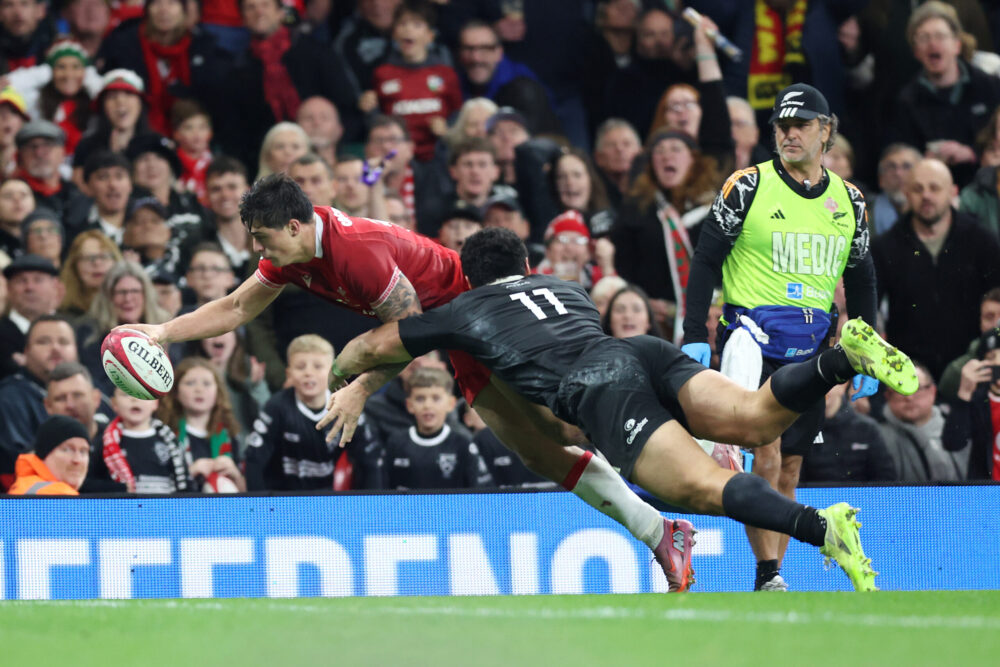
Then, with the defence sucked in, it was time to pull the trigger and once again the target was hit as Murray popped a scoring pass to Rees-Zammit who dived in acrobatically at the corner getting the ball down one handed.
So there you have it. A thoroughly entertaining game of 11 tries and no shortage of incidents for the 68,388 crowd.
But, perhaps most importantly of all, signs of a new history beginning for this enterprising young Welsh team.
Support our Nation today
For the price of a cup of coffee a month you can help us create an independent, not-for-profit, national news service for the people of Wales, by the people of Wales.


