


When Glamorgan defeated the Australians

Andrew Hignell, the Glamorgan archivist, historian and scorer introduces his forthcoming new book, The Extra Test The Story of Glamorgan playing the best 1875 – 2025, with an account of a famous Welsh win over the touring Australian cricket team in the Summer of 1964 which coincided with the National Eisteddfod visiting.
The Australians arrived at Swansea on 1 August 1964. They were one up in the Test series and had maintained their unbeaten record in the county games. Only the great Surrey team of the 1950s had defeated an Australian touring team since 1912.
During these fifty-two years, some of the greatest names in English cricket had pitted their skills against the Australians and fallen short.
Glamorgan were stuttering through a modest season, with just three wins to their name from twenty Championship matches.
Ossie Wheatley decided to offer several young players from the Colts a game against the tourists. The Australians looked, in racing parlance, to be “dead certs” to maintain their unbeaten sequence.
On the first day, in front of a crowd of over twenty thousand, the youthful side struggled against the off-spin of Tom Veivers, who took 5/85, and the lively seam of Neil Hawke who bagged three wickets.
Glamorgan were dismissed for 197. A brief shower of bank holiday Welsh rain then freshened up the Swansea pitch setting up Shepherd and Pressdee, who produced a magnificent spell of bowling as Australia slumped to 63-6, with the best of their batting talent sent packing by Glamorgan’s spin-twins.
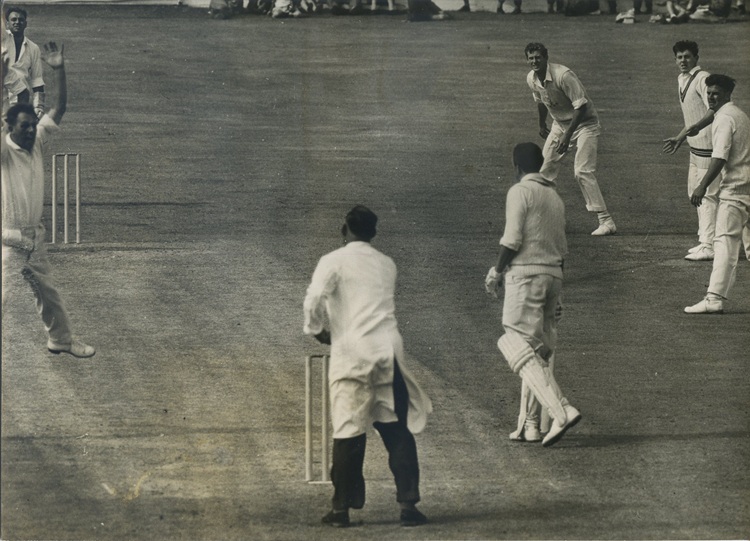
A few pints were raised in the Swansea pavilion that night to toast the divine intervention on Glamorgan’s behalf. But it wasn’t just the supporters at the St. Helen’s ground who were willing on the Glamorgan team as the National Eisteddfod was also being held just a mile or so down the road from the Swansea ground.
With thousands of patriotic Welsh men and women attending the premiere festival of national culture, music and the arts, the organisers of the eisteddfod showed great enterprise by arranging for television screens to be placed around the tented village, so that they could watch events at the cricket ground which was being covered live by BBC Wales. The monitors drew an ever-increasing crowd as word spread around the maes of Glamorgan’s fightback on the Saturday afternoon with the attendees at the eisteddfod being kept up to date with the progress of Wheatley and his team by word of mouth or catching a glimpse themselves of the flickering black and white images.
Later that evening, they were able to see both teams in the flesh as the Glamorgan and Australian teams attended the eisteddfod, with the tourists being delighted to find their nation’s great soprano Marie Collier as the star attraction.
Folk songs
After listening to a rendition of Welsh folk songs by a male voice choir totalling several hundred, the Australians were also summoned onto the stage before taking part in an impromptu singsong of their own with the Glamorgan players, in front of the audience of close to 10,000.
As Don Shepherd later remembered, “after going up on the stage that night, we were so full of hwyl that there was no way we were going to lose that match.”
On the Monday morning, Glamorgan’s bowlers swiftly polished off the Australians for 101. Tony Lewis began batting with freedom and confidence in front of a bumper crowd of over 25,000.
Veivers made the first breakthrough and then Walker had the misfortune of being caught and bowled by the spinner after the ball had ricocheted off the buttocks of Redpath at short-leg. Pressdee and Rees shared a productive stand. The Australians were left with a tricky target of 268 on the wearing surface.
There was a lot of expectation in the home camp during the final session but, by the close of play on the second evening, the tourists had fought back and had reached 75-1 with the crowd filing out through the gates and turnstiles at St. Helen’s, believing that their dream of a Welsh victory had evaporated once again.
The following morning, Glamorgan regained the momentum with Shepherd claiming three wickets during the opening half hour as Tony Lewis completed a superb running catch at mid-wicket to remove Norman O’Neill who failed to add to his overnight score, before Shepherd trapped Redpath l.b.w. and clean-bowled Jack Potter for a duck.
Counter attack
Whilst Bill Lawry stubbornly defended, Tom Veivers launched a counter-attack before being bowled by Pressdee shortly before the lunch interval. With the tourists on 180-5 it looked like advantage Glamorgan, but after lunch Lawry continued to defend besides quietly working the ball around with Barry Jarman as the tourists reached the 200-mark without losing any further wickets.
As the tourists edged forward towards a win Pressdee made a decisive breakthrough as Rees completed another superb catch waist-high at mid-wicket to end Lawry’s defiance. Barry Jarman held firm even being dropped as he drilled Pressdee to cover where Euros Lewis, the all-rounder from Dafen, was unable to hold onto the ball. One run later, Eifion Jones, the reserve wicket-keeper, caught him besides also removing the bails for good measure as Pressdee struck again to put Glamorgan well and truly into the box seat.
Johnny Martin then became another victim for Shepherd who, amidst the mounting excitement and the intense heat, had a bout of cramp in his left leg. Shepherd was not going to let it stop him from bowling in tandem alongside Pressdee with just two more wickets needed for the team to enter the cricketing record books. As history beckoned, the Glamorgan side, as well as the crowd, held their breath. With the total on 232, Rex Sellars was caught at forward short-leg off Shepherd.
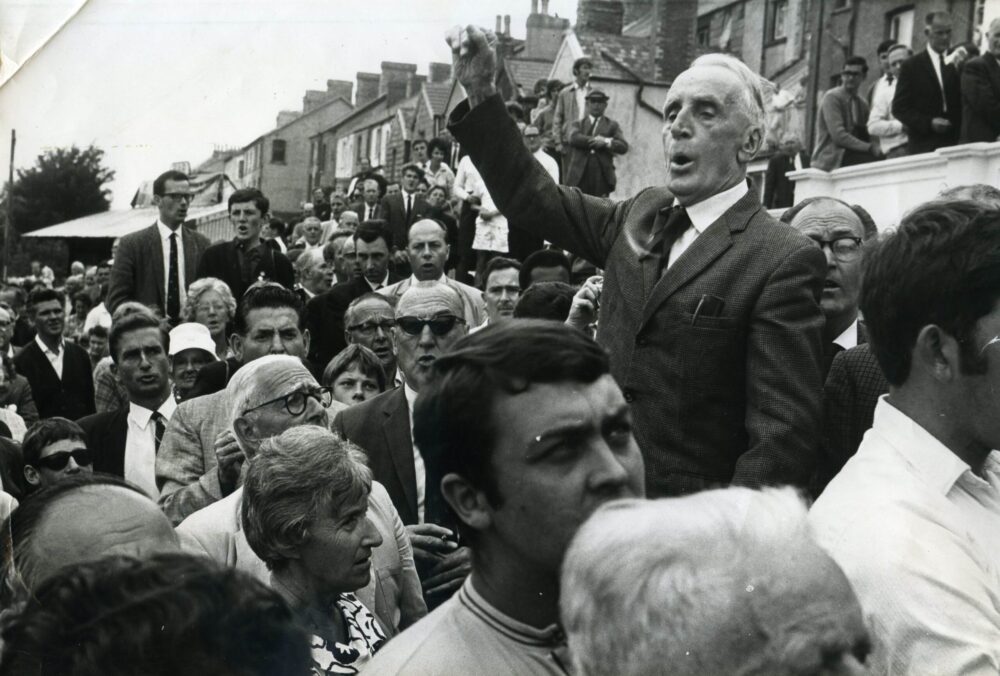
The first ball of the next over, with the clock on the Swansea Guildhall showing four o’clock, saw Eifion Jones claim another catch behind the stumps as he held onto an edge from Neil Hawke against Pressdee. It was a victory by thirty-six runs. Hundreds of Glamorgan supporters surged onto the outfield.
In the Western Mail newspaper that morning, the journalist JBG Thomas had written “If Shepherd and Pressdee can bowl Glamorgan to victory, I am sure the good folk of Swansea will then attempt to borrow the Crown and Chair from the neighbouring National Eisteddfod pavilion to honour them with pride!”
Thankfully no one took up his suggestion as the jubilant spectators took part in an unscripted, but very Welsh celebration. They gathered in front of the pavilion to hear the words of the two captains with Wheatley saying “This is better than winning a Test series”, before Simpson added “On the day, Glamorgan were just too good for us. They outplayed us from the word go.
When we return to Wales in 1968 perhaps we will avenge this defeat.” The challenge had been set.
Support our Nation today
For the price of a cup of coffee a month you can help us create an independent, not-for-profit, national news service for the people of Wales, by the people of Wales.


