


When Pele Broke Our Hearts – Wales in the World Cup Quarter Final
Leon Barton
With the World Cup now at the quarter final stage, 68 years ago Wales reached the last eight of international football’s showpiece competition, joining hosts Sweden, France, West Germany, Yugoslavia, The Soviet Union, Northern Ireland and Brazil in battling it out for a semi-final spot.
Having finished second in their qualifying group behind Czechoslovakia, the team hadn’t actually ‘qualified’ for the tournament. England, Scotland and Northern Ireland had, so the one ‘Home Nation’ due to to stay home was Wales. There was to be a reprieve though, as Israel, at that point not yet members of UEFA, were left stranded when their Arab neighbours refused to play them for a place from the ’Asia-Africa’ section.
With FIFA deciding only the hosts and holders could go to tournament without playing, Israel would have to play off against a European side who’d finished second in their group.
So into the hat all the teams went and out came… Belgium. But the Belgians turned down their place, deciding they had too much pride to go to Sweden in such circumstances. The next team picked out was Wales and the Football Association of Wales had no such concerns.
That Wales were – eventually – pulled from the hat was lucky in more ways than one. It almost certainly saved manager Jimmy Murphy’s life eight weeks later. Tragedy was to come, but in the December of 1957 Murphy was delighted by Wales’ World Cup reprieve. ’We have a second chance and you can take it from me the lads are going to grasp the opportunity with both hands’.
So the Welsh team went off to Tel Aviv where they won comfortably, 2-0. The return leg at Ninian Park appeared to be such a formality that Murphy – doing the Wales job part time in combination with his full time job as assistant to Matt Busby at Manchester United – offered to travel with his club to Yugoslavia for the second leg of their European Cup quarter final against Red Star Belgrade. ‘Go with Wales’ Busby told his assistant, ‘you’ll never forgive yourself if something goes wrong in Cardiff’. Nothing did, with Wales recording another comfortable 2-0 victory to ease through.
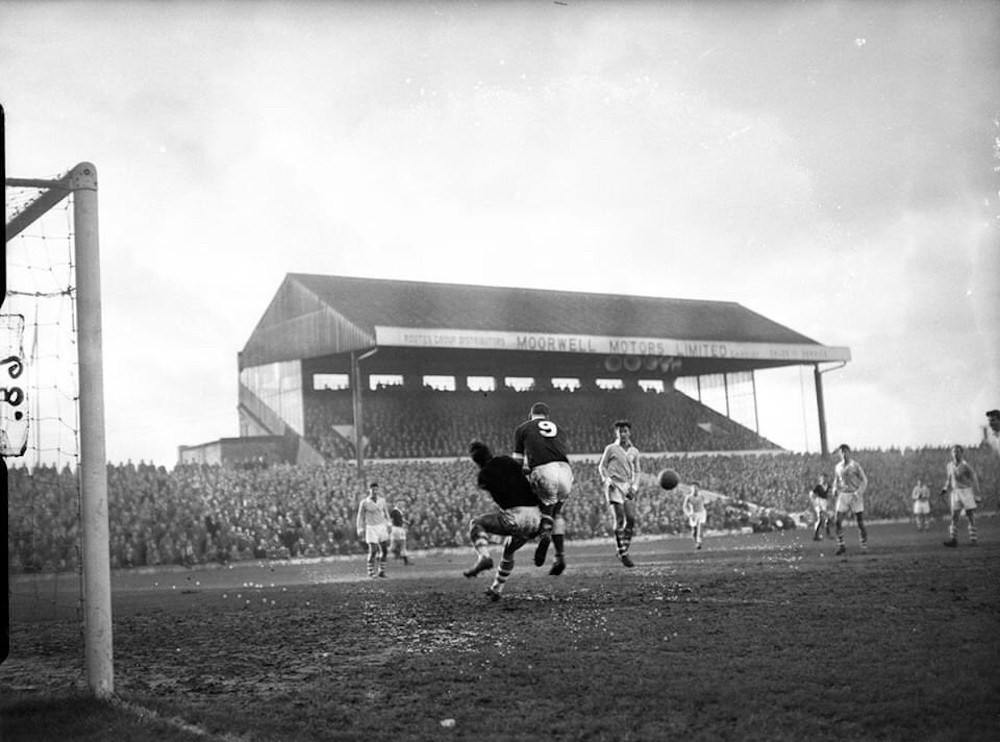
Meanwhile, United had taken part in a thrilling 3-3 draw to progress (the first leg at Old Trafford finished 2-1). But, after stopping to refuel in Munich, their plane crashed on its third take off attempt. Twenty people, including seven United players, died instantly. Matt Busby’s injuries were so severe that he was twice read the last rites.
Fifteen days later, 21 year old Duncan Edwards, considered by many the greatest English footballer of all, succumbed to his injuries in a Munich hospital. The heartbroken Murphy took the reins and did a remarkable job in Busby’s place, taking the patched up Manchester United side all the way to the FA Cup final.
By that point Busby was back, sitting pitch side at Wembley as an observer. He saw Bolton Wanderers win the final 2-0 but Murphy left London delighted, as he could sense his boss’s imminent return: ‘As he sat watching, the atmosphere of Wembley gripped Matt and the old gleam came back into his eyes. We had lost the cup but we had won back our manager’.
Taking the club to the FA Cup final in those circumstances was an incredible achievement and the presence of Busby lifted Murphy’s spirits as he prepared to take his nation to Sweden, even if, as defender Mel Charles admitted, ‘the World Cup wasn’t really a competition we were familiar with’.
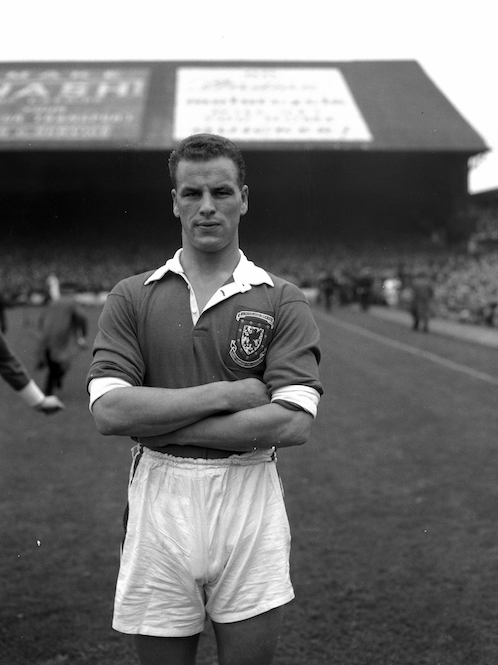
Wales had a number of excellent footballers to call upon, but one in particular stood out. ‘John Charles, like Duncan Edwards, was half a team himself …it was round the big fellow that we based our hopes and tactics’ Murphy admitted. But the ‘big fellow’ had a decent support cast around him, including his brother Mel, then at Swansea but soon to sign for Arsenal.
Ivor Allchurch was the so-called ‘golden boy’ of Welsh football. He spent the majority of his career at second tier Swansea but ‘in his early days, Manchester United were very interested in him’ according to Murphy, as ‘Ivor had the lot’. In those days of the maximum wage, top players didn’t always feel the need to leave for bigger clubs. Outside right Terry Medwin did though, leaving the Swans for Spurs in 1956. Cliff Jones was still at The Vetch but would soon join Medwin at Tottenham, where he would become one of the best wingers in the world.
Across North London, goalkeeper Jack Kelsey was considered one of the best around in his position, while Murphy believed his Arsenal teammate Dave Bowen was ‘the best captain the side has had since the war.. he has the knack of pulling the best out of a team’.
The duo were not the only Welsh stars at Highbury. Striker Derek Tapscott joined Arsenal in 1953 where he scored 61 goals in 119 games. He wasn’t picked to go to Sweden though. ‘One of the Welsh selectors came to watch me’ he told journalist Mario Risoli forty years later. ‘After the game he said if I signed for Cardiff I would go to the World Cup.’
The selector was Fred Dewey, also a Cardiff City director. ‘He thought he could get me on that type of sting but I wouldn’t be blackmailed I said ‘no thank you, I’m staying at Arsenal’ and I walked away. A player is supposed to be in the squad on ability not whether he signs for a club or not. Jimmy Murphy had a big say… but at the end of the day it was up to the selectors. They should have taken me, Ray Daniel, Trevor Ford and maybe Alf Sherwood as well. Alf had a lot of experience and was still playing well for NewportCounty… they left some of the best players behind’.
The non-selection of Ray Daniel was another shocking omission. Daniel was considered one of the best defenders in the UK and had performed heroically after a year without a game in the qualifier against Czechoslovakia even though Wales lost 2-0. The circumstances that are said to have led to his omission are scarcely believable. Daniel’s ‘crime’ was singing a song from the musical ‘Guys and Dolls’ on the coach back from the stadium to the hotel in Prague. Church-going FAW secretary Herbert Powell disapproved and Daniel was never selected for Wales again. ‘Most of the committee men were church-goers and they didn’t like Ray singing what they considered dirty songs’ said Terry Medwin.
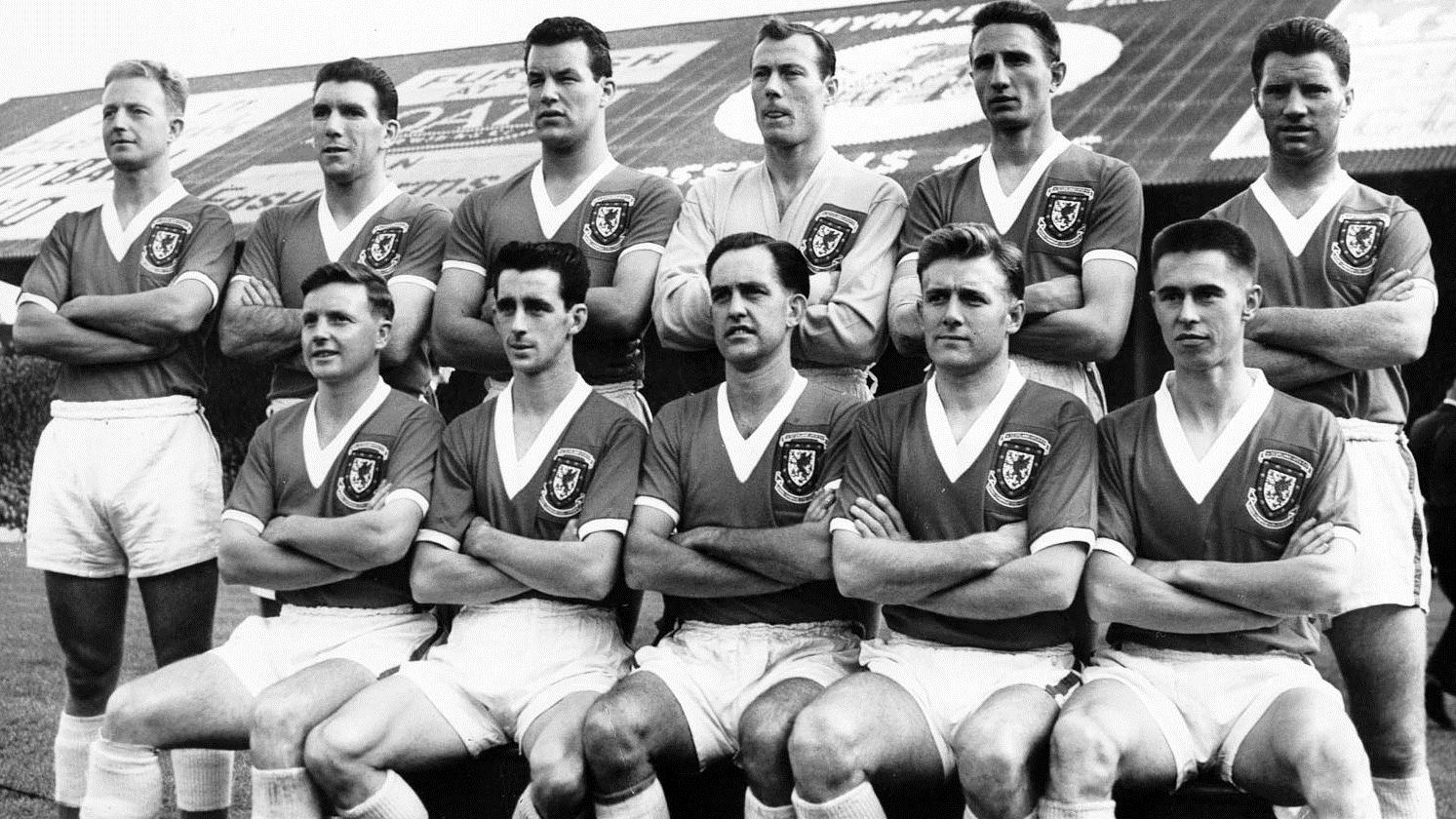
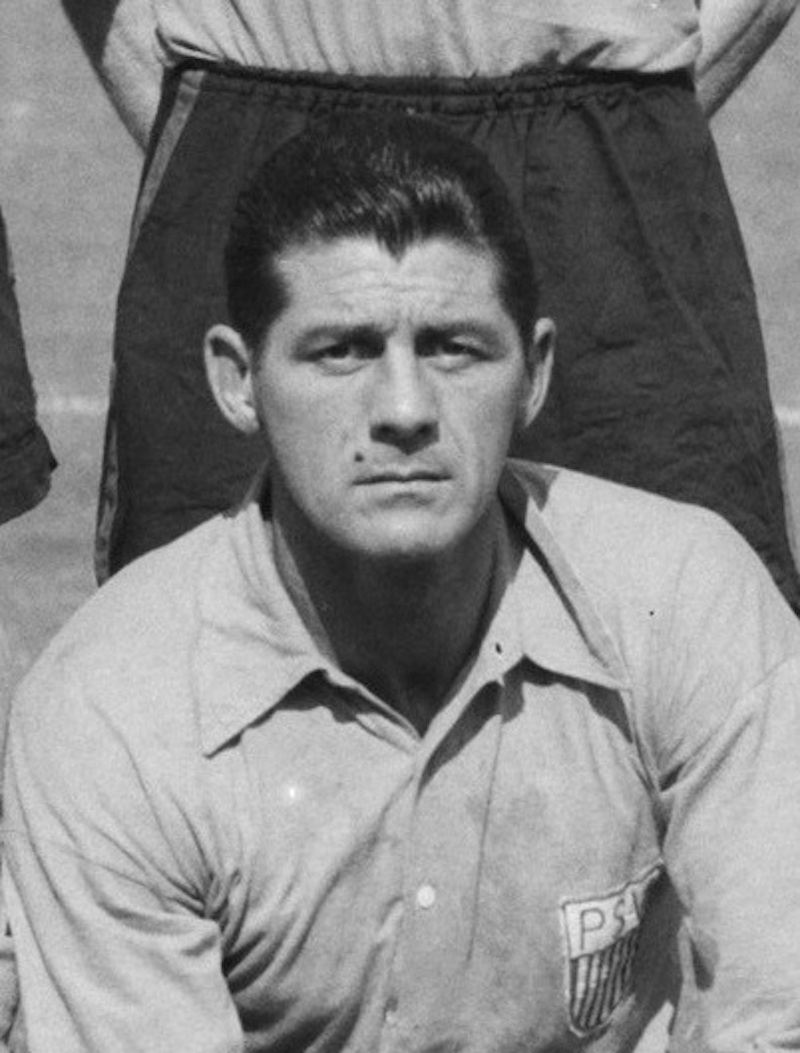
The non-selection of Trevor Ford was a little more understandable even if the FAW’s intransigence seems petty. Ford had only been available to Murphy for a 2-2 draw against Scotland in October 1956, a game in which he scored. Weeks later the outspoken strikers autobiography ‘I Lead the Attack’ was released and caused a furore. He was incensed by the maximum wage and was fully prepared to detail its absurdity by describing the way his club Sunderland circumvented the rule by offering payments and other incentives (such as free installation of new kitchen appliances) to players. His honesty earned him a ban from the Football Association. So off he went to PSV Eindhoven where he continued to bag goals at a prodigious rate.
But for the FAW’s Milwyn Jenkins the suggestion that Ford could be picked to go to Sweden was ‘sheer nonsense. There is no question of such a thing happening. The position is such that we would not dream of playing him.’ This standpoint was no surprise. The idea that the FAW would go against the FA, or the English football establishment in general at the time was anathema.
For Ford, the sense of regret was heartbreaking. ‘I could have done something in Sweden, I don’t know why the book caused such an uproar. What happened to me was unfair because I was only being honest. When I wrote the book I didn’t think we’d qualify. When we did, I was sick. I was crying my eyes out. If I’d known Wales would qualify, I wouldn’t have written the book. I would have written it afterwards.’
Not even an injury to Swansea Town’s Des Palmer, which meant he couldn’t go to Sweden either, would sway the selectors to consider Ford.
In the absence of Ford, Tapscott and Palmer, Manchester United’s Colin Webster was selected despite being discarded following a mediocre debut against the Czechs the previous year. Murphy had so many of his eggs in the John Charles basket and it still wasn’t clear if Juventus would release him for the tournament. Clubs had all the power in those days and Italy’s failure to reach Sweden was also a factor.
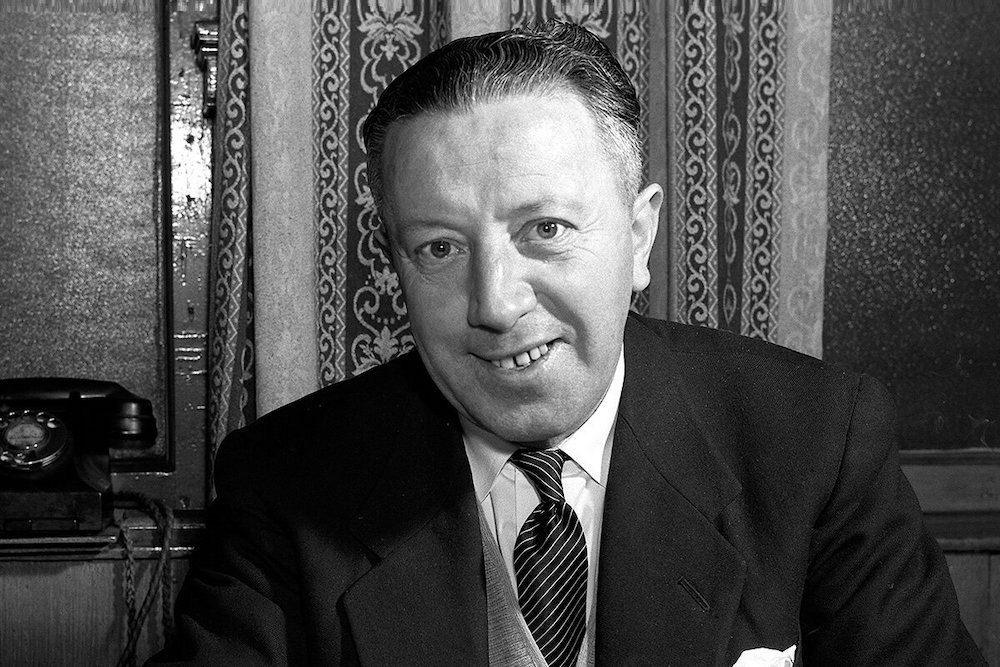
Would Italian clubs refuse to release their star foreigners out of sheer spite? It wasn’t just in selection that Murphy was working with with one hand tied behind his back. Eight days before flying out, the FAW were informed that the training facilities they had arranged in
London had fallen through. The team had to carry their gear over the road from their hotel in Bayswater to Hyde Park. Truly, it was ‘jumpers for goalposts’ stuff. Literally. Considering the ‘No Ball Games’ policy, Murphy even had to sweet talk the wardens into letting them train.
And then there were the selectors. ‘You couldn’t talk to them about football, they knew nothing about the game’ according to Mel Charles. Forty years later, not one Welsh player interviewed by Mario Risoli for his book ‘When Pele Broke Our Hearts’ had anything good to say about the FAW committee men. Sixteen travelled with the squad to Sweden, a veritable Dad’s army of clueless shopkeepers and roadsweepers who couldn’t tell Mel Charles and Mel Hopkins apart. ‘The only player they recognised was John Charles and that’s only because he was so big’ Colin Webster recalled. Wales could have taken a squad of 22 but opted for 18, only two more than the number of selectors.
Still, there were no complains about the luxurious Grand Hotel in Soltsjöbaden, which reserve goalkeeper Ken Jones believed ‘they only
booked because they didn’t think we were going to stay very long’. Murphy and the players thoroughly enjoyed the relaxed atmosphere at their base on the Baltic Sea, and their spirits were further lifted when John Charles arrived, having finally got the nod from Juventus to join up.
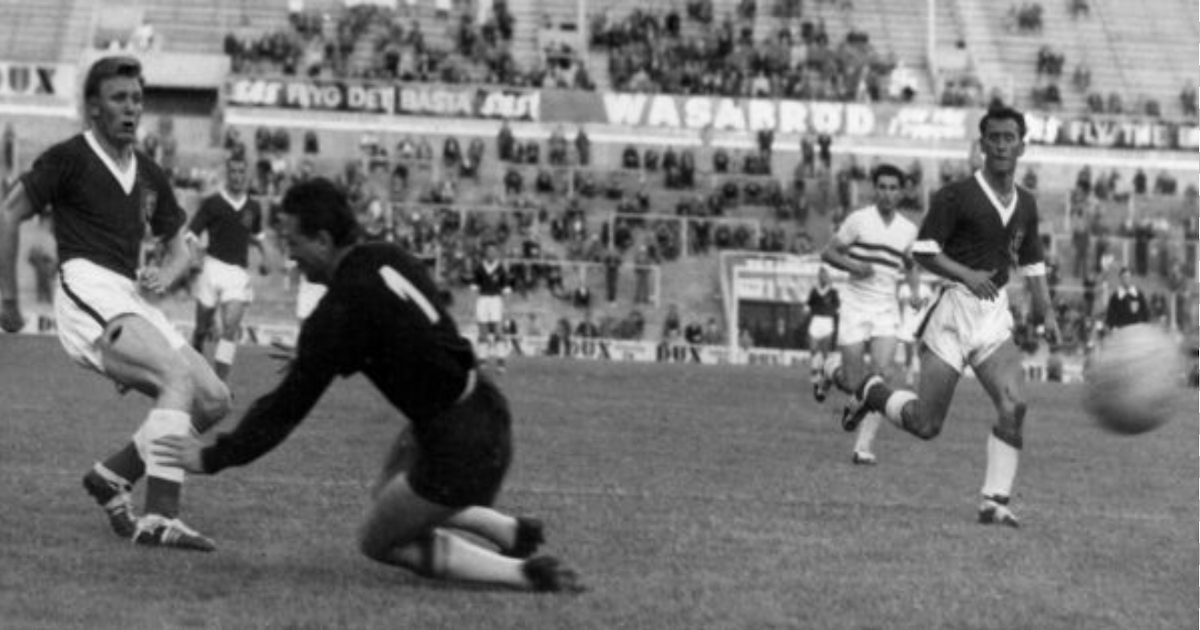
Wales drew all three of their group games; 1-1 with Hungary, 1- 1 with Mexico, and 0-0 with the hosts. In the days before goal difference was used to split teams on the same points, Wales and Hungary would play again for a place in the quarter final against Brazil but having assumed the team would be going home after three games, the FAW were forced to hastily re- arrange their travel and accommodation plans. Apparently, they possessed more faith in God than in Murphy and the team.
In Solna, a crowd of only 2,832 meant there was an eerie atmosphere at the Rasunda Stadion. A shame, as by all accounts it was an exciting match – one of the best of the tournament. Hungary went ahead in the first half through Lajos Tichy before Ivor Allchurch equalised with an outstanding volley – still, to this day, one of the great Wales goals. Terry Medwin hit the winner the 76th minute whereupon the Hungarians took out their frustrations on their opponents with some brutal treatment. John Charles bore the brunt of it.
Wales had won a match at the World Cup for the first time (and still only time) but there had been a price to pay. Charles, the team’s talisman, would miss the quarter final through injury.
Following the national trauma of being eleven minutes from winning the World Cup on home soil in 1950 before losing out to Uruguay – plus going out to Hungary four years later in the so- called ‘Battle of Berne’ – by 1958 Brazil were leaving nothing to chance.
When the Welsh squad were dodging the wardens in Hyde Park, the Brazilians were being put through a rigorous fitness regime. While Wales filled their plane with FAW selectors, alongside Brazil manager Vincente Feola was a doctor, an administrator, scout, trainer, supervisor, psychologist and a dentist, who was said to have removed dozens of infected teeth.
Doctor Hilton Gosling had been charged with choosing the team hotel. He scouted over two dozen before choosing one just outside Gothenburg and demanding they replace all their female staff with men, so the players wouldn’t be distracted. The Brazilians even tried to get the local nudist colony closed down for the duration of the tournament (the bid failed – the Swedes obviously take their right to get naked seriously!)
Preparation for an international tournament like this had never been seen before. By contrast, on the eve of the game, the Wales squad had a night out in Stockholm. Colin Webster got into a fracas with a waiter, allegedly head-butting him and knocking out three of his teeth. A furious Murphy wanted to send Webster home, with the FAW in agreement, but with Charles out, Wales had no-one else to play up front so the forward was reprieved. (That summer Webster was shipped out from Manchester United to Swansea. He never played for Wales again).
Brazil had stars like Didi, Garrincha, Zagallo and a 17 year old just starting to make a name for himself who went by the nickname Pele. Wales went into the biggest game in their history – against one of the best teams in history – without the three best Welsh centre forwards playing at the time: Charles, Ford and Tapscott. Unsurprisingly, the pundits saw this Quarter Final as the easiest to call. ‘Nobody really believed Wales could give us much trouble, and with all the praise we received from the newspapers, I’m afraid we began to believe it ourselves’ Pele admitted.
Against Brazil, Murphy used what he called a ‘retreating defence’. The team was set up to defend in numbers, attempt to keep a clean sheet and hope for an opportunity or two on the break.
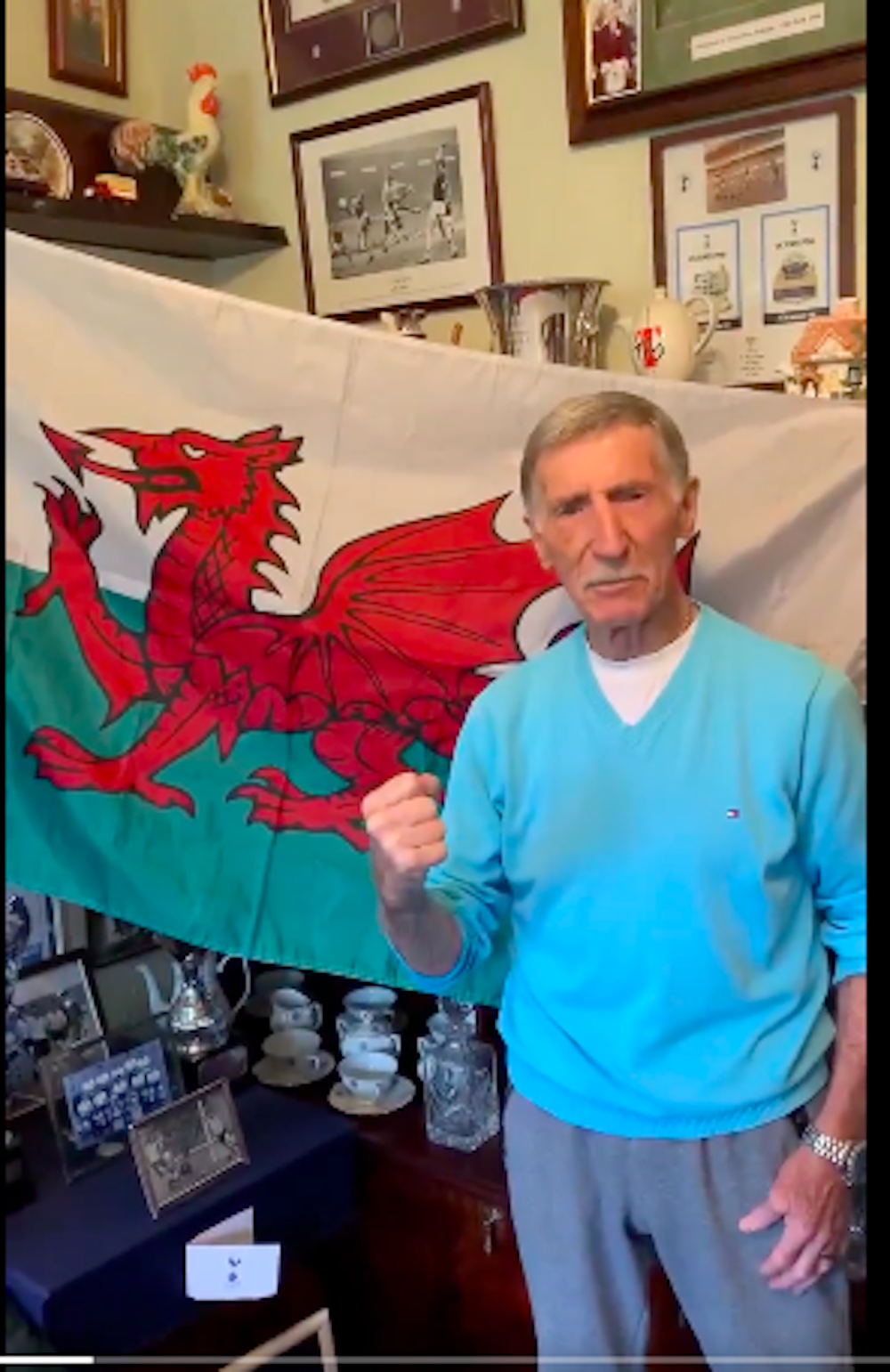
Despite all the hype around Brazil, Wales started the game on top, Colin Webster missing two presentable chances set up by Cliff Jones and Terry Medwin. Those two had their best games for Wales in the tournament but sadly, at 5’7”, Webster wasn’t able to get on the end of their deliveries. ‘Colin was a good player but there was only one John Charles. I’m certain that if John had been playing that day he would have got on the end of those crosses and made them count’ Jones believed.
Both wide men seemed to get the better of their full backs, De Sordi and Nilton Santos. ‘De Sordi was great in possession but I found him a little slow on the turn… he wasn’t a good defender’, according to Jones.
Gradually the Brazilians came into it though and centre forward Altafini wasted a glorious chance to open the scoring. Altafini, 19 at the time, had been so prolific for Palmeiras that AC Milan had decided to pay an eye-watering £80,000 to take him to Italy. Mel Charles basically ended his Brazil career that afternoon though. He never pulled on the gold shirt again (having spent three years in Italy he did win six caps for his new homeland in 1961/62, including appearances at the 1962 World Cup – Altafini later became a pundit on Italian TV and radio where he coined the expression ‘golazzo!’).
‘He suited me because he wasn’t a ball player. He was more of an English centre forward. He was good in the air, but against me he had no chance in the air and he didn’t see much of the play’, said Mel Charles.
In fact Altafini wasn’t the only Brazilian attacker to struggle that day, Mel Hopkins keeping the great Garrincha quiet. ‘That day, Mel
gave the best display I’ve ever seen from a full back’ said Cliff Jones. On the other side, Mario Zagallo got no change out of right back Stuart Williams. ‘I found Zagallo quite straightforward…he wanted to play one-twos or push the ball past you but I was quick in those days and could match him for speed’.
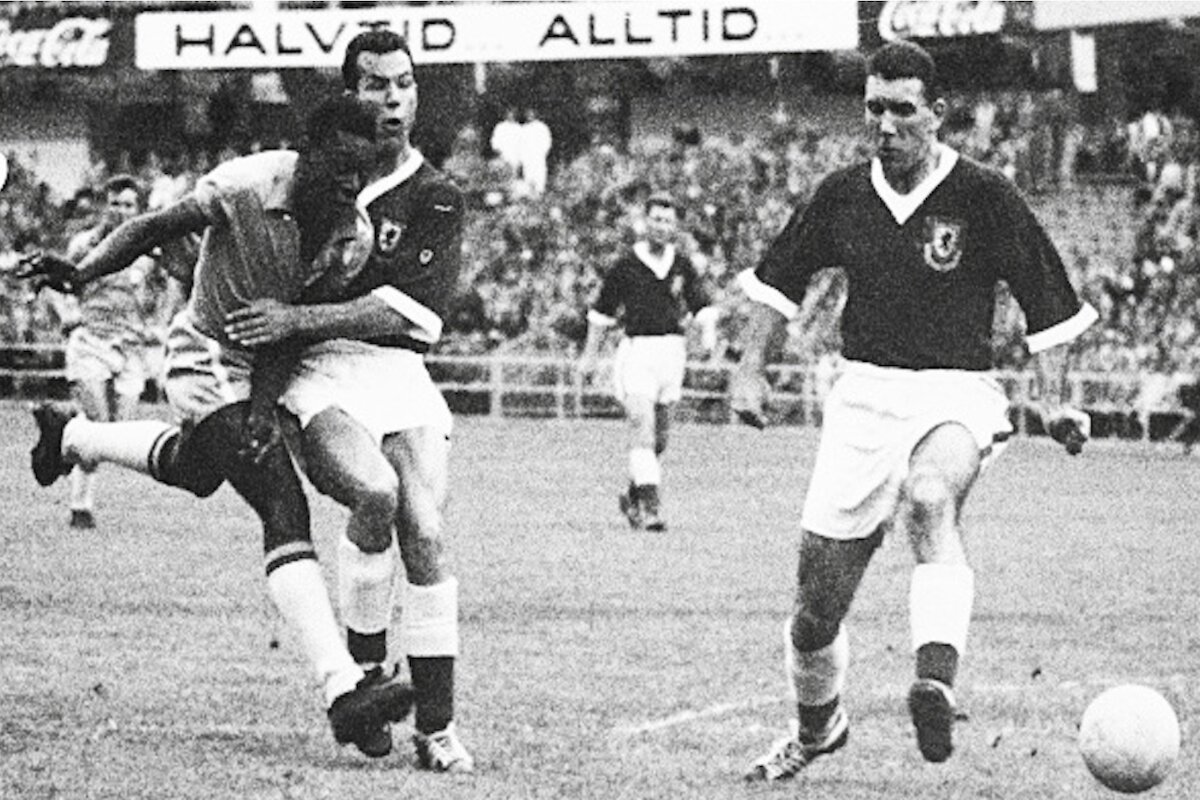
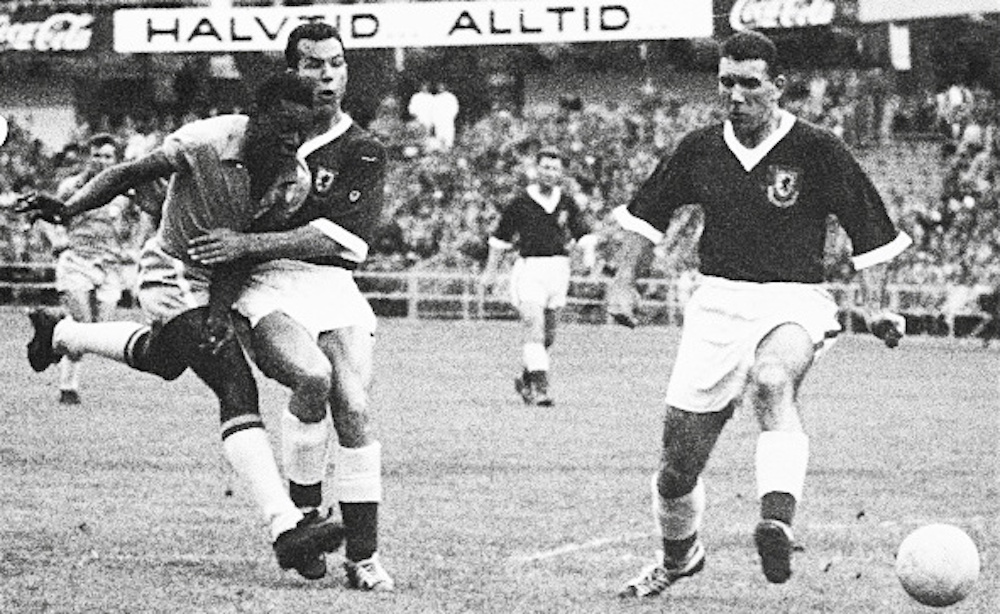
With Wales faring well against this array of attacking stars, it was the 17 year old lesser-known player that would break the deadlock in the 66th minute to save Brazil’s blushes. Pele shot early following a sharp turn in the box but it wasn’t hit hard and it took a slight deflection. ‘It was like golf putt’ said Mel Charles. The strike was celebrated with a gusto that was met with amusement by the Swedish crowd. Pele’s first World Cup goal was described as his ‘most important’ by the player himself.
With a lead to protect, the Brazilians played keep-ball and Wales weren’t able to fashion a chance to equalise. ‘Grandad always said if we’d had John Charles we’d have beaten Brazil and got to the semi-final’ says Jimmy Murphy’s Grandson Paul, while Derek Tapscott believed ‘we could have gone all the way to the final if a forward like myself or TrevorFord was playing’.
The Brazilians were full of respect for their vanquished opponents, with star midfielder Didi saying ‘you people tried to fool us. We had been told that Wales was the weakest of the countries in Britain, and that we could take things easy. Instead of that, we found ourselves up against a team full of fight, and yet, although they tackled strongly, they never tackled illegally’.
Pele later wrote that ’it will be hard ever to forget the excellent play of men like Hopkins and Bowen, of Stuart Williams and Sullivan, or the truly inspired goalkeeping of Jack Kelsey and those magic hands of his’.
As with the FA Cup final a few weeks earlier, there was huge pride in defeat for Murphy. ‘These boys brought glory to Wales and as their manager they made me feel proud to be associated with them’ he wrote in his memoir ‘Matt, United and Me’. If the scale of the Welsh achievement in only going down to a one goal defeat in a World Cup quarter final wasn’t widely recognised as the squad headed home, the results of the semi-final and final brought it into sharp focus. Brazil won both, against France and the hosts Sweden, 5-2, to win their first World Cup.
But in 1958 the tournament was not the massive global event it has gone on to become – it got very little media attention. For forty years, stories were told, but it wasn’t until the publication of Mario Risoli’s ‘When Pele Broke Our Hearts’ in 1998 that Wales’ achievement was more widely recognised.
At the time ‘nothing was said, nothing was done. I was surprised and disappointed. It was very poor’ Ron Hewitt lamented. Mel Charles’ return to Swansea was met with a ‘been on your holidays again, Mel?’ at the train station.
Wales had enjoyed an exceptional 1957/58 season, with a record 11 games, only losing to England and Brazil. The managers stock was high, and he received a phone call just after the World Cup from a Brazilian official: ‘Would I go to Brazil to coach their players? The salary offered made me whistle – £30,000 a year.’ But Murphy headed back to Manchester and ‘never regrettemy decision to go on as Matt’s assistant. A club with an overdraft and a bombed out ground had been fashioned into a great club, feared and respected all over Europe until it was wrecked in an airplane crash. I couldn’t walk away now; not with so much to be done…’
And ten years later, in one of football’s greatest redemption tales, Busby and Murphy (having left his post as Wales manager in 1964) guided Manchester United to their first European Cup.
The 3rd edition of Mario Risoli’s classic ‘When Pele Broke Our Hearts’ will be published by St. Davids Press later this month.
Leon Barton is the author of Brian Flynn – Little Wonder. He is currently working on a book about the managers of the Welsh National Team.
Support our Nation today
For the price of a cup of coffee a month you can help us create an independent, not-for-profit, national news service for the people of Wales, by the people of Wales.
Get more trusted Welsh news
Choose Nation.Cymru as a preferred source in Google News to see more of our journalism.


