


Book review: Children of Radium: A Buried Inheritance by Joe Dunthorne
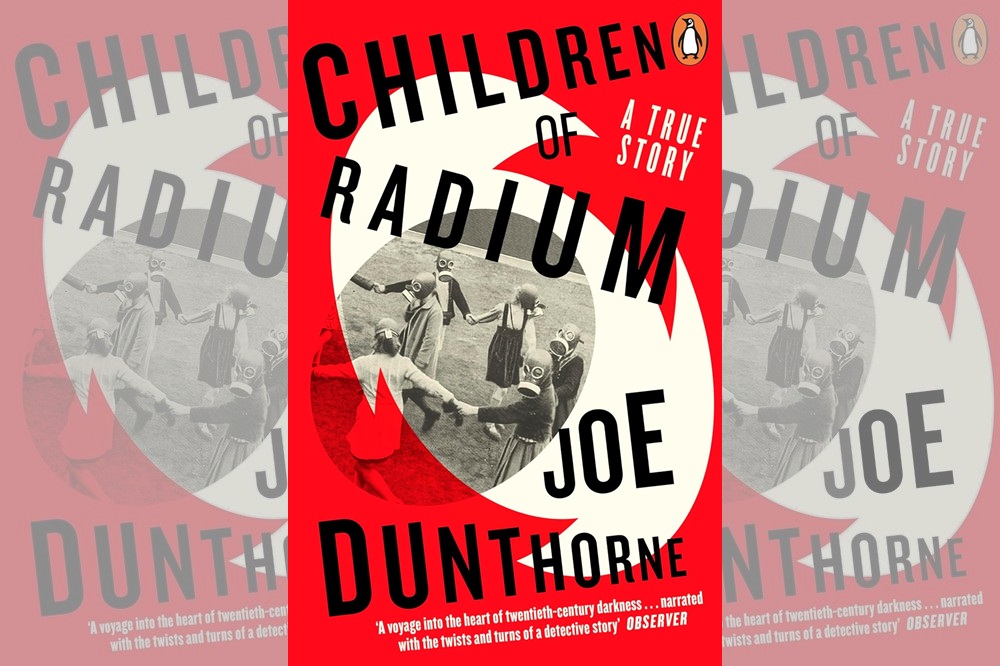
We continue our reviews of books shortlisted for the Wales Book of the Year award for 2026. This time we consider one of the titles in the Creative Non-Fiction catagory.
You can vote for the People’s Choice here.
Desmond Clifford
This is a biography of sorts, of Joe Dunthorne’s scientist great grandfather Siegfried. I say “of sorts” because it’s also about the author’s closer family, himself and his relationship to his family’s history.
Siegfried escaped the Holocaust – most of his family didn’t – and lived a long, troubled life.
We learn at the close of the book that the author and his family have taken German citizenship or, rather, reclaimed a citizenship of which the family was deprived by the Nazi regime. In that sense, the end of Siegfried’s story is the opening of another.
Siegfried, the author’s great grandfather, was a German commercial scientist. Among other accomplishments he helped manufacture radioactive toothpaste – nothing like a little light nuclear fission to polish the incisors.
But the real business of the factory he worked for at Oranienburg, north of Berlin, was the production of chemical weapons and equipment associated with it, like gas masks.
Ostensibly the author knows a great deal about Siegfried’s life because he left behind two thousand pages of an unpublished memoir. Before Joe, no one in the family had managed to read it in its entirety because it was so long, detailed and, frankly, boring.
The text occluded rather than explained Siegfried’s life and the forces at work. The story written by Joe Dunthorne fills in some of the holes, drawing attention to matters which Siegfried avoided or skipped.
After the Nazi came to power, Siegfried felt the first icy chills of Germany’s tightening race laws when he was forced, as a Jewish man, to adopt the name “Israel” as a pre-fix to his real name. This occurred while he worked alongside fellow scientists, some of whom became committed Nazis.
Siegfried even co-authored a scientific paper “The Danger of Carbon Monoxide in Garages” with Dr Erwin Thaler, a Nazi colleague. The joint paper was a tract on health and safety but, in light of what happened only a couple of years later, is heavy with poignance and moral confusion.
Siegfried saw the writing on the wall and departed Germany a few years ahead of the war to take up a post in Turkey which, modernising rapidly under Ataturk, actively recruited German expertise.
This was no middle-of-the-night flight. Siegfried and his wife departed Munich on the Orient Express and arrived in Turkey after a journey in high comfort. His scientific vocation had, in a direct sense, contributed to the Nazi evil, but had equally given him the means of escape.
Turkey was happy to import Nazi poison gas and to use it as a weapon in their civil conflict with Armenian and Kurdish minorities, notably at Dersim in 1938. Siegfried helped make this poison gas before he left Germany.
Siegfried may have escaped Nazism, and he was able to stop working on chemical weapons, but his sojourn in Turkey didn’t liberate him from moral ambiguity.
The Holocaust
Connecting Siegfried’s work directly to the Holocaust, Dunthorne describes the horrifying action of a gas chamber and its consequences for the prisoners murdered.
The camp staff who then entered the chambers to disentangle the bodies wore gas masks on which Siegfried worked. The moral confusion is stunning and numbing.
Siegfried’s whole narrative is morally taxing. We usually contemplate escapees from the Holocaust in a moral context where they sit unambiguously on the side of the wronged. Siegfried’s story complicates the territory. On the back of his scientist’s job, he escaped Germany and passed the war in relative tranquillity in Ankara while his wider family was being murdered by the Nazis.
Germany avoided using poison gas on the battlefield during the war, presumably from fear of reprisal, but gas was the weapon of mass murder for Jews.
At one stage, Dunthorne relates a confusing exchange with a German researcher about Siegfried. The German apologises – in the generic way some Germans do, to their credit, for the Holocaust – while Dunthorne was himself trying to, if not apologise, then at least note, his great grandfather’s contribution to poisoning of the land around Oranienburg.
Of the awkward misunderstanding Dunthorne says, “In the silence that followed I realized that there was no way for us to speak across these tangled pasts, one history making it impossible to acknowledge the other.”
Deep depression
After the war Siegfried relocated to America where he went into deep depressions requiring treatment in psychiatric hospitals and therapy.
Dunthorne wonders if his illness was simply post-retirement blues or trauma caused by remorse for his scientific work; “…these incompatible versions of his mental state: one in which he never recovered from the guilt of producing chemical weapons for a genocidal regime and the other in which he just needed a hobby.”
The main source for Dunthorne’s biography is Siegfried’s unpublished autobiography. It’s a massive document, detailed but based on avoidance.
Dunthorne says this, “I found myself reading the final page of the memoir and its two most unconvincing words: The End.”
Unconvincing for Siegfried because there was no end. The act of writing, we sense, kept at bay a burden of thought which he could not escape but could flick away through focus on extraneous and often pointless details, all helping him to avoid the more insistent questions.
And for Joe, too, and his family, The End was not an end but the beginning of an enquiry into a moral confusion which had no resolution. That’s quite a weight for anyone to carry around.
The book ends with Dunthorne, who grew up in Swansea, and his family, becoming German, reclaiming their citizenship as thousands of Jewish descendants of Holocaust survivors are doing, if only for the convenience of an EU passport.
In keeping with the themes of the book, citizenship resolved nothing, “no burdens were suddenly lifted”.
The procedure felt important, but he is unsure what to conclude from it, “It felt deeply meaningful and completely dishonest at exactly the same time.”
Complex
This is an excellent book by an established novelist whose own family story, it turns out, is more interesting and complex than most fiction.
It is plainly written and under-stated. He resists the temptation – and I suspect there was some resisting involved – to indulge in lengthy passages of equivocation or moralising about his great grandfather.
Instead, he lets the story tell the story, and the dilemmas present themselves very clearly without heavy authorial commentary. All but a handful of Holocaust survivors are now dead.
There’s a growing body of literature connecting Wales to the twentieth century’s great calamity and its echoing rebound.
We may feel like Sleepy Hollow sometimes but look around, lift up a few covers, speak to people – and we’re not so far from the world and its deadly traffic.
Support our Nation today
For the price of a cup of coffee a month you can help us create an independent, not-for-profit, national news service for the people of Wales, by the people of Wales.
Get more trusted Welsh news
Choose Nation.Cymru as a preferred source in Google News to see more of our journalism.



There is also a growing body of literature connecting Wales to a previous 17th and 18th century ‘calamity’ and its echoing rebound…
Please tell us more