


Book Review: Cold Grace by Meredith Miller
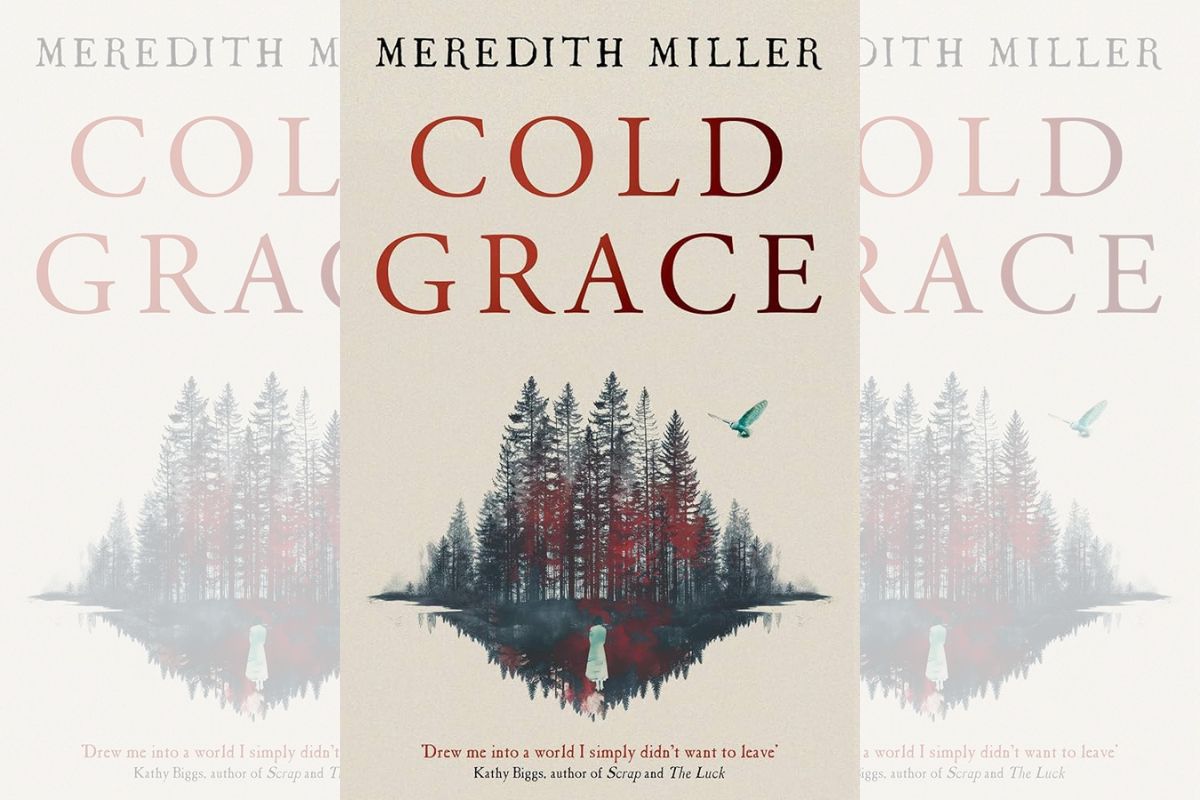
We continue our reviews of books shortlisted for the Wales Book of the Year award for 2026. This time we consider one of the titles in the English language Fiction category.
You can vote for the People’s Choice Award here.
Niall Griffiths
For those who are triggered by trigger warnings (yes, we do exist), allow me to supply a trigger warning that there’s a trigger warning in this book; it ‘contains scenes of sexual and other physical violence, as well as violence against disabled people. . . [S]ome characters express beliefs and ideas which are violent and distressing.
Please look after yourself while reading’. Well, if you feel the need to proffer such caution, then that exhortation of agency is the way to do it, I guess.
We all need to look after ourselves, although this reviewer remains flummoxed as to why books must carry such warnings when, for instance, the doorways to the local pubs don’t (maybe that’s to do with life experience and the personality that has been built out of them).
And whilst the book, in its strengths, effectively conjures the struggles and general muckiness of the lives and times it centres on, many of the scenes about which we are urged to take care are euphemistically, almost disinfectedly done. This isn’t Blood Meridian.
What it is is a depiction of rural life ‘in a non-specific area of New England in 1913’, we are told in the closing Historical Note. The milieu appears to be that of French settlers, although Welsh and Irish surnames appear too.
Familial interconnectedness, parental links of dubious and discussed authenticity, cruelties, internecine fraternal frictions.
The scrabbles are hard and there is a general air of brutishness; ‘all this killing and things swallowing each other seemed to be part of the secret of whatever lived up there’.
The protagonists are the Allen brothers, who have ‘something broken in the blood. . . turned in on themselves’, and their circling of Jeanne and other women of the area, delivered through her future monologue to a ‘government man [archivist from a] Federal Writer’s Project’.
Hers is a good and compelling voice, although in its tone and delivery (and even in the rendering of the affirmative as ‘ayuh’) and address to a speechless interlocutor is imitative of Stephen KIng’s Dolores Claiborne (one of his least preposterous, and most dullest, books).
Indeed, if Meredith Miller hasn’t read that book, then truly the literary world contains coincidental concatenations of unimaginable accuracy (the minor character ‘Sloat’, too, shares a name with a character in The Talisman).
Jeanne’s chapters alternate with third person, free indirect passages describing events to which she occasionally refers; the voices, the facets, the registers are all multi. Binaries and conflicting contrasts ground much of the narrative: city/country is powerfully illustrated when Eddie takes city boys hunting, permits them to feel ‘they’re more of men somehow. . . . That’s what they’re paying for really, to roll in the dirt like dogs trying to get the clean smell off themselves’.
Guileful
Too, the natural and the human, in its guileful, non-artless manifestation: ‘some creatures are born with their flesh and blood wrapped up against the snow like that. Humans have to steal somebody else’s skin to make it through winter, which is maybe what twists us’.
And, shortly afterwards, when Jeanne is visited by an owl (acting surely as a psychopomp here, coming as it does so soon after a death): ‘owls have eyes like wolves, yellow and sharp and right outside of anything like pity or sweetness, or evil either. They’re not bad creatures, just deadly’.
Compare this to the description of the returning brother Eddie, ‘who you don’t want to meet on the road or pass by. . . in the kitchen’. Eddie, we discover, has the rotten skeleton of rape in his closet; his victim, Etta Grace, will commit suicide by hanging from a tree branch, and will be found by Jerusha, the local quasi white witch and midwife: ‘seeing how things move and gauging different kinds of stillness is an animal thing that’s left in us. Etta Grace was speaking her absence in the way she hung there’.
Fine writing
The book bubbles with fine writing like that: incisive, concise, honed. When Eddie kills his first mammal (a female rabbit), there was a genuine pang in this reviewer’s heart: ‘it was only after she was in the sack that Eddie missed her. . . Something was absent, gone. He’d put something out of the world, and he could feel it. It was different than anything he’d ever felt before’.
On this micro level, the novel compels, and supplies satisfactions, but on the macro level, the structural dimension, confusion prevails: Jeanne shares a name with her mother, so which Jeanne is being studied is often unclear, and the relations and connections between the characters often become hard to follow, much less map. Which timeline we are in is often uncertain.
I wasn’t entirely sure why T-Roy felt the need to trek across the wilderness (well written tho that episode is). Nor was it clear why Hank and Micky torture Eddie – something about a land sale? – except that it’s a plot-advancing McGuffin. And the appearance of Ila, a minor but consequential character: who the heck is Ila? And from where did she come?
‘Eugenic sterilisation’
Further, the Historical Note tells us that an intended central theme of the novel is ‘eugenic sterilisation’, which was, in the US, ‘enacted chiefly as a form of racial violence against women and communities of colour, but was also practised on poor and disabled white women’.
Well, very little of that is communicated through the text (except perhaps in the coroner’s report on Etta Grace); that this was an avowed concern of the author came as a big surprise.
Okay, well, maybe the fault lies in my stars and what was invisible to me might be flagrant to another, but I do feel that the wayward issue of a trigger warning is euphemism and periphrasis and, through that, a kind of turning away from the true representational details of human experience. Horrors and raptures both.
Cold Grace by Meredith Miller is published by Honno and is available to purchase now.
You can vote for the People’s Choice Award here.
Support our Nation today
For the price of a cup of coffee a month you can help us create an independent, not-for-profit, national news service for the people of Wales, by the people of Wales.
Get more trusted Welsh news
Choose Nation.Cymru as a preferred source in Google News to see more of our journalism.


