

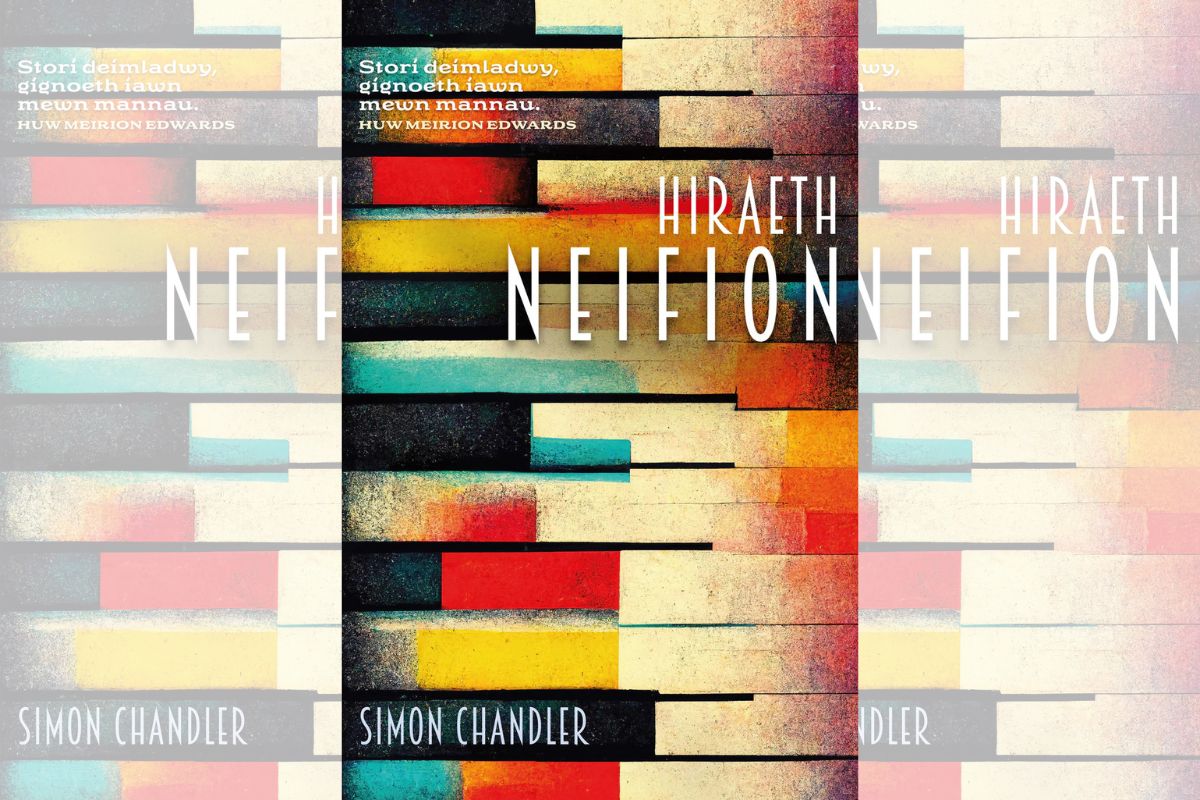
Book review: Hiraeth Neifion by Simon Chandler
Jon Gower
We continue our reviews of books shortlisted for the Wales Book of the Year award for 2026. This time we consider one of the titles in the Welsh language Fiction category.
You can vote for the People’s Choice here.
Jazz music only very occasionally makes its way into Welsh fiction in either language. It plays in the clubs of Occupied Paris in the Penarth-based Chris Lloyd’s novels about detective Eddie Girard. It’s there in Owen Martell’s novel Intermission, the beautifully measured account of the effect of the death of bassist Scott LaFaro on the pianist Bill Evans. But in Simon Chandler’s sophisticated sophomore novel Hiraeth Neifion, jazz, with its syncopations and spontaneity steps centre stage in a work that charts the way the music blows back and fore across the Atlantic at a time when Cool Jazz was being trumpeted into being. Or, in this novel, a music being made a decade before the genre became popular in post war America.
Soho sounds
Hiraeth Neifion starts, somewhat surprisingly – unless you’ve read Chandler’s first novel, Llygad Dieithryn – in Blaenau Ffestiniog, where the novel’s central character Ifan Williams lives and discovers he has a half-brother whose existence has been kept a secret. In light of the discovery, a violent altercation with Ifan’s boorish and beery father forces him to leave, decamping to London where he soon gravitates to clubs such as the Kit-Kat Club on Haymarket to find work in the kitchens. But he also finds time to visit swinging jazz clubs such as 43, Bag O’Nails and Chicago Red and eventually starts to get a few gigs in his own right.
Berlin bound
As his piano playing skills deepen so do Iwan opportunities widen, which eventually lead to Berlin, where the closing years of the Weimar Republic prove to be a petri dish for decadence and artistic experiment, both somewhat conducive for a form of music that fully spurns convention and suits night more than day. He gets some to play at some concerts whilst working for a very wealthy Jewish jazz impresario, Willi Grünbaum, the Neifion or Neptune of the book’s title.
Neptune’s Palace
Grünbaum runs a concert hall called Neptune’s PalaceAfter the most important audition of his life, Iwan joins the uber-gifted Asphalt Hustlers, under its talented band leader Art Wendell, who are out to push the jazz form to the limits. It leads to the Blaenau Ffestiniog- born pianist accompanying the New Orleans trumpeter and singer Louis “Satchmo” Armstrong in concert and, fortuitously, to a session of recording the band just before they have to necessarily disband as the Nazi darkness descends on Germany.
Nasty Nazi stalker
Ifan also meets Effi Schmidt, an ineffably beautiful singer, who at first keeps her distance before they eventually fall utterly in love with each other. But Effi has an admirer, Lutz Schneider, a nasty Nazi officer and stalker, whose obsessive lust for her seems to grow in tandem with the Nazis’ power, as they commandeer political authority and Hitler ushers in the Third Reich, with its Crystalnacht, pogroms and ultimately, the Final Solution of the Holocaust.
Art mirroring life
Simon Chandler, a lawyer by trade, handles the broad brush of history, the great sweeping changes in both America and Europe – the challenges to civil rights, the rise and rise of fascism and the dangers of populism and propaganda – which seems very timely at the moment.
Greenwich Village
Chandler can also deftly wield a finer brush to delineate the lives of a large cast of characters with both aplomb and supreme confidence. He’s particularly good on the the way art mirrors life, perhaps especially in dislocated and fractured times and reminds one of the magisteral study of Weimar art and expression in the opening chapters of Peter Hall’s Cities and Civilization.
Berlin in the early 1930s is a city which, according to one of the novel’s characters, musician Maurice White, reminded him of the freedoms of New York’s Greenwich Village, other than for the need to be vigilant about the men of the Sturmabteilung, the paramiltary wing of the Nazi Party, which was akin to Ku Klux Klan in America. It’s the freewheeling mix of invented folk such as Ifan Williams and his half-brother Ieuan and historical figures such as Heinrich Himmler and Hermann Göring that lend the book both a concrete authenticity and riffing flow in the telling, making it a page turner despite the weightiness of the matters with which it’s concerned.
So we get a huge panoply of events, from the fire at the Reichstag through the clashes between the Communists and Nazis on May Day 1929 to a very, very moving reunion in Germany in the 1990s. Simon Chandler very clearly has the novelistic skills to match the ambitious sweep and architecture of his storytelling, the dark, light and shade of momentous historical moments which still resonate troublingly today.
Hiraeth Neifion by Simon Chandler is published by Gwasg Carreg Gwalch and is available from all good bookshops.
Support our Nation today
For the price of a cup of coffee a month you can help us create an independent, not-for-profit, national news service for the people of Wales, by the people of Wales.
Get more trusted Welsh news
Choose Nation.Cymru as a preferred source in Google News to see more of our journalism.


