

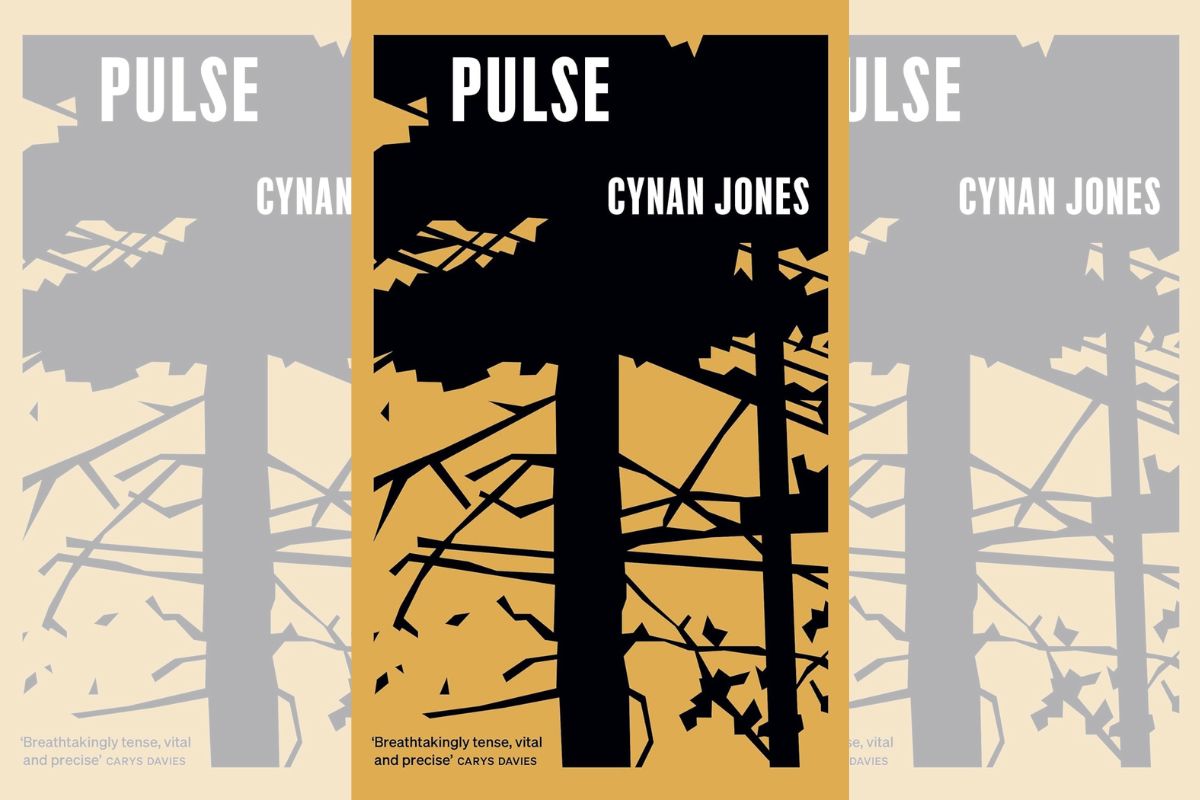
Book Review: Pulse by Cynan Jones
We continue our reviews of books shortlisted for the Wales Book of the Year award for 2026. This time we consider one of the titles in the English language fiction category.
You can vote for the People’s Choice here.
Niall Griffiths
Cynan Jones has the eye of a poet, not only for the loaded detail and the power of hieratic language but also for the use of white space; a page of his text, with the words adrift in white space, recall the typographies of such innovative, experimental poets as, say, Charles Olson, or Barry McSweeney.
Like them, his texts look and read like fragments, like something incomplete, or like originally longer works that have been judiciously and expertly pruned down to their essentials.
Space speaks, in Jones’s work. It breathes. At the risk of sounding like one of those jazz aficionados who insist that what is great about, for example, Miles Davis are the notes he doesn’t play, the whiteness of the page lasers the eye onto the blackness of the letters, puts them into focus and relief, displays, by contrast, their value.
So: the words. Jones is a fixture on the UK literary scene, now. Winner of the Welsh Book of the Year in 2015, amongst various other awards.
Over seven books he has worked on and honed a style that is so distinct, so idiosyncratic, that the reader attempts to ground his/herself with avatars and influences; Hemingway is oft-cited, perhaps facilely so (mere terseness is not a valuable comparator), and Cormac McCarthy (with more justification), but there’s also Thomas McGuane – gnomic, slightly puzzling (in a very good way), enigmatic, consistently alluring, and with a sly humour by which you find yourself bushwhacked.
The focus is on extreme emotional and physical weathers, the gory storms of rural life, frequently set in Jones’s bro of mid-Wales; struggle, small wars, visceralities. The title story of this superb collection begins in media res, outside a tempest-battered shack on a Welsh hillside, a man gathering logs (most of Jones’s characters remain nameless), his wife sheltering inside with the child, ‘the little one whom they hadn’t expected to have – the child who was at once a present fundamental fact but. . . still bewildering’.
A power-line has come down, turning the wet and churned earth potentially lethal.
This is a Jones trope, the land itself being made perilous by the depredations of the human (although we are constantly reminded of the inter-connectedness of the one to the other): ‘the pine was leaning farther into the cypress. It looked now not as if it were grasping stupidly, furiously at the out-of-reach power lines. . . . It looked now to be reaching intently toward them, with one long curled stretch’ (echoes of Blackwood’s ‘The Wendigo’ here).
The Man has a gentleness inside him – his handling of the dormant wasp is moving – but the world of which he is a part and which, as a species, he has ostensibly angered, comes together, amasses against him and his kind, and marshals to itself that which the human has created in an attempt at ease and comfort (electricity, in this case).
The child is a background figure but achieves a colossal significance at the last: ‘the little one had become, to each of them separately, their most safe point. That if they were within reach of her breath the rest of the world went away. Nothing more mattered, not even each other. I miss you, he wanted to say’.
The storm will not cease, and indeed seems to gather more wrath with each attempt to repair its ruinations. The ending of this story elicited a gasp, and indeed much of Jones’s writing has a somatic effect. The heart-rate remains elevated for some time after the words go into the white space.
Jonesian dichotomies
And then there’s the opening story, ‘Peregrine’: two men in a dinghy on a night-time sea, one resembling ‘some nervous wading animal’. Their quarry, we discover, is the nest of the titular falcon and the chicks or eggs therein, the purpose for which we never find out, but typically Jonesian dichotomies – the primeval and the modern, the pure and the sullied, all existing not in opposition but in a kind of symbiosis – are central.
One of the men seems to be turning into his dog, with the animal’s fur on the neoprene of his wetsuit. There might be a vengeful ghost of a boy who one of the men, years ago, bullied into suicide (perhaps). The ending is a literal cliffhanger and seems to suggest that our misdeeds and petty cruelties echo across species; they infect the stuff, the essential matter, of the world.
‘Cow’ is a punch to the guts. You feel every squelch, slobber and grunt of birth. The minutiae of farm life is brilliantly evoked (and talks of personal experience); it echoes the Ted Hughes of ‘February 17th’ (that search for influence again): ‘the muscle was peeled back around the cut. Had taken repeated slicing. A line of pale hide, rim of white fat, then the thick muscle that had hampered the anaesthetic. It looks like steak. It looks like steak. You’ve got to keep looking. Like steak. Because it is’.
Ambiguity
It is, on the surface, a story of the difficult delivery of a calf, foregrounded over a human illness (or maybe a complicated pregnancy itself; Jones’s ambiguity is another strength), but there’s also something about the transmigration of the soul perhaps, the exploration of an actuality beyond the one in which we physically live and love and which irrupts, mirrors, in ways that can communicate themselves only through action. That’s my take on it, anyway. Yours will no doubt be else.
Caveats? Minor; the obliqueness can, at times, mildly exasperate. There are linguistic tics that might niggle: ‘unnerve’ as a noun, ‘whelm’, and a predilection for italicised, onomatopoeic neologisms that don’t always land: ‘rrurl’, ‘ruzzed’, etc. Also, there can on occasion be a little too much pressure on the thematic drill: ‘like he was some little dog’. There is also the risk of falling into a kind of self-pastiche but that is a consequence of inimitable style.
But still, but still: with this latest collection, Cynan Jones further stamps his mark on the literature of these islands; his is an essential, extraordinary, vital voice. Read these words, explore these spaces, see the world anew, reanimated, gorgeously raw and refreshed.
Pulse by Cynan Jones is published by Granta and is available to purchase now.
You can vote for the People’s Choice award here
Support our Nation today
For the price of a cup of coffee a month you can help us create an independent, not-for-profit, national news service for the people of Wales, by the people of Wales.
Get more trusted Welsh news
Choose Nation.Cymru as a preferred source in Google News to see more of our journalism.


