

Book review: Trochi by Carwyn Eckley
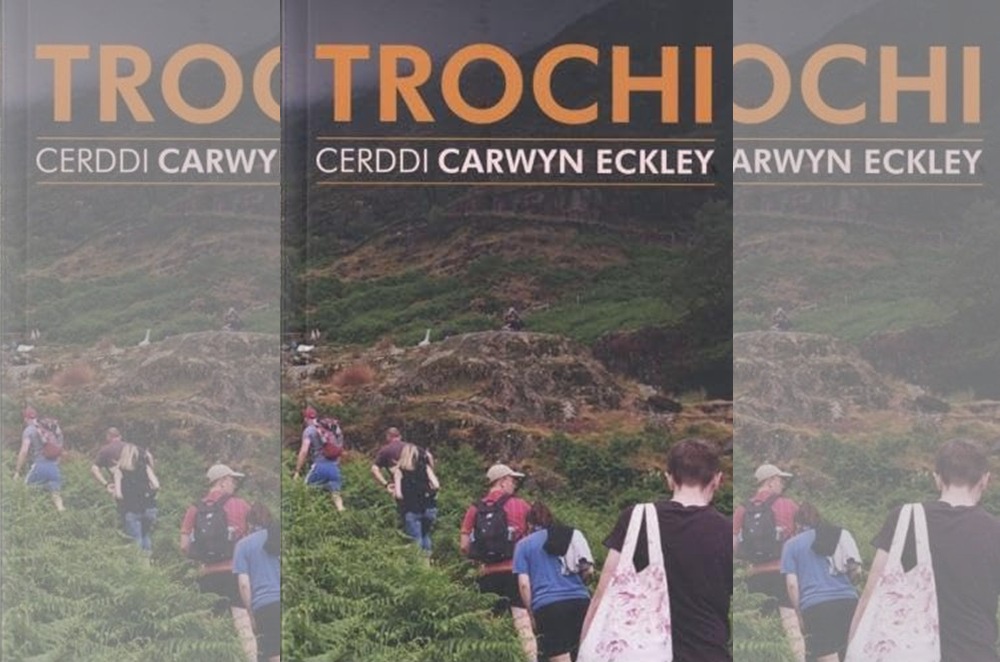
We continue our reviews of books shortlisted for the Wales Book of the Year award for 2026. This time we consider one of the titles in the Welsh language Poetry category.
You can vote for the People’s Choice here.
Ant Evans
“Trochi” is a verb, meaning “to immerse”. One thing any reader can be sure of is that they will certainly be immersed in Carwyn Eckley’s first volume of poetry, beginning, middle and end.
The central thread which is very much in evidence throughout this collection, is variety. From football, climate change, tributes, this collection truly has something for everyone.
However, the love the poet has for his family is something which stands out to the reader from the very beginning. And “Cadwyn” (chain) the work which won Eckley the Chair at the 2024 National Eisteddfod in Pontypridd, makes that abundantly clear.
Discussing the loss of his father, the reader is taken through the shadow of Eckley’s journey, from the summer of 2002 when he lost his father, to the dawn of 2024.
Of course, grief is very much a process rather than an event, and this reviewer found himself stopped in his tracks when reading “Euog” (Guilty), as it very much hit home for me:
“Hawdd yw addo,
a dweud ‘fod o
yno beunydd –
nid yw bob dydd.
A’r gwir garw?
Llai, ar fy llw,
yw’r graith weithiau
â nghof ynghau.
Er dod i’r du,
Er galaru,
rwy’n siŵr, yn sôn
di-ri’r straeon,
ei fod fel fi –
hwyl ei ddwli
yng nghist fy nghof.
Enaid ynof
o hyd ydyw.
O fath, mae’n fyw.”
“It’s easy to promise,
And say that he is
Always there –
he isn’t every day.
And the difficult truth?
Honestly, the scar,
is smaller sometimes
with my memory closed off.
Though dark times come,
Though I grieve,
I’m sure I tell
endless stories,
that he’s like me –
up for a bit of tomfoolery
in the back of my mind.
His spirit
is still within me.
In a way, he’s alive.”
As much as the works which won Eckley both the Urdd and National Eisteddfod Chairs are the clear stars here (reflecting the continued importance of both to Wales’ cultural future), this collection is filled with gems, which make the reader stop and think.
Such as “Anrhydedd” (most commonly meaning “Honour”, but in this case, leans more towards “Privilege”). This is a response to certain European countries introducing mandatory military service in the wake of the conflict in Ukraine. Though I feel it could apply just as easily to anywhere in the world experiencing conflict:
“Ni wyddom o’r newyddion beth yw bom,
beth yw byw bob noson
dan dân. Am fod ein dynion
yn saff ar yr ynys hon.”
“We’re none the wiser from the news what a bomb is,
what it is to live each night
under fire. As our men
Are safe on this island.”
The reader’s senses are also engaged in this collection. The first example to spring to mind is “Mintys” (Mint):
“Heno, roedd yn fy nghwpaniaid ddiod
flas o ddoe mewn gwydriad.
Yfais, llamais mewn llymaid
hafau’n ôl i ardd fy nhaid.”
“This evening, I had a drink in my cup
a taste of yesterday in a glass
I drank, and in a sip I was transported
Back to summer days in my grandfather’s garden.”
I could almost taste mint tea whilst reading this. Accompanying “Mintys” is a photo of the young Carwyn Eckley with his Taid (Grandfather) in the garden. Photographs (provided by Lois, the poet’s sister) serve to effectively immerse the reader in this volume further.
Honesty
Honesty and home truths can also be found in abundance in “Trochi”. Such as “Prydeiniwr” (Briton), a critique of the stereotypical Brit abroad:
“Pesgi ar y tsips a’r pysgod y mae
ym mar y Gwyddelod.
Un uniaith, un pinc hynod –
gwaethaf Brit yw Brit abroad.”
“Stuffing their faces with fish & chips
In the Irish pub.
A monoglot, incredibly pink –
the worst Brit is a Brit abroad.”
And then there’s “Cyfrwng Cymdeithasol?” (Social Media?) shedding a light on the idealised versions of oneself which others encounter on social media platforms, where the truth can be rather different:
“Weithiau, a’m hwyliau yn ulw – trwy hud
ffilter app, ar alw,
fy wyneb glân ‘welan nhw,
nid llai na phryfed lludw.”
“Sometimes, when I feel down in the dumps – as if by magic
An app’s filter, on demand
lets them see the best of me,
not what lies behind it.”
Social media
Are there any poems which stand out for me, which I’m likely to return to again? Plenty! Though if I were to choose just the one, probably “Ailagor” (Reopen). Here again, social media takes centre stage. One specific platform, which I still spend more time on than I’d like, has become something of a cesspit in recent years…:
“Rwy’n agor X, a’r hen gri
hiliol, wen, sydd o ‘mlaen-i.
Finnau’n driw i wefan drodd
yn uffern. Amser diffodd.
Hwn yw’r cawdel lle gwelir
wisgo gau yn masg y gwir,
y dweud gwâr sy’n ddweud o’i go;
geiriau sy’n arf i guro.
Ond bydd straeon yn cronni,
yma mewn awr, mi wn i,
yn dod fel un at ffrwd flêr.
Ac eto, af i’w gwter.”
“I open X, and before me
Is the same white racist cry.
I remain loyal to a website that became
hell. Time to switch off.
This is the fiery pit where one sees
dishonesty masked as truth,
The less than civilised responses which use;
words as a weapon with which to beat others.
But stories will gather,
here in an hour, I know,
I’ll come as one would approach a filthy stream.
And again, I’ll descend into the gutter.”
As I mentioned earlier in this review, “Trochi” truly does have something for everyone. If you haven’t read it yet, I can’t recommend it highly enough. I’m very much looking forward to Carwyn Eckley’s next collection of work.
Support our Nation today
For the price of a cup of coffee a month you can help us create an independent, not-for-profit, national news service for the people of Wales, by the people of Wales.
Get more trusted Welsh news
Choose Nation.Cymru as a preferred source in Google News to see more of our journalism.


