

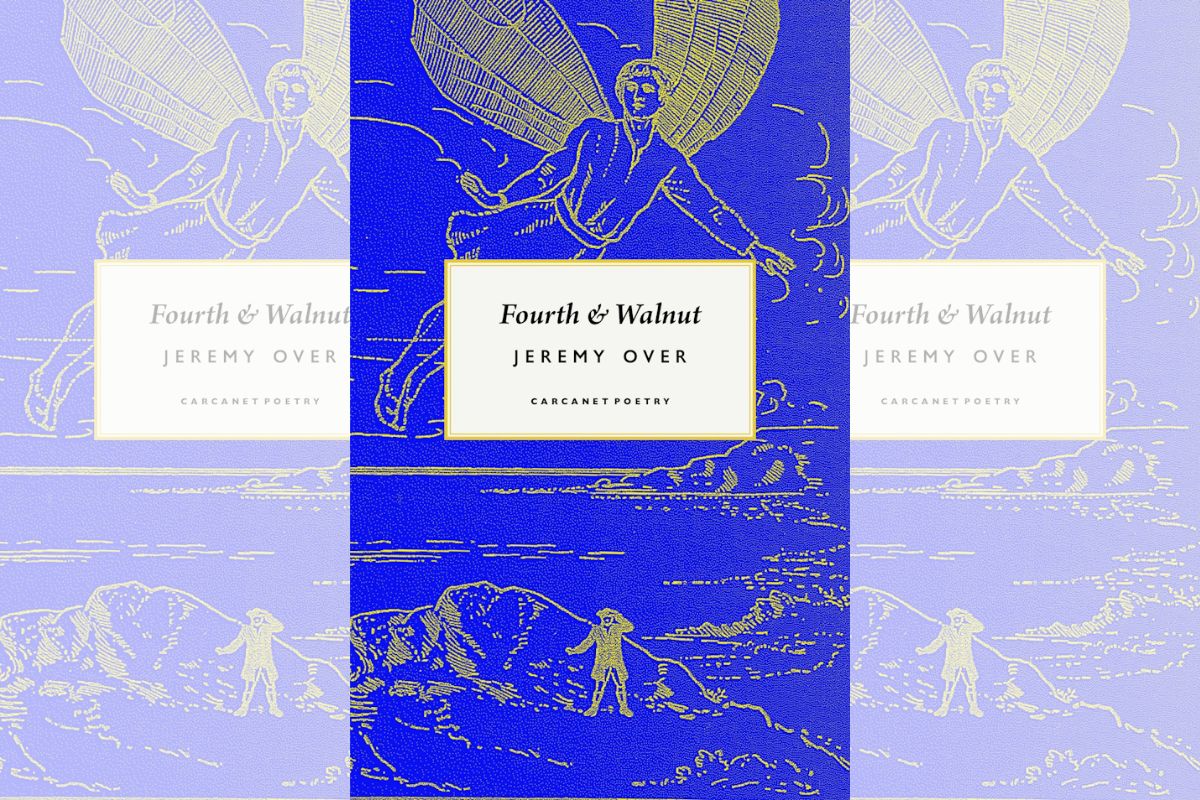
Poetry review: Fourth & Walnut by Jeremy Over
Jon Gower
We continue our reviews of books shortlisted for the Wales Book of the Year award for 2026. This time we consider one of the titles in the English language poetry category.
You can vote for the People’s Choice here.
Like the Swansea poet Nigel Jenkins in ‘Hotel Gwales’ before him Jeremy Over has used the Austrian poet Rainer Maria Rilke’s ‘Letter to a Young Poet’ as a springboard for his own musings. While the very intense Rilke seems to have been in deadly earnest both Jenkins and Over have a more playful disposition, the latter happily casting his net to advise doing things that other poets did, such as William Blake singing on his deathbed to his wife or following American novelist Henry Miller’s maxim that one should ‘Paint as You Like and Die Happy’ which is the title of a book of his vibrant watercolours.
Marshalling wonders
Playfulness is perhaps key, or at least one key to a reading of this, Over’s fourth collection and one produced after moving to live on a hill near Llanidloes. This is a place with co-ordinates he connects with the eponymous street corner in downtown Louisville, home of the mystic-poet Thomas Merton, who thought ‘There is no way of telling people that they are all walking around shining like the sun.’ Undeterred by Merton’s categorical assertion Over presses on with the business of marshalling wonders as he cheerfully messes around with words.
In the sequence “Equinox in a Box” Jeremy Over shows us the working-out of the poems as if in real time, combining material he produced on two days from dawn to dusk, the first being a solo retreat in the Cairngorms and the other in a sculpture park in Yorkshire. He gives us the time-code down the side of the page for the arrival of individual lines and ideas, underlining the sense that we are reading them pretty much as they were occurring to him – unfashioned, vivid and quiveringly alive.
Colourful riffs
Over riffs on the colour of the sky – ‘sky blue, Coventry City. Sir Jimmy Hill, Mini-cheddars’ and while you can keep up with him a little while – Coventry’s city’s football strip is Sky Blue and White which gives rise to their nickname the Sky Blues and Sir Jimmy took the club from the third division to the first the slide into Mini Cheddars is a lurch into the surreal. But who asks why Miles Davies goes from one note to the other if the music is the actual point?
That’s one of the things about Over’s verse, it tantalizes. Here is a little picture he draws in a single verse of a hillside scene:
The sound of the wind and the mad chuckle of grouse
silver black rip white ripples play of the wind on the water
grouse spiralling. Trees and a lake. Trees more complicated.
As if the hillside with the heather were alive.
You take it all in but then the word “complicated” gives you pause or makes you pause as you survey the scene, observe those grouse, by now, spiralling out of sight.
Counting snowdrops
Mind you the poet himself doesn’t always develop or take things to completion, as when he decides to count the snowdrops in his garden as both an act of meditation as well as arithmetic. He gives up after 54, perhaps daunted by his estimate of there being two or three thousand. Or maybe, like Wordworth it’s the sight of the daffodils, not the statistics that makes it a scene worth reassembling in words.
Unexpected rhinoceros
In the middle of the collection we find, or locate ‘The Middle of Things’ a conflation of images of a man walking a dog near a cliff and a photograph of the poet’s father carrying picnic equipment. In ‘Fourth & Walnut’ things are forever melding and melting into each other: boundaries blur whilst the poet always retains an element of surprise. As Over explains in the essay ‘Reading in the Rain,’ in which he, in turn, quotes from Frank Smith’s ‘Understanding Reading,’ ‘The fact that something always could rhinoceros take us by surprise – like the word rhinoceros a few words ago – is evidence that indeed we always predict but that our predictions are usually accurate. It is always possible that we could be surprised, yet our predictions are usually so appropriate that surprise is a very rare occurence. When was the last time you were surprised?’
I would have to answer it was when I turned over the pages of Jeremy Over’s collection of gentle poetic experiments which closes with a poem made by erasing bits of text from pre-existing books, thereby generating a form of found poetry. To quote Frank Smith it’s all thoroughly rhinoceros.
Fourth & Walnut by Jeremy Over is published by Carcanet and is available from all good bookshops.
Support our Nation today
For the price of a cup of coffee a month you can help us create an independent, not-for-profit, national news service for the people of Wales, by the people of Wales.
Get more trusted Welsh news
Choose Nation.Cymru as a preferred source in Google News to see more of our journalism.


