


The Curious Case of the Abridged Classics: Daniel Owen’s Enoc Huws Reissued
Stephen Price
Welsh publisher Melin Bapur has brought out a new full edition of Welsh classic Profedigaethau Enoc Huws, Daniel Owen’s classic comedic novel of hypocrisy, deceit and social embarrassment.
Originally serialised and then published in 1891, Daniel Owen’s classic novel concerns Captain Trefor, an outwardly respectable con-man who makes his way in the world by persuading investors to back fraudulent mining schemes.
His latest victim, the honest, upright but naive shopkeeper Enoc Huws, gets caught in the web, in part through his own eagerness to get close to the Captain’s daughter, Susi, with whom he is hopelessly in love (and who does not return his affections).
Long regarded as a classic and a high-point in Welsh literature of the Victorian period, the novel is deservedly famous. Less well known however is its surprisingly chequered publication history.
Melin Bapur editor Adam Pearce explains: “The novel has always been popular and there are a half dozen different editions, but after the first 1891 edition, subsequent editions are almost all abridged.
“Conciseness was fashionable among Welsh critics in the first half of the twentieth century, and the versions of the story which were published in the 30s and 1960s, the 80s and even the twenty-first century are actually quite heavily edited down.
“There have been some ‘children’s’ versions and versions for learners which cut even more, but even the versions marketed as the original novel, in the case of Enoc Huws, cut about 20,000 words, or 15% of the text of the novel.
“The same happened with Owen’s other two popular novels, Rhys Lewis and Gwen Tomos.”
Complete editions of the three main novels in Welsh did get published in the 1990s, and but these copies are hard to come by. As Pearce explains: “It’s probably easier to find the Victorian first editions than the modern complete ones that E. G. Millward did in the 1990s, which were the model for our new edition. All the other Welsh editions since the first are abridged to various degrees.”
Particularly strange is that the abridged editions, whose editors include well-respected literary figures Thomas Parry and T. Gwynn Jones, do not advertise the fact that they are abridged.
“I don’t want to say that these editors deliberately misled readers because that implies an actively malicious intent. But whilst the editors are credited, the fact remains that there is nothing in the editions that makes it clear to the reader that so much material has been cut. When I tell people about it, it’s almost always a surprise. I suspect that most of the people alive today who think they have read Daniel Owen’s books have not, in fact, read them as their author intended them.”
Pearce feels the novel reads best in its original form. He shared: “It’s true that Daniel Owen’s style can be a bit rambling, but no less so than Dickens or Eliot or any number of Victorian writers in English.
“It’s clear that they felt that Owen’s novels were improved by some pretty heavy editing. I completely disagree: Owen’s strength as a novelist is characterisation and his characters need to space to breathe.
“In Gwynn’s edition, Captain Trefor is less long-winded and verbose, which completely misses the point of that character. He also cut parts of the subplots, which are all crucial to Owen’s vision.
“He makes a fundamentally Victorian novel less Victorian. Thomas Parry’s cuts to Rhys Lewis are similar, though it could be argued that the case for cutting was stronger with the earlier novel – but either way, I think most people today would prefer to read any book as its author intended.
“It’s easy to speculate the best part of a century later why they felt it necessary to do this; but considering Daniel Owen has always been such a highly regarded author, it’s always seemed very strange to me.
“It’s hard to imagine English editors treating an English author in the same way, and I can’t help but perceive a kind of national insecurity here that led them to feel that editing Daniel Owen’s books was both permissible and necessary. I love almost everything that T. Gwynn Jones did, but this was a literary injustice.”
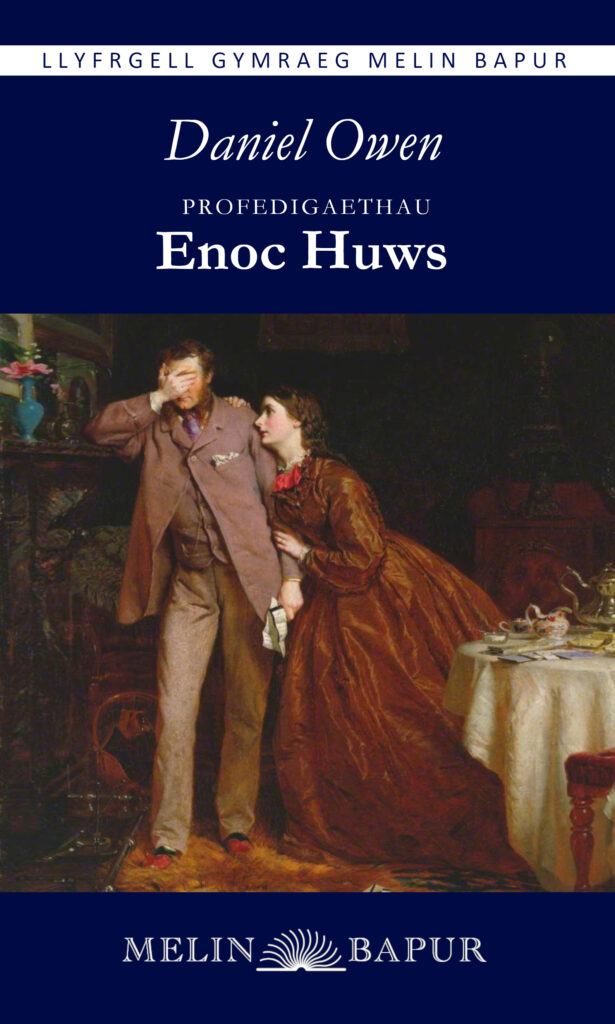
The cuts to Enoc Huws include all the novel’s front material, including the author’s Preamble and Introduction, included in all full editions of the novel.
“A quick way to see if your version is full is whether it kicks straight into Chapter 1 with the famously biting opening line, ‘Mab Llwyn a Pherth oedd Enoc Huws, ond nid yn Sir Fôn y ganwyd ef.’ [Enoc-Huws was a love-child, but was not born in Anglesey.], or whether it includes the proper Rhagarweiniad, and the Rhagymadrodd that he added for the first publication in book form.”
The novel is one Pearce has long admired: “I have a great personal affection for this book, because it was the book that really got me into Welsh literature when my GCSE Welsh teacher pressed a copy (of an abridged edition!) into my hand and said, ‘read this’.
“Daniel Owen ended up the subject of my PhD, which is where I first learned about the strange history of abridgement. I’m very pleased to be able to correct this with a new full edition in our Llyfrgell Gymraeg. Owen’s other novels are all on the to-do list.”
Melin Bapur’s new edition of Daniel Owen’s Profedigaethau Enoc Huws is available now from www.melinbapur.cymru for £13.99+P&P. Also new from Melin Bapur this month are a selection of Robert ap Gwilym Ddu’s poetry, Y Tir Pell a Cherddi Eraill (£7.99), and Gerald Coles’ debut novel Enigma (£9.99).
Support our Nation today
For the price of a cup of coffee a month you can help us create an independent, not-for-profit, national news service for the people of Wales, by the people of Wales.
Get more trusted Welsh news
Choose Nation.Cymru as a preferred source in Google News to see more of our journalism.


