

Yr Hen Iaith part 94: Writing a very different Wales: Daniel Owen’s Enoc Huws
Jerry Hunter
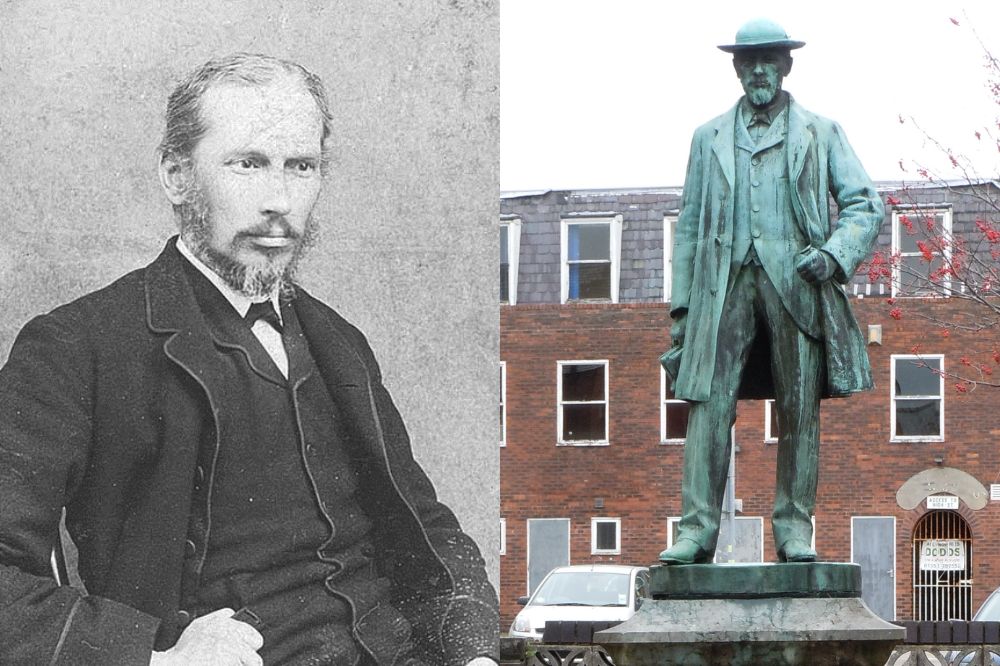
Daniel Owen was an extremely successful writer by the start of the 1890s. His fiction brought him financial rewards on a scale rare for Welsh-language authors: selling the copyright for his novel Hunangofiant Rhys Lewis had earned him enough money to pay for a new house in his home town, Yr Wyddgrug (Mold).
His next novel, Profedigaethau Enoc Huws (‘The Tribulations of Enoc Huws’), was used to help launch a weekly newspaper, Y Cymro.
Knowing that serializing it would attract readers in droves, the publisher, Isaac Foulkes, gave the author’s introduction to the novel pride of place as the very first piece of content readers encountered (after some advertising) in the very first number. That appeared on 22 May 1890.
The second number of Y Cymro came out a week later, and readers were not disappointed: the first chapter of Profedigaethau Enoc Huws was the first thing their eyes encountered (after the obligatory advertising).
As we’ve seen recently in Yr Hen Iaith, stalwarts of Welsh chapel culture considered novels to be frivolous and unworthy reading material. Now a novel was helping to sell papers. The fact that fiction was used to attract readers to what was ostensibly a vehicle for presenting facts – a newspaper – demonstrates that things were indeed changing.
The first nine words of that first chapter work together to deliver a short, sharp shock. First we read the chapter’s two-word title, Cymru Lân, ‘Pure Wales’. This was perhaps the most worn of those anodyne Victorian clichés used to present an acceptable vision of Wales.
Then we start reading the opening sentence: Mab llwyn a perth oedd Enoc Huws . . . (‘Enoc Huws was an illegitimate child . . .’). We know from the novel’s title that Enoc Huws is the main character and the first thing we learn about him is that he was born out of wedlock.
Not only that, but, while Daniel Owen could’ve chosen another phrase (for example, mab gordderch), he chose an earthy expression which suggests the physical circumstances in which an illegitimate child is conceived: mab, ‘the child’ or ‘son’ of llwyn a pherth, ‘thicket and hedge’. It is a phrase suggesting animal lust consummated in a place as far removed from a marital bed as possible.
Comforting
Imagine Welsh readers in 1891 who embraced those comforting clichés: they read the title, Cymru Lân, and think, ‘yes, great, this is exactly the kind of thing we want to read.’ And then the following words come as a slap in the face as they are forced to see that the Wales in which Enoc Huws lives is anything but that ‘pure’ country of idealized construct.
Reading on, we are presented with a wittily biting account of how society looks upon this innocent baby: Ni chanwyd y clychau ar ei enedigaeth, ac ni welid ac ni chlywid dim arwyddion o lawenydd o unrhyw natur. (‘The bells were not rung upon his birth, and no signs of joy of any kind were seen or heard’.)
Daniel Owen’s narrator is a lively literary construct in itself. He writes as if he’s a member of the community to which his characters belong, and he relates their stories in the manner of one sharing local gossip. He tells us that ‘neighbours’ (cymydogion) say that the sex of the baby wasn’t even discovered for a while because ‘there was so little interest in him’ (can lleied o ddyddordeb yn cael ei deimlo ynddo).
Then comes a sentence driven by Daniel Owen’s characteristic combination of pathos, irony and word-play:
Y rheswm am yr holl ddifrawder hwn yn nghylch y newydd-ddyfodiad oedd – nad oedd neb yn ei ddisgwyl, nad eisieu ei weled. Mi a ddywedais ormod: yr oedd un yn ei ddisgwyl.
(‘The reason for all of this indifference concerning the new-comer was that nobody expected him or wanted to see him. I said too much: one person was expecting him.’)
Returning to the blow landed by the chapter’s opening words, Daniel Owen then rubs salt in the wounds of Welsh Victorian pride:
Mi a wn ei fod yn bwnc tyner a llednais i’w grybwyll – mi a wn mai mwy hyfryd i’r teimlad yw gwrando ar leisiwr da yn canu, “Cymru Lân, gwlad y gân,” a rhoi encore iddo, ac iddo yntau drachefn roddi i ni “Hen wlad y menyg gwynion.” Ond ynfytyn a fyddai y dyn a dybiai ei fod wedi cael holl hanes Cymru yn y ddwy gân.
‘I know that it’s a sensitive and delicate subject – I know that sentiment would be better pleased by listening to a good vocalist singing, “Pure Wales, the Land of Song,” and by giving him an encore, and him then giving us “the Old Country of the White Gloves.” But a man who thinks that he’s had all of the history of Wales in those two songs is an idiot.’
Satirical
Enoc Huws is above all else a satirical novel, and it begins by satirizing the comforting lies which the Welsh had been telling themselves for decades. ‘Pure Wales’ was really a land plagued by poverty and social injustice, and ‘the Land of the White Gloves’ was in reality a place with its share of crime and moral failings, just like any other country.
Daniel Owen often revels in the grotesque as he forces readers to face these hard truths. Enoc’s mother dies soon after his birth, and his grandfather entrusts him to the care of a nurse, Mrs. Amos, before leaving the country. Although left enough money to care for the child, Mrs. Amos spends most of it on alcohol for herself, drugging the undernourished infant with laudanum in order to make him sleep.
She is the kind of Christian who does not want a baby to die unbaptized, even though she is directly responsible for hastening that impending death, and so she rushes to the house of the nearest Methodist minister:
Yr oedd y gŵr hwnw newydd orphen ei swper, a newydd roi tân ar ei bibell. Derbyniad oer a garw a roddodd efe i Mrs. Amos. Gwrthododd yn bendant symud o’i dŷ, ac ymgroesodd wrth feddwl am gyffwrdd â’r fath lwmp o lygredigaeth ag Enoc.
‘That man had just finished his supper, and just lit his pipe. He gave Mrs. Amos a cold and harsh reception. He refused emphatically to leave his house, and he was horrified at the thought of touching a lump of corruption such as Enoc.’
Religious hypocrisy is satirized thoroughly in this novel. It’s worth stressing that Daniel Owen was criticizing the very chapel culture to which he himself belonged; he was raised a Calvinistic Methodist and had considered becoming a minister when he was younger. This is a writer who is confident enough and brave enough to look critically at his own society’s sacred places.
Comedy
The fact that Enoc survives infancy and childhood is one of the many things which makes this novel a comedy rather than a tragedy. His grandfather’s money spent, Mrs. Amos puts him in y gweithdy (‘the workhouse’); like Oliver Twist, that influential novel by Daniel Owen’s older contemporary, Charles Dickens, Enoc Huws explores the cruel circumstances facing Victorian orphans.
Enoc emerges a young man, taking his place in the fictional version of Mold inhabited by the characters of Daniel Owen’s earlier fiction. He becomes a successful shop owner, and is soon targeted by Capten Trefor as a likely investor in his Ponzi scheme of a mine.
The most memorable of the novel’s characters, this captain of industry is a fast-talking hypocrite who combines an apparent knack for business with a religious façade. He is able to quote the Bible at length and employ the vocabulary of Nonconformist theology, and he does so in dazzling those whom he tries to persuade to invest in his business.
Word-play
The place is called Pwll-y-Gwynt, ‘The Mine of the Wind’, a name which we can later see as layered word-play, suggesting both the windbag Capten Trefor’s ability to talk nonsense – one thinks of the Welsh phrase malu awyr, ‘grinding air’ – and the fact that, rather than mineral ore, the mine’s tunnels are empty.
Raised in a household where appearances are everything, Capten Trefor’s daughter, Susi, is the epitome of bourgeois hypocrisy:
Ni chymerodd iddi hi lawer o amser i ffurfio ei chredo a chyffes ei ffydd. [….] [A] phe buasai rhywun yn gofyn i Miss Trefor wrth ba enw y galwasai hi y pethau hyn, gŵn yn sicr mai ei hatebiad a fuasai, “Fy ideas.” Ac, i nodi ychydig o’r ideas, gellir enwi y rhai canlynol – mae hi oedd y ferch brydferthaf yn y wlad […]. Fod prydferthwch yn dalent, ac y dylai enill deg talent ati wrth ei gosod yn y farchnad agored. Fod yn well i ferch ieuanc brydweddol fyw ar un pryd yn y dydd am dri mis, na gwisgo bonet allan o ffasiwn. Hyd yr oedd yn bosibl, na chymerai hi sylw o neb, yn wryw nac yn fenyw, islaw iddi hi ei hun, oddigerth mewn amgylchiadau ag y gwyddai hi yr edrychid ar hyny fel ymostyngiad rhinweddol a christnogol.
‘It did not take her much time to form her creed and her confession of faith. And if somebody asked Miss Trefor what she called these things, I know for certain that her answer would be, “My ideas.” And, to note a few of these ideas, one could name the following ones: that she was the most beautiful girl in the country. That beauty was a talent, and that it ought to earn ten talents when placed in the open market. That it’s better for a comely young woman to live on one meal a day for three months than to wear a bonnet which is out of fashion. That, whenever possible, she shouldn’t take notice of anybody, male or female, below herself, except in circumstances when she knew that it would be looked upon as a virtuous and Christian self-abasement.’
Transgressive
This is found in a chapter entitled Cyffes Ffydd Miss Trefor, ‘Miss Trefor’s Confession of Faith’. The Cyffes Ffydd was a document studied by members of a chapel, ‘the Confession of Faith’ which was adopted by everybody who joined that religious community. Daniel Owen’s use of the phrase in this context is joyfully transgressive and it solidifies the increasing feeling the reader has that most of what passes as religious in this community is superficial at best and downright blasphemous at worst.
This passage is also marked by Daniel Owen’s attention to linguistic detail. Rather than employing the kind of ‘pure Welsh’ one might hope to find in a ‘pure Wales’, many of these characters speak in a way which betrays their community’s proximity to England; Susi Trefor talks of ‘fy ideas’ rather than ‘fy syniadau’.
Among other things, Miss Trefor’s ‘Confession of Faith’ is a satirical exploration of the way in which capitalistic thinking can shape all aspects of life. Marriage is presented as a business deal, and this young woman thinks that her beauty is an asset which, when placed ‘on the open market’, should be worth ten other assets.
The question of Susi Trefor’s future marriage becomes central to the novel’s plot, as she is the object of Enoc’s affections. More anti-hero than hero in many ways, Enoc stumbles through life, enjoying some financial success while continually searching the deeper happiness which eludes him.
Aware of Enoc’s interest in his daughter, Capten Trefor uses her as bait in order to keep the young man engaged in a conversation about investment. While the novel is a comic farce in many ways, the triangle linking Enoc, Capten Trefor and Susi provides a much darker theme. A huge twist in the story makes that theme even darker, bringing this comical farce dangerously close to tragedy.
Further Reading:
Melin Bapur is preparing to reprint Profedigaethau Enoc Huws:
Episode 88 in this series:
https://nation.cymru/feature/yr-hen-iaith-the-present-taste-of-the-people-john-ceiriog-hughes/
On the website of the National Library of Wales:
https://www.llyfrgell.cymru/darganfod-dysgu/arddangosfeydd-arlein/llyfrau/rhyddiaith-a-nofelau/profedigaethau-enoc-huws
Support our Nation today
For the price of a cup of coffee a month you can help us create an independent, not-for-profit, national news service for the people of Wales, by the people of Wales.
Get more trusted Welsh news
Choose Nation.Cymru as a preferred source in Google News to see more of our journalism.


