


A new voting system meant the Welsh election couldn’t have been further from a two‑horse race – so why was it portrayed as one?
Stephen Cushion, Professor, Cardiff School of Journalism, Media and Culture, Cardiff University, Keighley Perkins, Research Associate School of Journalism, Media and Culture, Cardiff University; Swansea University, Maxwell Modell, Research Associate School of Journalism, Media and Culture, Cardiff University
Even before votes were counted in this year’s Senedd (Welsh parliament) election, speculation among commentators was rife that one campaign narrative had firmly taken hold – that the contest had become a two-horse race between Plaid Cymru and Reform UK.
Both parties promoted that framing during the campaign, urging voters to see the election as a straight choice between them. In the aftermath of the result – and Labour’s losses – attention quickly turned to whether the media had amplified that message, including criticism by a Labour Senedd member who refused to talk to ITV News because of its coverage.
A strange exchange this morning with one of Labour’s nine remaining members of the Senedd.
Mike Hedges refused to stop to talk to @itvnews and instead appeared to blame the media for last week’s election result. pic.twitter.com/GvTwyum6fA
— Rhys Williams﮷ (@RhysWilliamsTV) May 11, 2026
Clearly the media were not solely to blame for Labour’s decline. However, our analysis of election coverage found that more than one in four TV news items featured an opinion poll, often framing the contest as a battle between two parties. On UK-wide flagship bulletins, that figure rose to more than half. In the final week of the campaign, almost half of all TV news items referenced a poll.
A binary choice?
From the outset, Plaid Cymru and Reform used campaign slogans that presented the election as a direct battle between the two parties. The implication was that voters should back one of the frontrunners rather than waste their vote on other parties.
May 7 is a choice between more of the same or real change.
Vote Reform for real change. pic.twitter.com/7UwfflU0xK
— Dan Thomas MS (@DanWalesReform) May 2, 2026
That framing carried particular significance because this election was held under a new proportional voting system. Unlike Westminster’s first-past-the-post model, proportional systems are designed to produce representation for multiple parties. Seats are allocated according to vote share. Because of this system, the election couldn’t have been further from a two-horse race.
Stronger performances by Labour, the Conservatives, Greens or the Liberal Democrats could have translated into representation in the Senedd.
But public understanding of the new system remained limited throughout the campaign. Surveys conducted before and during the election suggested widespread confusion about how votes would translate into seats, alongside misinformation about tactical voting.
Whether the two-horse race narrative actually changed voting behaviour remains difficult to determine. Post-election research will need to assess whether voters acted tactically, misunderstood the electoral system, or were influenced by campaign messaging and media coverage.
Research has long suggested that heavy reporting of opinion polls can contribute to a “bandwagon effect”. This is where voters gravitate towards parties perceived to be gaining momentum.
Horse race dominated campaign coverage
As part of our election media analysis project, we tracked all election news coverage across both UK-wide and Welsh broadcasters between April 8 and May 6. This included flagship TV news bulletins on the BBC, ITV and Channel 4. We also looked at online news articles from BBC Wales, ITV Wales, S4C and Sky News, and social media content produced by these outlets.
Our previous analysis found that broadcasters produced many explainers during the campaign. These included videos outlining how the D’Hondt proportional voting system works.
But in day-to-day reporting, explanations of how votes translated into seats were far less common than stories about which parties were rising or falling in the polls. Instead, coverage increasingly focused on the electoral horse race, particularly in the final stretch of the campaign.
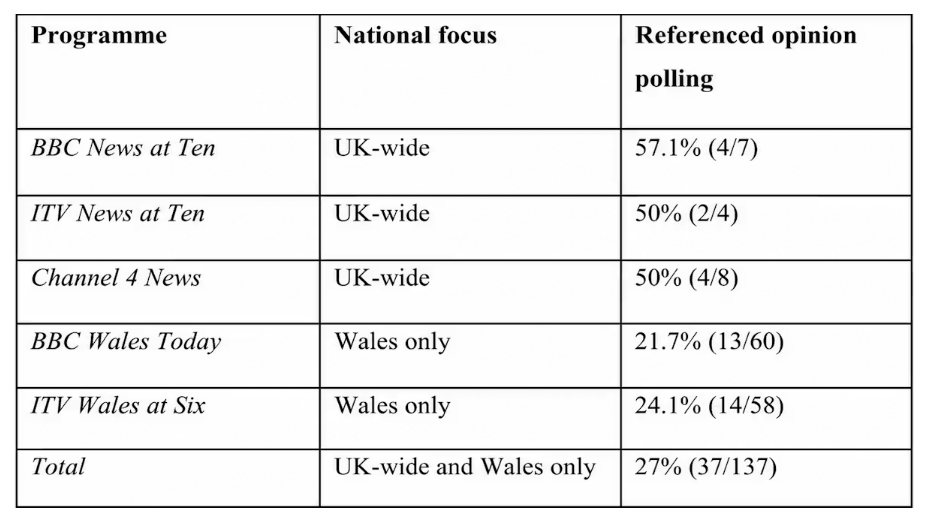
Seat projections also became more prominent as polling day approached. Although not always included alongside polls, they shaped reporting in the campaign’s final days across television, online coverage and social media. This included ten online items in the final week, four on social media and two on TV news.
Because Plaid Cymru and Reform were leading many of the polls, coverage often centred on those two parties. On May 5, for example, ITV News’ Wales at Six programme opened by reporting that Plaid Cymru was surging ahead of Reform in the broadcaster’s latest poll.
As polls increasingly drove coverage, the election itself came to be narrated as a contest between two parties competing for victory.
Did coverage squeeze out other parties?
The prominence of polling and seat projections inevitably reduced attention on other parties and on the broader dynamics of proportional representation.
It’s questionable whether broadcasters should have amplified campaign messaging that framed the election as a binary contest. After all, without understanding the proportional voting system, people may not have appreciated that it is designed to represent a range of parties rather than produce a winner‑takes‑all outcome.
Only Plaid Cymru can beat Reform, says Rhun ap Iorwerth https://t.co/Q0yifhjEUz
— BBC Wales News (@BBCWalesNews) May 1, 2026
At the same time, it is important to recognise the difficulty of isolating media influence. Broadcasters were largely reporting representative opinion polls that, in many cases, accurately reflected the final outcome. But our analysis suggests that, in the final week especially, the campaign was increasingly understood through the language of momentum, winners and losers.
That approach undoubtedly added drama and urgency to coverage. But it also risked diverting attention away from policy debates and from the realities of a proportional political system designed to produce a more representative mix of parties in the Senedd.
This article was first published on The Conversation

Support our Nation today
For the price of a cup of coffee a month you can help us create an independent, not-for-profit, national news service for the people of Wales, by the people of Wales.
Get more trusted Welsh news
Choose Nation.Cymru as a preferred source in Google News to see more of our journalism.



The media have bigged up Reform’s popularity for years now, effectively creating the surge. The only way to fight that was by going with the two horse narrative and use it against them. Plaid did the right thing, and it worked.
The system means that no one really won, or could win. PC had 44% of the vote, but no majority, and on a 52% turnout. Such a low turnout should concern us all. How on earth can Rhun get our money from Westminster with such a tepid mandate? I have a horrible feeling that nothing will change.
Correctly stating the harsh reality, even in the honeymoon period.
As much as we celebrated a party of our country ‘winning’, the reality is that barely 1 in 5 voted for Plaid, not far off the ratio of people who have criminal convictions. So we have much work to do and the former showing ‘compassion’ for the latter simply does not work.
Sure, turnout is a problem across the nations of Britain and is not unique to Wales. Any apathy has been caused by decades of misrule by unionist parties, both in Wales and at Westminster.
The majority of those who voted for Reform cited the cost of living, the default 20 mph speed limit, and asylum seekers as key concerns—even though immigration is not devolved to Wales, and is arguably a consequence of Brexit championed by the likes of Conservative conman, Nigel Farage.
Plaid Cymru has a “tepid” mandate—are you for real? Turnout for the Senedd Cymru election was the highest since devolution. Did you see the results for the English council elections? They averaged 40.5%, and that’s with Reform supposedly on a high. Was that “tepid” too? Things have already changed. Keir Starmer and Labour has responded to Plaid’s call for further powers just nine days into office. Yes, actions speak louder than words—but in the two years Starmer’s been in office , and since Eluned Morgan became First Minister, UK Labour patronised and ignored her and the Welsh Government’s calls ,… Read more »
The turnout is the highest in 27 years of the Senedd / Asssembly.
Yup. And just over 50% turnout is a very very sad indictment of our political system. And this was an election where interest was higher than it’s ever been…
I think Plaid won considering they are the party in power. Apathy has been caused by decades of parties lying about what they stand for just to get into power and mistrust is rife. To get the first turnout in a Senedd election over 50 percent was massively significant and it wasn’t much lower the. the turnout for the General Election 2 years ago. As far back as I remember no party has got anywhere near a majority of those eligible to vote voting for them but Plaid had comfortably the most votes comfortably the most seats and finished first… Read more »
Simple.
Senedd told no one apart from a leaflet drop. (maybe mentioned it oncer or twice but comms is woeful on procedure).
A proportional voting system doesn’t solve the problem of a nefarious party raised in the ways of FPTP but fearing embarrassing Nigel by messing up in power hoping to get the most votes or seats and being kept out of power by a “leftist stitchup” so they could spend three years peddling a stolen election corrupt democracy narrative to justify Nigel abolishing devolution in 2029. Avoiding this outcome makes a two horse race inevitable.
Because we’re in the Age of Extremes, ‘me now’ people demanding only what they want regardless of the expense /exploitation of others, so that means switching to whoever tells them whatever they want to hear and those parties going from 13 to 77 seats.
Unlike Plaid Cymru, which was funded by its grassroots supporters, some celebrity endorsements, members who worked tirelessly knocking doors , Reform had the backing of the Rupert Murdoch rightwing media, platforms such as GB News, billionaires such as goose-stepping Elon Musk and Thailand-based crypto tax avoider Christopher Harborne, who donated £12 million to their coffers. Yet Farage’s office boy, Dan Thomas, still failed despite their arrogant assumption that they would become the largest party in the Senedd and become the Welsh Government.
GB News is owned by Marshall and a Dubhai investment company. Murdoch runs Sky, The Sun and The Times.
Proportional or not, the largest party status was a two horse race, as correctly framed by the media. It was important that that was explained to voters.
Can you imagine the state of our democracy right now if Reform had won that status but a left/Welsh block came together to govern? Completely normal in European politics of course but not in the UK, and Reform would have gone to town on that. Thankfully, the public understood it was a two-horse race and Wales has enjoyed a week of joy, relief and hope as a result.
The authors’ colleagues at Cardiff have explained why it could well be seen as a two-horse race. Richard Wyn Jones has demonstrated that we have two voting blocs and Jac Larner has explained how it makes sense to vote the largest party in your favoured bloc, under the D’Hondt system.
Of course, this doesn’t take away from the fact the media coverage of Welsh elections is weak: covering parties’ talking points with little analysis of their claims.
It suited the two main parties, especially plaid to push that narrative. Given how little attention was paid by most of the public to the new voting system, they were able to get away with it. It was depressing how little attention was given to manifesto detail. This is one of the few chances where policy and direction of government can be publicly debated. Seems as though media and/or Welsh public aren’t bothered by that
Where other than Nation Cymru would a debate on policies be platformed ?
The UK controls the BBC and almost all the printed media.
The UK also controls Welsh economy and almost all tax receipts include income and corporation tax.
The headline is nonsense. Like it or not, it absolutely was a two horse race. Plaid and Reform won 80% of the seats between them. The polls consistently said so and the results confirmed it as most people like to see a “winner”. I find it amusing that academics and advocates of PR can’t (or don’t want to) see what is blindingly obvious.