


Making Tracks: Blaenau Ffestiniog
Jon Gower visits an evolving garden in the hills and seeks out a very special stone mentioned in the Mabinogi.
The train ride along the Conwy Valley line from Llandudno to Blaenau Ffestiniog is the very definition of scenic, initially hugging the river’s edge where Telford’s bridge connects with Edward I’s castle. Then a parade of shelduck and oystercatcher starts, pied and variegated birds standing on silver, glistening mudflats.
These riverine reaches are soon replaced by Phragmites reedbeds as you slow down into Dolgarrog, a village long, long ago associated with more supernatural creatures. Y Garrog was a dragon of enormous appetite that preyed on sheep, especially those on one particular meadow, or dôl. After being poisoned by local farmers the gluttonous creature’s body was buried in nearby Eglwysbach but its name lives on.
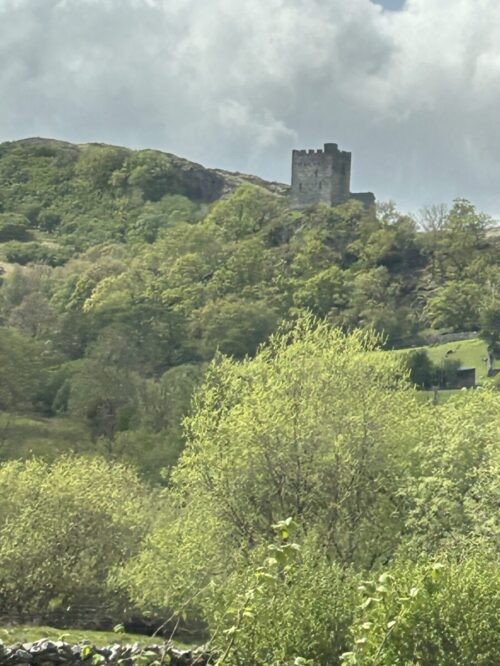
Then there’s a Welsh castle at Dolwyddelan. From the train window even a glimpse of the square solidity of this mountain fastness is prohibitive, a building stamped with the who-goes-there authority of Llywelyn ap Iorwerth, who probably built it between 1210 and 1240.
It guarded a mountain pass, an early trade route running east to west, which follows the river’s course as does the train.
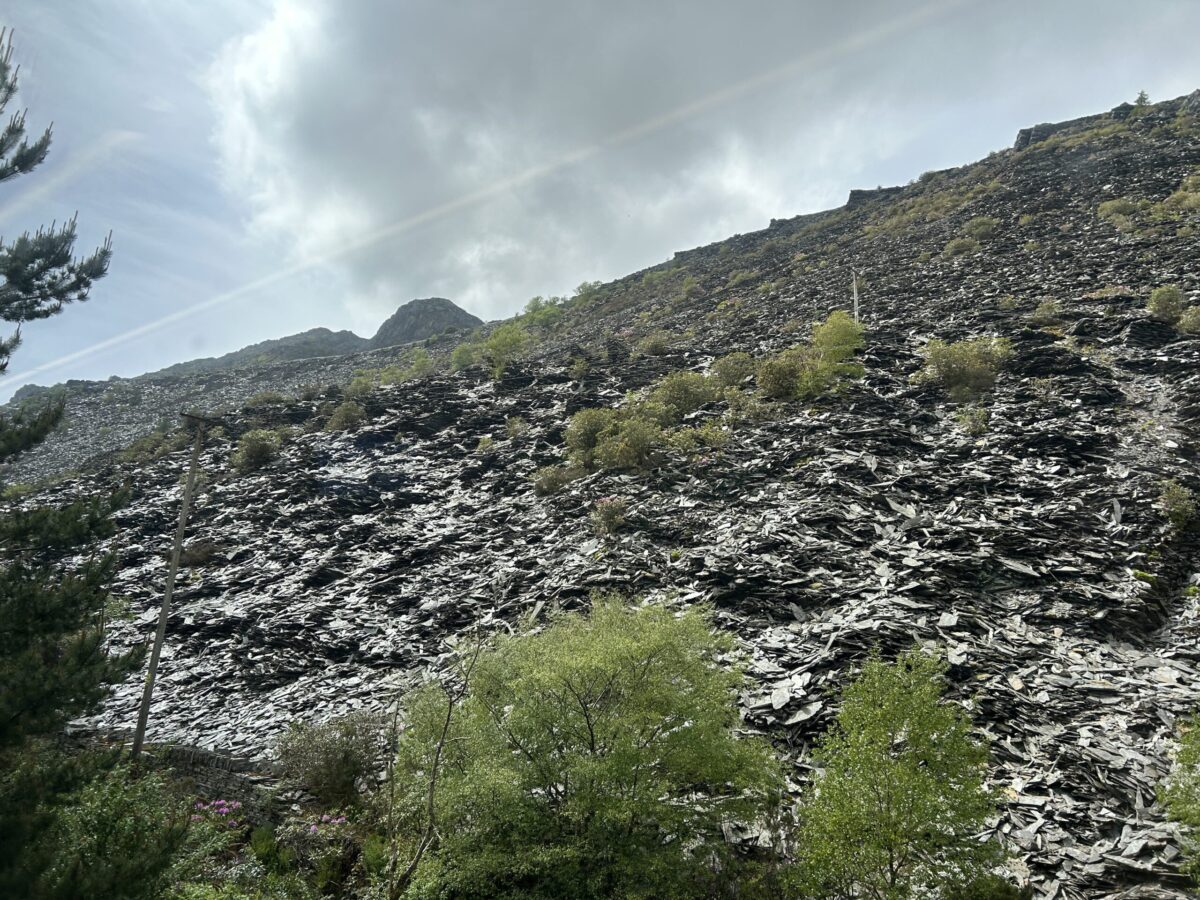
The entry into Blaenau Ffestiniog station has to be the most dramatic in Wales. After passing through a two mile tunnel cut through the heart of a mountain you cut through gargantuan piles of slate, a jagged grey terrain of industrial spoil, enlivened by the occasional blurt of purple rhododendron.
Not far away is a brown hill called Boot Hill, literally made of such footwear, dating back to World War II, when Blaenau’s Market Hall was a boot manufactory.
On the train I chat with Carl Hughes from Llan Ffestiniog who, as a young man worked on tarmac gangs before spending most of his working life in Blaenau Plastics.
He has many relatives on his mother’s side who worked in the slate quarries. ‘All of her brothers and my taid, Lewis Jones. They called him Lewis Jones, Gors. He lived in 4, Taliesin Terrace. Then there was my uncle Lewis who died at the age of 47 from silicosis.
He came home from school one day when he was fourteen and his father, my grandfather, told him he was starting work in the quarry on the Monday.’
Carl explains how the work could be very dangerous indeed. Last thing at night there’d be a loud warning before ‘setting off explosives in the quarry, in a huge opening as big as St Paul’s Cathedral. They’d leave everything settle overnight, then my uncle and three companions would be the first into the dust in the morning, to make sure the place was safe, that there weren’t any overhangs that could crash down.
All four of them died in their forties. They didn’t have torches, just carpet lamps or candles. They would use chains and bars to remove any dangerous rocks, sometimes having to tie two wooden ladders together with rope to reach some of the overhangs.
There were stories about bodies being brought out of there in sacks because they had been smashed so badly after slate had fallen.’
Before we part company, Carl tells me about a local schoolteacher’s remarkable daily journey. ‘There was a school for slate workers’ children in Penmachno. At the end of the day the teacher there would travel down from the top of Graig Ddu on a loaded tram known as y car gwyllt, the wild car, past a series of lakes, then down other inclines to a goods yard. Full trams go down at speed and the empty ones would go up, using a pulley system, with men riding to work on these.’ And one schoolteacher.
Carl informs me that of the many Blaenau slate quarries only Cwt y Bugail, the highest industrial site in the UK, is still in business.
‘Blaenau slate is now expensive and they import from Spain and Brazil, but the quality of those isn’t so good. The Spanish ones turn red and the Brazilian ones turn green and then to powder after ten years. Blaenau slates last for a century.
‘Yr Hen Lygad, the Old Eye in the Oakeley quarry was the best vein of slate. There’s a photograph of this old boy working there, folding over a piece of slate. He could get sixteen slates out of an inch-thick slate, so each one was a sixteenth of an inch thick and there’s another photo of a man standing on such a slate set between two bricks and they can take his weight.’
Slate quarrying and fashioning was the principal industry hereabouts, trimming hard material into slates as thick as the pages of a poetry book, which had names such as Empresses and Broad Countesses, Wide Ladies and Duchesses Bach. The many different sizes of slate were first given the titles of female aristocrats – a rich bank of titles like Little Viscountess, Princess and Marchioness – from the late 1730s onward.
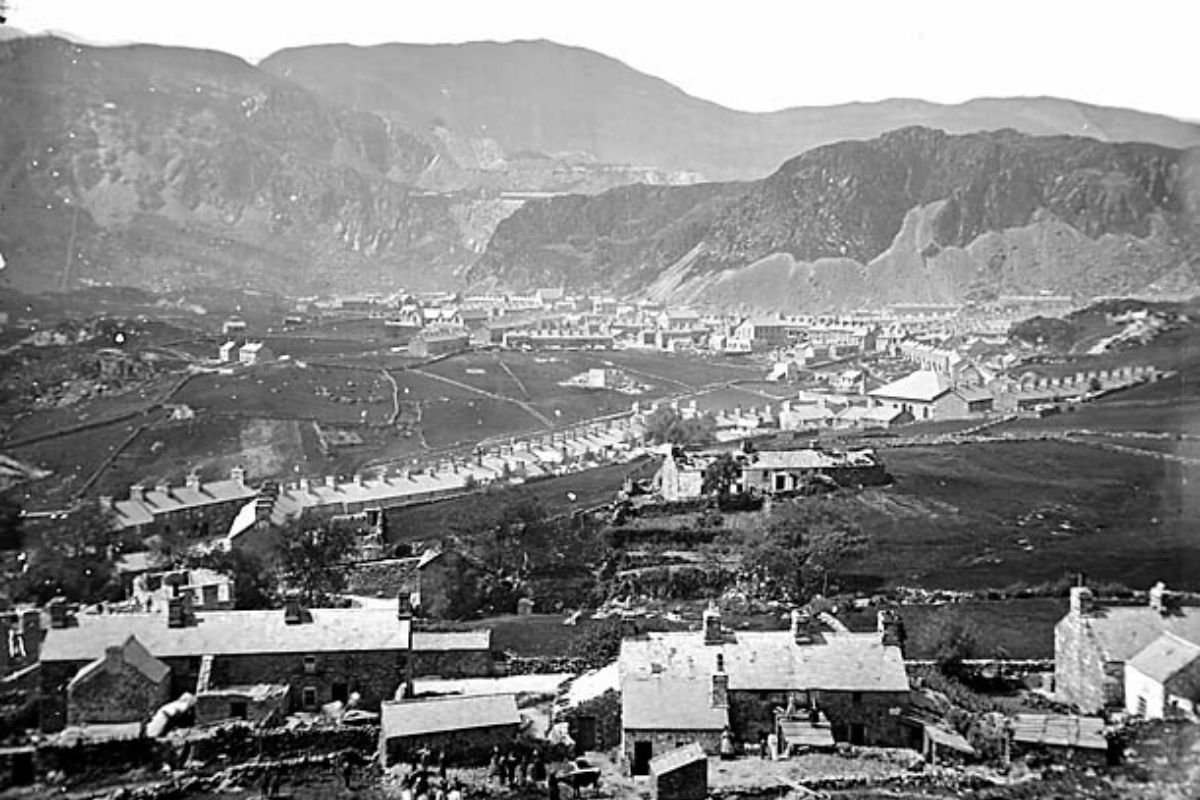
At the peak of slate production 12,000 people lived in the town. But as the industry declined so did the population dwindle: now there are some 4,000 living in ‘Stiniog, as locals call it.
The lack of jobs led to challenging times but as a song lyric by local band Anweledig suggests ‘Mae na lechen yn y gwaed/There is slate in the blood,’ suggesting a toughness and a hardiness about its people and it is certainly a place with a resilient community spirit.
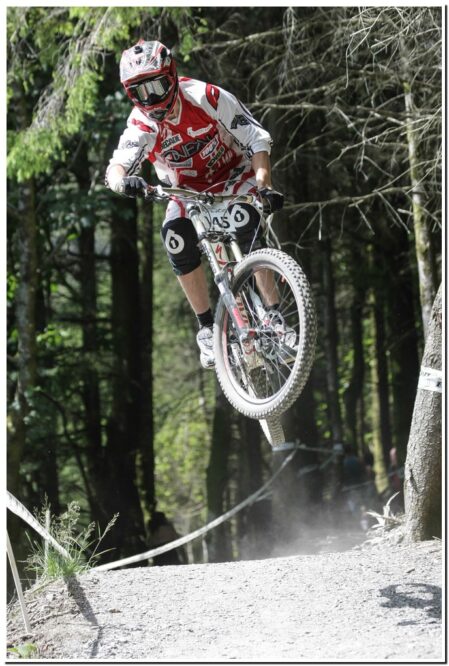
This is perhaps manifested in the fact that Blaenau Ffestiniog has a great many social enterprises which include a leisure centre, an arts and crafts workshop, a successful mountain biking centre, energy production and energy saving promotions, reducing food waste, river cleaning and youth work.
A total of thirteen such social enterprises pull together in the same direction under the umbrella of Cwmni Bro Ffestiniog.
As Ceri Cunnington from Cwmi Bro suggested in an interview with Deb Luxon on Nation.Cymru: ‘Old economic models have failed us – we’re taking ownership and redefining what a high street means, looking at it as a whole. We now have the highest density of social enterprises throughout the UK. The whole idea is working together, sharing resources, expertise and putting pressure where it’s needed.”
One such enterprises is Seren Stiniog which creates many opportunities for people with learning disabilities. These include a café, a community hub in Porthmadog, a furniture repair workshop and a hotel called Gwesty Seren. Guto Evens, finance manager at Seren told me the company’s history and ethos.
‘It was established in 1996. It started out small, just a company looking after a couple of individuals. We’ve grown a lot and now we look after about 70 individuals. We employ more than 80 staff, so it’s the second largest employer in the area after Blaenau Plastics. We give people with learning difficulties various opportunities including proper work.
‘We’re also looking after the community – we try to do everything as locally as possible. One of the other strings to their bow is Gerddi Stiniog, a community garden right next to the hotel in Llan Ffestiniog.
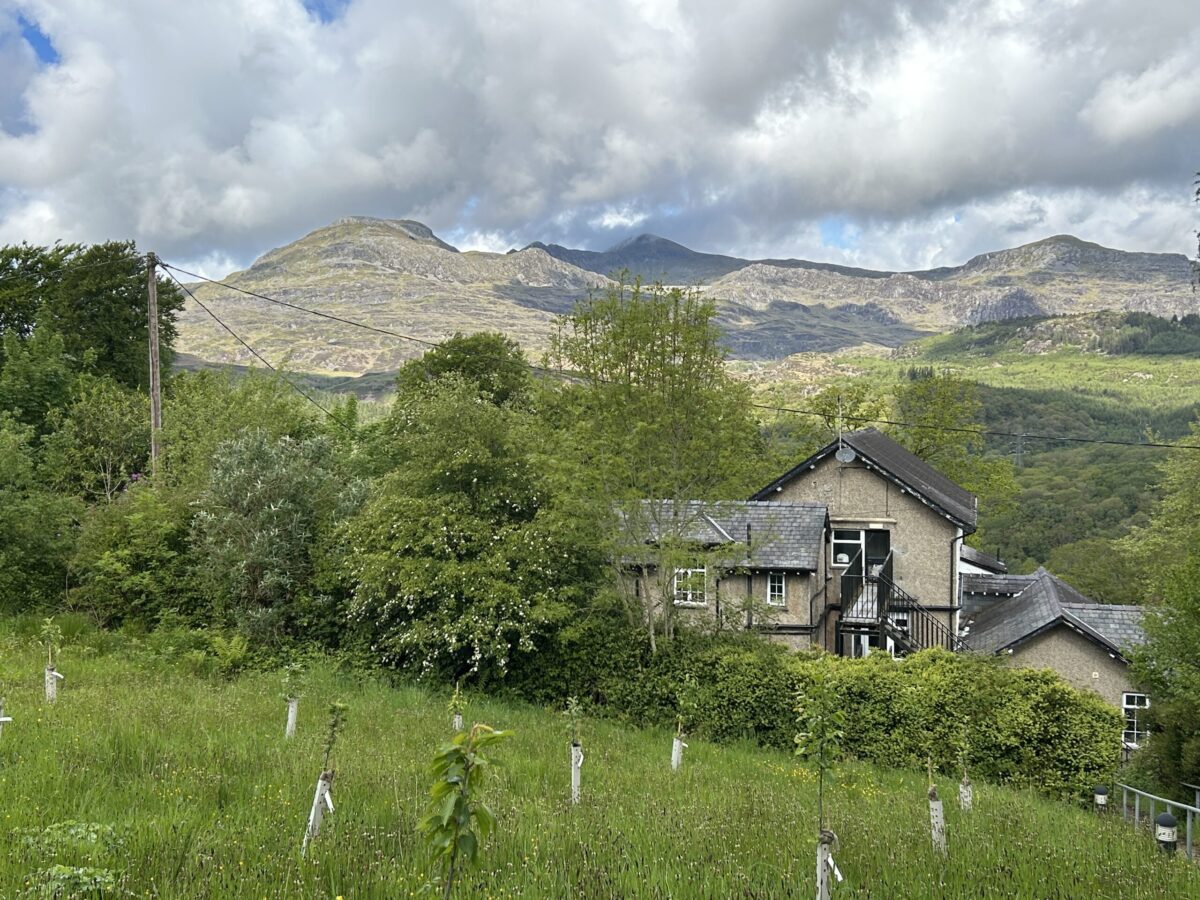
Joss Lucas is in charge of the gardens and explains the challenges they faced early on. ‘I started in the gardens 5 years ago, when you couldn’t see from one end to the other because of trees and bushes – it had run wild over the years.
‘We did a lot of clearing, created a sensory garden, a picnic area. But it’s ongoing, things grow back every year.’ He’s under a bit of pressure at the moment as they’re about to take part in the National Open Garden Scheme for the first time, so there are paths to finish and loads of flowers to be planted. ‘It didn’t help that this year has been so wet.’
Joss wasn’t trained as a gardener and did a range of jobs before this one: lorry mechanic, roofer, a little bit of gardening in a caravan park, then started doing maintenance before moving into the gardens where he admits, ‘I’m not a gardener: everything I’ve learned I’ve learned on the job.’
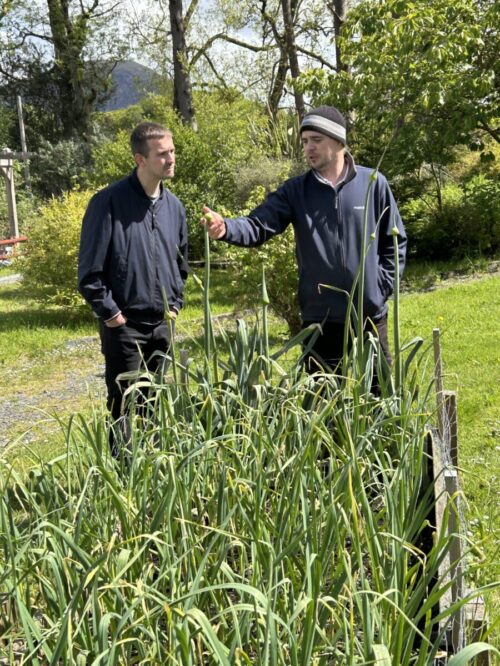
He is now one of three members of staff and 11 locals come here to work for varying number of days each week. ‘Some of the older people just like coming here and being with the crew here – we’re all mates.’
One of those is Mei Thomas who has been working here since 1991, five days a week, looking after the chickens and finding the eggs. He lives in Bryn Blodau care home and walks to work each day.
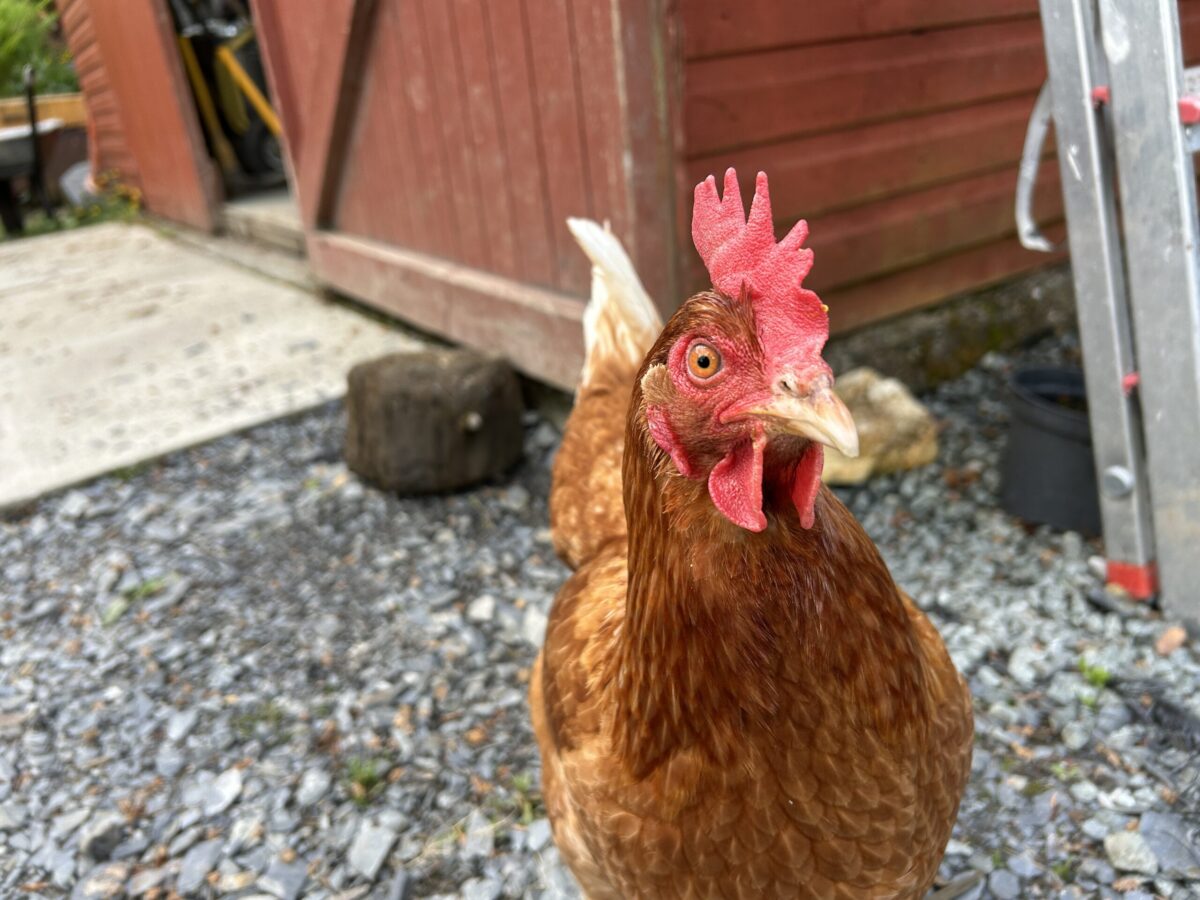
In Gerddi Stiniog he tends the eight hens and hunts for their eggs, which are used to supply the hotel. ‘They taste better than anything from a supermarket,’ he tells me, chuckling as he admits he does have the occasional one for his own breakfast.
As this amiable man ambles away some of the chickens follow him, cluckingly keeping him company.
Given the area’s heavy rainfall I ask Joss what sort of plants thrive under such wet conditions? ‘Weeds! But seriously you wouldn’t believe how different the weather in Llan Ffestiniog is compared with Blaenau.
‘Blaenau can be under black clouds but the sun can be out here. I don’t know how many times I’ve driven through Manod heading for Blaenau and it’s started raining. The soil isn’t great as it’s clay soil, so we’ve pretty much had to bring soil in wherever we want to plant things, using raised beds and polytunnels for anything that needs a bit more warmth such as tomatoes, cucumbers, peppers and chillies.’
One plant that does thrive is an unwanted visitor, namely rhododendron, which is a scourge both locally and throughout Eryri. ‘We tried to kill as much as we could last year, with chainsaws and herbicides because it poisons the ground underneath and nothing else can grow there.’
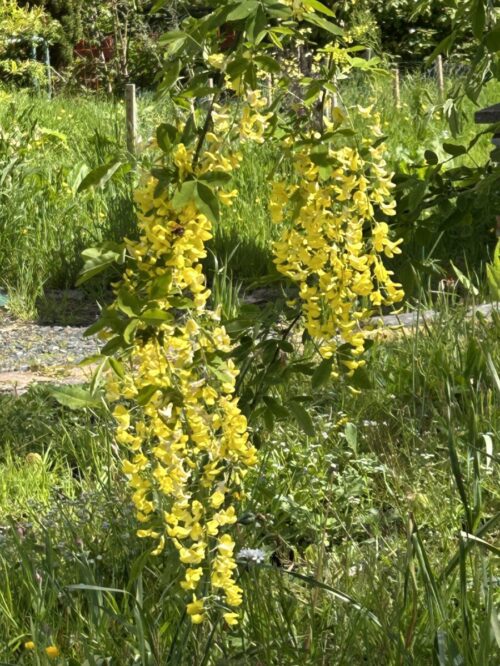
We pause at some laburnums as there’s a story behind them. ‘Where I grew up in Nant Gwynant there was a sizeable laburnum outside the house which had been split in two by lightning. My father ratcheted it back together and held it together with nets and we used to play in this enormous laburnum.
‘The house burned down and the tree was cut down as it was thought to be dangerous. I was gutted. So I wanted one here but they were £120 for a six foot tree. I couldn’t justify spending that much. But I went to the shop in Llan Ffestiniog and they had three for sale for four pounds each, so I bought them straight away. Some man in Llan grows them from seed.’
Joss points out a shed made by Hefin Hamer, a community craftsman from Dref Werdd, the local environmental social enterprise. ‘He fashioned it from a single larch tree, which came down in a storm, sawing it on site.’
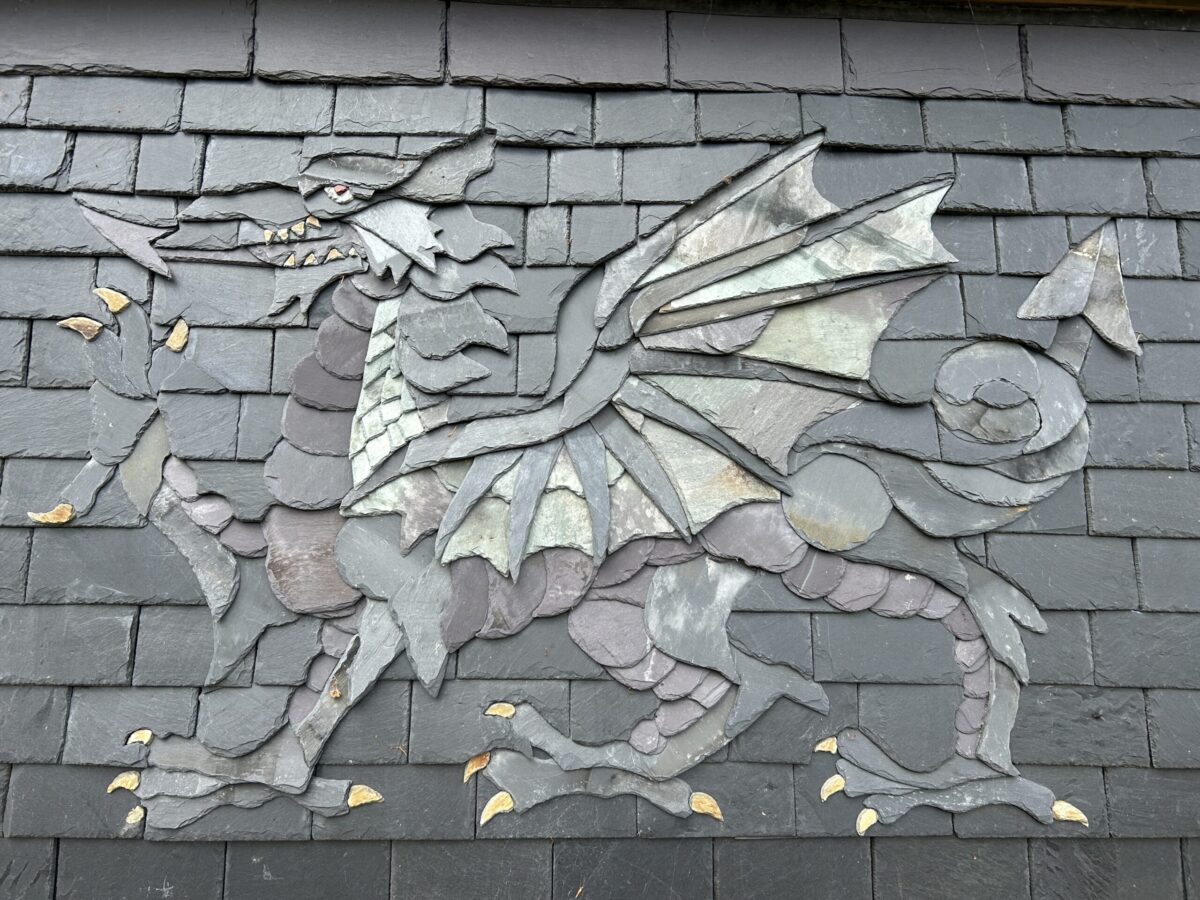
We also pause at a dragon made from slate which took hundreds of hours to make. Ieuan Williamson from roofing company Llechen Lân in Llanfrothen used different slates for the various colours. ‘Even the white toes on the claws are made of slate.’
This came from the Pwll Fanog which sank in the Menai Strait. Rediscovered in 1976, scientists managed to salvage the 16th century ship along with many crates of its cargo of 40,000 slates, which had bleached their colour after long decades in salt water. This is particularly appropriate as Ieuan’s great grandfather was a ferryman transporting slate from Blaenau to Porthmadog to be sent all over the world. Joss adds: ‘There are also slates from ‘Stiniog, black ones from Spain, puce ones from Port Dinorwig as well as the green ones. The red eyes of the dragon come from New York State, and are very, very expensive. In 2010 a single slate would have set you back £ 25.’
Joss explains that they grow veg for the hotel and prepare veg boxes for the staff. They have stands of garlic, raised beds of leeks, grow red cabbage and pak choi. One of his favourites is three-cornered leek, an invasive that arrived in a delivery of soil yet he’s rather glad they did. ‘They’re stunning to look at and they taste fabulous, are great in salads. The bulb is like a cross between an onion and a water chestnut.’
One of the absolute pleasures of Joss’s job is seeing the way people thrive in the garden.
‘One person didn’t speak for three weeks, so shy, not a word but since then he’s developed and developed and how he’s got a proper job. This place feeds the soul. I’m really happy to come to work each day. I’ve just had a week off. Some people aren’t thrilled at the prospect of returning to work but I was really keen to come back here today. I’m so happy here and I don’t think there are many places like this in the world.’
The photographer Medwyn Roberts suggested in his Letter from Blaenau Ffestiniog that people often employ tired stereotypes to evoke the place. ‘Grey, slate-town, Mordor, always raining, little trains, and even the occasional “why would you go there of all places?”’
The former punk singer and archaeologist Rhys Mwyn in Real Gwynedd described it as ‘Too industrial, too many slate tips, not green enough to be included within the Snowdonia National Park, Blaenau Ffestiniog is an island cut off from the rest of the park by slate tips. But there it is, sitting right in the middle, dissected by the A470, with high rainfall and sheep on the streets. No argument; in Blaenau Ffestiniog’s case the clichés are true.’
My rather old edition of The Rough Guide to Wales also suggests it’s always pouring down, as it ‘attracts some of Snowdonia’s worst weather, and when clouds hunker low in the great cwm and rain lashes the grey roofs, walls and paving slabs it looks terrifically gloomy.’ Which makes me want to reach for the rain gauge. Fact check. The town gets 1490 mm or almost sixty inches of rain annually. There are 60.81 rainy days in a year which means it’s coming down for 16.66% of the time. Thank me when it comes up in Trivial Pursuit.
Poet Gwyn Thomas, born in Blaenau, referred to the place as ‘a bracelet of a town on a bone of rock’ – ‘Breichled o dref ar asgwrn o graig.’ Indeed, some of his words can be seen on the streets, where punchy poetic lines are carved into many pavements and walls, often referring directly to a nearby business or building.
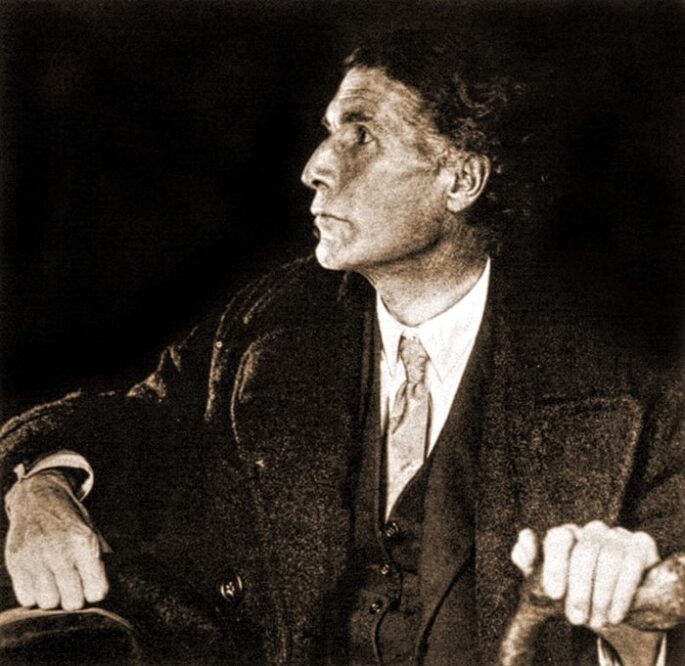
I first visited Blaenau Ffestiniog because one of my all-time favourite writers, John Cowper Powys once lived here and also died in the local cottage hospital. His house was No. 1, Waterloo, where the author of Owen Glendower and Obstinate Cymric lived before moving down the map-contours to nearby Manod.
The notion that it always rains in Blaenau would was confirmed by Powys’ American wife Phyllis after a few years of living with anything from drizzle to deluge.
In a letter to John’s brother Francis she said: ‘It has been stormy and bitterly cold – and now that it is warmer – it rains and rains – 48 hours once sans cesse – with dense mist as the only variation.’
Blaenau Ffestinog suited John Cowper Powys and it seems he fitted in well, as one of his friends, the poet Raymond Garlick attested.
In his old age Powys was a ‘very grand-looking man but also very gentle and warm and completely unpretentious.
But Blaenau was in many ways a town totally attuned to eccentricity. You could be as eccentric as you liked and Blaenau would have taken you to its heart…I think that people were rather proud that he had chosen to live in Blaenau. They knew that he was a major writer and that also was something that people honoured in a person. It was a highly literate community.’ It would have helped that Powys learned Welsh to the point where he could correspond with other writers in Wales, such as Iorwerth Peate, founder of the Welsh Folk Museum.
Another distinguished novelist, Niall Griffiths, has just moved into the area. His connection with north Wales goes way back, to some troubled years of his. ‘When I was a kid in Liverpool I was a bit naughty and was sent on an enforced outward-bound course, a kind of short sharp shock that wasn’t quite Borstal – really hard living in the wilderness. I loved it. And it was there, spending days on top of Eryri, that I began to really feel the Welsh part of my soul, the Welsh part of my blood. The kind of violence I was feeling in my soul was mirrored in the surroundings. It seemed to speak to me, it seemed to sing.’
‘The mountains here give off this kind of hum, you know, and it’s a wonderful kind of background noise. It’s just this kind of drone, like when you’re on a long-haul flight, you begin to discern voices in the songs, in the thrumming of the engines. When the slate quarries were going, the sound would have been the clanking the machinery. Blaenau seems haunted by that burnout. It seems haunted by the death of that. But it’s got so much going for it by now. It’s a beautiful, beautiful landscape. My girlfriend spent a lot of time in in Alaska and she says it reminds her of its rocks and rain and snow line.’
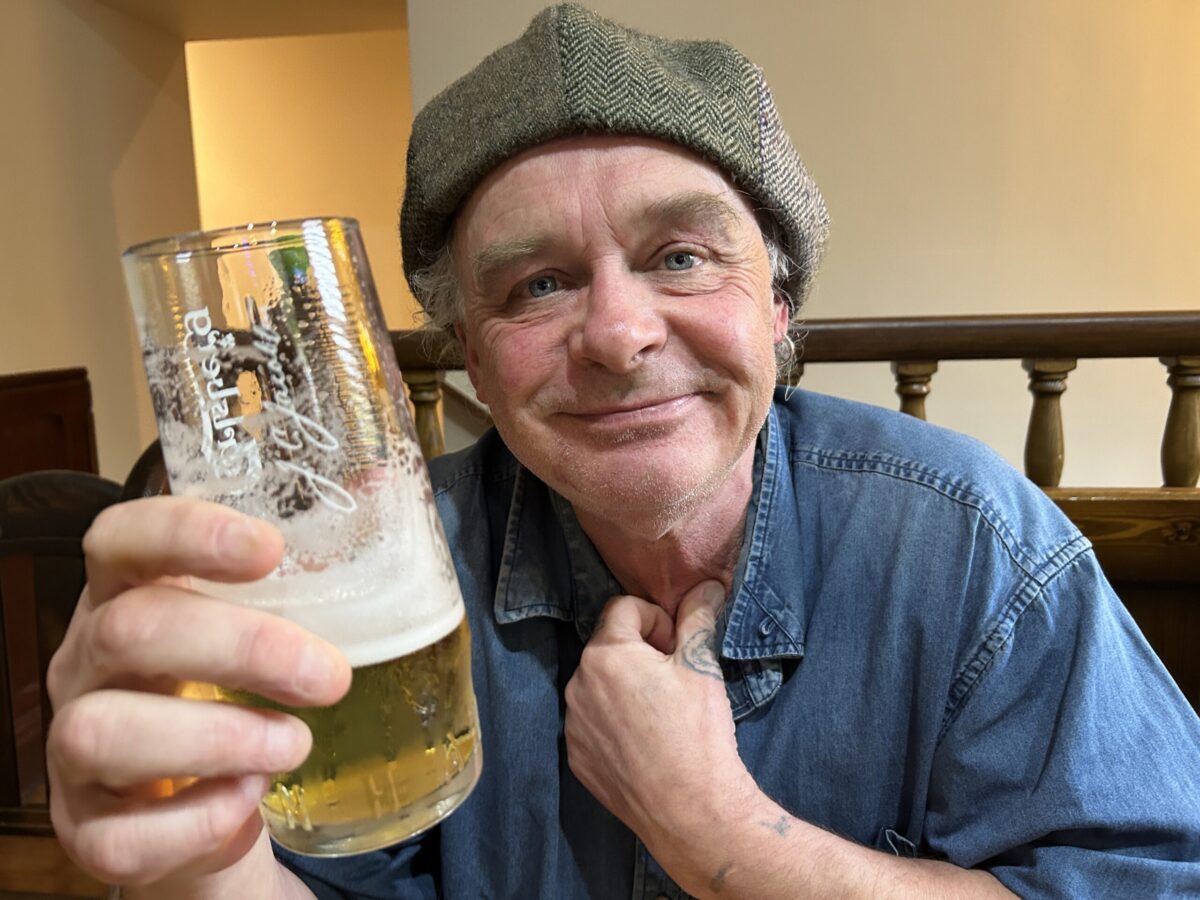
Over a pint in the Grapes in Maentwrog we talk about the poetry of the names hereabouts: Moelwyn Bach and Moelwyn Mawr. Moel yr Hydd and Allt Fawr. ‘They’re historically weighted, they’re beautifully phrased, names that are just soaked in myth and legend’
One of those is the name Maentwrog itself. ‘It means the rock of Twrog. Apparently, the story behind that is Twrog was up on the mountain, preaching Christianity. He saw people having a pagan party in the graveyard, so he hurled a big rock at them to stamp out their fire and crush them all. That was the story. But there are so many places in Wales that have this myth of these great big rocks from the sky, you know, and it’s usually given to wizardry or druidry or something divine.’
The rocks and rockiness of Blaenau Ffestiniog were part of the appeal of the place for John Cowper Powys, the quarries reminding him of his childhood home in Derbyshire. He also loved the plentiful local connections with his beloved Mabinogi.
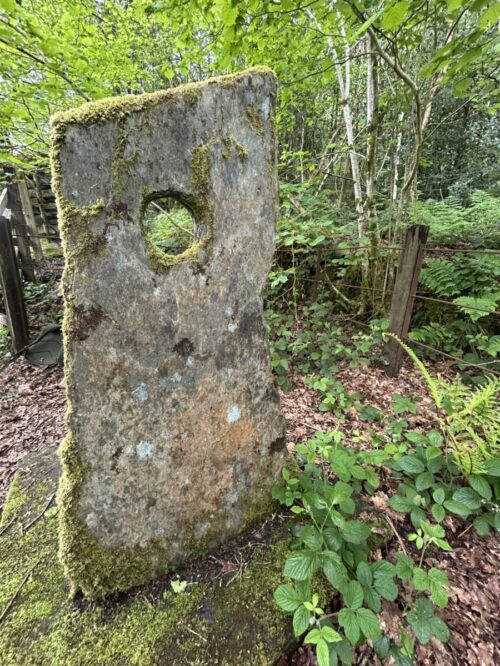
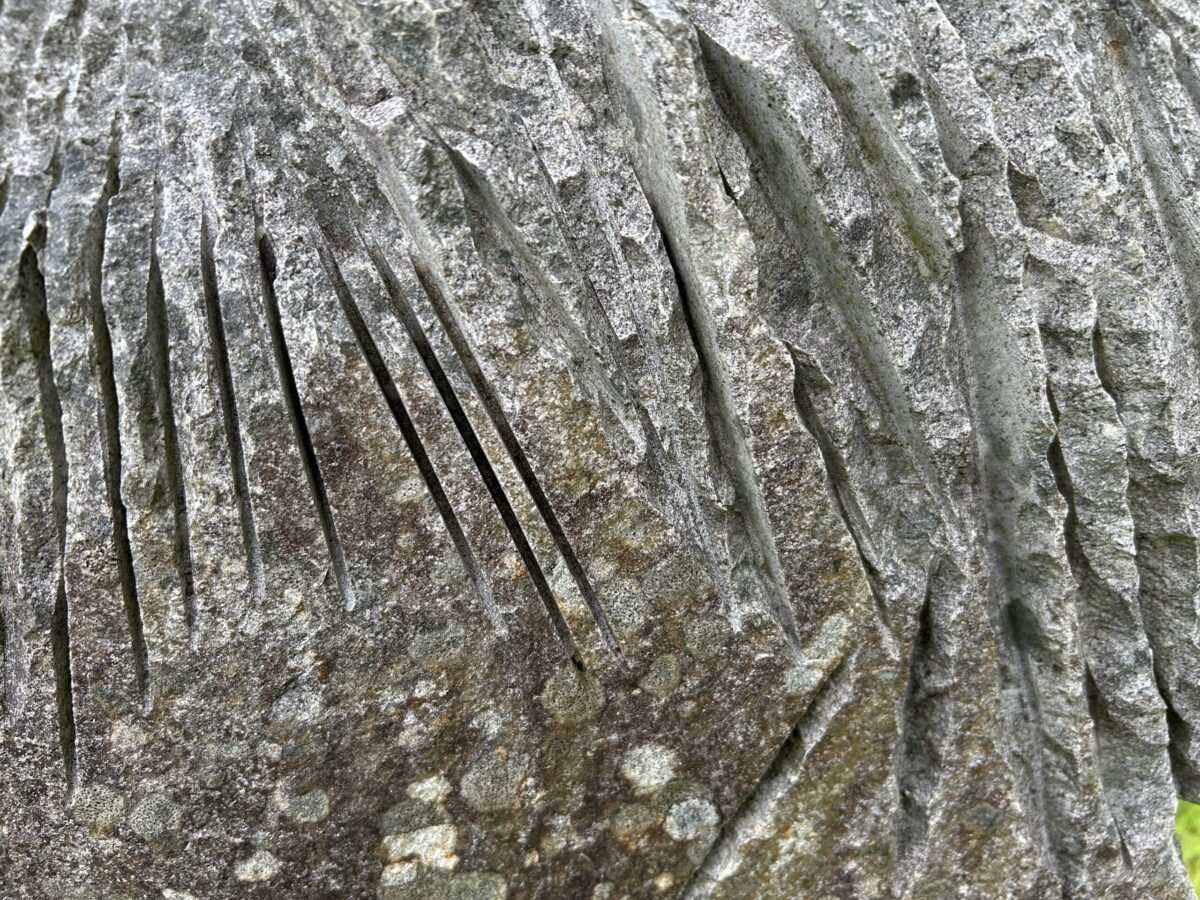
One such Mabinogi connection is to be found in the shape of Llech Ronw, the stone used by Gronw Pebr to defend himself from Lleu Llaw Gyffes’ spear in the Fourth Branch of the Mabinogi. who shot an arrow at him. Gronw held up a large stone in lieu of a shield.
Gwyn Thomas suggests that this stone, complete with a hole in its shield-like surface would have been seen by travellers following old routes in the middle Ages.
Then one storyteller placed it in the revenge story of Lleu and Blodeuwedd. Llech Ronw itself was then lost for many years until two local men, Geraint Vaughan Jones and Edgar Evans rediscovered it and today it sits on the edge of a field near Bontnewydd between Llan Ffestiniog and Gellilydan.
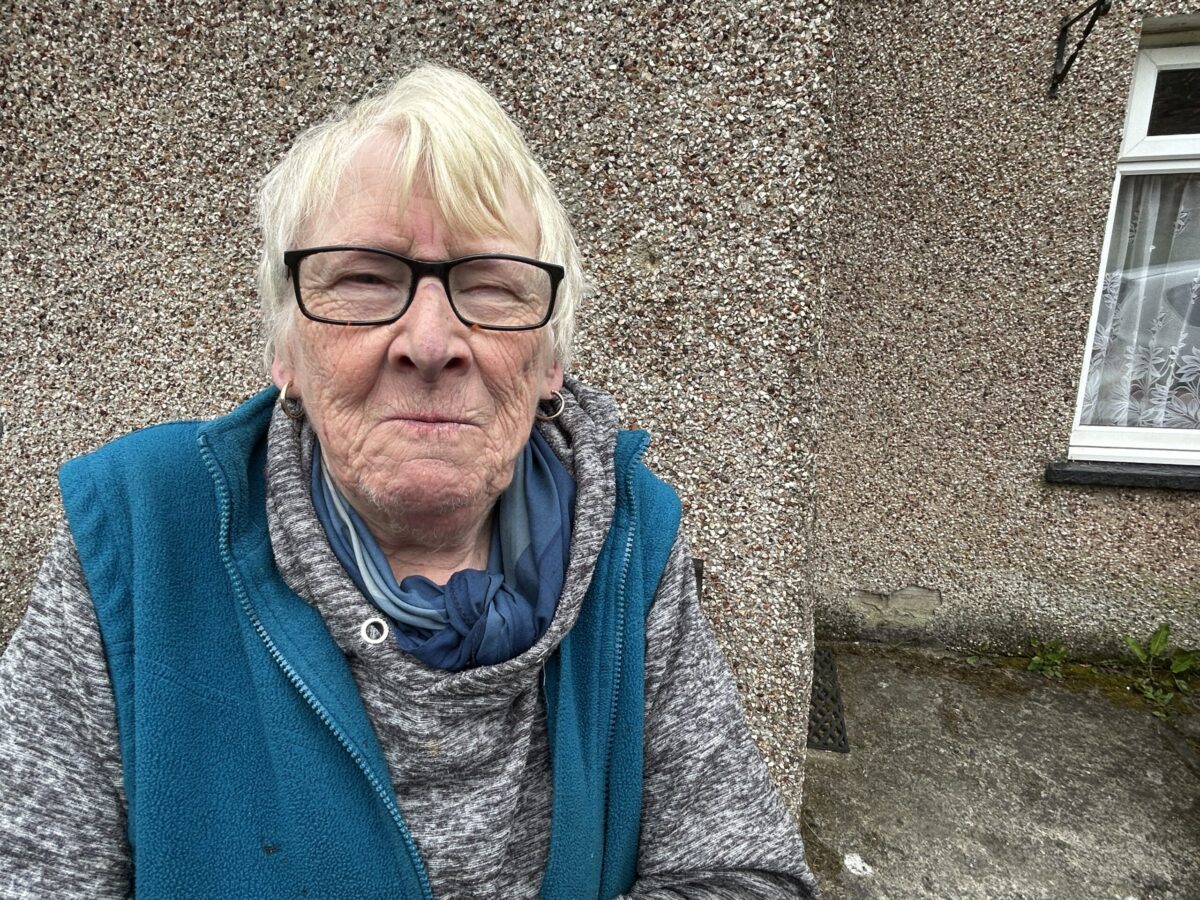
Seventy-eight year old Olwen Davies was born and raised in Bryn Saeth and has seen many visitors come here over the decades. ‘Many people come here to see her, from America, from Bangor University College, from Plas Tanybwlch – which has closed how – they’d often come in a minibus on a Sunday afternoon.
Schoolchildren have come on a trip, from Four Crosses outside Pwllheli. Here, Bryn Saeth, is named after an arrow. There’s Llech Goronwy, higher up. Then Bryn Cyfergyd over there, the hill of the blow, opposite here, Bryn Saeth where the spear was thrown. It makes sense. The stone was found down there somewhere and was carried up here. They were given permission by my brother to put it in a corner over there. Then a man from the village put here on some concrete and put railings around it.
‘I’ll tell you another story…my father used to say that a Welsh language teacher from Ysgol y Moelwyn in Blaenau came here many years ago and found the stone in the river and asked my father if he’d pull her out using a horse.’ Stories always beget stories.
There are other places in the area connected with the Fourth Branch of the Mabinogi such as the old castles, Mur Castell, at Tomen y Mur and Bryn Castell as well as the lake called Llyn y Morwynion. Many connect with the story of Blodeuwedd, the lady made of flowers.
In 2013 Theatr Genedlaethol staged an open air retelling of the story, using these actual locations to perform Saunders Lewis’ play. At the point when the woman-made-of-flowers Blodeuwedd is transformed into an owl there was a very effective coup de théâtre when the actress Morfydd Clark dropped behind a low wall at the same time an actual owl was released. We, in the audience were very much convinced by the transformation, seemingly proof of the lasting magic of our finest folk tales.
No wonder John Cowper Powys loved living here. In 1962 the poet Raymond Garlick visited the writer who by then had moved downstairs, where he was lying on a divan, ‘very still and composed, silvery, fragile, gothic, the long limbs and magnificent head aligned and supine as though on a catafalque’ while his mind seemed to be ‘far away in time and place from that still, huge amphitheatre in the mountains.’
As the two men said goodbye, Garlick recollected, ‘he gave me his hand – the hand that had taken that of William Barnes, born in 1801, of Yeats, of Hardy – I had, as always, that vivid sense of bridging a century and a half, of being momentarily linked to the great tradition, of shaking hands with English Literature.’
It was a feeling akin to the moment when I briefly placed my palm on the stone called Llech Ronw, and felt connected to the old, old storytellers, who could explain the existence of a hole in a stone by employing the language of wonder and the power of myth. And as one French writer once put it, myth is, after all, only very old gossip.

Jon Gower is Transport for Wales’ writer-in-residence. He will be travelling the breadth and length of the country over the course of a year, reporting on his travels and gathering material for The Great Book of Wales, to be published by the H’mm Foundation in late 2026.
Support our Nation today
For the price of a cup of coffee a month you can help us create an independent, not-for-profit, national news service for the people of Wales, by the people of Wales.
Get more trusted Welsh news
Choose Nation.Cymru as a preferred source in Google News to see more of our journalism.



Very nostalgic. First stayed with the Garlicks in 1956. Later, living in Llanrwst, took the train to Blaenau Ffestiniog, then the bus down to Penrhyndeudraeth, then the train again to Dyfi Junction, then to Aberystwyth where I was a student 1957-60. Have lived in Japan since 1965. Catharine
I’ve always thought Blaenau beautiful, maybe there is something wrong with my eyesight, but when I visit North Wales I always try to base myself in the town, sure in the knowledge that I could relax and speak Cymraeg without thinking about it. My visit in 2018 changed that perception a little. One evening, walking into the Queens Hotel and up to the bar and asking for a beeer in Cymraeg elicited the response from the bar person that they were di-Gymraeg. About turn for me, and fortunately I found Y Meirion where I was welcomed. In 2002 a friend… Read more »