


Yr Hen Iaith part 76: A Friend’s Invitation and a Mother’s Grief: the poetry of Angharad James
Jerry Hunter
As was noted while discussing the medieval poet Gwerful Mechain in episode 27 and the sixteenth-century poet Alis ferch Gruffudd in episode 38, one of the most exciting developments in Welsh scholarship during recent decades has been the publication of work by women from past centuries.
Moving through eighteenth-century Welsh literature in the current series of Yr Hen Iaith affords further opportunities for revelling in this most welcome of scholarly revolutions. In this episode we consider the work of Angharad James (1677- 1749), a multitalented woman from Gelli Ffrydiau in the Nantlle Valley who settled at Penamnen near Dolwyddelan after marrying.
She seems to have been an authority on Welsh literature, as she was respected for her work collecting, copying and studying manuscripts.
Sadly, what seems to have been the crowning achievement of these intellectual pursuits, Llyfr Coch Angharad James, ‘The Red Book of Angharad James’, disappeared in the nineteenth century.
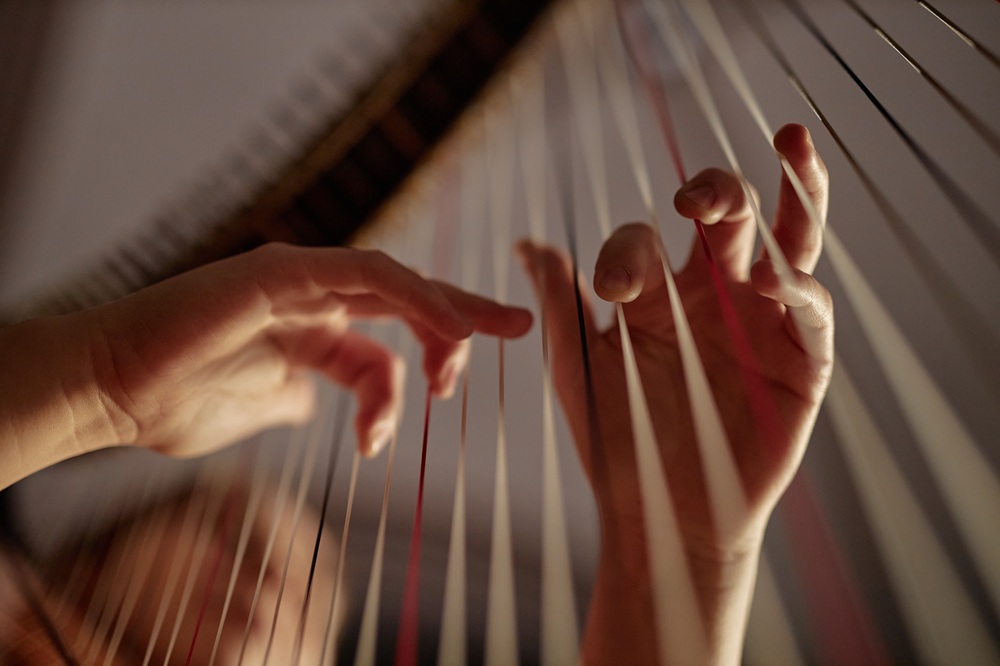
Cerdd dafod (‘tongue craft’ or poetry) and cerdd dant (‘string craft’, playing the harp and/or cwrth) were two sides of the same traditional Welsh coin, and Angharad James was proficient in both arts. Known as a talented harpist, she was also a poet and a versatile one that, composing in some of the strict metres while also producing memorable free-metre poems.
One of her surviving free-metre pieces is an Annerch or ‘Address’ inviting a friend and relative, Alis ferch Wiliam, to come and stay with her for a while. This lively text gives us an idea as to the role which poetry played in the lives of these Welsh women.
Two episodes ago we looked at a cywydd by Goronwy Owen which he addressed to his friend William Parry, inviting him to leave London for a while and stay with the poet in the country.
Despite Goronwy Owen’s mastery of the strict metre and the associated cynghanedd line ornamentation, and despite his studied employment of Augustan themes, I personally find Angharad James’ metrical invitation more engaging, witty and emotionally satisfying.
The first two verses hit the ground running, setting a lively tempo for the entire poem. Angharad crafts witty lines which suggest that, while Alis has not been to visit her recently, she does not hold this against her. The poem is sent [yn] ddi-gilwg, ‘without a frown’, and focusses on the good times the two enjoyed during past visits instead of her friend’s recent absence from her life:
Can annerch, cwyn union, o ‘wyllys fy nghalon,
Yr ydwy’ yn ei ddanfon yn gyson ar gân;
Trwy bur garedigrwydd, ddi-gilwg, ddi-gelwydd,
At Alis, wych hylwydd, ach Wiliam.
Paham na ddowch weithian i rodio i Benamnen
Lle y buoch yn llawen, ddigynnen deg wedd,
Yn gwrando yn ddiniwed ar howddgar fwyn ganiad,
A minna’ ‘run fwriad i oferedd?
‘In Addressing, [by means of] a direct plea, from my heart’s desire,
I am sending it harmoniously in song;
Through pure kindness, without a frown [and] without falsehood,
To Alis daughter of Wiliam, [may this invitation travel] most swiftly.
Why don’t you come now to visit Penamnen,
Where you were merrily [in the past], ten times without a care,
Listening innocently to a pleasant tender song,
And me for my part, like-minded, [enoying] frivolity.’
Translated here as ‘frivolity’, oferedd was often used in the eighteenth century to describe cultural pursuits which were enjoyable but not religious in nature or edifying in an obvious way. In describing the pleasure which both women take in cerdd dafod and cerdd dant, Angharad James acknowledges playfully that they enjoy poetry of this sort while also defending that enjoyment as an ‘innocent’ pastime.
Friendship
One of the things which makes this poem so wonderful is the way in which Angharad James effortlessly combines a heart-felt invitation and expression of friendship with a defence of art for art’s sake.
Llid, llygredigaeth ac awydd i gyweth,
A bydol wybodaeth, ryw drafferth rhy drwch,
Sy’n rhwystro llawenydd lle gwelsoch chwi gynnydd
A howddgar, dda ddeunydd, ddiddanwch.
‘Anger, corruption, a desire for wealth
And profane knowledge – such grief is so prevalent! –
Prevent merriment where once you saw the blessing
And good, tender substance of entertainment.’
With wonderfully musical words, Angharad James describes how unsavoury aspects of human nature can keep one from enjoying life’s pleasures. She then reminds Alis that she has enjoyed ‘[c]aniade’, ‘songs’ and/or ‘poems’, and da diwnie, ‘good melodies’, in the past.
Angharad ‘hopes that her friend will not forget this’ (Am hyn `rwy’n gobeithio na ‘llyngwch yn ango’), and ends her enticing metrical invitation by stressing the point: A chymryd ein pleser mewn cariad a mwynder / Tra fôm ar y ddaear yn ddiwyd (‘And take our pleasure in love and tenderness / while we are still on the earth’).
Marwnad
Angharad James composed a very different poem following the death of her son Dafydd. For this she turned to the strict-metre cywydd form, and her marwnad or ‘elegy’ can be set instructively against scores of cywyddau marwnad from the previous centuries. Avoiding the traditional turns of phrase and well-worn tropes, this strict-metre elegy is a powerfully original expression of a mother’s grief. While grief often seems performative and manifest only in bardic convention in so many examples of the genre, in this marwnad artistry serves emotion rather than the other way around.
The opening lines set the roots of an extended metaphor casting her life as a garden in which her son Dafydd stood out as the most beautiful of young trees.
Yr oedd gardd o iraidd goed,
Fwyngu, yn llawn o fangoed,
Ddifyr iawn, lawn eleni,
Ddydd a wn, o’m eiddo i.
Torrwyd o’m gardd yr hardda’
Impyn sad o dyfiad da;
Impyn pêr, un tyner teg,
Ar ei godiad, rym gwiwdeg.
‘There was a garden which I once had,
[Earlier] this year it was full
of verdant trees and shrubs,
Dear and tender, very pleasant.
The most beautiful sturdy young tree of good growth
In my garden was cut down;
A sweet young tree, a fair, gentle one,
In the middle of growing up, with a fittingly fair vigour.’
Heart-wrenching
A series of heart-wrenching lines describes her son as her ‘main comfort’ (penna’ cysur), her ‘main corner[stone]’ (pen congol) and her ‘main school’ (pen ysgol) – the later expression succinctly describing the intellectual joy of conversing with him. He was also ‘the height of praise’ (pen y glod), the most important thing in her ‘vineyard’ (pen fy ngwinllan), and the most important thin in her ‘home’ (a phen fy annedd) – and by extension, in her life.
Continuing the extended metaphor which opens the poem, she describes burying her son in the ground as placing ‘the sweet tree in the hateful cellar’ (y pren pêr i’r seler swrth). Instead of the living tree’s beauty, we have only dead wood stacked underground. Metaphor then gives way to a named grief:
Ei gariad a’i hawddgarwch,
Sy yn y llan dan y llwch.
Er wylo, er cwyno’r cam,
Ni welaf Ddafydd Wiliam;
F’un mab, gwiw arab gore’,
Galwyd a nolwyd i ne’.
‘His love and his amiability
Are in the churchyard beneath the dust.
Despite crying, despite bemoaning the injustice,
I do not see Dafydd Wiliam;
My only son, the best joyful one,
He has been called and fetched to heaven.’
Only ten poems by Angharad James have survived. Given the technical range and emotional intensity uncovered by our brief look at these two texts, we can only wonder at the wealth which was lost with her ‘Red Book’.
Further Reading:
Cathryn Charnell-White (ed.), Beirdd Ceridwen: Blodeugerdd Barddas o Ganu Menywod hyd tua 1800 (2005).
Katie Gramich a Catherine Brennan (eds.), Welsh Women’s Poetry 1460-2001 (2003).
Episode 27 [Gwerful Mechain]: https://nation.cymru/culture/yr-hen-iaith-part-twenty-seven-female-poets-heard-at-very-long-last/
Episode 38 Yr Hen Iaith [Alis ferch Gruffudd]: https://nation.cymru/culture/yr-hen-iaith-part-thirty-eight-the-hearts-desires-vs-a-fathers-expectations/
Episode 74 [Goronwy Owen]: https://nation.cymru/feature/yr-hen-iaith-part-74-invitations-and-exiles-goronwy-owen/
Support our Nation today
For the price of a cup of coffee a month you can help us create an independent, not-for-profit, national news service for the people of Wales, by the people of Wales.



Gwerth eu darllen – rhaid cyrchu’r deg sy’n aros