


Yr Hen Iaith: ‘The Present Taste of the People’: John Ceiriog Hughes
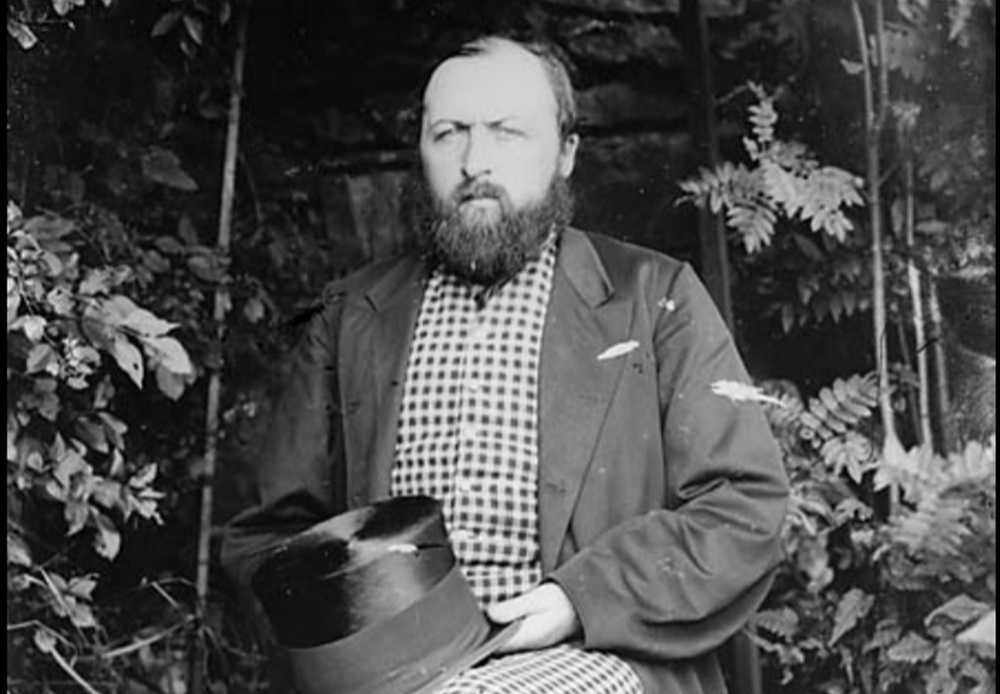
Jerry Hunter
Let’s begin with the end. When John Ceiriog Hughes died in 1887 at the age of 54, he was buried in Llanwnnog, Powys. An ornate monument was erected over his grave, featuring an epitaph which he himself had written.
Arguably the most famous Welsh-language poet of the time, Ceiriog earned his reputation largely on account of his free-metre verse.
However, this final poem is an englyn. While I might be reading too much between these four lines, I’ll venture to suggest that, at least in terms of form, he returned to the age-old bardic tradition at the end:
Carodd eiriau cerddorol, – carodd feirdd,
Carodd fyw’n naturiol;
Carodd gerdd yn angerddol:
Dyma ei lwch, a dim lol.
‘He loved musical words, – he loved poets,
He loved living simply;
He loved cerdd passionately:
Here is his dust, and no nonsense.’
I’ve left cerdd untranslated here as it can mean both ‘poetry’ and ‘music’ – a meaningful ambiguity which had been a part of Welsh culture for many centuries and to which we’ll later return.
When read in the context of his life and work, this epitaph stands out as the most honest poem he ever wrote.
Born in Llanarmon-Dyffryn-Ceiriog, Denbighshire, John Hughes began writing poetry at a young age and published several verses before moving to Manchester at the age of sixteen.
He found work in the Manchester London Road railway station (now Manchester Picadilly), and associated with other Welsh exiles with a taste for literature.
One of these was Robert Jones, who, in an act aimed at countering the weight of Anglicization, changed his name to R. J. Derfel.
John Hughes followed suit, adopting the name Ceiriog. Significantly, these Welshmen, living in an English city, were articulating their identities by using names taken from their native regions.
This was during the first few years after the publication of the ‘Blue Books’.
Of course, the most obvious effect which those official reports had on Welsh-language culture was the impetus to prioritize English, a rampant Anglicization which became manifest most violently in the implementation of the infamous ‘Welsh Not’ in schools.
However, the ways in which the Blue Books disparaged Welsh culture had discernible effects on those who continued to embrace their negative language.
R. J. Derfel protested bitterly and creatively, labelling the publication of the Blue Books a ‘treachery’ (brad), and equating them with the work of the Devil (see episode 86 in this series).
Condescension
Other Welsh writers, editors and publishers sought to counter the condescension by producing material aimed at persuading the Welsh that they were not the ignorant and immoral people described in the ‘Reports’ (see episode 87, for example).
In many ways, the poetry of John Ceiriog Hughes exemplifies the most prominent effect of the Blue Books on the course of Welsh-language literature. Rather than devising an intricate literary protest as did R. J. Derfel or proving the worth of the Welsh language as a literary medium by pushing it to new experimental heights, he strove to create nice, acceptable sentimental images of Wales and the Welsh.
In several touchstone studies, Hywel Teifi Edwards analyses this trend eloquently, describing Ceiriog as a poet who gave the Welsh people what they wanted rather than challenging them.
This became the dominant literary reaction to the insult of the Blue Books, and many poets and writers followed suit.
All of this sentimental, consoling and insipidly uplifting literature enshrined phrases such as Cymru lân (‘pure Wales’), Gwlad y Gân (‘The Land of Song’), Gwlad y Menyg Gwynion (‘Land of the White Gloves’, implying a lack of crime) and Cymru lonydd (‘tranquil Wales’).
Tired clichés
These tired clichés would be the targets of satire by the end of the century, but some of them continue in currency even today, proving that common Welsh discourse is still conditioned in some ways by this reaction to the Blue Books.
Ceiriog excelled at penning lyrics which present charming visions of rural Wales.
By the end of the century, the novelist Daniel Owen would, in addition to lampooning the Cymru lân cliché, explore themes such as poverty, deceit, hypocrisy and the uneasy marriage of religion and capitalism.
Ceiriog’s poetry did the exact opposite, drawing attention away from the negative aspects of society by concentrating seductively on a romanticized landscape and an idealized people.
He did that so well that several of his verses earned the timeless status of folk songs. One of these popular compositions begins:
Wrth ddychwel tuag adref
Mi glywais gwcw lon
Oedd newydd groesi’r moroedd
I’r ynys fechan hon.
‘While returning home,
I heard a merry cuckoo
Which had just crossed the seas
To this little island.’
Sung by generations of Welsh children (and a mainstay of the noson lawen evenings which I experienced when I first came to Wales), people are usually surprised when they learn that, rather than being a ‘real folk song’, these words were composed by a known historical figure.
That is also true for another of Ceiriog’s songs, ‘Nant y Mynydd’ (‘the Mountain Stream’), which begins by setting us in one of those idealized rural settings:
Nant y Mynydd groyw loyw,
Yn ymdroelli tua’r pant,
Rhwng y brwyn yn sisial ganu;
O na bawn i fel y nant!
‘The fresh bright Mountain Stream,
Winding its way towards the valley,
Murmuring-singing between the rushes,
Oh, that I might be like the stream!’
The persona addressing us is here too, romantically contrasting the confines of human existence with the freedom he sees in the stream.
The next verse begins by describing Grug y Mynydd yn eu blodau, ‘The Heather of the Mountain in flower’, seeing hiraeth (an intense longing) in them, and ends by voicing a desitre ‘to remain in the hills / with the breeze and the heather’ (Am gael aros ar y bryniau / Yn yr awel efo’r grug).
The third verse invites us to see ‘the little birds of the high Mountain / ascending in the healthy breeze (Adar mân y Mynydd uchel / Godant yn yr awel iach), and ends predictably by exclaiming that the speaker desires to be ‘like a little bird’ (fel deryn bach).
The final verse takes this song in a different direction, focusing entirely on the situation of the persona who has been addressing us all along:
Mab y Mynydd ydwyf innau
Oddi cartref yn gwneud cân
Ond mae ’nghalon yn y mynydd
Efo’r grug a’r adar mân.
‘I myself am a Son of the Mountain
Away from home composing a song
But my heart is in the mountain
With the heather and the little birds’.
While maintaining the easy lyricism of the proceeding verses, Ceiriog here capitalizes on the word hiraeth presented earlier, revealing that we are being addressed by a Welsh songster who, like the poet from Dyffryn Ceiriog living in Manchester, is far from his native mountains.
Ceiriog also wrote the words to ‘Ar Hyd y Nos’ (‘All Through the Night’), yet again displaying an ability to create appealing, accessible words which could be sung enthusiastically and easily remembered.
Cerdd
Recalling that cerdd can mean both ‘music’ and ‘poetry’, John Ceiriog Hughes did more than any another Welsh Victorian poet (perhaps with the exception of some of the more prolific hymnists of the time) to provide Welsh singers with new words.
Welsh musical culture was changing, with a new kind of concert – in purpose-built village halls or eisteddfod pavilions – providing a secular context demanding words to be sung by soloists, ensembles and choirs.
The appearance of the upright piano made it possible for more families to have such an instrument at home, and the desire for informal parlour sing-alongs provided another market demanding new songs.
In addition to addressing this need, Ceiriog reflected on his role, publishing Y Bardd a’r Cerddor (‘The Poet and the Musician’) in 1863. With smugly triumphant tones, he claims that Welsh culture was refining itself:
Y mae mwy o alwad nag eiroed y dyddiau hyn am eiriau i’w canu, ac achlysuron i wneud defnydd o’r cyfryw ganeuon, mewn cyngherddau a chyrddau adlonawl, wedi dyblu a threblu rhagor yr hyn oeddynt flynyddoedd yn ôl. Y mae cymdeithas hefyd wedi esgyn ris yn uwch, nes mae lluaws o’r hen gerddi wedi myned yn anaddas i chwaeth bresennol y bobl. Yn wir y mae cyfnod newydd wedi dechreu ar ganiadau y genedl.
‘More than ever there is a demand these days for words to sing, and occasions to make use of such songs, in concerts and meetings held for the sake of entertainment, have doubled and tripled compared to years ago. Society has climbed a step higher as well, so that a great many of the only poems [or ‘songs’] have become unsuitable to the present taste of the people. Truly, a new period for the nation’s songs has begun.’
The shadow of the Blue Books darkens these words: Ceiriog is convincing himself as well as his readers that Welsh culture is now more elevated and refined than it used to be.
While the ‘Cwcw’, ‘Nant y Mynydd’ and ‘Ar Hyd y Nos’ are still widely known today, there are many of Ceiriog’s compositions which have been thoroughly forgotten. I have never experienced a reaction other than a combination of abject horror and patent disbelief when I quote these verses (from two separate poems) to people:
‘Rwyf yn Sais a Chymro Syr’
Atebai’r bugail bach.
‘Fy machgen hardd nis gall y wlad
A’th fagodd di ddim bod yn ddwy’ –
‘O gall fe all’ atebai’r llanc,
‘Mae dau yn un os unir hwy.’
‘I am an Englisman and a Welshman, Sir’,
The little shepherd answered.
‘My handsome boy, the country which
Raised you cannot be two’ –
‘Oh yes it can,’ the lad answered,
‘Two are one if they are joined.’
Ac ar dy delyn dysga
‘Ar hyd y Nos’ yn gynta’,
Ac yna dysg dy lais a’th law
I daraw ‘Rule Britannia.’
‘And on your harp
First learn ‘All through the Night’,
And then teach your voice and your hand
To strike up “Rule Britannia”.’
Anglophilia
While this embrace of Anglophilia and triumphant Britishness does not sit well with many Welsh people today, it was, of course, common in the nineteenth century. One of the things which made the ‘Treachery of the Blue Books’ such a treachery was that the Welsh, for the most part, were proud members of the British Empire and yet were repaid for that loyalty with insult and scorn.
Despite claiming to help Welsh culture become more respectable and ‘climb up a step’, I can’t help wondering if John Ceiriog Hughes didn’t reflect on his work in another, more honest way, at times.
After all, that epitaph which he wrote for himself ends with the line Dyma ei lwch, a dim lol (‘Here is his dust, and no nonsense’), suggesting that he did in fact write a great deal of nonsense during his life.
Further Reading:
Episode 87: https://nation.cymru/feature/yr-hen-iaith-part-87welsh-womens-writing-in-the-shadow-of-the-blue-books/
Hywel Teifi Edwards, Ceiriog (1987).
Hywel Teifi Edwards, Codi’r Hen Wlad yn ei Hôl [:] 1850-1914 (1989).
Support our Nation today
For the price of a cup of coffee a month you can help us create an independent, not-for-profit, national news service for the people of Wales, by the people of Wales.
Get more trusted Welsh news
Choose Nation.Cymru as a preferred source in Google News to see more of our journalism.



Great article, ruined by a petulant little tantrum at the end. It can’t really come as a shock that someone living over the border (in the only country we do border) might consider themselves as having a foot in both camps. This goes both ways, too – I had a grandfather from SE England who considered himself both. It’s not something I feel personally, but I do feel a connection with the city in England I lived in for much of my life. Hardly a ‘nonsense’
These are murky waters, but certainly there are areas of England just over the border which until comparatively recently were Welsh speaking, including the areas around Oswestry adjoining the Ceiriog valley. Also, as Wikipedia points out “Even after the Act of Union, many of the borders remained vague and moveable until the Sunday Closing (Wales) Act 1881” and Ceiriog Hughes (d. 1887) would have lived most of his life prior to this. All this suggests, irrespective of the mindset ascribed to Ceriog’s poem, many in the area might legitimately & quite naturally regard themselves as both English by land of birth… Read more »