


Is voting now proportional in Wales and can we do better?
Rhyd Lewis
A new voting system was used in the recent Senedd election. As with most elections in the UK, voters were asked to mark just one box on their voting slips; however, this time a new process was used to divvy up the 96 seats – the so-called D’Hondt method.
The D’Hondt method was first described by Thomas Jefferson in 1792 in a letter to George Washington, although it takes its name from the Belgian mathematician Victor D’Hondt, who rediscovered it around a century later. The method is used to allocate seats based on the number of votes that political parties receive. That is, if a party collects 25% of the votes, then it should also get around 25% of the seats. D’Hondt is used in dozens of countries worldwide, including Spain, the Netherlands, Denmark, Switzerland, Argentina, and Japan.
Historically, elections in the UK have made use of a system called First Past the Post (FPTP). In FPTP, the party that wins the most votes in a constituency takes the seat, and everyone else gets nothing. This can lead to tactical voting, hence the cliches “Vote Labour to keep the Tories out”, and “A Liberal vote is a wasted vote”. It can also lead to significant distortions, as we will see later. The use of D’Hondt to allocate six seats in each of the sixteen new Welsh constituencies was intended to alleviate these issues.
So how did it do?
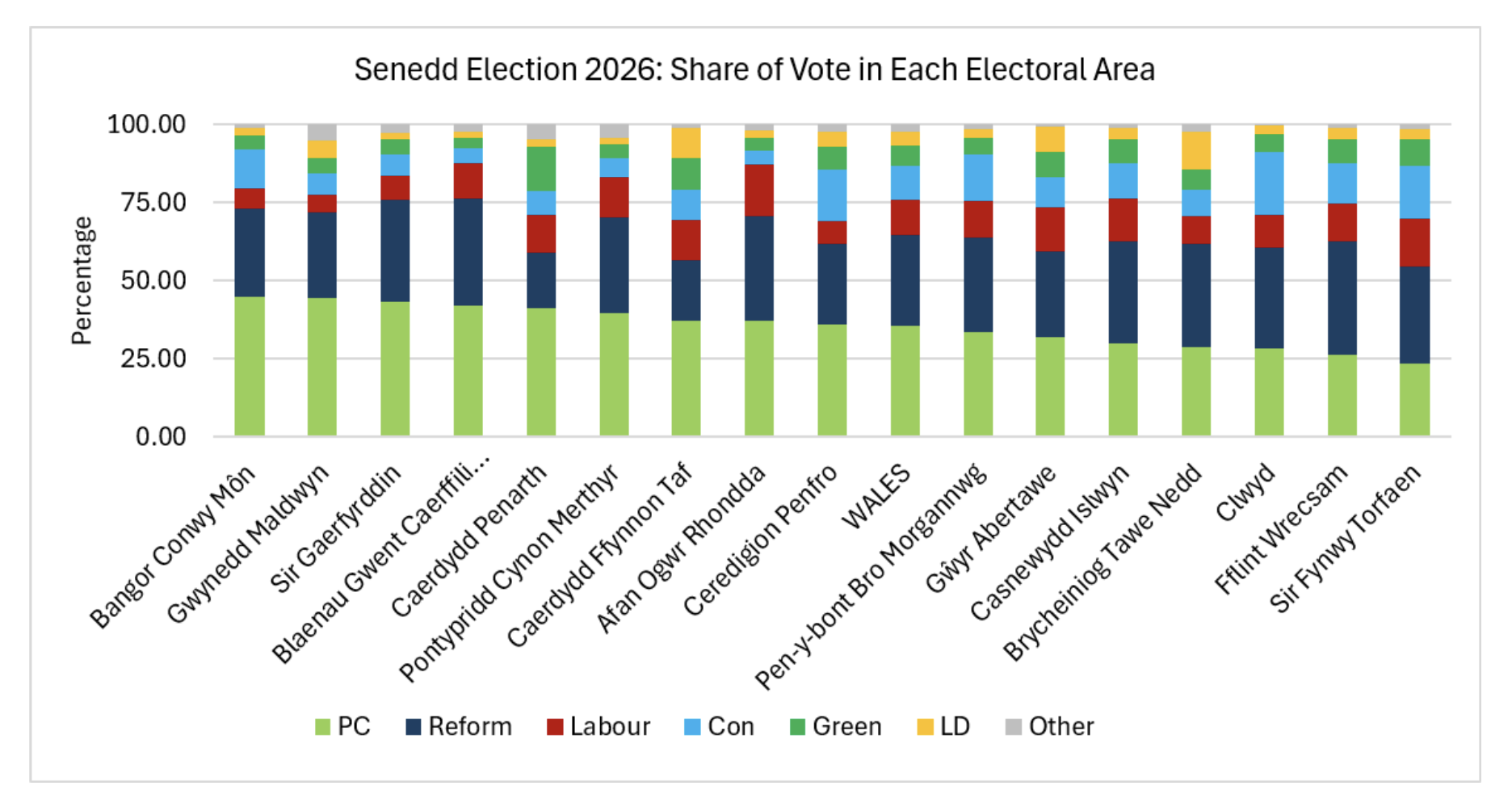
The chart above shows the vote share in each Welsh constituency. We can see broadly consistent patterns, with Plaid Cymru and Reform together gaining the most votes, and Labour and the Conservatives receiving around 10% each. What is interesting here is how similar the patterns are across the constituencies. Does this mean that people are eschewing tactical voting in their constituencies and instead voting for their preferred parties? This matter deserves further investigation but will not be considered further here.
Instead, let us consider how the Wales-wide vote was been converted into seats.
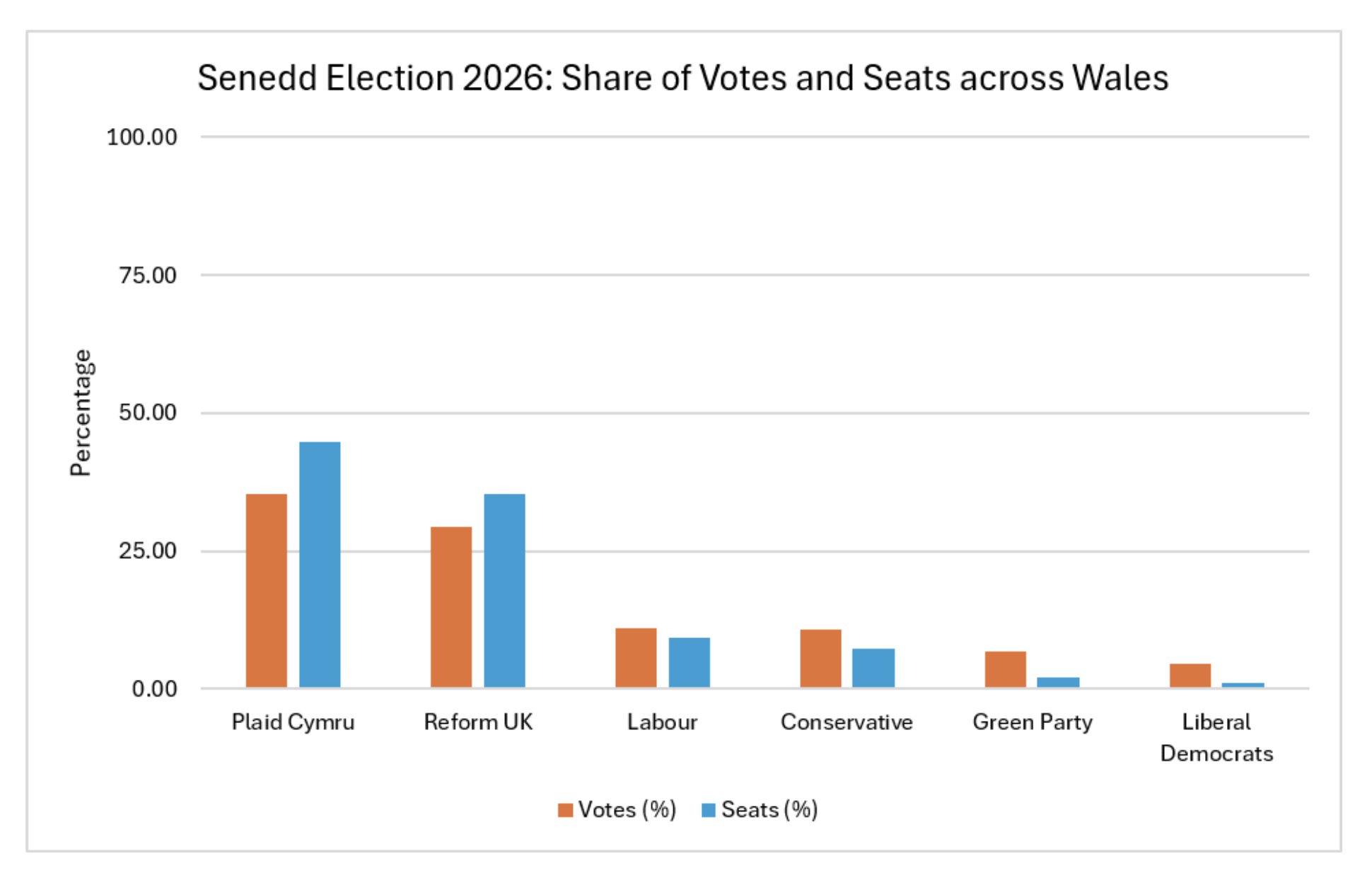
In the chart above, we see that Plaid Cymru and Reform have benefited from this new system, gaining proportionally more seats than votes, whereas the other main parties have missed out. A notable example of this was seen in Sir Gaerfyrddin, where Plaid Cymru and Reform both received 50% of the seats, while gaining just 43% and 33% of votes, respectively.
This is to be expected. A mathematical quirk of D’Hondt is that, as more seats are allocated in a single area, the results become more proportional. However, with only six seats per constituency, the method has shown its tendency to allocate disproportionately more seats to the largest parties, leading to the results seen above.
Horse Race Politics
Despite these features, and as noted in a previous article on this website, the results of the recent Senedd election are still much more proportional compared to previous elections conducted under FPTP.
To see this, the chart below summarises the results of the 2024 UK general election, where Labour secured a whomping majority, winning nearly two thirds of Westminster seats from just 34% of the total vote. A further twist is that, in the previous election, Labour took less than one third of seats from 32% of the vote. Yes, that’s right: by increasing their share of votes by just 2% in five years, Labour increased their number of MPs by over 200.
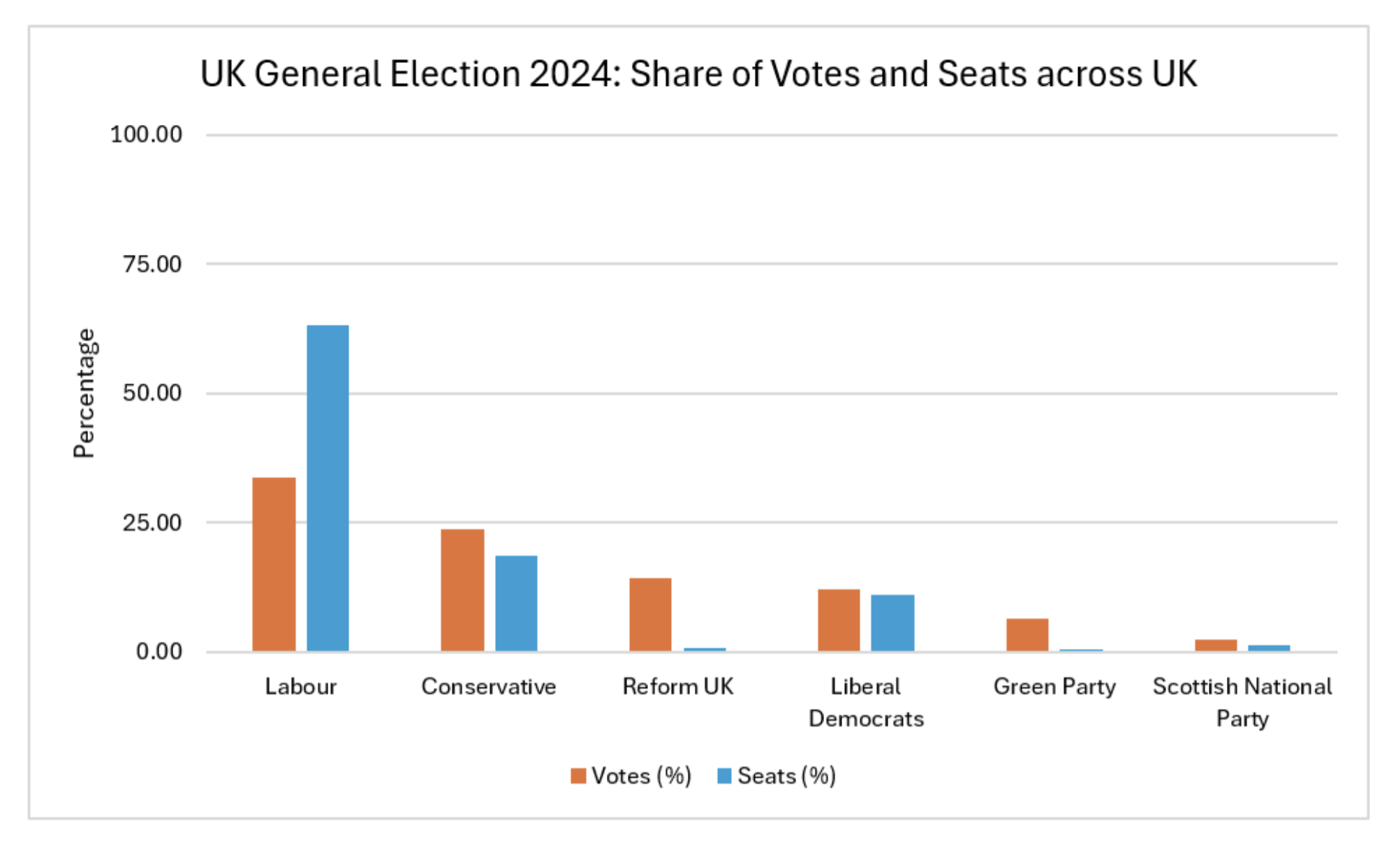
It gets worse still when we look at Wales in isolation. In the 2024 UK general election, Labour took 27 of the 32 Welsh seats from just 36% of the popular vote. The only other successes came from Plaid Cymru and the Liberal Democrats, who secured victories due to a concentration of votes in particular constituencies.
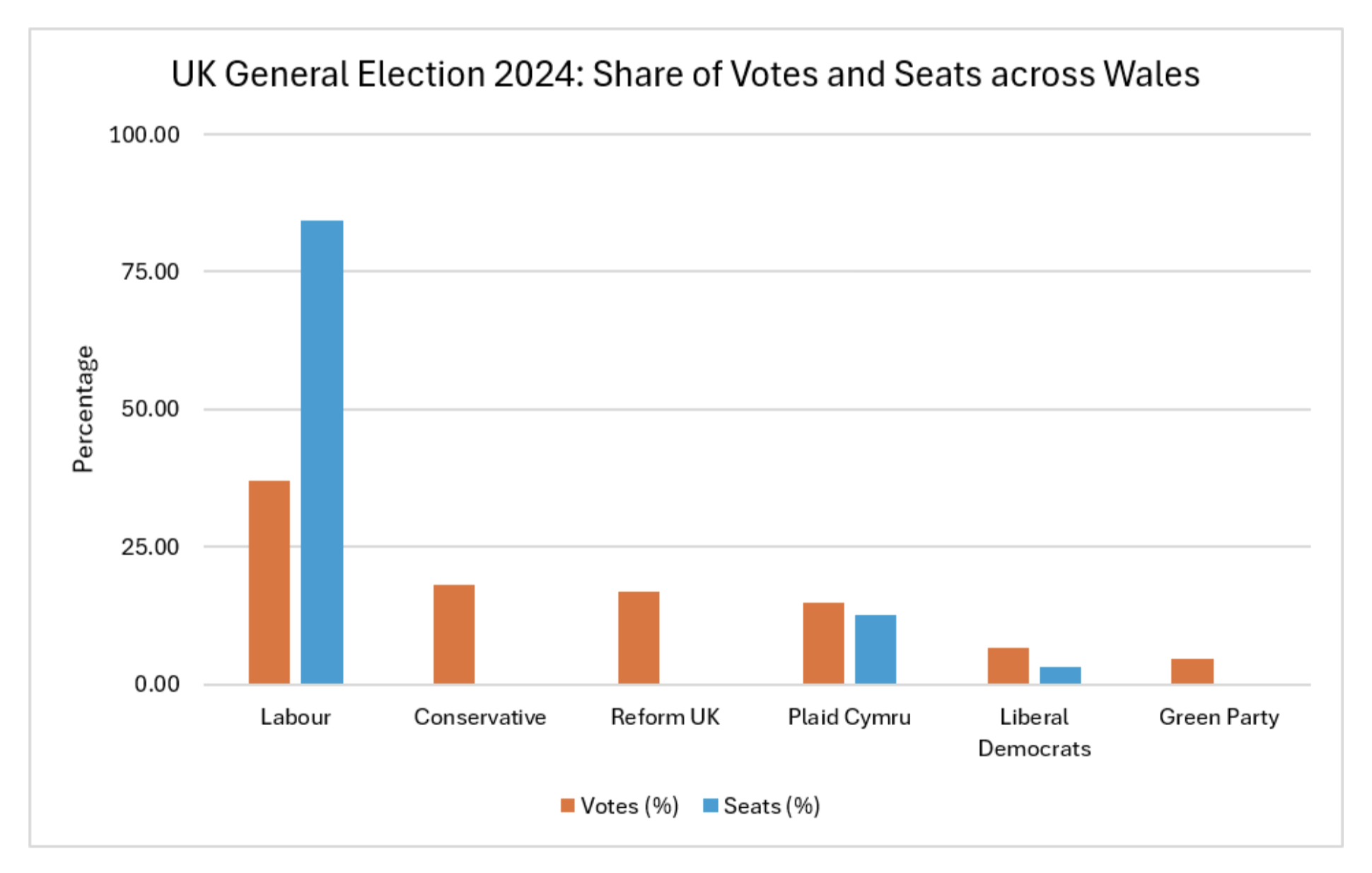
To summarise: First Past the Post is often highly disproportionate. Indeed, it is not the share of votes that decides FPTP elections, but how the votes are distributed among constituencies.

One Citizen, One Vote
Wales’s new voting system is prone to fewer distortions than FPTP. But is it the best we can do?
Imagine you own a chocolate factory and want to find out what people think of your products. To do this, you employ an expensive consultancy firm to conduct taste tests. After many weeks of giving away free chocolates, they report the following results.

At this point, you may want to conclude that coffee creams are the “people’s choice”. But are they? In fact, you suspect that many people actually dislike coffee creams, but the information is not available. It seems, then, that the consultancy firm have charged you a lot of money, but have not really collected enough information to make solid, evidence-based conclusions.
A better, and certainly more scientific, method would have been to collect information on how participants rank the chocolates, as demonstrated in the following table.

With this extra information, it is now clear that coffee creams are actually rather unpopular. Instead, there is more consensus for toffee (or fudge), while coffee creams are more of a love-hate thing.
I expect you can see where I am going with this argument. Elections, while expensive, are the main opportunity for citizens to express their preferences on how they are governed. So why make all this effort to only collect information about each person’s single favourite party? Isn’t it also important to consider their second favourite, their third favourite, and also their thoughts on who should not govern?
There are various methods for determining winners based on rankings. One respected method is the Single Transferrable Vote (STV) system, used in Ireland, Australia, and Malta. In 2020, this was recommended for future elections by the Committee on Senedd Electoral Reform, though the Welsh Government chose not to adopt it in the legislation that set the rules for 2026.
This was not without controversy, though, with individual members like Jane Dodds MS (Liberal Democrat) and Siân Gwenllian MS (Plaid Cymru) continuing to advocate for STV. Fortunately, a review mechanism was built into the legislation, meaning that Senedd members will have the opportunity to re-evaluate the system and potentially reconsider STV for future elections.
Let us hope they do.
Rhyd Lewis is Professor of Mathematics at Cardiff University
Support our Nation today
For the price of a cup of coffee a month you can help us create an independent, not-for-profit, national news service for the people of Wales, by the people of Wales.
Get more trusted Welsh news
Choose Nation.Cymru as a preferred source in Google News to see more of our journalism.



Thank you for the article. The D’Hont method favours party favourites. Being placed number one in your party list amounts to near total job security ( sorry Baroness) with very few exceptions. This is a retrograde step in democracy. It puts more power into the unelected shadow people within the party and less in the hands of the electorate. The real strength in a democracy does not come from choosing our representative but from rejecting him. So many dictatorships have in their own ways been selected by the people but once in power find inventive ways to cling onto power.… Read more »