
Elfed, Doyen of the Eisteddfod
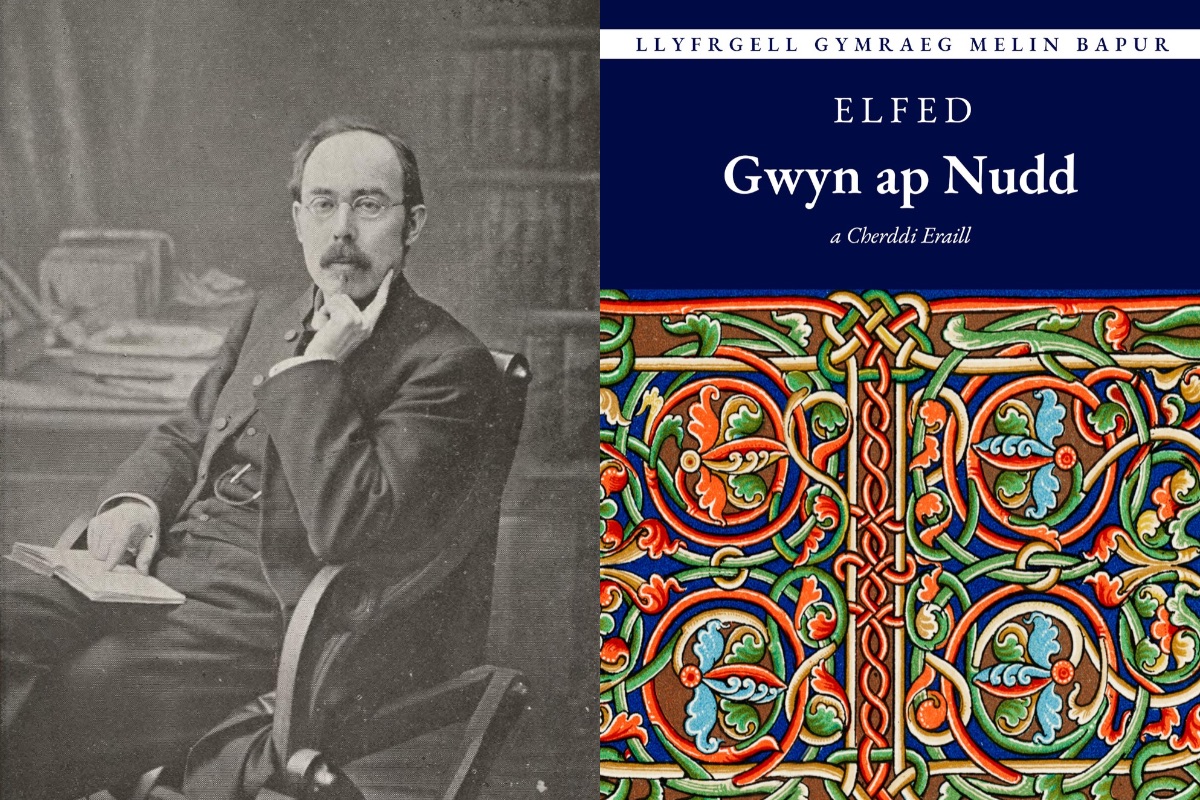
Adam Pearce, Melin Bapur Books
Pretty much since the turn of the twentieth century, the critical consensus in Welsh literature has been that the last decades of the nineteenth were something of a nadir of Welsh poetry.
Many (though not all) of the most highly regarded poets of the period were examples of the so-called ‘Bardd Newydd’ (‘New Poet’), a loose categorisation of poets whose work emphasised philosophical introspection, often at the expense of clarity and fluency.
Whilst it may seem harsh, you’d be hard pressed to find a single person alive today, even if they have extensive knowledge of our poetic tradition, who can recall as much as a single line of the work of the likes of Iolo Caernarfon, Cadvan, or Tudno, though they were all extremely highly regarded in their day, and dominated the main awards at the National Eisteddfod (just these three names between them won a total of five crowns and two chairs).
These days, to the extent the ‘Bardd Newydd’ is discussed at all it is usually to explain the context for what came after it: the poetic ‘renaissance’ that begins properly at the turn of the twentieth century, but had been presaged by one of its founders, John Morris-Jones, during the Bardd Newydd period.
If there is a single figure from this period however who deserves some rehabilitation, then it is Elfed (1860–1953), though the ‘Bardd Newydd’ label sits very uneasily on him.
Born in Blaen-y-coed, Carmarthenshire, Howell Elvet Lewis took his bardic name by de-anglicising his own middle name, which was also the name of the ancient Welsh cwmwd in which he had been born. The son of house servants, he was educated locally and like so many promising Welsh students of his age he trained to be a minister.
Immersed in both the bardic tradition and the Nonconformist hymnic tradition of Williams Pantycelyn and Ann Griffiths, his poetic career peaked early during his 20s and 30s. The 1888 National Eisteddfod would sometimes be referred to as ‘Eisteddfod Elfed’ because of his multiple successes, which included the Crown. He repeated the feat the following year, and won the Chair in 1894.
None of the poems which won the National Chair or Crown in the 19th century have any real reputation today, and Elfed’s 1888 pryddest ‘Y Saboth yng Nghymru’ (The Sabbath in Wales) and his 1894 awdl on ‘Hunan-aberth’ (Self-sacrifice) are as dry as their titles suggest. The poem for which he won the 1889 Crown however, ‘Llywelyn ein Llyw Olaf’, is probably the best and most engaging poem to win the Crown before Silyn’s ‘Trystan ac Esyllt’. Appropriately epic in scope, it recalls the prose historical romances that were extremely popular at the time.
Elfed’s best poems are on a smaller canvas however, and to the extent he is remembered today at all it is as a hymnist: indeed he was one of the last great contributors to the Welsh hymnic tradition, and is represented in the cross-denominational collection Caneuon Ffydd by more hymns than any other poet except Pantycelyn. His lyrical poetry is well worth exploring however: his best poems, like ‘Y Ddau Frawd’, draw close to the poet whom all the Beirdd Newydd admired, Islwyn (1832–78), by injecting an element of philosophical introspection into a short lyric, without losing its conciseness and clarity:
I Gwsg, brawd arall sy,
A chry’ fel angel yw:
Ryw hwyrddydd, Hwnnw ddaw i gau
Amrantau dynion byw.
[To Sleep there is a brother,
With an angel’s strength,
Who, some evening, comes to close
The eyes of living men.]
It is probably this philosophical element as well as Elfed’s occasional dabbling in mysticism that led some to group him with the ‘Bardd Newydd’, but most of his best poetry is largely free of the movement’s defects. Another aspect that distances him from his contemporaries, and that will likely endear Elfed to modern readers, is that a number of his poems draw on Welsh mythology, such as ‘Gwyn ap Nudd’, perhaps Elfed’s best poem, which relates the tale of the downfall of the titular fairy-trickster king at the hands of St. Collen:
Ti, sy’n arfer mynd fel nos
Heb ysgwyd clychau grug y rhos;
Ti sy’n chwerthin ar y bryn,
O dan ledrith cwmwl gwyn;
Ti, sy’n mynd â’r teithiwr prudd
O gors i gors, Gwyn ap Nudd—
I ble’r ei di’n wyllt dy wedd,
 naws rhyfel ar dy gledd?
Other poems to draw on Welsh mythology include ‘Y Drws Caeedig’ (The Closed Door), which describes the seven survivors of Bendigeidfran’s assault on Ireland in the second branch of the Mabinogi (a tale that recalls elements of the Pandora’s Box myth); and ‘Adar Llwch Gwin’.
This awareness of mythology very much ties Elfed into the 20th-century Welsh poetic renaissance. Indeed, his impact on that renaissance has probably been understated: more than any other poet except John Morris-Jones it is Elfed’s work that most obviously heralds the new era, and poets like W. J. Gruffydd explicitly acknowledged the older poet’s influence.
For whatever reason, however, Elfed would play no real part in the new era, composing very little in the twentieth century: indeed, though he lived to see the Korean War and the coronation of Elizabeth II, as a poet he remains very much a figure of the Victorian era. He continued to play an active role in the cultural life of his country however, serving as archdruid in the 20s, and remaining a popular figure as a preacher.
Indeed, perhaps it was the very fact that he lived and retained a public profile for so long, alongside his status as a doyen of the Eisteddfod, that meant he became increasingly seen in his later years as a conservative figure, and became the subject of scathing criticisms by young poets like Pennar Davies. Had he died in 1900 he would probably have a better reputation! Regardless, on the merits of his own work, Elfed is by some distance the most engaging and successful Eisteddfod poet of the end of the 19th century.
Gwyn ap Nudd a Cherddi Eraill is available now from www.melinbapur.cymru and all good Welsh bookshops for £9.99+P&P. Also new this week from Melin Bapur is Ann Griffiths: Yr Emynau a’r Llythyrau, a new edition of the complete works of Ann Griffiths, for £7.99+P&P.
Other books by poets mentioned in this article are John Morris-Jones’s Caniadau, Silyn’s Anobaith Serch and W. J. Gruffydd’s Y Tlawd Hwn. All these books are also available as ebooks from www.melinbapur.cymru.
Support our Nation today
For the price of a cup of coffee a month you can help us create an independent, not-for-profit, national news service for the people of Wales, by the people of Wales.
Get more trusted Welsh news
Choose Nation.Cymru as a preferred source in Google News to see more of our journalism.